Nitrates medication list
A nitrates medication list is a point-of-care reference that sets out the main c...

1
Last Updated: Oct 6, 2026

A work physical form is a standardized medical document that records whether an employee can safely perform job-specific tasks.
The form captures vital signs, medical history, physical examination findings, and a provider’s fitness-for-duty certification.
Under the ADA, a pre-employment physical is legal only after a conditional job offer has been made.
OSHA, the FMCSA, and some state agencies can make the exam mandatory on their own schedules.
Practice management software like Pabau replaces the paper file with digital intake forms and e-signatures.
The form covers vital signs, medical history, and physical examination findings by body system. It also carries a job duties section and space for the provider’s fitness-for-duty certification.
Download templateA work physical form documents an employee’s baseline health and certifies whether they can safely perform a specific job. The employer requests it, a licensed provider completes it, and the employer sees only the fitness-for-duty result.
This page carries the form itself, what belongs in each section, and the one timing rule that decides when the exam is legal.
A work physical form is a standardized medical assessment that records an individual’s health at one point in time. Practices complete it before employment begins, or as part of periodic occupational health surveillance.
The form does three jobs:
Unlike a routine annual physical kept in the patient’s own record, a work physical form is employer-driven. It asks whether a candidate can safely perform the essential functions of one specific role.
The evaluation is job-specific. A warehouse worker’s physical demands differ from an administrative assistant’s, so the examination focus shifts with the role. A general history and physical form covers the same body systems without that occupational framing.
Physicians, nurse practitioners, and other licensed providers conduct the exam and certify the findings. The completed form becomes a confidential medical record under HIPAA and EEOC ADA guidance. Employers cannot see the full exam detail, only the fitness-for-duty determination.
A complete work physical captures several data points to build the occupational health picture. Knowing what each section is for keeps the examination thorough and defensible.
The physical examination findings section is usually subdivided by body system. Cardiovascular, respiratory, musculoskeletal, neurological, vision, and hearing each get their own block.
That structure stops an organ system being skipped, and it lets the examiner flag findings that match the job demands. Grip strength matters for construction work. Color vision matters for a pilot.
Depending on the industry and the role, the form may also carry drug screening results or a psychological evaluation. Noise-exposed workers get audiometric testing, and respiratory hazard roles get spirometry.
OSHA occupational health standards mandate medical surveillance in named hazardous industries, and forms for those roles include regulated testing tied to exposure limits.
Before the exam, give the candidate a job demands analysis document listing physical requirements (weight limits, reaching, climbing, confined spaces, temperature extremes, hazardous substances). The provider uses this to frame exam findings and document whether restrictions apply to those specific demands.
Healthcare providers complete the form during the examination, or immediately after it. Working through the sections in a fixed order keeps the documentation complete and legally defensible.
Accuracy and objectivity are critical. Use standardized medical terminology, so “grade 5/5 strength” replaces “strong”. Avoid language that implies a medical decision beyond your scope.
The provider reports findings. The employer makes the hiring or accommodation decision from them. Where a worker returns for periodic surveillance, a separate vital signs record keeps the readings comparable across exams.
No federal law requires a pre-employment physical for every job. What the law controls is timing and scope, and three separate authorities can still make an exam mandatory for particular roles. The sequence below shows where the exam legally fits, and who can require one.
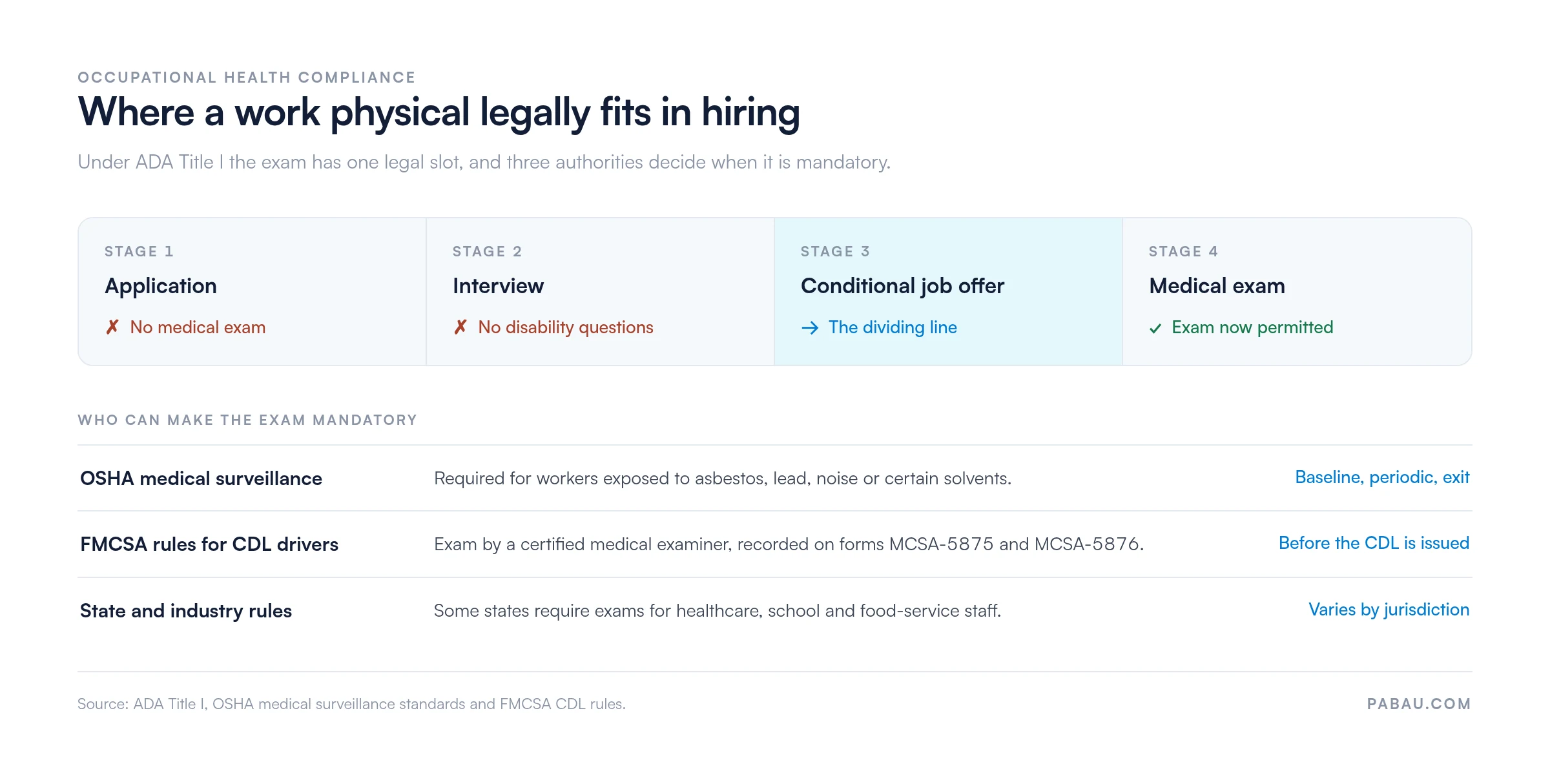
Americans with Disabilities Act timing rule: ADA Title I permits a medical examination only after a conditional job offer has been made. Screening for disabilities before the offer is illegal, so most employers hold the physical until the offer is out.
OSHA surveillance requirements: OSHA rules require medical surveillance for workers exposed to asbestos, lead, noise, or certain solvents. Those baseline, periodic, and exit exams are mandatory rather than optional.
DOT and CDL physicals: Commercial drivers must pass an examination by a certified medical examiner before a commercial driver’s license is issued. The examiner records the result on form MCSA-5875 and issues the certificate on MCSA-5876.
State and industry variations: Some states require physicals for healthcare workers, school employees, or food handlers. Construction and manufacturing often carry insurance-driven requirements. Check your state occupational health board and any industry regulation before you set a policy.
Who completes it: A licensed healthcare provider signs the form. That means a physician, a nurse practitioner, a physician assistant, or in some states an occupational health nurse. The provider must hold a license in the state where the exam happens, and the form is invalid without their signature and credentials.
Who pays: The employer normally pays for a physical it requires, either directly to the practice or by reimbursing the employee. Some employers cover the fee but ask the employee to use a named provider. Where the exam is a condition of employment, the employer should absorb the cost as a hiring expense.
Frequency: A pre-employment physical happens once, at the start of employment or when someone moves into a role with different physical demands. Periodic surveillance exams for OSHA-regulated hazards run on fixed schedules, often annually or every three years.
Record keeping: Medical records stay confidential and sit apart from personnel files, per the EEOC legal resources on ADA confidentiality. The employer keeps the determination, not the exam detail behind it.
The template adapts to most industries once you adjust the job demands section and add any industry-specific testing fields.
Keep customizations focused on job demands rather than on protected characteristics. Avoid questions that touch age, gender, race, disability status, or family planning. They invite a discrimination claim even when the intent was innocent.
Occupational health requirements differ sharply by sector. A nurse’s exam and a commercial pilot’s exam share almost no content beyond the vital signs.
Nursing, emergency medical services, and law enforcement roles demand high physical capability for patient handling, emergency response, and self-protection. Forms emphasize musculoskeletal function, cardiovascular fitness, psychological stability, and communicable disease screening. Many healthcare employers also ask for annual testing and documented tetanus immunization.
Workers exposed to asbestos, lead, solvents, or noise undergo OSHA-mandated surveillance on fixed schedules. A baseline exam establishes health status before exposure, and periodic exams track the change from it. Forms add specialized testing, including spirometry for lung function, audiometry for hearing, and biological monitoring such as blood lead levels.
Physical demands dominate here, from lifting and climbing to balance and working in temperature extremes. Forms carry a detailed musculoskeletal assessment plus functional capacity testing for job-specific movements. Some large contractors use a full functional capacity evaluation instead of a standard form for high-risk roles.
Four kinds of practice use the form most:
Any practice serving working adults sees the request eventually, whether the employer sends the patient or the patient asks for baseline documentation.
Work physicals arrive in small volumes at first, then in batches. A single employer contract, say a local manufacturer, can be worth dozens of exams a year. A professional, legally sound form is what wins that contract and keeps the paperwork moving.
Legal protection: A standardized form creates a contemporaneous medical record. That record shows a hiring decision rested on occupational health findings rather than on a protected characteristic.
Workflow consistency: A template stops critical fields being skipped and evens out documentation quality. Staff can also read and process forms from different examiners without relearning the layout each time.
Regulatory alignment: A form built around ADA timing rules, OSHA surveillance requirements, and state standards keeps the practice compliant without redesigning the documentation each time.
Patient and employer satisfaction: Clear, professional documentation reassures employers that the practice takes occupational health seriously. Employees value a thorough, well-organized evaluation that explains findings in plain language.
Digital scalability: A paper form is slow and easy to mis-transcribe. Moving it into patient intake software cuts transcription errors, speeds up retrieval, and leaves a searchable, secure record.
A paper work physical ends up in a filing cabinet, or as a scan in a folder the practice never opens again. Practice management software like Pabau stores each completed exam against the client record instead. Staff can see which forms are outstanding and pull a completion report for the employer.
Pabau’s digital forms let a practice upload the work physical template and use it as a live document. The employee fills it in on a tablet at the appointment, or online beforehand, so the record no longer depends on legible handwriting.
Vital signs, medical history, and exam findings land in structured fields. That makes the record searchable, and it makes an employer report a matter of a few clicks rather than a filing trip.
An embedded e-signature makes the provider’s certification binding and tamper-evident. The finished form is stored in the client records with a full audit trail. That trail is what a regulator or a malpractice review asks to see.
The employer receives only the fitness-for-duty result, so the exam detail never leaves the practice.

Replace paper forms with digital intake workflows, e-signatures, and secure medical records. Your team completes occupational health exams faster and keeps the documentation audit-ready.

The form itself is the easy part. What decides whether a work physical holds up is timing and the discipline of the record behind it.
Get the sequence right and the rest follows. Wait for the conditional offer, examine against the written job demands, and report the determination rather than the diagnosis. A practice that does those three things consistently becomes the one local employers keep calling.
The paperwork is usually where it slips, and that is a workflow problem rather than a clinical one. Book a demo to see how Pabau keeps work physicals, signatures, and employer reports in one client record.

Documenting a fitness decision in writing? Medical clearance letter gives you the wording that releases a patient back to work or activity.
Need the medical history in more depth? Family medical history form captures the hereditary detail a single-page work physical has no room for.
Releasing records to an employer? Medical release form documents the patient’s authorization before any exam detail leaves the practice.
A work physical form is a standardized medical assessment document that evaluates whether an individual can safely perform job-specific tasks. It captures vital signs, medical history, physical examination findings, and the provider’s fitness-for-duty certification.
No. Under the Americans with Disabilities Act (ADA), employers cannot require a medical examination or ask disability-related questions before making a conditional job offer. Medical exams must happen after the offer is made.
If a provider certifies someone is “not fit for duty”, the employer must explore reasonable accommodations before rescinding an offer or terminating employment. In some cases, temporary restrictions (“fit with limitations”) allow the employee to start while accommodations are arranged.
Only a licensed healthcare provider can complete and sign the form. That means a physician, nurse practitioner, physician assistant, or in some states a registered nurse with occupational health certification. The provider must be licensed in the state where the exam occurs.
Validity depends on the employer’s requirements and the regulations that apply. Pre-employment physicals are typically valid for one year. OSHA-mandated surveillance exams follow fixed schedules, whether annual, triennial, or exit exams. Always check with the employer or regulatory agency for the applicable timeframe.
No. An annual physical evaluates general health for preventive care. A work physical evaluates fitness for a specific job. They may cover similar body systems, but the work physical’s focus is occupational rather than general wellness.