Needle stick injury protocol: template and step-by-step guide
A needle stick injury protocol is a written plan that tells staff what to do aft...

Last Updated: Oct 15, 2026

A medical record request form is a HIPAA authorization that lets a patient reach their own records or send them to a third party.
HIPAA requires eight elements under 45 CFR 164.508, including a statement that the recipient may redisclose the records.
Providers must respond within 30 days, may take one 30-day extension, and can charge only reasonable, cost-based copying fees.
State law wins where it is stricter, so California expects copies within 15 days rather than 30.
Pabau’s form builder and patient portal let practices collect, track, and fulfill record requests without paper.
A HIPAA-compliant form a patient signs to reach their own records or authorize disclosure to a third party. It carries the required authorization elements, identity verification, and the compliance fields your file needs.
Download templateA medical record request form is the document a patient signs to have their health records released, either to themselves or to someone else. HIPAA decides what has to appear on it. Miss one required element and the authorization is invalid, so the records stay where they are.
This page covers the eight elements HIPAA requires and how to complete the form. It also covers the response deadlines, the fees you may charge, and where state law tightens both. The template above is free to download.
A medical record request form is a standardized legal document with two jobs. It lets patients ask for their own medical records. It also lets them authorize a provider to release those records to a third party, such as an insurer, an attorney, or a new provider.
Under HIPAA (Health Insurance Portability and Accountability Act), patients hold a right of access to their health information. The provider then has 30 days to answer the request.
The form does two jobs at once. It documents the patient’s consent for disclosure, which protects the provider. It also holds the release to the records the patient named, and no others.
Without a signed authorization, a provider cannot disclose protected health information (PHI) except in narrow circumstances such as an emergency or a law enforcement request. The same applies to a workplace accommodation request, where the employer may ask the provider for further medical details.
Some practices keep the request form separate from the authorization for release of information form. The first is a patient asking for their own copy. The second sends records to someone else. A single combined form covers both cases, which is what most practices use.
Under 45 CFR 164.508, a valid HIPAA authorization must include eight mandatory elements. Omit one and the authorization is invalid, which leaves the provider unable to release the records.
Five of the eight are details you collect from the patient. The other three are statements the form itself has to print, and they are the ones most often missing.
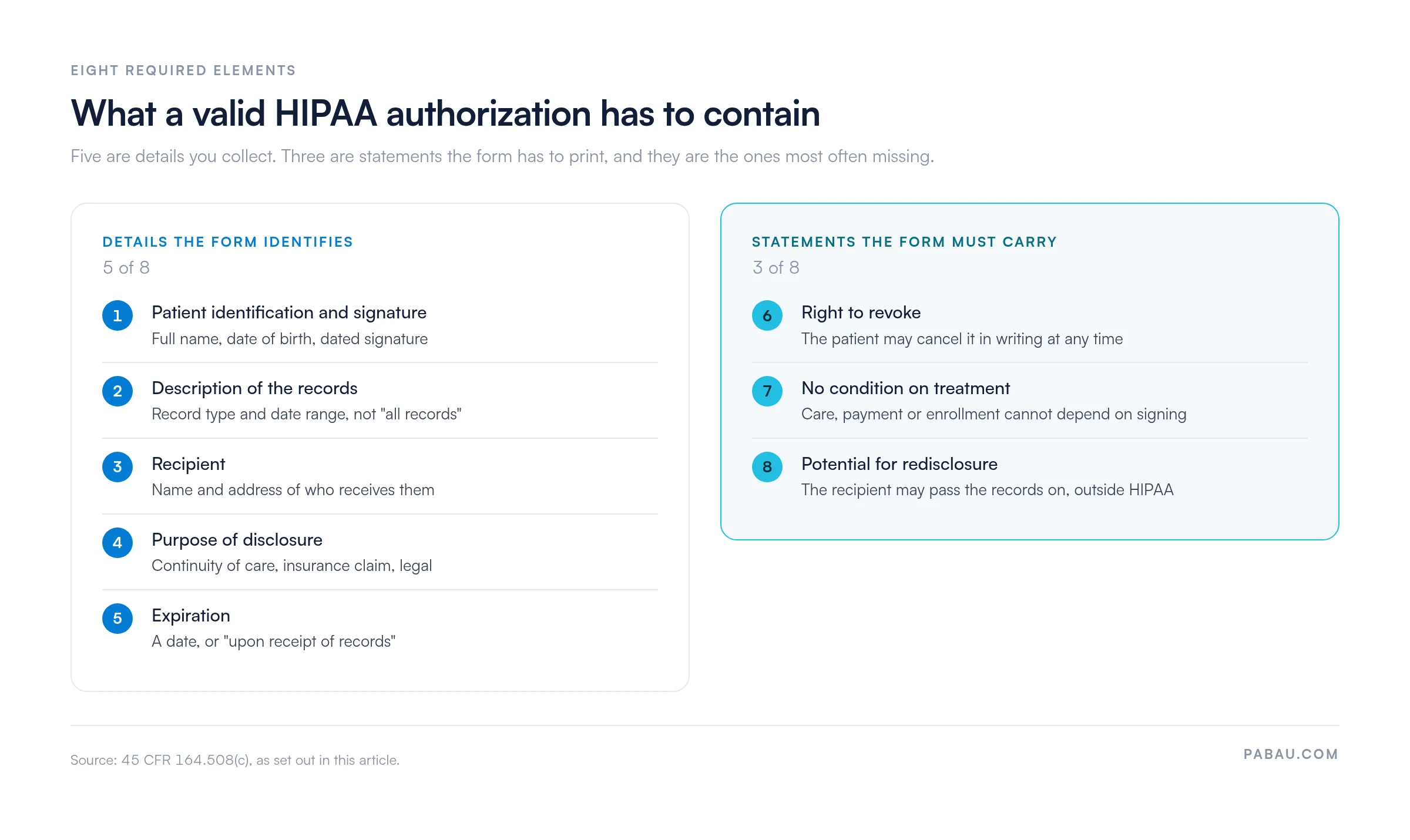
Beyond the required elements, four additions save the front desk a follow-up call:
A compliant authorization form is one control among many. Our guide to HIPAA compliance for medical offices covers the policies, training, and audits that sit around it.
Not every request follows the same rules. The record type and the state both change which form you need, and what extra consent it has to carry.
This is the common case. A patient wants records sent to a new provider, an insurer, or an attorney. The standard form carries all eight HIPAA elements and covers general medical, surgical, and diagnostic records. Most disclosure requests need nothing more than this version.
Mental health records carry stricter confidentiality rules, and substance use disorder treatment records fall under 42 CFR Part 2. That federal rule is tighter than HIPAA in places, so these records need their own authorization form. The form has to name the mental health or substance use records being released. Several states add requirements on top, such as a signature witnessed by a staff member.
Under HIPAA’s right of amendment (45 CFR 164.526), a patient can ask for a correction to their record. This takes a different form. The patient is not authorizing disclosure. They are asking the provider to change or add information, and the provider has 60 days to respond. The answer is either the amendment itself or a written denial with a reason.
For patients, the process is short. For staff handling incoming requests, checking each form for completeness is what prevents a second round of correspondence.
Collecting these requests through a patient portal removes the paper handling and date-stamps every step for the audit trail.
Once a completed form arrives, HIPAA sets both the clock and the rules for the provider’s response.
Handling requests inside a medical records management system keeps the request date, the deadline, and the fulfillment status on one screen.
HIPAA is the floor, not the ceiling. Where a state law gives the patient more, the state law applies. The usual differences are shorter deadlines, lower fee caps, and extra consent for mental health records.
Check your state medical board or health department for the current rules, since many states publish their own official form. State law also sets medical record retention periods, which decide how far back a request can reach.
Paper forms leave the tracking to staff. Someone has to log the request, check it is complete, diary the deadline, and chase the records. Compliance management software like Pabau does that work in the background.
Patients submit through the secure patient portal, so requests never sit in a pile at reception. Our form builder lets you add state-specific fields, your practice’s logo, and submission instructions.
Each submission joins a tracked queue with deadline alerts, so the 30-day clock stays visible to the whole team. Staff attach the released records to the patient record, which leaves a dated audit trail.
Every view of a record is logged, which supports the audit controls the HIPAA Security Rule requires. Records go out by secure portal download rather than open email.

Pabau’s digital forms and patient portal collect record requests, log every access, and flag the 30-day deadline before it passes. Your team works from one audit trail instead of a paper file.

The form itself is the cheap part. The costs come later. An invalid authorization, a missed deadline, or a fee your state never allowed all land on the practice.
So download the template, check it against the eight elements, and add whatever your state asks for on top. Then decide who owns the clock once a request arrives, because that is the part a form cannot do for you.
Book a demo to see how Pabau tracks record requests, deadlines, and access logs in one place.

Need the general release version? HIPAA medical release form gives you a one-page authorization for disclosure to a third party.
Sending records to another provider? Authorization for release of protected health information covers the wording a receiving practice expects.
Still drafting the privacy notice patients sign for? Notice of privacy practices sets out what you have to tell patients about their data.
Unsure how long to keep the file? How long to keep medical records explains the federal and state retention periods.
A medical record request form is a standardized HIPAA-compliant document. It authorizes a provider to release a patient’s protected health information (PHI). The recipient may be the patient, or a third party such as an insurer, attorney, or new provider. It records the patient’s consent and names the records to release.
Under 45 CFR 164.508 the form must identify the patient, the records, the recipient, and the purpose. It needs a dated signature and an expiration date. It also needs three statements, covering the right to revoke, no condition on treatment, and the potential for redisclosure.
HIPAA requires providers to respond within 30 days of receiving the request. Where that is not feasible, the provider may take one 30-day extension, as long as they notify the patient in writing of the delay.
Providers may charge reasonable, cost-based fees, typically $0.50 to $1.00 per page for copying, plus postage. They cannot charge search or retrieval fees. Electronic access fees are more limited and must reflect the cost of production. Some states cap fees lower than HIPAA allows.
The terms are used interchangeably. Both refer to a HIPAA-compliant authorization that permits disclosure of health information. The form may be titled “medical record request form,” “HIPAA authorization form,” or “authorization for release of information.” The legal framework and the required elements are identical.
Yes. Mental health records and substance use disorder treatment records need their own authorization form, under stricter confidentiality rules. Never combine them with a standard medical record authorization on the same form.