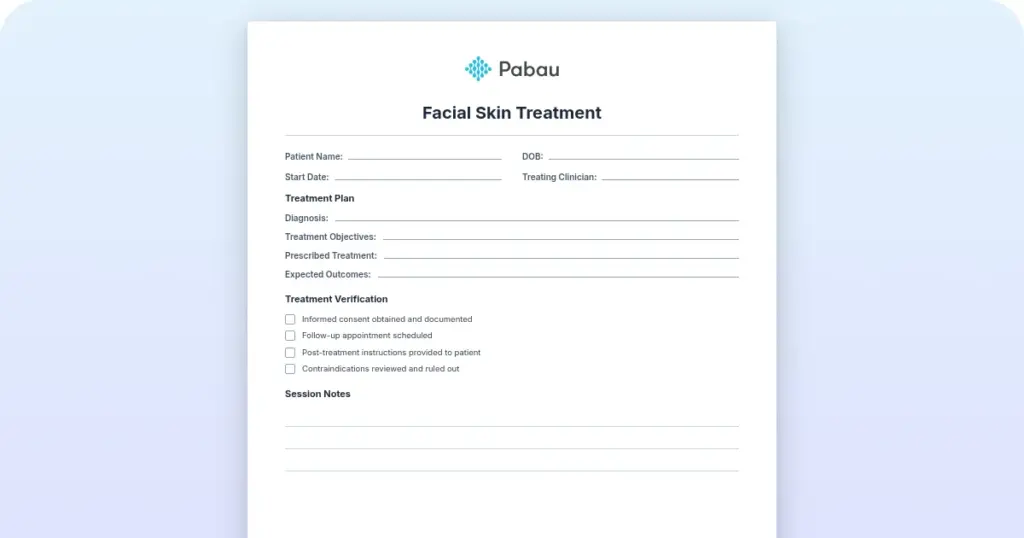
Facial skin treatment consent form template: Microneedling and phi-ion
A facial skin treatment consent form is the signed proof that a patient was scre...

2
Last Updated: Oct 21, 2026

A genital piercing chart puts placement, healing window, starter gauge, and jewelry type for 14 female and male placements on one page.
Female placements run from four weeks for labia minora to nine months for Christina, which also carries the highest rejection risk.
Male placements run from four weeks for a Prince Albert to twelve months for an ampallang or an apadravya.
The reverse Prince Albert heals in four to nine months, so it should never be scheduled like a standard Prince Albert.
Triangle, fourchette, and Isabella placements depend on tissue depth, so screen anatomy at consultation and record what you found.
A blank, printable chart with columns for placement, healing time, starter gauge, jewelry type, and anatomy notes. Fill it in from the reference tables on this page, keep the placements your studio offers, and use it for consultations and staff training.
Download templateA genital piercing chart lists every major female and male genital piercing next to its placement, healing window, starter gauge, and jewelry type.
Healing runs from four weeks for a labia minora piercing to twelve months for an ampallang. Starter gauge sits between 10g and 14g for almost every placement, and starter jewelry should be implant-grade.
The tables below cover 14 placements, eight female and six male. They are grouped by how the tissue heals rather than by anatomy. A Prince Albert and a reverse Prince Albert sit inches apart and heal months apart. You can also download the same chart as a blank PDF and fill it in with the placements your studio offers.
The chart runs across six columns: piercing name, anatomical placement, healing time range, recommended starter gauge, jewelry type, and anatomy suitability notes. Work left to right during a consultation and you cover the questions clients ask, in the order they ask them.
Female placements run from the clitoral hood piercings most studios perform every week to the Isabella, which very few anatomies suit. The table lists all eight, with the healing range and the starter gauge for each.
Male placements split into urethral, glans, shaft, and scrotal positions. Healing varies more widely here than on the female side, from four weeks for a Prince Albert to a full year for a glans piercing.
Group the placements by how the tissue heals and the scheduling gets much easier. Surface and thin-tissue piercings close in weeks. Thicker tissue takes months. Deep channels and rejection-prone surface placements take most of a year. The spread between the shortest and longest window is close to a full year.
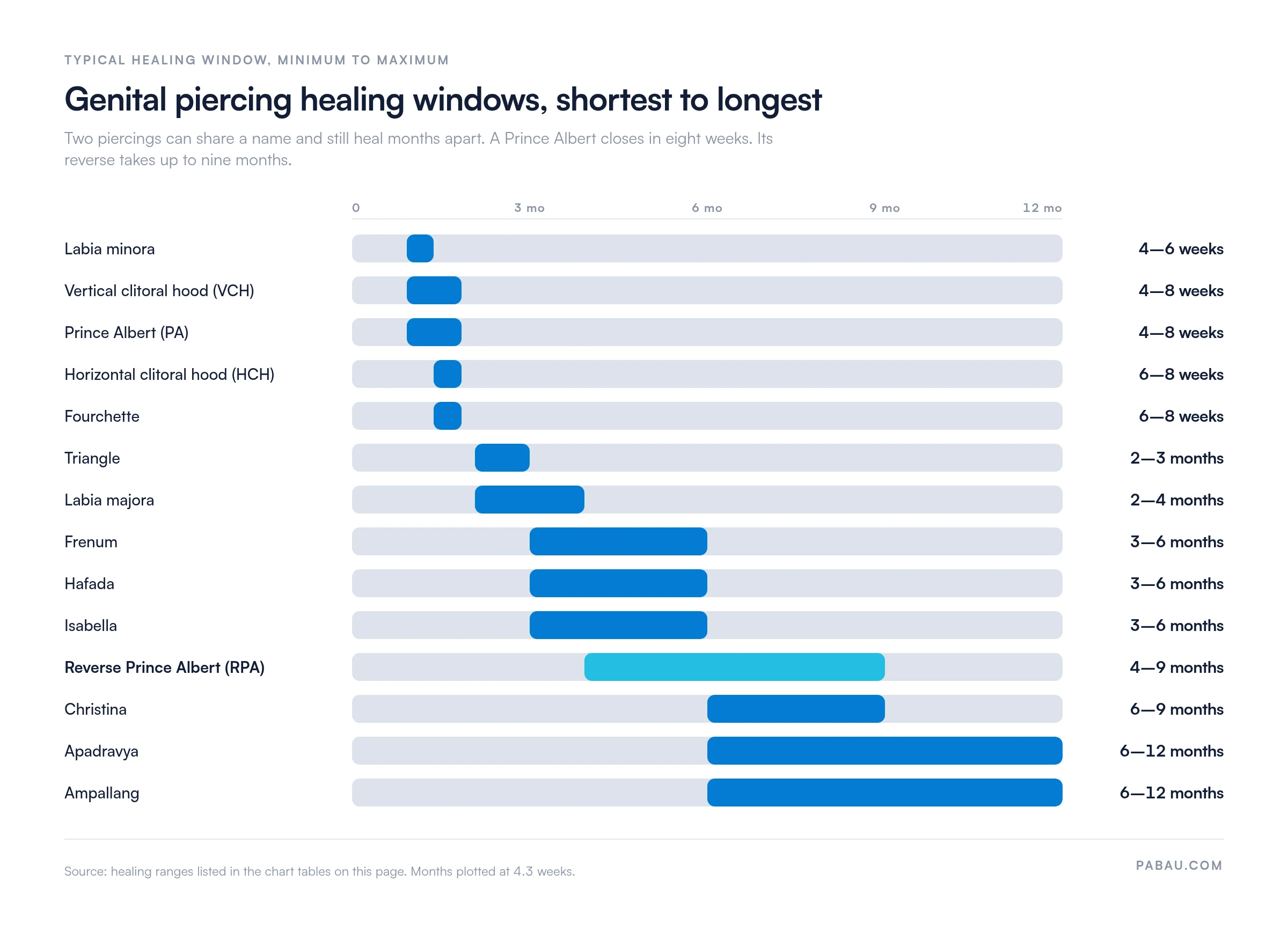
The three bands below are the shorthand for booking and aftercare. Quote the individual figure from the detailed tables when you are talking to a client. Set automated follow-up reminders against the band the placement belongs to.
Gauge and material decide how comfortable the first six weeks are. Most genital placements start between 10g and 14g in implant-grade titanium (ASTM F136), implant-grade steel, or solid 14k gold. Record the gauge, material, and jewelry style in the client record, so a downsize starts from the fitted piece rather than a guess.
Aftercare is where most healing complications get decided. The Association of Professional Piercers (APP) publishes the baseline, and these five steps cover what clients need through the first weeks.
Hand them a written copy rather than talking them through it, and adapt our body piercing aftercare instructions if you need a printable version.
Not every placement suits every client, and the assessment happens before anyone agrees to anything. These are the factors that decide it:
Screening is only worth doing if the result gets written down. A spa intake form that asks about anatomy, previous piercings, and healing history gives you the record. It also gives the client the explanation behind a placement you have turned down.
Print a copy for the consultation area and keep a digital one in each client’s file. Use it to set healing expectations before the needle comes out, and to explain why a placement you have declined is the right call.
It also settles disagreements between piercers. Two people in the same studio can quote healing times that are months apart. A shared reference stops a client hearing two answers to one question.
Most piercing studios run the consultation on paper and the aftercare on memory. The consent form goes in a folder, the healing window gets said out loud, and the check-in happens only if the client books it themselves.
Practice management software like Pabau puts those pieces on one record. It is software built for spas and studios. The appointment, the signed consent, the anatomy notes, and the jewelry details all live on the same client file. When someone returns at four months with an irritated frenum, the piercer can see what gauge went in and what was advised.
The follow-up then runs itself. Pabau sends the aftercare instructions once the appointment ends. The check-in reminder goes out at the interval you set for that healing band, so a nine-month piercing gets chased at nine months. Every subscription includes the forms, the records, and the automated messaging.

Pabau’s digital forms, client records, and automated follow-ups give piercing studios one file per client. Anatomy notes, signed consent, jewelry details, and check-in reminders all live together.

The chart earns its place when it changes what you say in the room. Quote the range instead of the best case. Screen the anatomy before you agree to a placement, and write down what you found.
The trade-off worth remembering is that healing times are typical, not promised. Two clients with the same piercing and the same aftercare can finish months apart. Book a demo to see how Pabau keeps consent, anatomy notes, and healing check-ins on one client record.

Running consultations for a new service? The esthetician consultation form shows how to structure the questions so nobody has to improvise.
Comparing systems for the studio? Best software for spas walks through what to look for in booking, records, and client messaging.
A genital piercing chart is a reference table covering every major female and male genital piercing. Each entry lists the placement, typical healing time, recommended starter gauge, and anatomy suitability notes. Studios use it for client education, consent documentation, and staff training.
Healing runs from four weeks to twelve months depending on placement. Thin-tissue piercings such as labia minora, VCH, and the Prince Albert close in 4-8 weeks. Thicker tissue like labia majora and the triangle takes 2-4 months. Deep or rejection-prone placements, including the apadravya, ampallang, Christina, and reverse Prince Albert, take 3-12 months.
Most female placements start at 12g to 14g. Male urethral and glans placements usually start at 10g to 12g. The exact gauge depends on tissue thickness and anatomy. Use implant-grade materials only, meaning ASTM F136 titanium, implant-grade steel, or solid 14k gold and above.
Not straight away. Association of Professional Piercers guidance points to two to six weeks, depending on placement and how much the client swells. Agree the specific timeline with the piercer at the consultation, and confirm it at the first check-in.
Normal healing means mild swelling for the first three to five days, clear lymphatic discharge, and mild redness. Warning signs are swelling that worsens after day three, thick colored discharge, foul odor, fever, or severe pain. A client with any of those should see a physician the same day.
Search the member directory on the Association of Professional Piercers website by location. APP membership signals adherence to the hygiene, consent, and safety standards that genital piercing procedures require.