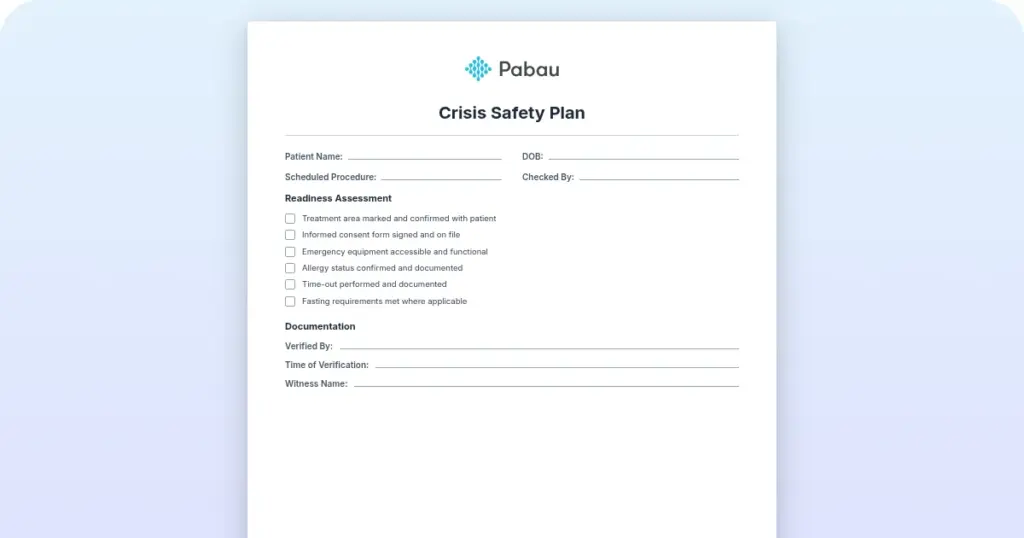
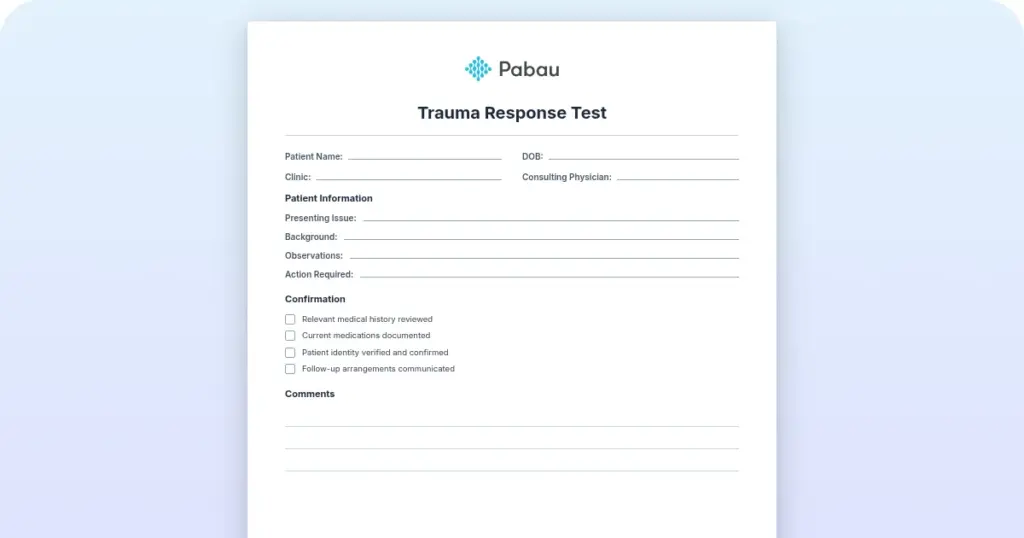
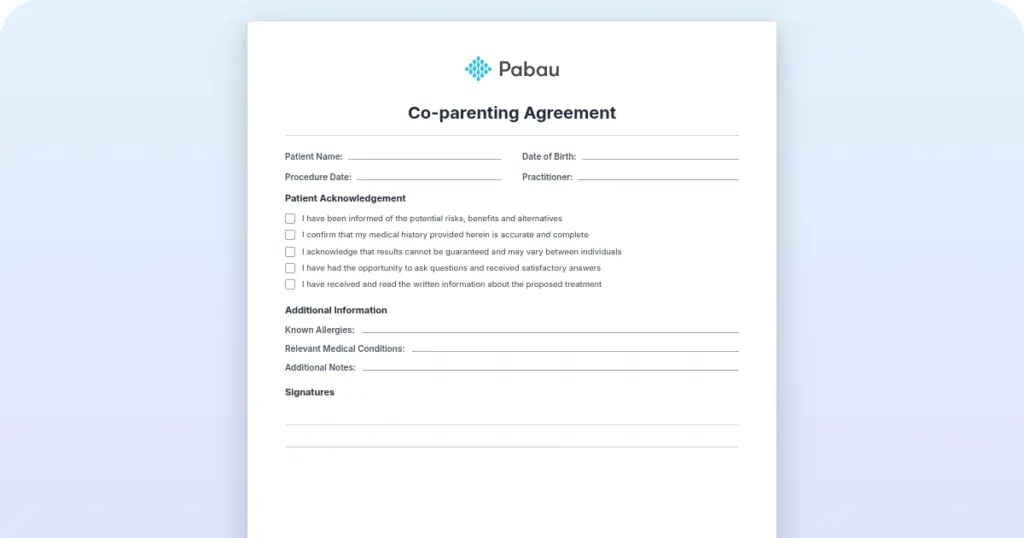
Crisis safety plan template
A crisis safety plan is a short, personalized written plan that a patient and cl...

2
Last Updated: Oct 19, 2026

A parenting style questionnaire scores how a parent balances warmth and control, then sorts them into one of four Baumrind-derived styles.
The PSDQ short form runs to 32 items, the PAQ to 30, and the MAPS to 34 items across seven subscales.
Administering one follows five steps, from framing the purpose through to setting a goal with the parent.
Results guide therapy by pinpointing where warmth, structure, or communication needs to change first.
When two co-parents complete the form separately, the distance between their scores is often the more useful clinical finding.
A ready-to-use assessment tool for clinicians to evaluate parenting approaches across authoritative, authoritarian, permissive, and uninvolved dimensions. Includes scoring guidance and clinical interpretation support.
Download templateA parenting style questionnaire is a validated form that scores how a parent balances warmth and control. Those two scores place the parent in one of four styles, which gives treatment planning a concrete starting point.
Most parenting style questionnaires online are consumer quizzes. This guide is written for the consultation room instead. It compares the three instruments clinicians use, walks through administration and scoring, and shows how to turn a score into a therapeutic goal.
The template above is ready for your next structured initial consultation. You’ll also find guidance on comparing two co-parents’ results, which is often where the useful clinical material sits.
A parenting style questionnaire is a standardized form measuring how parents handle discipline, warmth, communication, and structure with their children. It draws on Diana Baumrind’s research from the 1960s, which Maccoby and Martin expanded in 1983.
The framework rests on a useful clinical assumption. Parenting approach, unlike parent personality, is something a family can change. Identify the current style and you have a map of the behaviors worth targeting.
Baumrind’s original model named three styles. Maccoby and Martin added a fourth in 1983 by separating uninvolved parenting from permissive parenting. That four-style version is still the standard today.
Every instrument in this category scores two dimensions. Warmth covers affection and responsiveness. Control covers structure, limits, and monitoring. The four styles are the four combinations of high and low on each dimension.
Authoritative parenting is linked to stronger self-regulation and better academic outcomes in Western samples. Cultural variation is well documented, so treat the framework as a conversation starter rather than a verdict on the family.
Any clinician working with parent-child relationships gets more from a scored form than from impressions alone. Psychology practice software increasingly builds these tools straight into intake.
Whatever the setting, most of the value comes from repeating the assessment. Therapy practice management systems store each round, so you can compare scores across months instead of relying on memory.
A scored instrument also shares the weight of clinical judgment with the evidence base. That matters, because carrying every call alone is one of the quieter drivers of therapist burnout.
Three instruments dominate clinical and research practice. Choose between them on the time you have, the client population, and how much dimensional detail you need.
All three show good internal consistency and test-retest reliability in English-speaking samples. The PSDQ is the quickest at 5 to 10 minutes. The MAPS takes longest and returns the most detail.
Administering the form takes five steps. Framing matters most, so position it as collaborative rather than as a test the parent can fail.
Don’t administer the form while a parent is in acute distress, because the answers won’t reflect how they usually parent. Work through a crisis management plan first, then schedule the questionnaire once rapport is stable.
Most instruments use a five-point Likert scale. You sum or average the items in each subscale, then compare the profile against the manual’s reference data to identify the dominant style.
Deliver the result in the parent’s language, not the manual’s. Instead of “your authoritarian score is elevated”, give them something they can picture.
“Your answers show you value clear rules and expect the children to follow them. They also show less time goes into talking through the reasons behind those rules. Let’s look at whether adding that would help.”
When both parents attend the feedback session, a family meeting agenda keeps the conversation on the scores rather than on old arguments.
Recording results safely means storing the raw scores, your interpretation, and any agreed goals in a HIPAA or GDPR-compliant system.
Assessment results only matter if they change the treatment plan. Convert each finding into one observable behavior the parent can practice before the next session.
Low warmth with high control points to a connection goal. One example: “Parent will hold a 10-minute daily check-in, asking open questions without redirecting to behavior.”
High warmth with low control points to a structure goal, such as a consistent bedtime routine with expectations the child can repeat back unprompted.
Rigid answers on the authoritarian subscale often rest on fixed beliefs about obedience and respect. A core belief worksheet lets you test those beliefs without challenging the parent head-on.
When two co-parents complete the form separately, the distance between their scores is often the more useful finding. A child moving between a high-control home and a low-control home gets no consistent signal about limits.
Patient care planning keeps that thread visible across sessions. Record the style, the behavior you’re targeting, and the date you plan to re-administer the form.
Plenty of practices still hand the form over on paper when the parent arrives. It gets filled in while the clock runs, scored by hand afterward, and filed somewhere the rest of the team never looks.
Practice management software like Pabau moves that work off the appointment. Digital forms go out before the first session, so the responses are waiting when the parent walks in.

Completed questionnaires, scores, and your interpretation notes sit in the client record with everything else. Any clinician who opens the file sees the parenting history without hunting for a paper form.
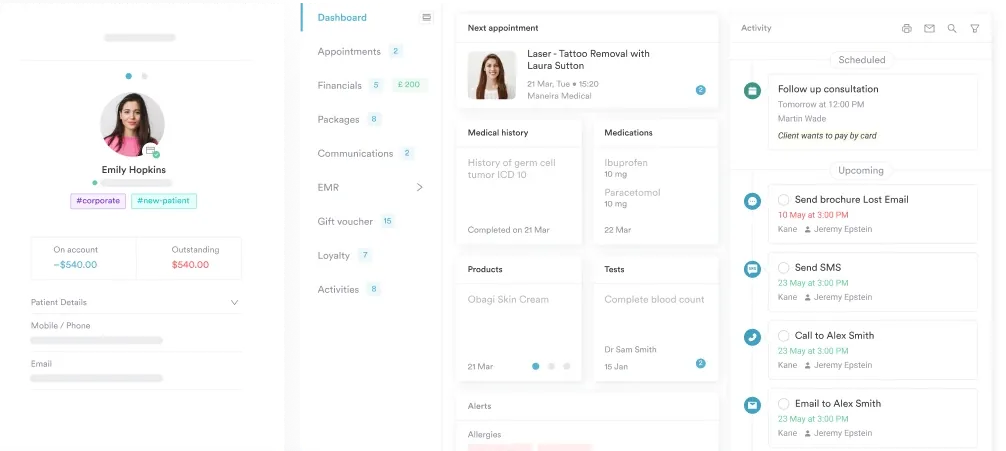
Automated workflows handle the re-assessment. Set the reminder at three and six months, and the parent gets the form again without anyone on your team having to remember.
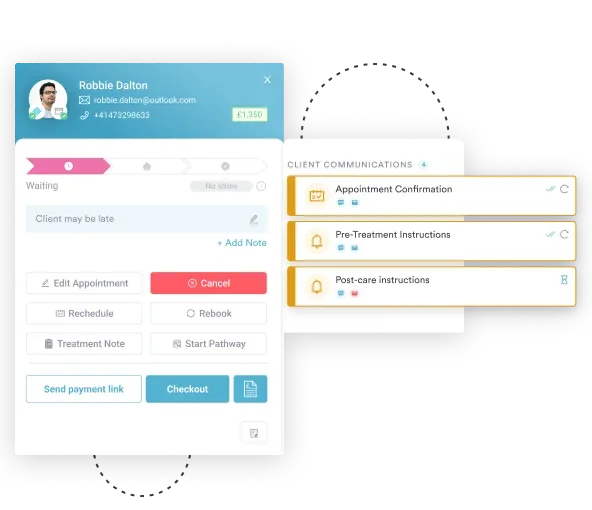

Pabau’s digital intake forms deliver the questionnaire before the appointment and file every score in the client record. Automated reminders handle the three-month and six-month re-assessment.

Pick one instrument and stay with it. The PSDQ short form is the safest default for a general caseload, and swapping instruments between sessions makes your score comparisons meaningless.
The score itself changes nothing. What changes a family is the goal you write from it, and the follow-up that confirms the behavior shifted.
The template above is ready to print or send digitally. Book a demo to see how Pabau sends, scores, and stores parenting assessments in one client record.

Building a self-care habit into your day? 5 minute gratitude journal pairs morning and evening prompts with weekly reflection for busy practice staff.
Assessing the child as well as the parent? ADOS-2 assessment walks through the observation schedule clinicians use in autism evaluation.
Want a tool the family can use at home? Coping wheel gives parents and children a simple way to practice regulation between sessions.
Adding a quick mindfulness moment to sessions? 5-minute meditation script guides patients through breathing, a body scan, and present-moment awareness with pacing notes.
Supporting a client’s recovery program alongside therapy? AA Step 2 worksheet structures reflection on belief, sanity, and practical commitments for the second step.
It is a validated form that measures parenting behavior across dimensions like warmth, structure, and control. The result identifies whether a parent’s approach is authoritative, authoritarian, permissive, or uninvolved, which tells you where to target change.
Most parents finish in 5 to 15 minutes. The PSDQ short form has 32 items, the PAQ has 30, and the MAPS has 34. Reading level and format also affect the time.
Both measure the same three styles, which are authoritative, authoritarian, and permissive. The PSDQ short form uses 32 items and appears more often in practice settings. The PAQ uses 30 items and is more common in academic research.
Yes. Each parent completes the form about their own approach. Comparing the two profiles often reveals the misalignment driving the conflict, and that comparison usually becomes the focus of co-parenting work.
Yes. The template at the top of this page is free to download and use. PsycNET and PubMed Central also carry the original PSDQ and PAQ validation studies, which include the full instruments.
Responses are summed or averaged within each subscale, following the instrument manual. Scores are then compared with normative data to find the dominant style. Interpretation focuses on strengths and one or two specific behavior changes.