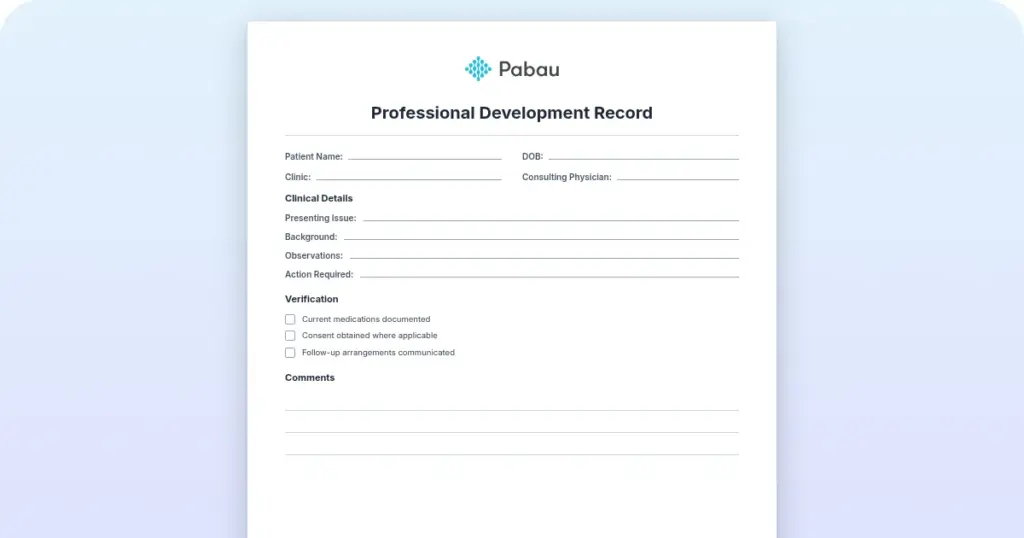
Professional development record
A professional development record is a structured log of a healthcare practition...

8
Last Updated: Oct 8, 2026

A counseling informed consent form documents that clients understand the therapist’s credentials, therapy process, confidentiality limits, and client rights before treatment begins.
HIPAA, the ACA Code of Ethics, and state licensing boards all mandate written informed consent. Non-compliance carries regulatory fines, license suspension, and malpractice liability.
Required elements include therapist credentials, confidentiality exceptions, fees and cancellation policy, client rights, mandatory reporting obligations, and signature blocks. Telehealth and minor-client care require additional addenda.
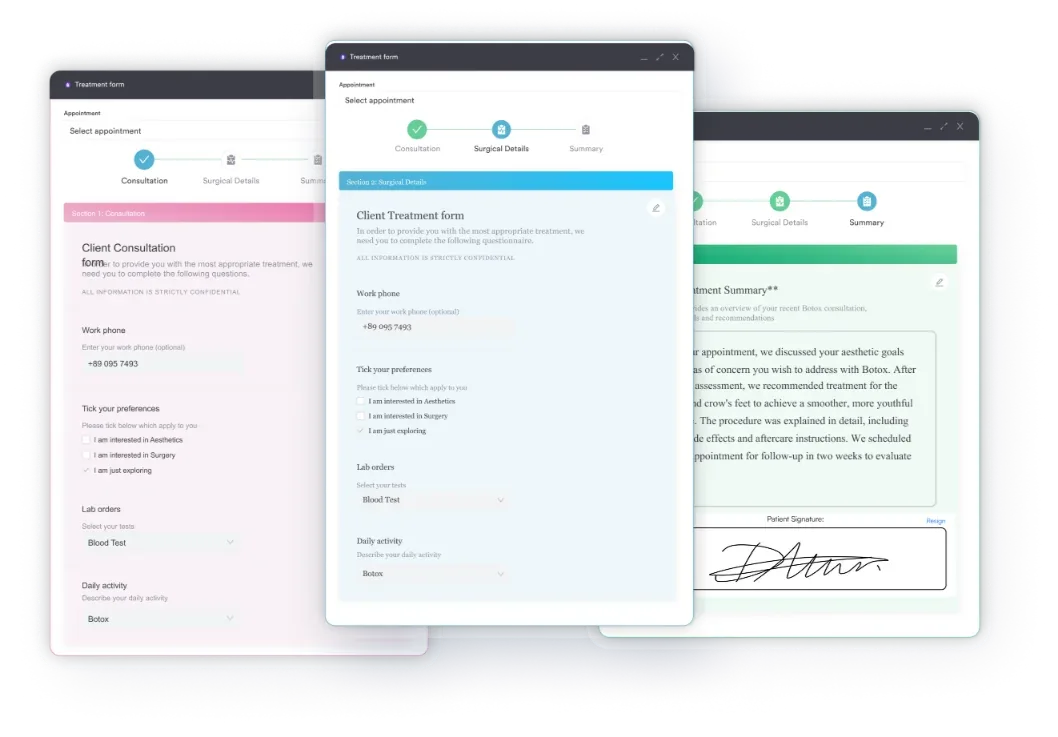
Digital form platforms like Pabau automate consent delivery, e-signature collection, and audit-trail documentation, eliminating manual tracking and proving compliance to auditors.
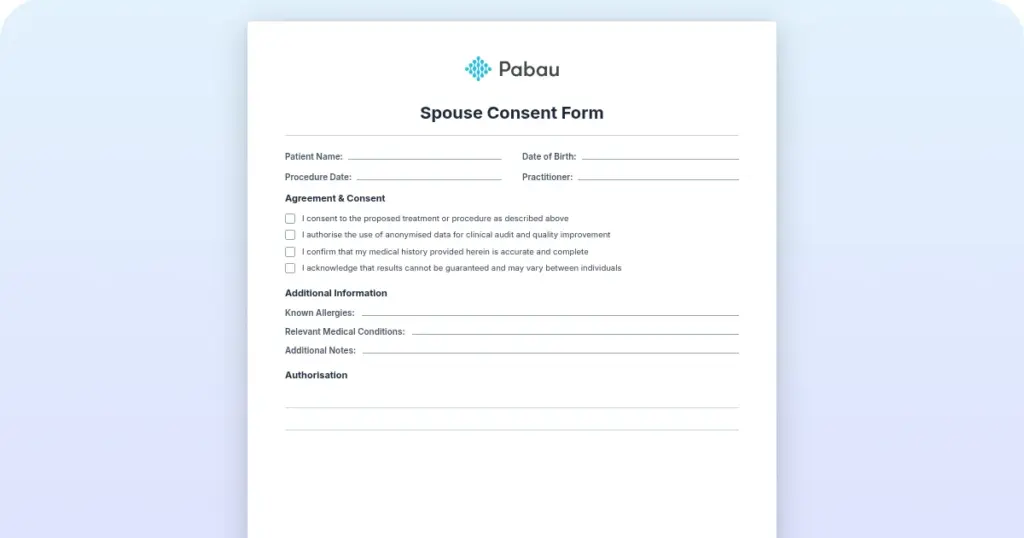
A ready-to-use informed consent form covering therapist credentials, confidentiality limits, mandatory reporting obligations, fees, cancellation policy, client rights, and signature blocks.
Download templateBefore a client begins therapy, they need to understand what they’re agreeing to. A counseling informed consent form is the legal foundation that establishes this understanding. It outlines your role as a therapist, the limits of confidentiality, fees, and the therapeutic process itself.
The form protects both you and your clients by documenting informed consent, reducing liability risk, and ensuring compliance with HIPAA, ACA ethical guidelines, and state licensing board requirements. Without it, you expose your practice to regulatory findings and malpractice claims.
This guide covers what every counseling informed consent form must include, the legal requirements driving those elements, and how to customize the template for your practice setting, whether you’re in individual therapy, working with minors, or offering telehealth sessions.
A counseling informed consent form is a written agreement between a therapist and client that documents the client’s understanding of therapy, its potential risks and benefits, and the professional boundaries of the therapeutic relationship.
The form works as a transparency tool. It tells clients exactly how your practice operates: Your license and qualifications, what you will and won’t keep confidential, what you charge, when you’re available, and what happens if they miss an appointment.
Why it matters legally: The American Counseling Association (ACA) Code of Ethics Section A.2.a mandates informed consent at the outset of the counseling relationship. HIPAA regulations (45 CFR §164.508) require written authorization for use and disclosure of protected health information. State licensing boards enforce similar requirements. Many states explicitly require documented informed consent before the first billable session.
Without a signed consent form, you cannot claim the client agreed to your terms.
Federal law (HIPAA): Your consent form must disclose how client data will be used, who may access it, and how long it will be retained.
ACA Code of Ethics: Section A.2.a explicitly mandates informed consent at the outset of the counseling relationship. Section B.1.c requires disclosure of the limits of confidentiality. These requirements are binding for ACA members and influence standard-of-care expectations across the profession.
State licensing boards: Every state’s LPC, LCSW, or MFT licensing board specifies informed consent requirements. Most require disclosure of therapist credentials, scope of practice, right to ask questions, mandatory reporting duties, fee structures, and cancellation policies.
42 CFR Part 2: If you treat substance use disorder, federal confidentiality rules (stricter than HIPAA) apply. Your consent form must separately disclose these enhanced protections and restrictions on disclosure.
A comprehensive counseling informed consent form contains the following sections. Not every practice weights each section equally. A solo practitioner’s form looks different from a group practice’s, but all these elements must be addressed.
State your name, license type (LPC, LCSW, MFT), license number, issuing state, and licensure date. Name any specializations (trauma-informed care, EMDR, CBT) and treatment modalities you use. If you’re operating under supervision or are a trainee, disclose this. Clients need to know who they’re working with and what qualifications you bring.
Disclosure runs both ways at the first appointment. A structured intake worksheet gathers background, current concerns, support systems, and treatment goals before the session begins.
This is the most legally critical section. Explain that therapy is confidential, then enumerate the exceptions. These are the situations where you must disclose without consent.
Always note that state laws vary. Frame your form around your state’s laws, then add: “Depending on jurisdiction-specific requirements, additional exceptions may apply.” For imminent-risk disclosures.
Disclose your session fee, payment methods, when payment is due, and your late-cancellation and no-show fees. If you bill insurance, explain the client’s financial responsibility if claims are denied. If you use a billing service, name it and explain how client data flows (HIPAA-relevant).
Clarify client rights and responsibilities before treatment begins.
Clients have the right to:
They’re responsible for attending scheduled sessions, communicating openly, and paying fees as agreed. If your approach includes between-session assignments, name them in this section. A journal entry log that records the situation, an intensity rating from 0 to 10, and the action taken makes that expectation concrete.
Storing this resource in an EMR designed for behavioral health keeps client progress visible across sessions.
When the client is a minor, consent rules shift. In most states, a parent or legal guardian must sign the informed consent form. However, some states allow minors 12 and older to consent independently to outpatient mental health treatment, and a few allow minors 16+ to consent without parental notice.
Depending on your state and the minor’s age, you must determine whether you need parental consent, parental notice only, or the minor’s independent consent. Some states require a separate “minor consent addendum” that discloses the parent’s right to access therapy notes (and when that right is limited for confidentiality reasons).
Always consult your state licensing board’s guidance before accepting minor clients. A single error in consent documentation can expose you to license discipline and malpractice liability.
If you offer online therapy, your standard informed consent form needs a telehealth addendum addressing digital-specific risks and disclosures:
Many licensing boards and telehealth software providers publish sample addenda. Incorporate state-specific language and your practice’s policies.
The template provided is a starting point. You must personalize it for your practice, state, and modality.
After customization, have your form reviewed by your legal counsel or your state licensing board. Never publish a form you haven’t personally verified against current state law.

Digital forms, e-signatures, and audit trails built in. Reduce admin burden and stay HIPAA-compliant.

Managing paper consent forms creates administrative overhead: Printing, signing, filing, version tracking when policies change, and proving clients received them. Practice management software like Pabau.
With Pabau’s client portal feature, you upload your customized consent form once. When a client books their first appointment, the form is automatically sent via email and SMS. The client completes it, signs electronically, and you receive a timestamped. If you update policies, you can trigger re-consent workflows automatically. No manual follow-up needed.
Compliance benefit: Every signature is logged with a timestamp, IP address, and browser details. That’s exactly what auditors and regulatory boards want to see. You can instantly prove consent was obtained and documented.
A well-written counseling informed consent form is your first line of defense against regulatory findings and malpractice claims. It establishes clear expectations, discloses professional boundaries, and documents that your client understands and agrees to therapy’s terms.
Use the template provided as a foundation, customize it thoroughly for your state and practice, and have it reviewed by legal counsel before deployment. If managing paper forms feels burdensome, digital intake forms with automated delivery and e-signature let you maintain compliance without manual overhead. They also create the audit trail regulators expect to see.

Need to document telehealth-specific risks? Pabau’s telehealth software feature supports secure session delivery and templates tailored to virtual care disclosures.
Looking for printable reasoning exercises? Critical thinking worksheets covers logical reasoning, inference and pattern recognition organized by grade level.
Want clients to build a daily gratitude habit? Daily gratitude journal template offers guided morning and evening prompts with mood tracking for anxiety relief.
Informed consent is a documented agreement in which a client acknowledges understanding the therapist’s credentials, the therapy process, confidentiality limits, fees, and risks and benefits of treatment before the first session begins.
Yes. The American Counseling Association Code of Ethics mandates informed consent. HIPAA requires written authorization for use and disclosure of health information. Most state licensing boards explicitly require documented consent before the first billable session.
Therapists must disclose information without the client’s consent when a child is being abused, an elder is being abused, there is imminent danger to self or others, a court orders disclosure, or public health emergencies require it. State laws vary. Your consent form should enumerate your state’s specific exceptions.
Your standard form needs a telehealth addendum addressing platform security, technology failure protocols, reduced privacy guarantees, cross-state licensure limitations, and recording prohibitions. Do not use the same consent form for in-person and online therapy without these telehealth-specific disclosures.
It depends on your state and the minor’s age. Most states require parental consent for minors under 12. Some allow minors 12-17 to consent independently for outpatient mental health treatment, though parental notice may still be required. Check your state licensing board’s guidance.
Start with a template like the one provided, then customize it: Insert your credentials, fees, state-specific disclosures, confidentiality exceptions, cancellation policy, client rights, and practice emergency procedures. Have it reviewed by your state licensing board or legal counsel before use.