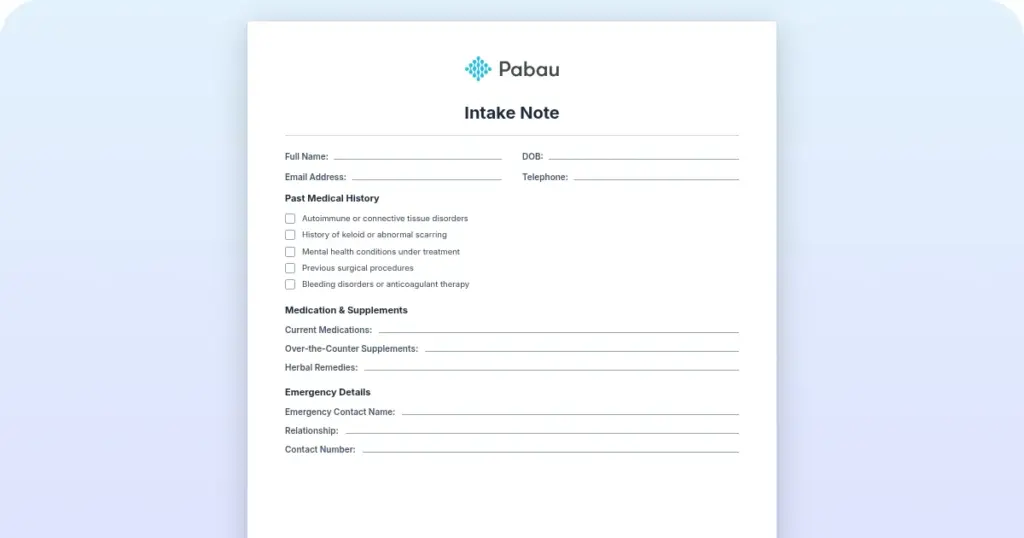
Intake note template
An intake note is the clinical record a therapist or counselor writes at the sta...

1
Last Updated: Oct 22, 2026

A list of feelings is a curated reference of emotion vocabulary, organized by valence and clinical context, to support emotional identification in therapeutic settings.
Therapists and counselors use feelings lists to move clients from vague descriptions like ‘I feel bad’ to precise emotional naming, improving treatment and self-awareness.
The resource covers 270+ emotion words across positive, negative, neutral, and complex emotions, plus frameworks like Ekman’s primary emotions and Plutchik’s wheel of emotions.
Practice management software like Pabau turns this list into an active clinical tool, built into intake forms and client records rather than a static handout.
A comprehensive emotional vocabulary reference with 270+ feeling words organized by valence (positive, negative, neutral) and clinical application for therapy, counseling, and mental health assessment.
Download templateEmotion vocabulary is foundational to therapeutic work. Clients often struggle to articulate what they feel. They default to vague statements such as ‘I’m not okay’ or ‘everything is wrong’ instead of naming a specific emotion. A structured list of feelings turns that vague language into clinical precision. This printable reference helps practitioners and clients move beyond surface-level feeling descriptions. It opens up the emotional nuance that drives behavior, decisions, and treatment planning.
A list of feelings is a comprehensive reference of emotion vocabulary. It helps practitioners and clients identify, name, and communicate emotional states with clinical precision.
A clinical feelings list goes beyond a casual mood tracker by distinguishing between:
The core purpose is educational and therapeutic: naming emotions reduces amygdala activation and emotional distress, increases self-awareness, and creates shared language between practitioner and client. A structured feelings list moves emotional assessment from subjective impression to documented emotional vocabulary, strengthening both clinical notes and treatment accountability.
Emotional literacy is the ability to recognize and name feeling states. It is linked to better therapy outcomes, improved emotional regulation, and reduced symptom severity across anxiety, depression, and trauma. Practitioners who integrate a feelings reference into intake, session notes, and treatment planning create three documented benefits:
Research from the American Psychological Association (APA) confirms this. Clients who build emotional vocabulary through structured practice show improved emotion regulation skills and higher treatment satisfaction scores.
The following reference organizes feeling words by emotional valence and type. It creates a taxonomy your team can use during intake, check-ins, and treatment planning.
Positive emotions reflect states where client needs are being met or where the body senses safety and growth. These words help normalize emotional wellness and create aspirational targets in treatment planning.
Negative emotions signal unmet needs, perceived threat, or loss. These emotions are valid and informative, not flaws to fix. A psychiatric evaluation template should include space for negative emotion descriptors, so assessment captures the full emotional landscape.
Complex emotions blend positive and negative valences and represent ambivalent or conflicted states. Neutral feelings reflect acceptance or resignation without strong emotional charge.
Research by psychologist Paul Ekman identified six primary emotions-happiness, sadness, fear, anger, disgust, and surprise-as universally recognized across cultures. Secondary emotions arise from blending primaries (e.g., anger + sadness = despair). Understanding this framework helps practitioners ask targeted follow-up questions.
A structured mental health EMR integrates the feelings list directly into your assessment workflow. During intake, therapists reference the feelings list to help clients move beyond surface reporting into emotional specificity. Different modalities use the list in different ways:
Integration into your EMR means the feelings vocabulary sits beside structured SOAP notes. That creates a searchable record of emotional symptoms across sessions.
This feelings reference is designed for:
Use the patient care management strategies in your EMR to share the feelings list with clients during intake or as a psychoeducational handout. This supports their emotional development outside sessions.
A feelings list becomes clinically effective when embedded in your workflow. Here is how to implement it:
The feelings list works as an active clinical tool for teaching emotional regulation, not just a reference. Clients who learn to identify emotions with precision gain two advantages.
They catch sadness early, at the melancholy stage, rather than waiting until it deepens into despair. They also select coping skills that match the specific emotion, since anxiety management differs from anger management.
Use AI-assisted clinical notes to document these skill-building moments consistently. That creates a searchable record of which emotional states trigger which coping strategies, useful for treatment adjustment and for measuring emotional skill growth over time.
A printed feelings list usually lives on a clipboard at intake, separate from the treatment note where the session actually gets documented. Six months later, nobody can search across sessions to see how a client’s emotional language has changed.
Pabau keeps the feelings list and the client record in the same system, rather than in two disconnected places. A therapist documenting today’s session can reference the exact words a client used last month, without digging through paper files.
That continuity matters for teams, not just individual therapists. When a psychiatrist, a therapist, and a peer support worker pull from the same client record, they document affect with the same vocabulary. That consistency makes it possible to track how a client’s emotional language shifts over months of treatment.

Pabau’s digital intake forms and treatment notes store feeling words in the client file, so your team can track emotional language across sessions.

Emotional vocabulary is clinical infrastructure. It shapes how clinicians and clients name the full range of human feeling, and that precision sharpens assessment and treatment planning. The feelings list you download today becomes a reference your entire team uses for years. It supports better documentation, better client outcomes, and stronger emotional literacy across your practice.
Ready to make emotional assessment part of your everyday workflow? Book a demo of Pabau to see how clinical notes and intake forms can integrate emotional vocabulary directly into your patient records. The feelings list becomes an active, searchable part of treatment planning from day one.

Need templates for structured emotional assessment? Psychiatric evaluation template provides a complete framework for documenting emotional status in intake and ongoing assessment.
Want to streamline clinical documentation? Pabau’s AI-powered clinical documentation auto-generates structured SOAP notes that reference emotional vocabulary from your practice workflow.
Looking for compliance best practices? Medical billing compliance essentials include proper documentation of emotional and behavioral health outcomes, making emotional vocabulary part of your billing accuracy process.
Emotions are biological responses-automatic, brief reactions in the nervous system. Feelings are the subjective experience of those emotions, shaped by context, memory, and meaning. A clinical feelings list distinguishes between the two because the words clients use (the feelings) often reveal how they are interpreting their emotional experience.
Research suggests 6-8 primary emotions (Ekman identified 6: happiness, sadness, fear, anger, disgust, surprise). Plutchik’s wheel adds anticipation and acceptance. All other emotions are secondary-blends or variations of these primaries, which is why a comprehensive feelings list organizes words hierarchically by primary emotion base.
A structured feelings list speeds up emotional identification and reduces assessment time. It creates consistency across your team’s documentation and gives clients permission and language to explore their emotional landscape. It transforms vague feeling descriptions into measurable emotional symptom tracking.
Yes. For younger children (5-8), use the simplified positive/negative section and add visual emoji associations. For older children and teens (9+), use the full list as-is. The vocabulary grows with the child’s emotional literacy, making the list a developmental tool rather than a static reference.
Psychologist Robert Plutchik’s wheel organizes eight primary emotions in opposing pairs (joy-sadness, trust-disgust, fear-anger, surprise-anticipation). Each emotion can blend with adjacent emotions to create secondary ones. It is a theoretical framework useful for teaching clients how emotions relate and combine, complementing the word list as an educational tool.