Getting along with siblings worksheet
A getting along with siblings worksheet is a printable that helps children and t...

1
Last Updated: Oct 23, 2026
Emotions cards are visual prompts, such as faces, scenarios or flashcards, that help people name, recognize and talk about how they feel. Therapists, teachers and parents use them to build emotional vocabulary, especially with children and autistic learners.
The free emotions cards PDF on this page is ready to download and print. The guidance below covers therapy sessions, classrooms and adult counseling, plus how to track progress over several weeks.
A printable template with emotion prompts for identifying, expressing and exploring feelings during counseling and therapy sessions.
Download template
The emotions cards PDF is free to download and print.
Practitioners often use the cards to support emotion recognition in autistic learners.
Adult use in CBT and DBT has less formal research behind it.
Practice software such as Pabau keeps intake forms, consent and session notes in each patient file.
Emotions cards are a set of visual prompts, such as faces, scenarios or flashcards, that each represent a feeling. Clinicians use them to help patients put words to feelings before they explore what caused those feelings.
School psychologists, counselors and ABA practitioners use the same kind of visual tool, usually with more structure and a record of each session.
Speech-language pathologists who build emotion vocabulary use the cards too, often logging each session in their speech therapy software. How many cards to use depends on the patient’s age, the session length and how much structure the plan needs.
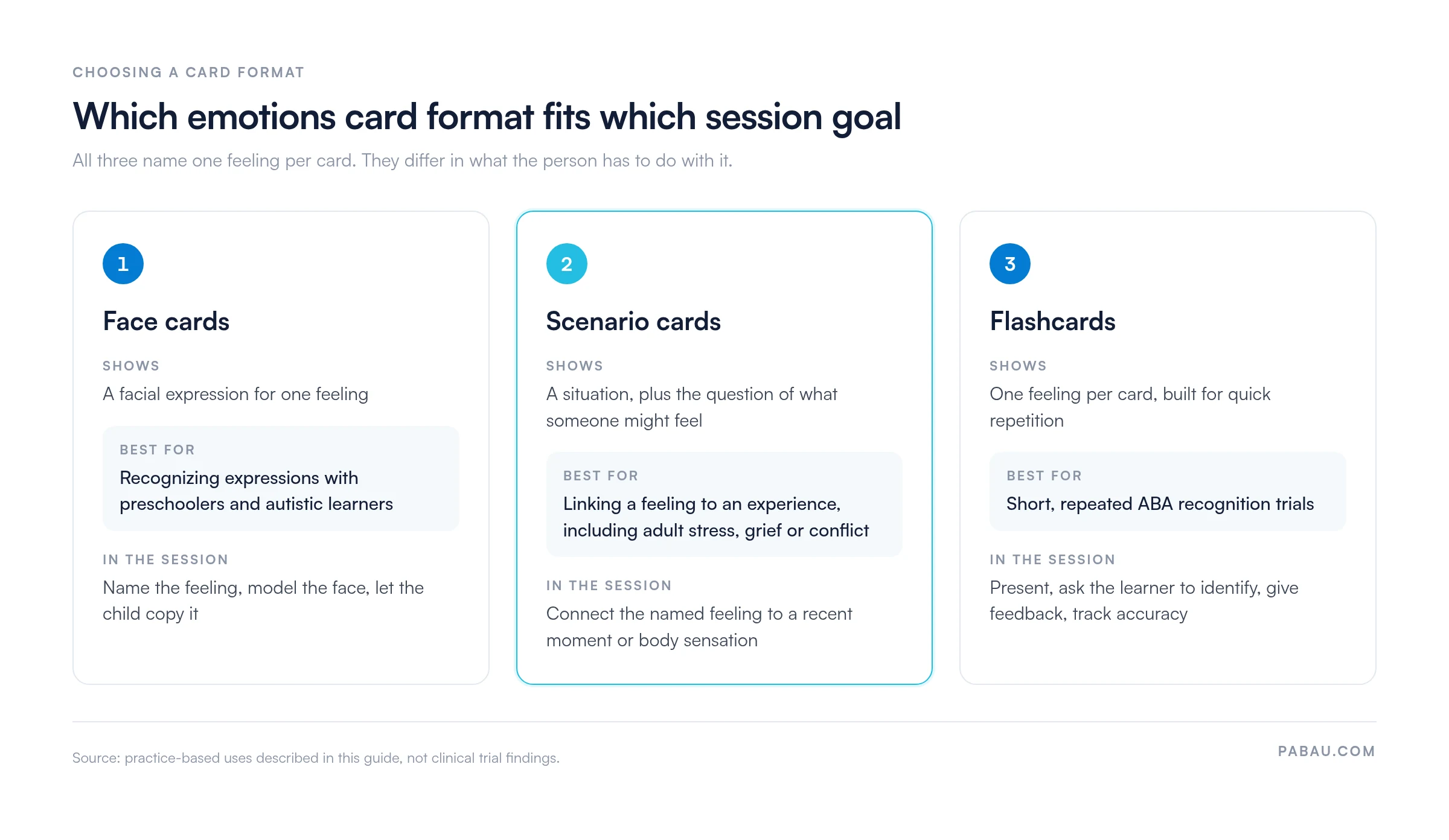
The three common formats suit different goals. Face cards focus on facial expressions, while scenario cards describe a situation and ask what someone might feel. Flashcards suit short, repeated practice, and the chart below matches each format to its best use.
Use the PDF in five steps. Print it, choose a few feelings and name each one aloud, then link each feeling to an experience and note what you observe.
Notes from each session are easier to review when they sit in the patient record rather than on loose paper.
Emotions cards make abstract feelings concrete and visible. A card gives a patient or student something to point at when words are hard to find.
They also fit the goals of social-emotional learning, a framework promoted by CASEL. Naming feelings, reading facial cues and choosing a response are all common goals.
Audit your card set before each session. Remove feelings the person has not yet met, and focus on two or three words that matter this week. Keep a short note of the feelings each person names confidently, then build from there. Revisit that note at each review so progress stays visible. This keeps the activity focused and stops it feeling like a quiz.
Keep sessions short when using emotions cards with preschoolers. Two or three feelings is usually enough for a single session.
Teachers often run this as a short circle-time activity, with each child choosing a card before sharing a recent moment.
Emotions cards are used with autistic learners as a visual support for recognizing facial expressions and naming feelings. Visual supports appear widely in autism guidance from organizations such as the National Autistic Society.
The CDC describes autism as a spectrum, so each learner’s needs differ. Research on specific card formats is still developing, so treat cards as one tool within a wider plan rather than a standalone intervention.
ABA practitioners use emotion flashcards as short, repeated trials that build recognition over time. Each trial presents a card, asks the learner to identify the feeling and gives feedback.
Practitioners typically track accuracy across sessions to see which feelings need more practice. For wider context on communication goals, see the autism and speech delay guide.
Some counselors use emotions cards with adult patients, although formal research on adult card interventions is limited.
Where it helps: Adults often use them to name feelings that are hard to describe, such as frustration that sits underneath irritability. The cards can also frame a discussion of stress, grief or relationship conflict.
Good practice: Therapists working in CBT or DBT sometimes use feeling cards within emotional regulation exercises. Treat this as practice-based rather than evidence-proven, and follow the guidance of your own modality.
Print a test page on plain paper before using card stock, so you can check the layout and scale. Heavier card stock makes the cards easier to handle in busy sessions.
Laminating the pages extends their life, which helps when the same printed emotions cards go through many sessions. Store each set in a labeled envelope so you can find it quickly.
Practices that run emotion-based sessions often juggle intake, notes and follow-up tasks in separate tools. The cards get used in the room, but what the patient named often ends up on loose paper.
Pabau, the practice management platform we build, brings those pieces together as therapy practice management software. Intake and consent forms are completed before the first session, and AI-assisted clinical documentation helps draft session notes afterward.
Each note then sits in the patient record of a mental health EMR, next to earlier sessions. At a review, you can see which feelings a child named confidently in week one and which ones still need practice.

Pabau brings patient records, digital forms and follow-up tasks into one system, so your team can review progress without hunting through folders.

Emotions cards work best as a short routine you repeat across sessions. Pick two or three feelings, return to them each week, and note which ones the person names without prompting.
The trade-off is scope. The cards build feeling vocabulary and recognition, but they don’t stand in for a treatment plan, and evidence for adult use is still limited. Pair them with your own modality’s tools once the work moves past naming feelings.
Keep your observations from each session, because change over several weeks is the clearest sign the cards are helping. Book a demo to see how Pabau keeps session notes, forms and follow-ups in one patient record for your therapy practice.

Want a quick way to rate intensity? Feelings thermometer template helps the person show how strong a feeling is once they have named it.
Need more words than the cards cover? List of feelings gives a wider vocabulary to draw on once the core feelings are secure.
Ready to move from naming to managing? Emotional regulation worksheet builds on the cards with steps for handling strong emotions.
Building a coping plan? Coping wheel template helps children and adults choose strategies to use when a feeling gets big.
Working with a younger child on anger? Anger meter worksheet gives children a simple scale for rating how angry they feel.
Emotions cards are visual prompts, such as faces, scenarios or flashcards, that each represent a feeling. They help children and adults name, recognize and talk about how they feel.
Yes. The emotions cards PDF on this page is free to download and print for therapy sessions, classrooms or home use.
Two or three feelings is usually enough for a single session, especially with young children. Add new feelings once the person names the first ones confidently.
Many practitioners use them as a visual support for recognizing facial expressions and naming feelings. Research on specific card formats is still developing, so use them as one tool within a wider plan.
Yes. Some counselors use them with adults to name feelings that are hard to describe, such as frustration underneath irritability. Formal research on adult card use is limited, so treat it as practice-based.