Emotional awareness worksheet
An emotional awareness worksheet is a structured psychoeducational tool that hel...

4
Last Updated: Oct 16, 2026
365 days journal prompts give you one guided question for every day of the year, so you never start an entry from a blank page. The prompts below are grouped into six themes (self-discovery, gratitude, mindfulness, mental health, creativity, and goals), with a seasonal focus for each quarter.
A free printable log comes with them, so you can record each entry and spot patterns over time. Therapists can assign the prompts as homework and review the log with the patient at each session.
A printable journaling log with one row per entry for the date, time, situation, intensity from 0 to 10, and notes. It closes with space for the patterns you noticed and questions to bring to your next appointment.
Download template
365 days journal prompts give you one guided question per day across self-discovery, gratitude, mindfulness, mental health, creativity, and goals.
Seasonal sets shift the focus each quarter, and a review every 90 days shows how your entries have changed.
Daily journaling is easier to sustain as a small, fixed ritual, and expressive writing supports stress reduction and emotional regulation.
The free log records each entry’s situation, intensity, and notes, so patterns are easy to bring to a therapy session.
Therapists can share the prompts and collect the log through practice management software like Pabau, so entries reach the patient record.
A year of daily prompts turns journaling from an occasional exercise into a routine you keep. Research from psychologist James Pennebaker and colleagues at the University of Texas shows that expressive writing improves both mental and physical health. Writing every day gives those benefits more chances to build up.
For therapists, a year-long journaling practice gives patients structured work between sessions and leaves a written record of progress. A Psychology Today guide to journaling notes that there is no right amount of time to spend on an entry. That makes a short daily prompt a gentle way in for nervous beginners.
Using the 365 prompts is straightforward: Download the log, select your format (print or digital), and commit to one prompt per day.
The 365 prompts rotate through six core themes, with optional seasonal grouping that lines your reflection up with the time of year.
Seasonal variants group these themes by quarter, and each season carries its own focus. Optional monthly grouping keeps the practice fresh within each quarter.
Mental health practitioners often use self-discovery prompts in therapy to help patients clarify their values and identity. Here are 12 sample prompts to start with.
A free personality questionnaire gives patients a trait profile to write against, so the year’s entries build on one starting point.
NAMI (National Alliance on Mental Illness) recognizes journaling as a complementary tool for managing anxiety, depression, and emotional dysregulation. These prompts are therapeutic in nature and work best alongside clinical care.
If you rate your mood each day, a daily mood chart puts those scores side by side, so shifts across weeks are easy to see.
One prompt asks, “What negative self-talk did I notice, and what is the truth?” When a patient needs a structured way to test that thought, pair it with a checking the facts worksheet.
Gratitude journaling trains your attention on what went well, even on a hard day. Studies of daily gratitude lists have linked the habit to higher well-being. Try these prompts.
Mindfulness journaling slows rumination and anchors you in the present moment. Mind, a leading UK mental health charity, recommends mindful writing as a grounding tool. Start with these prompts.
Seasonal prompts tie your reflection to the time of year, so the questions shift as your routines and energy do. Each quarter carries its own focus and ends with a review of what you wrote, as the year below shows.
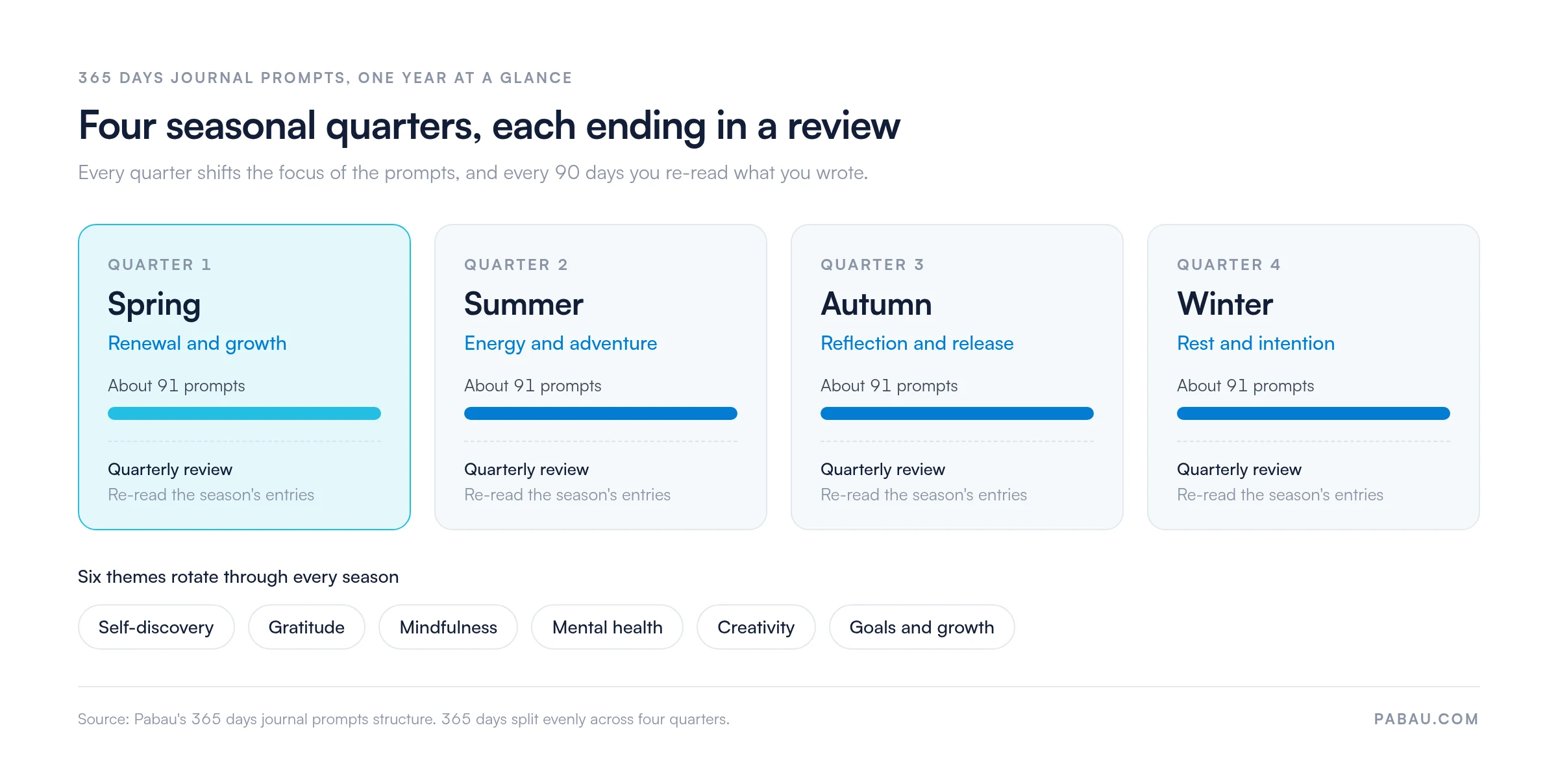
Spring prompts focus on renewal and growth, and summer prompts on energy and adventure. Autumn turns to reflection and release, and winter to rest and intention. Working with each season’s pace makes the prompts easier to answer honestly.
Therapists can share each season’s set through a patient portal, so patients open the right questions without a printout.
Beginners often freeze at the blank page, and ready-made prompts remove that barrier. Start here.
Beginner-friendly examples include “What was good today?”, “What am I learning?”, “How did I show up for someone?” and “What made me laugh?” Each one is a simple entry point into deeper reflection.
Consistency is the hard part of a year-long practice. These strategies help you keep going through all four seasons.
Therapists can assign the prompts as homework and follow up at each session. Weekly check-ins on engagement build accountability and give you clinically rich material to explore. Tracking those assignments in therapy practice management software keeps them next to your session notes.
Journaling homework usually runs on paper. You hand over a sheet of prompts, and you only see the entries if the patient remembers to bring them back. Comparing months of entries then means flipping through loose pages in session.
Pabau keeps that work in the patient’s file instead. You can rebuild the log as one of Pabau’s digital forms, so patients fill it in before their appointment. Their answers are saved to their Client record, next to your treatment notes.
Each session then starts from the patient’s own words. You can spot a rising intensity score or a recurring trigger before the patient sits down. Every entry also stays on file for the next quarterly review.

Pabau’s digital forms let patients complete their journaling log before each appointment, with every entry saved to their record. You walk into the session already knowing what to explore.

Start with one prompt tomorrow and keep the log beside it for a month. If the habit holds that long, the seasonal sets will carry you through the rest of the year. Skip any prompt that doesn’t fit, since a year of short, honest entries is worth more than a perfect streak.
For therapists, the payoff comes when those entries reach the session. Book a demo to see how Pabau saves patients’ journaling logs to their record before each appointment.

Want a gratitude practice that takes one page a day? Daily gratitude journal template gives you a printable page for listing what went well each day.
Need to clear your head before you write? Brain dump journal explains how to empty racing thoughts onto paper, with a free template.
Prefer structured morning and evening reflection? Daily stoic journal pairs stoic questions with a free PDF log.
Working through DBT skills with patients? DBT journal offers prompts for all four DBT modules in one free template.
Want a quick way to name how you feel? Emotional check-in worksheet walks patients through a short, structured feelings check.
365 days journal prompts are a year-long set of guided questions, one for each day. They’re organized by themes such as self-discovery, gratitude, mindfulness, and mental health. They remove the blank-page barrier and help you build a year-long journaling habit.
Download the free log, choose your medium (pen and paper, a digital document, or an app), and set a fixed daily time. Then write for 5-20 minutes in response to each prompt. Habit stacking (anchoring journaling to an existing routine) makes consistency easier. If you miss a day, restart the next day without judgment.
Yes. The prompts include a full self-discovery theme covering identity, values, beliefs, and life goals. These prompts help you clarify who you are and what matters most to you.
Expressive writing (including journaling with prompts) reduces stress, anxiety, and depression, and improves emotional regulation. Research by James Pennebaker and others shows that putting feelings into words decreases rumination and builds resilience. Journaling is most effective as a complement to professional care, not a replacement.
Yes. The collection includes beginner-friendly prompts with simple, non-threatening entry points such as “What was good today?” and “What made me laugh?” Beginners can write for as little as five minutes per day and gradually build the habit.
Missing one day is normal and not a failure. Simply resume journaling the next day, because the habit is built through consistency over time rather than perfection. Momentum starts to slip after two or three missed days in a row. If that happens, recommit on day four and treat it as a fresh start.