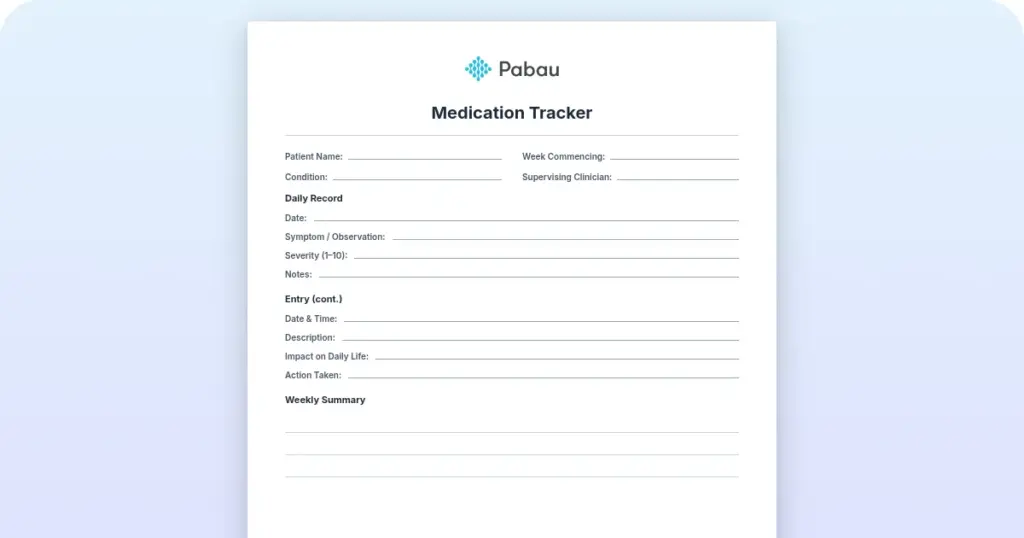
Medication tracker template: Free PDF for clinicians and caregivers
A medication tracker is a form that records each medication a patient takes, whe...

2
Last Updated: Oct 12, 2026
A medication administration form is the signed record that authorizes a medication order and documents consent before the first dose is given. Healthcare practices, schools, care facilities, and childcare providers all use one.
It captures patient identifiers, medication details, prescriber authorization, and parental or guardian consent in a single place.
Completing the form the same way every time is what makes it useful later. An inspector, a surveyor, or a covering nurse reads it to confirm who authorized the medication, what was agreed, and when the authorization runs out.
This guide sets out what belongs on the form and how to complete it in each setting. It also covers the rules that govern the record, and where forms software for practices replaces the paper version without losing HIPAA or FERPA compliance.
Inside is an authorization section for patient identifiers, allergies, medication details, prescriber signature, and guardian consent. A daily log grid follows it, with editable columns for date, time, dose given, and staff initials.
Download template
A medication administration form authorizes a prescriber’s order and records consent from a parent, guardian, or patient before the first dose.
Every form needs patient demographics, medication details, prescriber authorization, and consent signatures, plus allergies, start and end dates, and staff initials.
Schools, care facilities, and childcare settings answer to different regulators, so the form has to match the rules in your state.
Pabau’s digital forms and online patient portal let a guardian sign consent electronically, and the signed form files itself against the patient record.
A medication administration form serves as the authorization and baseline record for any medication order before staff administer it. Its primary functions are:
In schools the form meets state Department of Education requirements, and in care facilities it satisfies state health and safety regulations. In a practice it documents consent for treatments such as IV therapy or an injectable course. The form and the medication administration log do different jobs. The form authorizes the order, and the log records each dose given.
Every form must capture these core elements to keep administration safe and auditable:
School medication forms must comply with state Department of Education rules and fit the school nurse’s daily routine. Most states require one authorization form for prescription medications and a separate one for over-the-counter medications given by school staff. Where a minor is treated without a parent present, a consent to treat minor form usually sits alongside it.
Five requirements are specific to schools:
School forms usually include a line for the nurse to initial each administration date. They separate in-school doses, take-home instructions, and emergency-use orders such as inhalers or epinephrine auto-injectors. Check your state’s Department of Education website first, because many states publish a form that schools are required to use.
Medication forms in care facilities run longer than school forms, because staff give several doses a day to residents with complex histories. These forms combine the authorization and the daily administration log in one document.
Four things set a care facility form apart:
The log section carries columns for date, time, dose given, staff initials, and notes such as “given with food”. Keeping the authorization and the daily record in one document means the resident’s chart tells the whole story.
Follow these steps to complete the form accurately and cut down on errors:
Store the signed form in the patient’s chart, on paper or electronically. Retention runs for the length of the medication order plus seven years, under CMS guidance, so do not dispose of a form early.
Medication documentation answers to several sets of rules at once. HIPAA covers medication records held by a covered entity, such as a practice, hospital, or home health agency. It requires access controls, encryption, and audit logs. Schools are not HIPAA covered entities, so student health records held by a district fall under FERPA instead.
State rules matter just as much. Each state’s Board of Nursing, Department of Education, or Department of Health sets the minimum documentation standard for schools, care facilities, and clinical settings.
Connecticut’s State Department of Education, for instance, requires school nurses to record each administration in real time. North Carolina’s childcare regulations call for a combined permission form and daily log. Always check the guidance for your own state.
Medicare-certified care facilities must document medication orders, administration, and any adverse effects under the Conditions of Participation. Surveyors read those records during compliance audits.
The form authorizes the medication once. The log then records every dose that follows. The two are often confused, and they carry different content:
One signed authorization can sit behind dozens of log entries, and both records share the same retention clock.
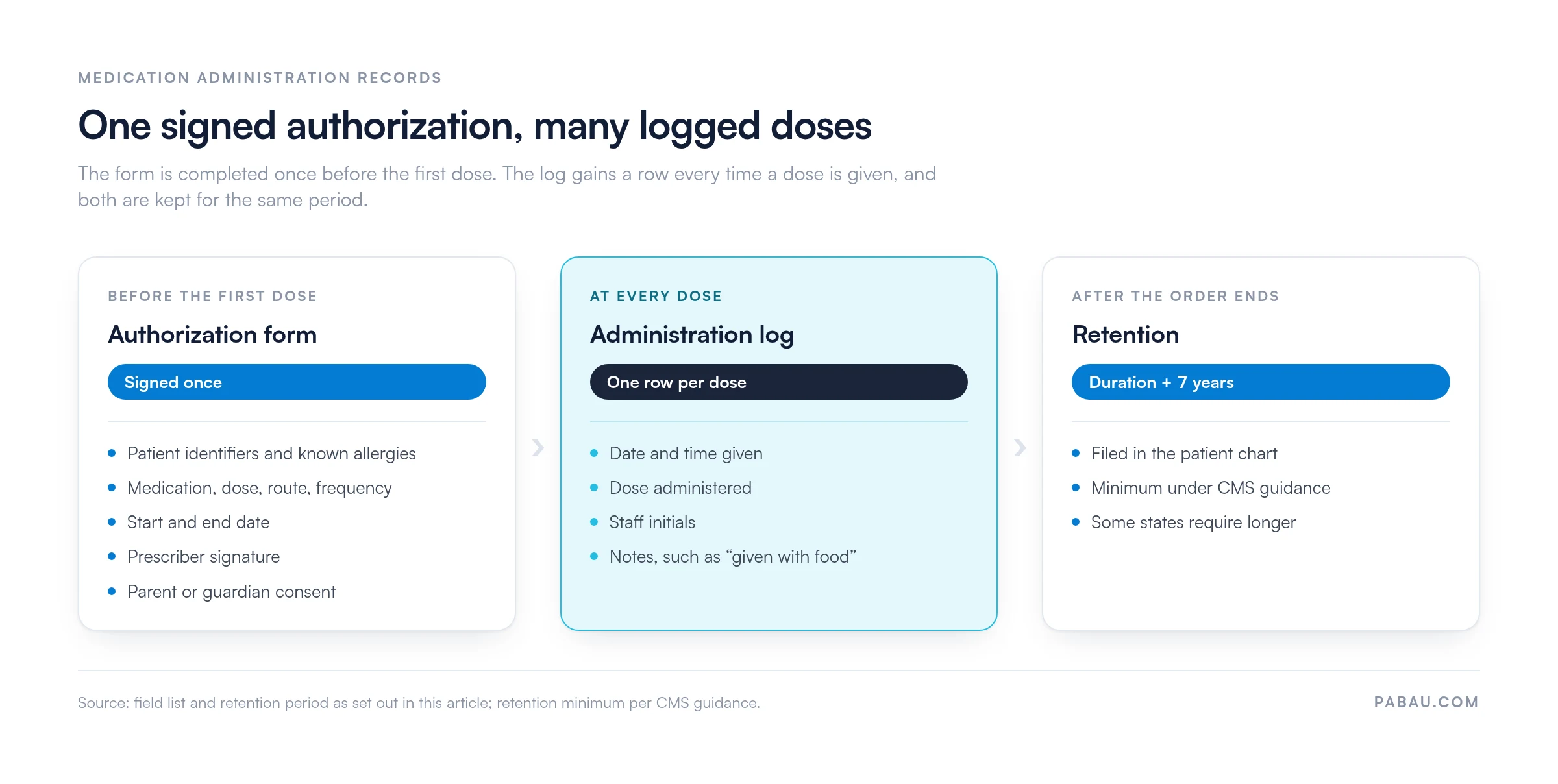
A well-designed form carries both sections. The authorization sits at the top, signed once, and a daily log grid runs underneath it. If you need the daily record on its own, a separate medication log template covers the columns each dose entry needs.
Paper adds friction at every signature. The prescriber prints, signs, and returns the form. A parent signs another copy at the school office. Staff hand-write the daily log, and the whole set goes into a filing cabinet where it can be lost or read by the wrong person.
Practice management software like Pabau keeps the same record in one place. Digital forms carry the authorization fields, and the completed form files itself against the patient record rather than a folder. Through the patient portal, a parent or guardian reviews the medication details and signs consent before the appointment.
Each entry is stamped with a time and a staff member, so the audit trail builds itself as the work happens. E-signatures satisfy the Electronic Signatures in Global and National Commerce Act, and access controls limit who can open a record. When a surveyor asks for evidence, compliance management software produces the report without a search through folders.

Pabau’s digital forms capture prescriber authorization and guardian consent online, then file the signed record against the patient chart. Every dose logged carries a timestamp and the staff member’s name, so audits take minutes.

A medication administration form is only worth as much as the detail captured before the first dose. Get the identifiers, the medication details, the authorization window, and both signatures right, and the daily log has something solid to sit on.
Match the template to your own state’s requirements before you print it. A school district, a nursing home, and a practice are each inspected against different rules. A paper form is quick to start and slow to prove, and a signed digital record works the other way round.
If your team is chasing signatures across several settings, the paperwork becomes the bottleneck. Book a demo to see how Pabau captures medication consent and logs every dose in one patient record.

Documenting a reaction after a dose? The adverse reaction form captures what was given, what happened, and the action taken.
Managing medications in a home setting? The home care form template covers the wider care record that sits around a medication order.
Need emergency details on file too? The emergency medical form collects allergies, conditions, and contacts a school or facility needs in a hurry.
Still chasing paperwork before appointments? How to get forms completed before appointments explains how practices collect signatures ahead of the visit.
A medication administration form authorizes and documents one-time or ongoing medication orders before administration begins. It captures the prescriber’s order and obtains informed consent from a parent, guardian, or patient. Staff then use it to verify the correct drug, dose, route, and frequency at each administration.
The prescriber must sign to authorize the order, and that means a licensed MD, DO, NP, or PA in your state. In schools, care facilities, and childcare, a parent or legal guardian must also sign to document informed consent. An adult patient may sign for themselves, while a minor always needs a guardian signature.
The authorization form is completed once, before any dose is given, and it records the order and the consent. The log is a daily record completed each time a dose is administered, capturing date, time, dose, and staff identity. One form may generate many log entries over weeks of administration.
Yes. Free templates such as the one above can be adapted to your setting and to your state’s requirements. Check first that your state or facility does not mandate a specific official form. Schools and care facilities often have a state-approved template you are required to use.
HIPAA requires medication records held by covered entities, such as practices and hospitals, to be protected with access controls and encryption. Schools comply with FERPA instead. State Boards of Nursing and Departments of Health set minimum documentation standards, and CMS-certified facilities must meet the Conditions of Participation. Always check the requirements in your own jurisdiction.
Retain the form for the duration of medication administration plus a minimum of seven years, per CMS retention guidance. Some states require longer retention, so verify your local rules before archiving. Do not dispose of a form early.