GLP-1 diet plan
A GLP-1 diet plan is a structured eating framework for patients taking semagluti...

2
Last Updated: Oct 13, 2026
A pulmonary hypertension medication list gives clinicians one place to check every FDA-approved PAH therapy, its route, and what needs monitoring. Six drug classes act on three biological pathways, and a seventh agent works outside all of them. One rule drives most decisions.
Class matters more than brand, because escalation means adding a pathway you have not yet targeted. Get that mapping wrong and a patient stays on two drugs that hit the same receptor. What follows is the full drug table, WHO functional class guidance, monitoring rules, and a reference sheet you can download.
A one-page reference covering every FDA-approved PAH drug by class, with route, monitoring requirements, and WHO functional class guidance. Print it for the exam room or attach it to your treatment protocol.
Download template
Six drug classes target the endothelin, nitric oxide, and prostacyclin pathways, and sotatercept works outside all three.
WHO functional class sets the starting regimen, so record it at diagnosis and at every follow-up.
Most newly diagnosed patients begin on dual or triple therapy rather than a single agent.
Bosentan is the only endothelin receptor antagonist that still needs monthly liver function tests.
Riociguat is never combined with a PDE-5 inhibitor or a nitrate, because blood pressure drops sharply.
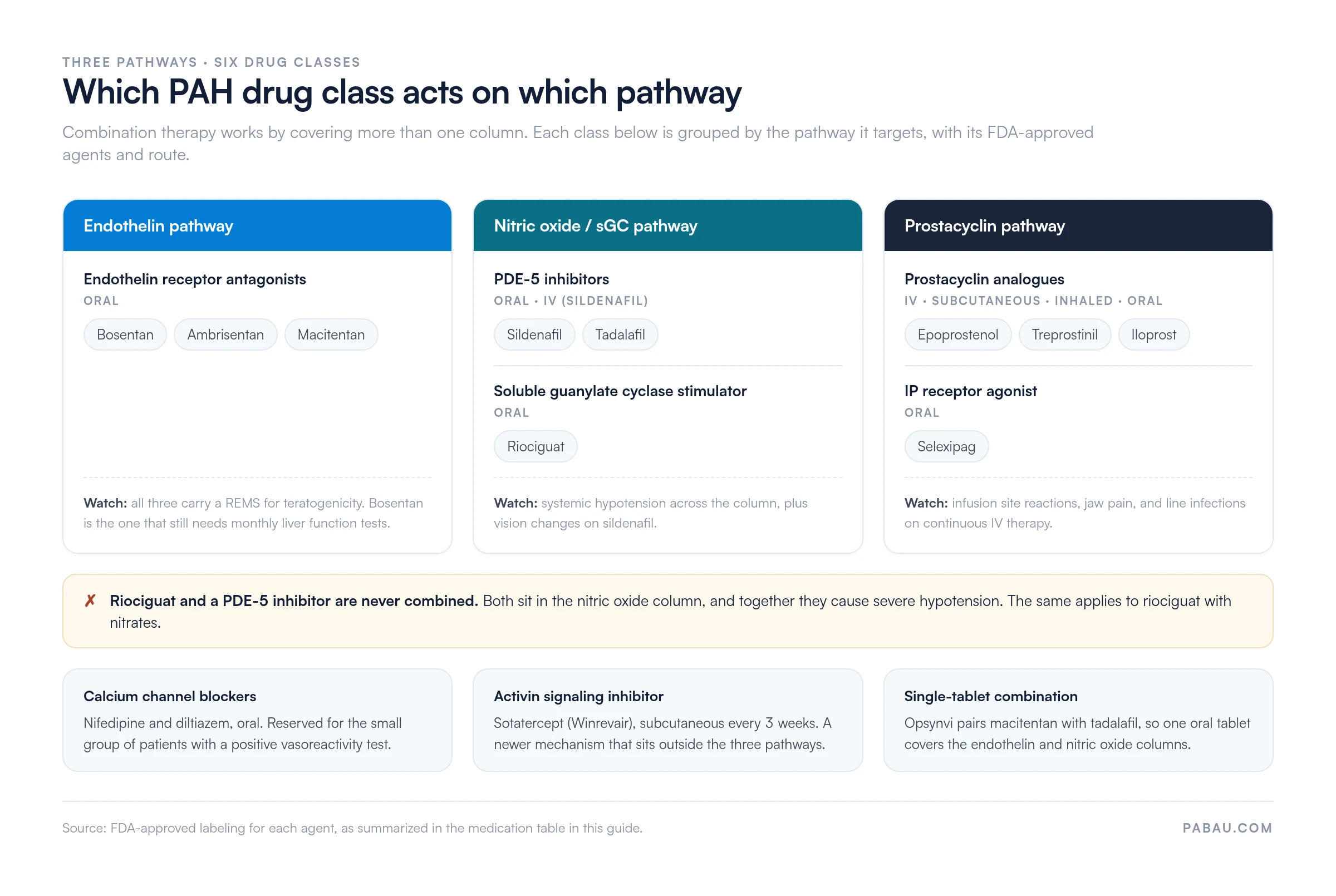
Pulmonary arterial hypertension is treated by widening the pulmonary arteries and slowing the vessel remodeling behind the pressure. Three pathways do that work. The endothelin pathway drives vasoconstriction and fibrosis.
The nitric oxide and sGC pathway widens vessels and holds back cell proliferation. The prostacyclin pathway also widens vessels and damps down platelet activity. Almost every approved drug acts on one of those three.
So a reference that lists brand names alphabetically is hard to use at the bedside. Grouping by pathway shows you what a patient already has covered, and which column is still open. The map below sets each class against the pathway it targets.
Other groupings exist. Stanford’s Pulmonary Hypertension Program sorts approved therapies into vasodilator and antiproliferative agents, calcium channel blockers, and supportive treatments. Keeping those details in the patient’s medical records beats a loose printout that only one person updates.
Each row below carries the generic and brand name, the route, and the monitoring point that decides whether the drug is safe to continue. Six classes make up the core of targeted therapy. Two further entries sit alongside them.
Opsynvi, approved in March 2024, puts macitentan and tadalafil in a single daily tablet. It suits patients already heading for that pairing, and it removes one pill from the regimen. Sotatercept (Winrevair) arrived the same month with a mechanism none of the older classes share.
Functional class is what you record first, and what you recheck first. The 2022 ESC/ERS pulmonary hypertension guidelines build their treatment algorithm around it. Functional class feeds a formal risk assessment, which is then repeated at every follow-up.
Read the table as a starting point, not a rule. A patient in class III with comorbidities may be managed differently from a young patient with idiopathic disease. What stays constant is the habit of writing the class down at every visit.
Sequential monotherapy has largely gone. Targeting two or three pathways at once produces faster hemodynamic improvement and fewer episodes of clinical worsening.
The ESC/ERS guidelines recommend starting most newly diagnosed patients on a combination rather than a single agent. Approved pairings include:
One combination is never allowed. Riociguat and a PDE-5 inhibitor both act on the nitric oxide pathway, and together they cause severe hypotension and syncope. The same warning applies to riociguat with any nitrate.
Bosentan is the only endothelin receptor antagonist that still requires monthly liver function tests. The FDA removed that requirement for ambrisentan in 2011, and it was never mandated for macitentan.
All three remain under a REMS for teratogenicity, so patients who can conceive need contraception counseling and monthly pregnancy tests.
PDE-5 inhibitors need blood pressure checks, and sildenafil adds a question about vision changes. Continuous prostacyclin infusions need daily pump management and a look at the infusion site. A line infection is the complication that puts these patients in the hospital.
Sotatercept is dosed subcutaneously every three weeks. Its FDA label asks for hemoglobin and platelet counts before each of the first five doses, then periodically after that. Erythrocytosis and thrombocytopenia are the reasons those counts matter.
Turning that into practice is a scheduling job. Setting the interval once per drug class in your workflow automation means the lab, the pregnancy test, or the follow-up echo gets chased on time.
The sheet earns its keep when it drives the consultation rather than sitting in a folder. Five steps cover a typical visit:
Targeted therapy is only part of the regimen. Diuretics manage fluid overload from right heart failure. Anticoagulants are used in selected patients to reduce thrombosis risk. Supplemental oxygen corrects hypoxia, and digoxin is sometimes added for right ventricular support.
Sotatercept is the newest addition and the first activin signaling inhibitor approved for PAH. It is given as a subcutaneous injection every three weeks, on top of background therapy. It was studied in patients whose response to standard combination therapy was inadequate.
A stale list is worse than no list, because the next clinician trusts it. Four failures turn up again and again in practice:
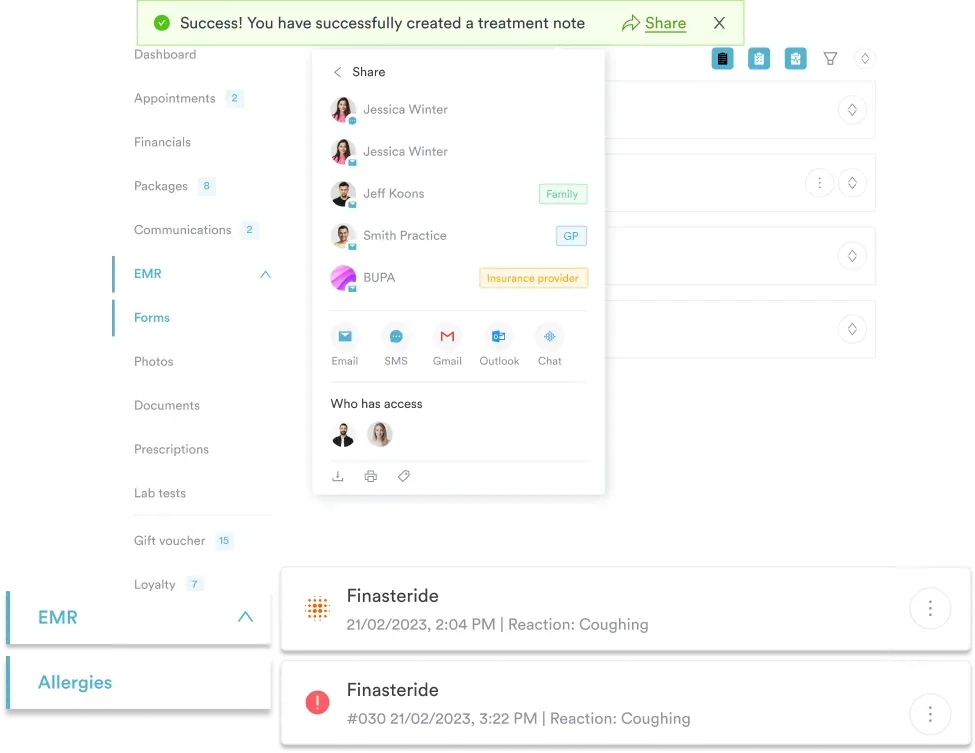
Asking for the medication history on pre-visit intake forms catches what a rushed verbal review misses. Patients list what they actually take, which is not always what was prescribed.
Before you close a PAH consultation, check five boxes:
If you also track each administered dose, the medication log template sits alongside this reference and covers that job.
Where your own staff give the injection, a dose administration form carries the prescriber’s authorization above the daily log. An injectable course such as sotatercept needs that authorization signed before the first dose.
Cardiologists, pulmonologists, internists, and cardiac nurses use it most. It also helps practice managers who build documentation standards for a group, and pharmacists checking a regimen against the approved routes.
A shared format pays off at audit too, because compliance documentation has to show the monitoring actually happened. One agreed layout across the team makes that far easier to evidence.
Most practices keep the PAH medication list in two places. The EMR carries the prescription, while a spreadsheet or printout carries functional class, REMS dates, and the monitoring schedule. Within a few months the two versions disagree.
Pabau holds all of that on one patient record. Intake forms collect the current medication history before the appointment. Custom fields hold WHO functional class and the pathways already covered, so the next clinician sees them without opening a second system.
Automated reminders then run the monitoring calendar. You set the interval once per drug class, and Pabau chases the lab, the pregnancy test, or the follow-up echo when it falls due. The schedule no longer rests on one person’s memory.
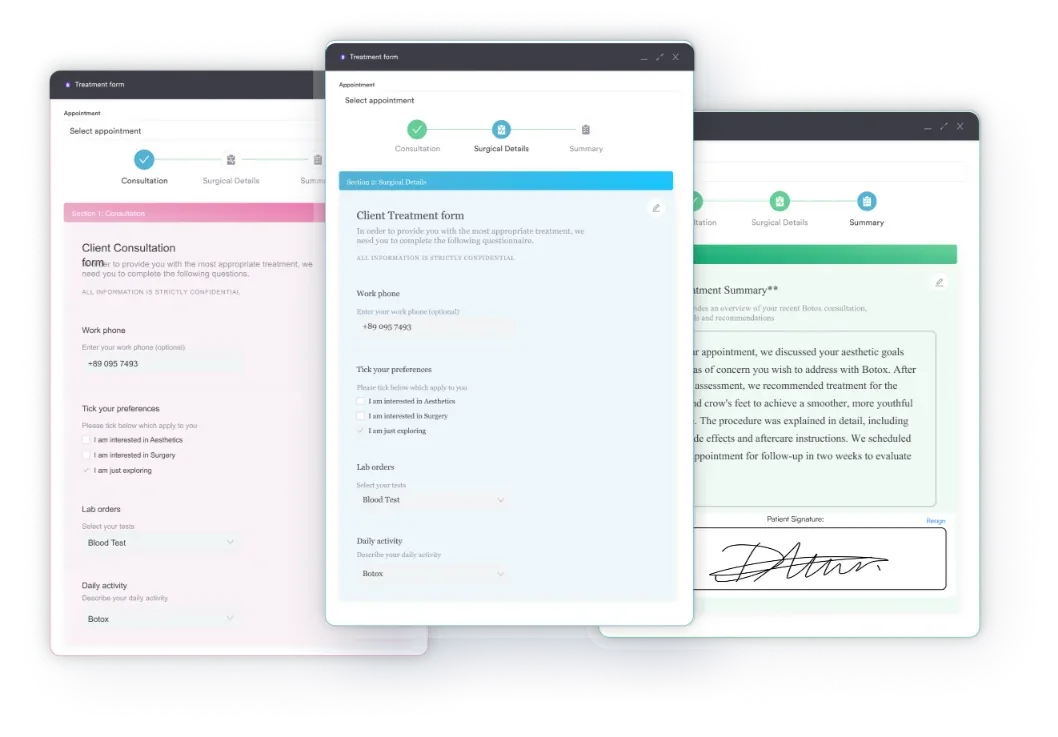

Pabau holds medication history, WHO functional class, and monitoring dates on one patient record, then schedules the labs and reviews each drug class needs. Your team stops reconciling a spreadsheet against the chart.

Assembling the list is the easy part. Keeping it accurate between visits is the work, because doses change over the phone and patients stop drugs they cannot tolerate.
Print the reference sheet, agree who updates the record after each contact, and name the monitoring parameter beside every date. A regimen documented by pathway is far easier to escalate safely when functional class slips.
Book a demo to see how Pabau keeps medication records, monitoring dates, and functional class on a single patient file.

Need to record every dose you give? Medication log gives you a dated administration record that sits alongside this reference.
Building a drug reference for trainees? Drug card sets out mechanism, dose, and monitoring on a single page per agent.
Documenting a side effect properly? Adverse reaction form captures the detail a REMS report and a discontinuation note both need.
Managing right heart failure? Decreased cardiac output nursing care plan covers the assessments and interventions that follow.
Charting dyspnea and hypoxia? Impaired gas exchange nursing care plan structures the respiratory assessment behind a functional class.
No. Approved therapies improve symptoms, exercise capacity, and hemodynamics, but none reverses the underlying disease. The goal is to slow progression, delay right heart failure, and keep patients out of the hospital. Early diagnosis and prompt escalation matter more to survival than the choice of first agent.
No. The drugs listed here are approved for group 1 pulmonary arterial hypertension. In group 2 disease, caused by left heart failure, targeted therapy can worsen pulmonary edema. Group 3 disease is driven by lung disease or hypoxia, so treatment targets the underlying condition and oxygenation. Inhaled treprostinil is the exception, approved for group 3 PH linked to interstitial lung disease.
No. Pregnancy carries a high maternal mortality risk in PAH, and endothelin receptor antagonists are teratogenic. That risk is exactly what the REMS programs for bosentan, ambrisentan, macitentan, and Opsynvi exist to prevent. Patients who can conceive need reliable contraception and monthly pregnancy testing while on these drugs.
Treat it as urgent. Continuous IV and subcutaneous prostacyclins have very short half-lives, so an interruption can trigger rebound pulmonary hypertension within hours. Patients should carry a backup pump, spare cassettes, and their PAH center’s 24-hour number. Any pump alarm or line problem needs a call the same day.