Head to toe assessment cheat sheet: Printable nursing guide
A head to toe assessment cheat sheet gives you one fixed order at the bedside, s...

3
Last Updated: Oct 23, 2026

A nursing concept map organizes patient assessment data, NANDA nursing diagnoses, interventions, rationales, and expected outcomes in one connected diagram.
The six components are subjective and objective data, nursing diagnoses, interventions, clinical rationales, measurable outcomes, and evaluation.
The rationale field is what separates a concept map from a task list, because it makes you explain each choice.
Concept maps are a standard study tool for NCLEX-RN preparation and a planning tool in day-to-day nursing practice.
Practice management software like Pabau captures the same fields in a searchable patient record, so the plan stays current between shifts.
A ready-to-fill structure covering patient observations, assessment data, nursing diagnoses, interventions, rationales, and expected outcomes. Evaluation fields let you record what changed at each reassessment, so the same sheet works in acute care, long-term care, and on a student rotation.
Download templateA nursing concept map is a diagram that connects one patient’s assessment data to their nursing diagnoses, interventions, rationales, and expected outcomes. The template above gives you that structure as a form you can fill in.
Diagram tools hand you a blank canvas and leave the thinking to you. This template names the six fields, shows worked examples for three common conditions, and explains what each field is for.
Below you will find what belongs in each component and a five-step method for filling one out. Three condition examples follow, plus how the same fields carry over into a patient record.
A nursing concept map is a diagram showing how one patient’s assessment findings, nursing diagnoses, interventions, and expected outcomes connect to each other. A linear care plan lists those elements in sequence. A concept map draws the links between them, which is what makes the patient’s situation readable at a glance.
The template puts the assessment data at the center, both subjective reports and objective findings. From there it branches out to the NANDA diagnoses and the interventions chosen for each one. Two further branches carry the clinical rationale and the outcomes the nursing team expects to see.
Concept maps run right through nursing education, from undergraduate RN programs to graduate specialties. In practice they sit alongside the forms nursing teams complete at the point of care. They earn their keep in two places: building clinical reasoning, and planning care for one patient rather than a diagnosis.
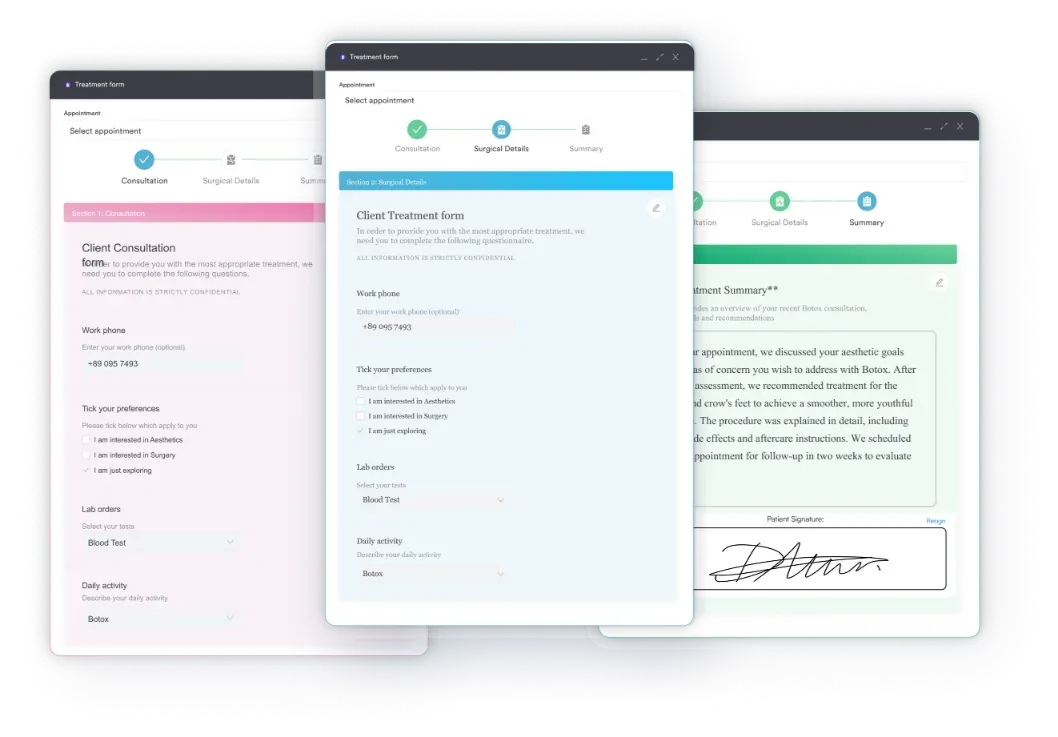
Six components have to be present and linked for the template to do its job.
The order matters as much as the content, because each component depends on the one before it. The diagram below shows how the chain runs, and where it turns back on itself.
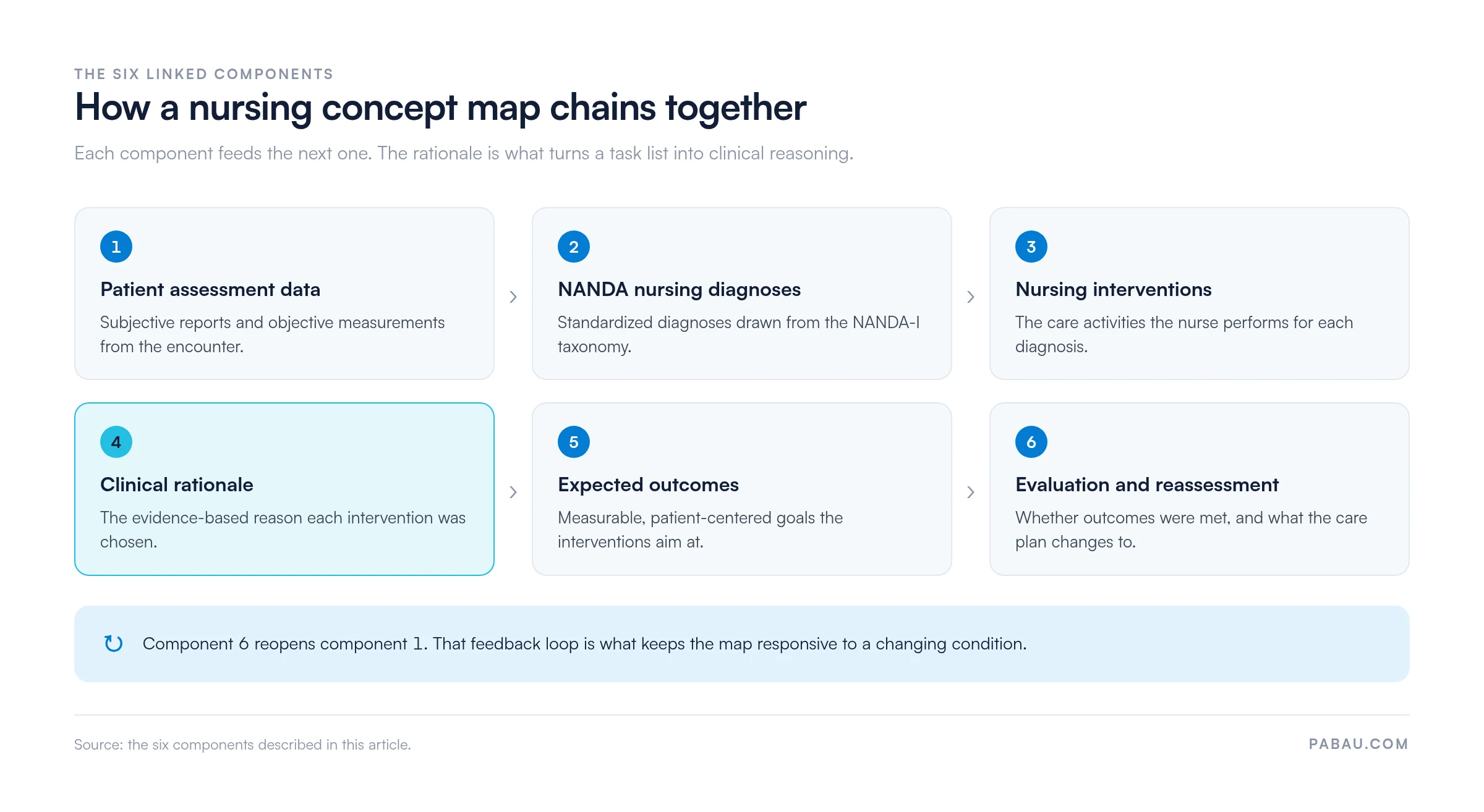
Keeping all six visible at once is the point of the layout. You can see the assessment data driving the diagnosis, the diagnosis setting the interventions, and the outcomes you will measure them against.
Work through these five steps in order. Most nursing programs teach the same sequence, and skipping ahead is usually where the reasoning falls apart.
Filled out this way, the map stops being a document you hand in. It becomes a searchable clinical record that guides the next shift’s decisions.
Three worked examples show how the same structure holds across very different presentations.
The structure does not change from one condition to the next. Assessment data leads to a diagnosis, the diagnosis to interventions with rationales, and the interventions to outcomes you can measure.
Medical-surgical units are where most nursing students first use a concept map. Med-surg patients often carry several diagnoses at once, such as post-operative pain, infection risk, limited mobility, and fluid imbalance.
Those diagnoses then have to be ranked, which is the harder skill. On a med-surg rotation the template usually gains fields for:
Working this way trains you to spot which nursing action is most urgent on a busy surgical unit. It also gives you a way to check whether the patient is moving toward discharge or standing still.
The template earns its place in a nursing program because of what filling it in demands. Five benefits come out of building a map instead of a list.
Nursing education research consistently links concept mapping to better performance on critical thinking assessments. Students who build maps also tend to settle into independent practice more smoothly.
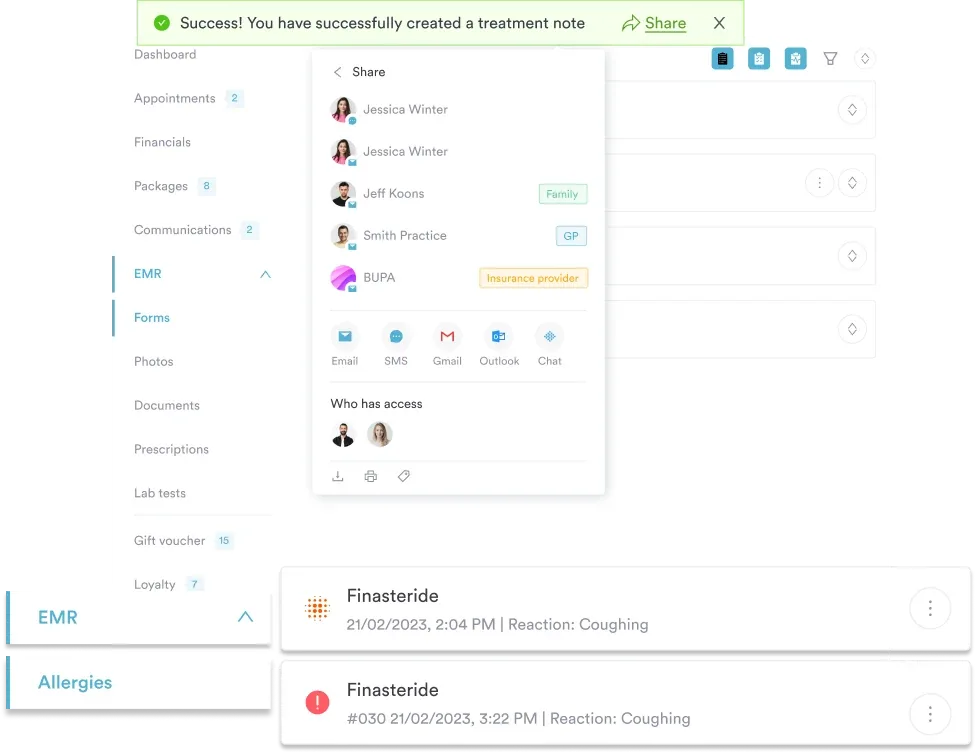
A paper concept map does its job in the classroom, then stops. Practice management software like Pabau keeps the same six fields alive in the patient’s record. Pabau’s automated care workflows let nursing teams log assessment data, diagnoses, interventions, and outcomes as structured entries.
Instead of printing a template for every patient, teams collect subjective and objective data on digital forms at the point of care. The record then shows the ranked diagnoses, the current interventions, and the expected outcomes in one place. Any provider on the case reads the same plan.
Pabau Scribe, our AI scribe, can listen during rounds and draft the note text for those sections. Clinicians review and correct the draft before it is saved, which keeps the wording clinical rather than approximate.
The result is a concept map that behaves like a living care plan. It stays current, takes less time to write up, and reads the same way to whoever picks the patient up next.

Digital forms, automated care workflows, and AI-assisted notes let nursing teams record concept map fields straight into the patient record. Your plan updates as the patient does, without a second write-up.

What makes a concept map worth the time is the rationale column. If you can defend every intervention you listed, the map has done its work. If you cannot, it has just shown you what to go and read.
So download the template, fill it in for one patient, and keep it next to the chart rather than in a folder. Book a demo to see how Pabau holds concept map fields in the patient record, so the plan updates as the patient does.

Want a worked care plan to compare against? Pancreatitis nursing care plan sets out the same diagnoses, interventions and outcomes in linear form.
Need to design better clinical forms? Medical forms and clinical documentation explains how to structure a form so it captures every field you need.
Handing the plan over at shift change? Bedside shift report template gives you a structure for talking through the current plan in a few minutes.
Ready to move the map off paper? Clinical documentation software covers what to look for when notes and care plans live in one record.
A nursing concept map is a diagram that connects patient assessment data, NANDA nursing diagnoses, evidence-based interventions, clinical rationales, and expected outcomes. Drawing those links shows how each part of the care plan supports the patient’s recovery. Nursing programs and practicing teams use it to build critical thinking and plan care for one patient.
Start by collecting and organizing the assessment data, both subjective and objective findings. Then identify the NANDA diagnoses that fit, choose evidence-based interventions for each one, and write the rationale behind every choice. Finish by defining measurable outcomes. At reassessment, record whether each outcome was met and adjust the plan.
Six components: patient assessment data, NANDA nursing diagnoses, nursing interventions, clinical rationales, expected outcomes, and evaluation. All six have to be present and linked to each other. A map missing the rationale field becomes a task list, because nothing on it explains why those interventions were chosen.
A traditional care plan is linear and text-heavy, listing diagnoses and interventions in sequence. A concept map is visual and interconnected, so you can see the assessment data driving the diagnosis and several interventions working toward one outcome. Concept maps teach clinical reasoning better, and both formats are used in practice.
Yes. NCLEX-RN questions test the same joined-up reasoning a concept map requires, connecting assessment findings to diagnoses and then to interventions. Building maps regularly gives you practice at the diagnostic reasoning behind scenario questions, where you have to judge which finding should change your nursing action.
Most often medical-surgical patients with an acute illness or post-operative status, including hypertension, heart failure, pneumonia, and other multi-system presentations. The format is used across every specialty, though, wherever a student needs practice at joining assessment, diagnosis, and intervention for a single patient.
A free, ready-to-fill nursing concept map template is available as a PDF at the top of this page. It suits acute care, long-term care, and nursing school rotations. All six core sections are there: patient data, diagnoses, interventions, rationales, outcomes, and evaluation fields.