Maja Popovska

Panic and agoraphobia scale: Free PDF template & scoring guide
Download your free Panic and Agoraphobia Scale template A two-page form with all...

2
Last Updated: Nov 4, 2026
Free PDF 2 pages, print-ready Clinician-reviewed
CBT activity sheets are structured worksheets a therapist assigns between cognitive behavioral therapy sessions. Each one lets the patient practice a single skill at home. Completed sheets give patient and clinician something concrete to review at the next appointment.
The free download is a two-page behavioral activation sheet for patients with low mood. It combines a weekly activity schedule, a mastery and pleasure log, an activity menu and review questions. Explain each part in session before the patient takes it home.
A two-page behavioral activation worksheet with a weekly activity schedule, a mastery and pleasure log, an activity menu and a weekly review. Patients bring it to the next session.
Start from scratch, or upload this PDF or any form you already use, and Pabau's AI Form rebuilds it with tick boxes, text fields and a signature. Attach it to the treatment once, and every patient gets it on time.
AI Form rebuilds the consent, history and aftercare forms you already use. You review each one, then publish.
Patients complete forms on their phone before they arrive, so the front desk stops retyping paper.
Every signed form is versioned and attached to the treatment record, ready when you need it.
Set how long a consent stays valid. Returning patients skip forms they have already signed.
Supports HIPAA and GDPR compliance AES-256 encryption 4.8 on G2 4.7 on Capterra Trusted by 4,000+ practices worldwide

CBT activity sheets are structured homework worksheets a therapist assigns between sessions, then reviews with the patient at the next visit.
The free download is a two-page behavioral activation sheet with a weekly schedule, a mastery and pleasure log, an activity menu and review questions.
Match the sheet to the phase: monitoring sheets during assessment, behavioral sheets early, cognitive and exposure sheets later, goal sheets for relapse prevention.
Homework completion is linked with better CBT outcomes, so review the sheet at the start of the next session.
Rebuilt as a digital form in Pabau, the practice management system we build, each completed sheet lands in the patient record beside your notes.
CBT activity sheets are structured worksheets that a therapist assigns as homework between cognitive behavioral therapy sessions. Each one practices a single skill, such as scheduling activity, catching an automatic thought or ranking feared situations.
The main types are thought records, behavioral activation schedules, cognitive distortion checklists, mood diaries, exposure hierarchies, SMART goal sheets and social skills practice logs. The free download on this page is a behavioral activation sheet, the most common starting point for patients with low mood.
Each sheet turns a week between sessions into data you can review together. A patient who says the week was “bad” can then show which days dipped, what they did and what they thought at the time.
The download is a two-page sheet that you introduce in session and the patient brings back the following week. Walk through it in the order it is printed, filling in the first entries together.
The footer states that the sheet is for use alongside therapy and is not a treatment on its own. It also lists the 988 Suicide and Crisis Lifeline for US patients in crisis.
The sheet runs on a one-week loop, and each stage of that week uses a different part of the download.
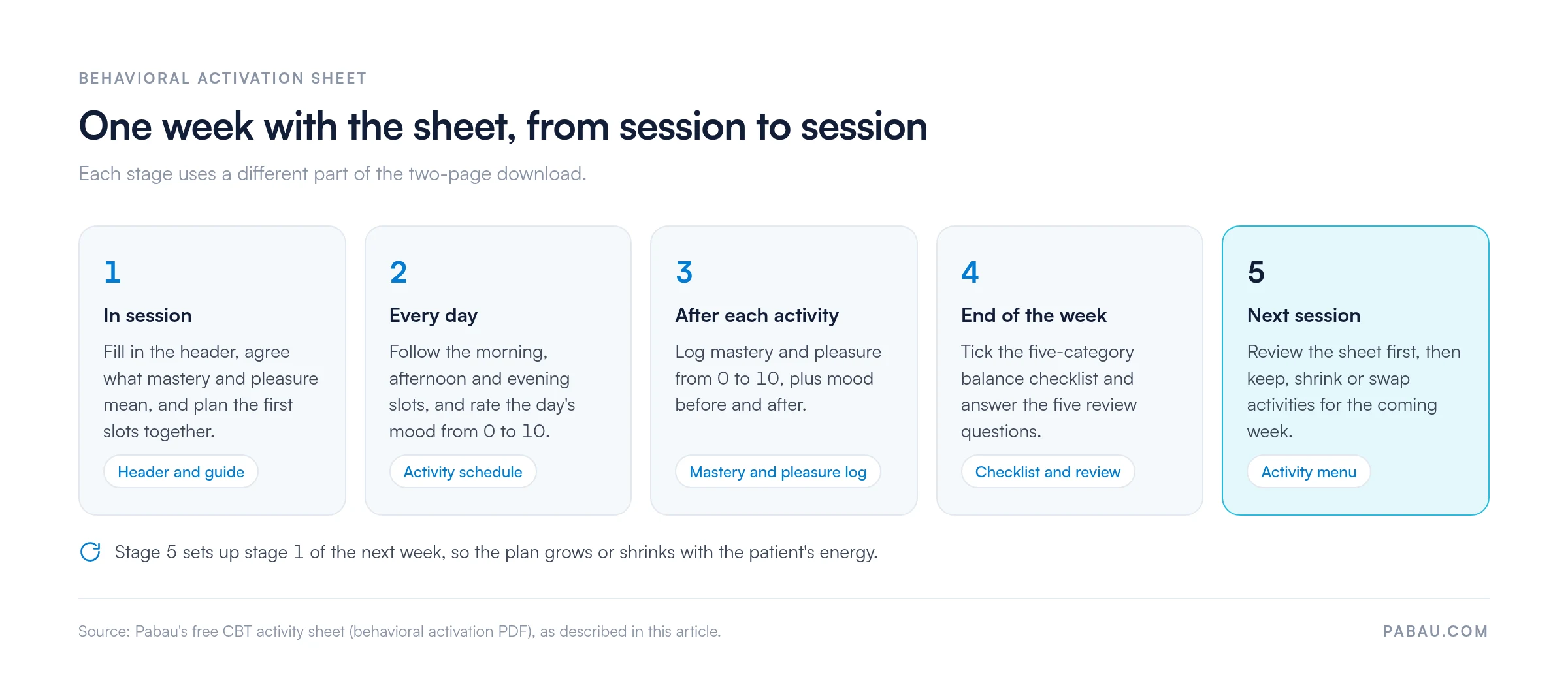
The log is most useful when you read it for patterns rather than single scores. These are the patterns worth raising in session, with a practical adjustment for each.
Worked example: A patient with low mood after a job loss plans three walks and one call to a friend. The log shows two walks rated mastery 4 and pleasure 3, with mood rising from 3 to 4 after each. The call never happened. Next week keeps the walks and swaps the call for a five-minute text message.
Assign the sheet that fits the presenting problem and the phase of treatment. Most free worksheet libraries list sheets by type, which leaves you to decide the order. The matrix below suggests one main sheet per phase for five common presentations.
Read the matrix as a starting point. Your formulation decides the order, and many patients need two sheets running at once. The free sheet in the early phase reflects the order of the download itself, which schedules activity first and lets motivation follow.
Keep to one main sheet per week where you can. A single sheet that the patient completes tells you more than three that come back half-filled.
A thought record is the most widely used CBT activity sheet. It asks the patient to note a situation, the automatic thought it triggered, the emotion and its intensity, and a more balanced alternative thought.
Use it once the patient can notice their thoughts, usually in the middle phase of treatment for depression, worry and social anxiety. It suits patients whose distress is driven by a few recurring predictions or self-judgments.
Walk the patient through it in this order:
Worked example: A colleague does not reply to a message. The automatic thought is “She thinks my work is poor,” with anxiety at 70. The patient notes that she was in meetings all afternoon. The alternative thought, “She is busy and will reply later,” brings anxiety down to 35.
Behavioral activation worksheets help patients who have withdrawn from routine and valued activities. They schedule activity first, then record how it affected mood, mastery and pleasure.
They are the usual first sheet for depression and low mood. The NICE guideline on depression in adults (NG222) lists group and individual behavioral activation among first-line treatment options for less severe depression. It also lists individual behavioral activation as an option for more severe depression.
Worked example: A patient who stopped cooking schedules one simple meal on Tuesday and Friday. Mastery scores 6 and pleasure scores 4, with mood up two points each time. Next week adds a third meal and invites a sibling to one of them.
A cognitive distortions sheet is a checklist of habitual thinking errors, which the patient uses to label their own thoughts. Spotting a pattern comes before trying to challenge it.
Use it early in treatment for worry, panic and low self-esteem, often as a step toward full thought records. Patients who find thought records too demanding can start here.
Introduce two or three distortions per session rather than the whole list. Ask the patient to tick each one they notice during the week, with a one-line example. Worked example: After a short dizzy spell, a patient with panic writes “I am going to collapse” and ticks catastrophizing.
A mood diary, such as a daily mood chart, records emotion ratings across the day, usually on a 0 to 10 scale. Over a week, the pattern shows which situations, times or activities drive low mood or anxiety.
Use it during assessment to set a baseline, and again in later sessions to check progress against it. Ask the patient to rate mood at three fixed points each day, with a short note on what they were doing.
Bring the completed diary to the next session and compare ratings with the activities logged. A vague sense of “bad weeks” becomes specific, workable targets. Worked example: A patient’s diary shows mood at 2 or 3 every Sunday evening. The pattern points to dread about the work week, which becomes the next session’s focus.
An exposure hierarchy is a ranked list of feared situations, from least to most distressing. Patients use it to plan graded exposure, moving up one step only when the previous step feels manageable.
Use it in the middle phase of treatment for panic, social anxiety and specific fears. Build the list together, rating each step for expected distress from 0 to 100.
Repeat each step until the distress rating drops clearly, then move up. Ask the patient to drop safety behaviors during the exposure, such as avoiding eye contact or rehearsing every sentence. The patient records the distress rating before, during and after each attempt.
A SMART goals sheet turns a broad aim into a goal that is specific, measurable, achievable, relevant and time-bound. “Feel less stressed” gives the patient no way to check progress, while a SMART goal does.
Use it at the start of treatment to agree targets, and again in relapse prevention to plan the weeks after therapy ends. Goal sheets sit naturally alongside behavioral activation.
Worked example: “Feel less stressed” becomes “Walk for 20 minutes after work on Monday, Wednesday and Friday for the next four weeks.” Review each goal at the start of every session, noting what was completed and what got in the way.
Social skills worksheets support patients working on assertiveness, conversation practice and role-play. They are used in CBT for social anxiety and in autism-informed CBT, where practicing interactions is part of the plan.
Rehearse the script in session first, then set one practice for the week. Worked example: A patient plans to decline extra weekend shifts with “I can’t take that one, but I can cover Thursday.” The log records the reply they got and their anxiety before and after.
Adult sheets often focus on panic cycles, scheduled worry time and safety behavior logs. Safety behaviors are actions patients take to prevent a feared outcome, and logging them shows how they keep anxiety going.
Adults can usually manage longer sheets and written reflection, so a full thought record is realistic by the middle phase. The free sheet suits adults whose low mood has narrowed their routine. They plan the week ahead, then rate each activity for mastery and pleasure.
Younger patients respond better to simpler formats, such as thought bubbles, feelings thermometers and short social skills prompts. Adapt the language, length and rating scales to the child’s developmental stage.
For a younger child, swap the 0 to 10 scale for three faces, and keep the activity menu to a few pictures. Teens often prefer a shorter activity log they can fill in on a phone. Involve a parent or guardian in reviewing the sheet, and document consent according to local requirements.
Patients complete more homework when the task is set up in session, sized to their energy and reviewed at the start of the next one. That matters for outcomes.
A meta-analysis of 23 studies by Mausbach and colleagues (2010) found a significant link between homework compliance and treatment outcome, a small to medium effect. A 2016 meta-analysis by Kazantzis and colleagues found that both the amount and the quality of homework were related to CBT outcomes.
Introduce each sheet in session and complete the first row together. A patient who has filled in one row with you knows exactly what the rest of the sheet asks for.
Open the next session with the sheet, before any new material. Ask what the patient noticed, then praise the attempt before discussing the content. Reviewing homework early shows that the work between sessions shapes what happens in the room.
Treat an incomplete sheet as information about the task. Ask what got in the way, then change one variable. That might be a smaller task, a different time of day or a phone-friendly format.
If the patient completed part of the sheet, review that part in full. If they did none of it, complete one entry together in the session from memory of the past week.
Paper worksheets travel home in a bag and often come back creased, half-filled or not at all. The therapist then rebuilds the week from memory at the start of the session.
Pabau’s digital forms let your practice rebuild a CBT activity sheet as a form and assign it to the patient record. The patient completes it between sessions, and the finished version lands in their record automatically. You can then read it beside your treatment notes before the patient arrives.
In Pabau’s therapy practice management software, the same record holds appointments, reminders and invoices. A missed session and an unfinished sheet then show up together. Every plan includes the core features, such as forms, patient records and scheduling, and add-ons enhance the experience. New practices start with structured onboarding, so your forms are set up before the first patient uses them.

See how digital forms, treatment notes and scheduling keep each patient’s completed sheets, session notes and appointments in one place.

Choose each sheet by the phase of treatment the patient is in. A patient in early depression needs activity on paper before thoughts, and an anxious patient needs to label distortions before climbing a hierarchy.
Start with the free behavioral activation sheet if your caseload leans toward low mood, and review it at the top of the next session. To see how completed sheets can sit in the patient record beside your notes, book a demo.

Need a structured intake process? Psychiatric Evaluation Template covers a full clinical assessment structure.
Supporting a patient in crisis? Crisis intervention strategies for clinicians outlines safety planning approaches.
Want every core CBT technique on one page? CBT cheat sheet summarizes the main techniques and when each one fits.
Explaining how thoughts drive feelings and actions? The cognitive triangle walks through the model behind most CBT worksheets.
A CBT activity sheet is a structured worksheet that guides a patient through one cognitive behavioral therapy technique between sessions. Common types include thought records, activity schedules, mood diaries and exposure hierarchies. Therapists assign them as homework and review them at the next session.
An activity schedule is a behavioral activation sheet where the patient plans activities across the week, then records what they did. Most versions also capture mood and ratings of mastery and pleasure. It is usually the first sheet used for low mood.
Mastery rates how much a sense of achievement an activity gave, and pleasure rates how much it was enjoyed. Each is usually scored from 0 to 10. Rating both helps patients notice activities that still help, even when low mood flattens enjoyment.
The most common CBT worksheets are thought records, behavioral activation schedules, cognitive distortion checklists and mood diaries. Exposure hierarchies, SMART goal sheets and social skills practice logs are also widely used. Which one to assign depends on the presenting problem and the phase of treatment.
One main worksheet per week is a sensible default, sized to the patient’s current energy. A single sheet that comes back complete gives you more to work with than several that come back half-filled. Add a second sheet only when the first one has become routine.
They are designed for therapist-guided use, where a clinician sets up the sheet and reviews it. People using sheets without a clinician should be pointed to structured self-help resources and monitored for safety. Anyone in crisis in the US can call or text 988.
Yes, with simpler formats and language suited to the child’s age. Feelings thermometers, thought bubbles and picture-based rating scales work well for younger children. Teens often prefer short logs, and a parent or guardian is usually involved in reviewing them.