Getting along with siblings worksheet
A getting along with siblings worksheet is a printable that helps children and t...

1
Last Updated: Oct 23, 2026
A fight or flight response worksheet is a two-page psychoeducation handout that helps a patient map their own stress reaction, from trigger to coping plan. The fight or flight response itself is the body’s automatic reaction to a perceived threat. It’s driven by the sympathetic nervous system and hormones such as adrenaline and cortisol.
Our free PDF takes one stressful episode through six patient sections, then leaves a page for your clinical interpretation. It supports a session conversation and doesn’t replace assessment or treatment.
A two-page worksheet with space for the patient’s triggers, physical, emotional, cognitive and behavioral reactions, and coping strategies. Page two holds the practitioner’s notes and observations.
Download template
The fight or flight response is an acute stress reaction driven by the sympathetic nervous system.
Adrenaline and cortisol are the main hormones released during the response, with norepinephrine also involved.
The worksheet traces one episode through triggers, physical, emotional, cognitive and behavioral reactions, then coping strategies.
It supports psychoeducation in CBT, anxiety and trauma-informed sessions, not diagnosis.
Pabau, the practice management platform we build, includes digital forms in every subscription, so completed worksheets sit alongside patient records.
A fight or flight response worksheet is a psychoeducation handout that walks a patient through one episode of their acute stress response. It captures what set the reaction off and how it showed up in their body, feelings, thoughts and actions.
Clinicians commonly use it in CBT, anxiety and trauma-informed work. It isn’t a diagnostic tool and doesn’t replace a formal assessment. Its job is to make an abstract process concrete enough to discuss.
The term goes back to physiologist Walter Cannon, who described the response in the early 20th century. His later work with Philip Bard became the Cannon-Bard theory of emotion.
The PDF opens with the patient’s name and the date, followed by six prompted sections for the patient to complete:
Page two is for you. The practitioner’s interpretation section holds your notes and observations, so the completed sheet doubles as a session record.
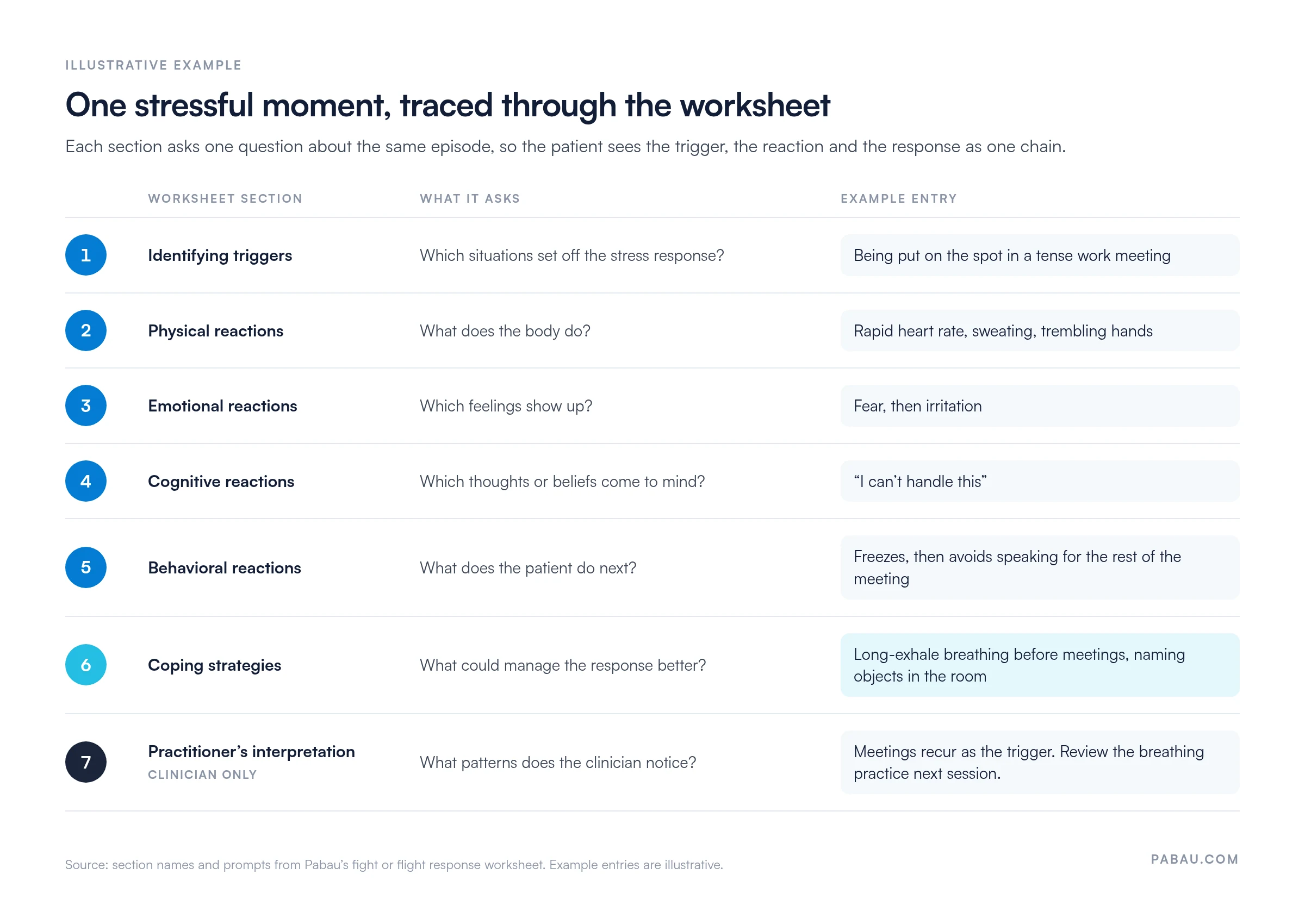
The sections follow the order of the response itself, so you can work through them top to bottom in one sitting:
Here is how a single episode might look once every section is filled in.
For children and young people, simplify the language and use the worksheet alongside age-appropriate activities. Apply your own professional supervision standards, particularly where a patient has a diagnosed trauma or PTSD presentation.
The physical symptoms of fight or flight include a faster heart rate, rapid breathing, muscle tension, sweating and a dry mouth. These signs come from sympathetic nervous system activation, which prepares the body for immediate action.
Patients often describe these signs without linking them to stress. The physical reactions section helps them connect a bodily sensation to a known process, which can make it feel less alarming.
Some patients struggle to put a name to what they feel. A body sensations template can build that vocabulary before you start on the worksheet.
A common example is a driver who brakes suddenly to avoid a collision and feels their heart pound for several minutes afterward. Another is a person who freezes during a tense work meeting, then struggles to concentrate for the rest of the day.
These examples help patients see that the response is normal and adaptive in the moment. The clinical question is whether it fires too often, or lasts too long, to be helpful. A window of tolerance worksheet helps a patient see where that line sits for them.
The sympathetic nervous system drives the activation phase of the fight or flight response. The parasympathetic nervous system supports recovery, slowing the heart and letting the body settle once the perceived threat has passed.
If you work from polyvagal theory, the polyvagal ladder gives patients a visual way to track the shift from activation back to calm.
Adrenaline (epinephrine) and cortisol are the primary hormones released during the fight or flight response. Norepinephrine also takes part, acting alongside adrenaline to raise alertness and heart output.
Keep hormonal explanations at the level the patient needs. Detailed endocrine mechanisms belong in clinical reference material rather than a patient handout.
Regulation strategies work best when a patient practices them before they’re under pressure. Breathing exercises that lengthen the exhale are commonly used because they engage the parasympathetic system. A breathing exercises handout gives patients a script to follow at home.
Grounding techniques, such as naming objects in the room, redirect attention to the present. A grounding worksheet helps patients choose the techniques that suit them.
Whatever goes into the coping strategies section becomes a short practice plan. The patient tries one strategy between sessions and reports back on what changed.
Handing out a PDF is simple. Tracking what was shared, and linking the completed sheet to the patient’s notes, is harder. Practices that run worksheets across several clinicians often lose track of who received which resource.
Pabau’s digital forms, included in every subscription, let practices store and share worksheets alongside patient records. You can rebuild this worksheet as a form, send it before the session, and find the answers in the patient’s Client records afterward.
Because each completed sheet stays on file, you can compare triggers and coping strategies across sessions instead of hunting through paper folders. Our therapy practice management software also handles the scheduling, notes and billing around those sessions.

Send worksheets as digital forms and file every completed sheet against the patient record, so session patterns are easy to review.

Start with one recent episode rather than a general discussion of stress. A single, specific moment gives the patient something concrete to recognize the next time their heart starts racing.
The value builds over time. A pile of completed sheets shows which triggers keep returning and which coping strategies hold up, and that’s where your interpretation earns its place.
Book a demo to see how Pabau keeps every completed worksheet on the patient record, ready for the next session.

Want a broader look at stress? Stress worksheet helps patients review their stressors beyond a single fight or flight episode.
Need a handout on anxiety itself? Anxiety fact sheet covers symptoms, causes and treatment in patient-friendly language.
Looking for a coping script to use in session? Mindful breathing script gives you wording for a guided breathing exercise.
Seeing signs of a trauma response? Trauma response test offers a structured way to explore them with the patient.
The fight or flight response is the body’s automatic acute stress reaction, driven by the sympathetic nervous system and the hormones adrenaline and cortisol. It prepares the body to respond quickly to a perceived threat.
Fight or flight is driven by the sympathetic nervous system. The parasympathetic nervous system supports recovery once the threat has passed.
Yes, with simplified language and clinician supervision. Clinicians should apply their own professional standards, especially where a child has a diagnosed trauma or PTSD presentation.