Co-parenting agreement
A co-parenting agreement is a written plan that separated or divorced parents us...

1
Last Updated: Oct 15, 2026
A trauma response test is a structured screening questionnaire that helps clinicians identify how a patient responds to traumatic experiences. It flags who may need a fuller assessment, but it cannot diagnose PTSD, so results need clinical interpretation before any conclusion is drawn.
The free template below lists 20 stress-related problems, each rated from 0 to 4 for the past month. A consistent tool like this catches patterns that an unstructured intake conversation can miss, and it gives you a score to compare at every review.
Download it below, then use the guidance that follows to administer it, score it and act on the results.
A printable questionnaire with a patient details section and 20 stress-related problems. Patients rate how much each one bothered them in the past month, from 0 (not at all) to 4 (extremely).
Download template
A trauma response test screens how patients react to trauma and flags who needs a fuller assessment.
Responses commonly grouped as fight, flight, freeze and fawn guide what clinicians observe.
ACE scores measure childhood adversity exposure and do not, on their own, predict PTSD.
Results need clinical interpretation and documented follow-up before any treatment decision.
Practice software such as Pabau can send the screening before the first session and store it in the patient record.
A trauma response test is a screening questionnaire that records how a person responds to traumatic experiences, including symptoms, coping strategies and behavior. It supports clinical assessment but does not confirm a diagnosis of PTSD or any trauma disorder.
Clinicians use these tools to structure the first conversation about trauma, to track change over time and to decide whether a fuller assessment is needed. The National Center for PTSD, part of the US Department of Veterans Affairs, publishes free resources on validated trauma measures. Its PTSD self-screen is a useful reference point.
The fight, flight, freeze and fawn framework describes four common patterns of survival response. Each pattern carries behavioral indicators that clinicians can note during screening and intake.
Most people show more than one pattern, and the dominant response can shift with context. Use the framework to choose follow-up questions, and avoid assigning a single label at intake.
Screening works best when it sits inside a clear clinical workflow. The five steps below take you from explaining the questionnaire to recording the follow-up plan.
Trauma-informed practice means giving patients control over what they share and when. Keep the tone collaborative, and avoid implying that the questionnaire reveals more than it does. Our trauma-informed care cheat sheet sums up these principles for front desk and clinical staff.
The Adverse Childhood Experiences (ACE) questionnaire asks about ten categories of childhood adversity, and an ACE score counts how many categories a person reports. It came out of the CDC and Kaiser Permanente study. The CDC still publishes guidance on its use in its overview of adverse childhood experiences.
A higher ACE score is associated with greater risk of later health and mental health problems across populations. It does not determine any individual outcome, and resilience factors such as supportive relationships can meaningfully change the picture.
Several validated instruments sit alongside a general trauma response questionnaire. The Brief Trauma Questionnaire, for example, is available through the National Center for PTSD and screens for exposure to a range of traumatic events.
Where you need to separate PTSD from complex PTSD under ICD-11, the International Trauma Questionnaire is a short self-report option.
Check the publisher’s administration notes before use, since scoring rules and population focus differ between instruments. Where a tool is not validated for your patient group, say so in your records.
Read the total alongside the clinical interview and the patient’s history. A high score is a reason for further assessment, and it never confirms a diagnosis by itself.
The 20 items on this template follow the wording of the PCL-5, so you can add the ratings for a total between 0 and 80. The VA National Center for PTSD reports that a PCL-5 total of 31 to 33 indicates probable PTSD across samples. A structured clinical interview remains the standard for diagnosis.
Communicate results in plain language, and explain what the next step will be. Good documentation records both the score and your reasoning.
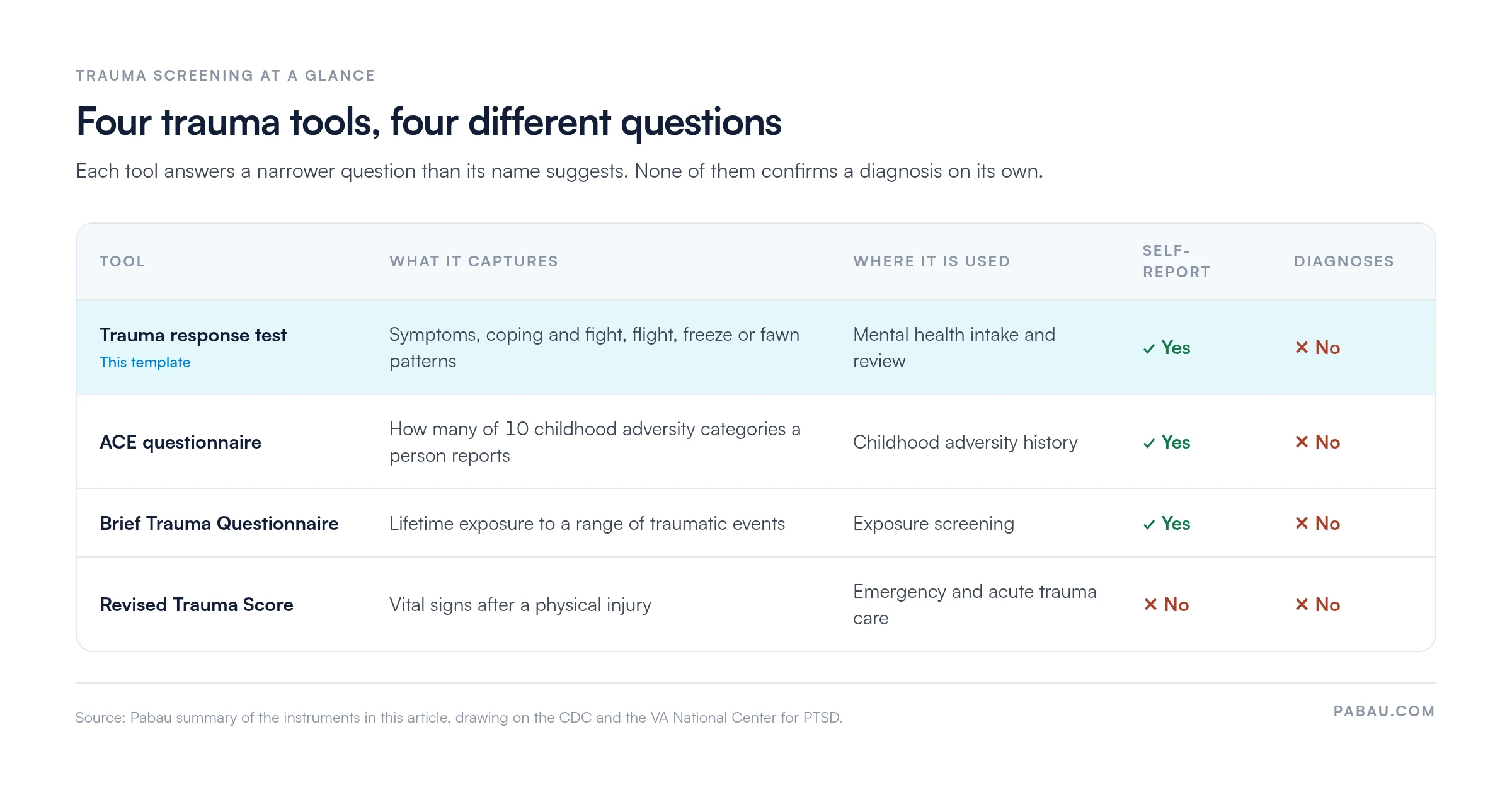
The Revised Trauma Score is a physiological scoring tool used in emergency and acute trauma care, based on vital signs. Because it measures physiology rather than symptoms, it cannot stand in for a trauma response questionnaire in outpatient mental health settings.
Self-report tools suit ongoing mental health assessment, while physiological scores guide immediate medical triage. Knowing which applies prevents mismatched expectations in the record. The comparison below sets the four tools in this guide side by side, and none of them confirms a diagnosis alone.
Clinicians often screen for dissociation and trauma bonding alongside trauma response. Both can appear in the same patient, and neither should be treated as a pathology in itself without careful assessment.
Frame these questions as part of a broader picture. Normal responses to stress are common, and a screening result is one input among many. When dissociation comes up, the Dissociative Experiences Scale gives you a structured follow-up measure.
The PDF opens with a patient details section covering name, date of birth, contact details and consultation date. It then lists the 20 problems, each with a 0 to 4 rating scale.
The form has no space for clinician notes, so record your observations, the total score and the follow-up decision in the patient’s record. Print it for in-room use, or rebuild it as a digital form so patients can complete it before the session.
Audit your screening forms every six months. Remove questions your team never reviews, and add a line on how results feed into follow-up care. Short, purposeful forms get completed more consistently.
Many practices still run trauma screening on paper. The patient completes the form in the waiting room, someone scans it, and the clinician’s observations end up in a separate note.
Pabau’s patient intake software sends the questionnaire before the first session, so patients answer in private and at their own pace. With Care Pathways, the completed form flows into the patient record automatically.
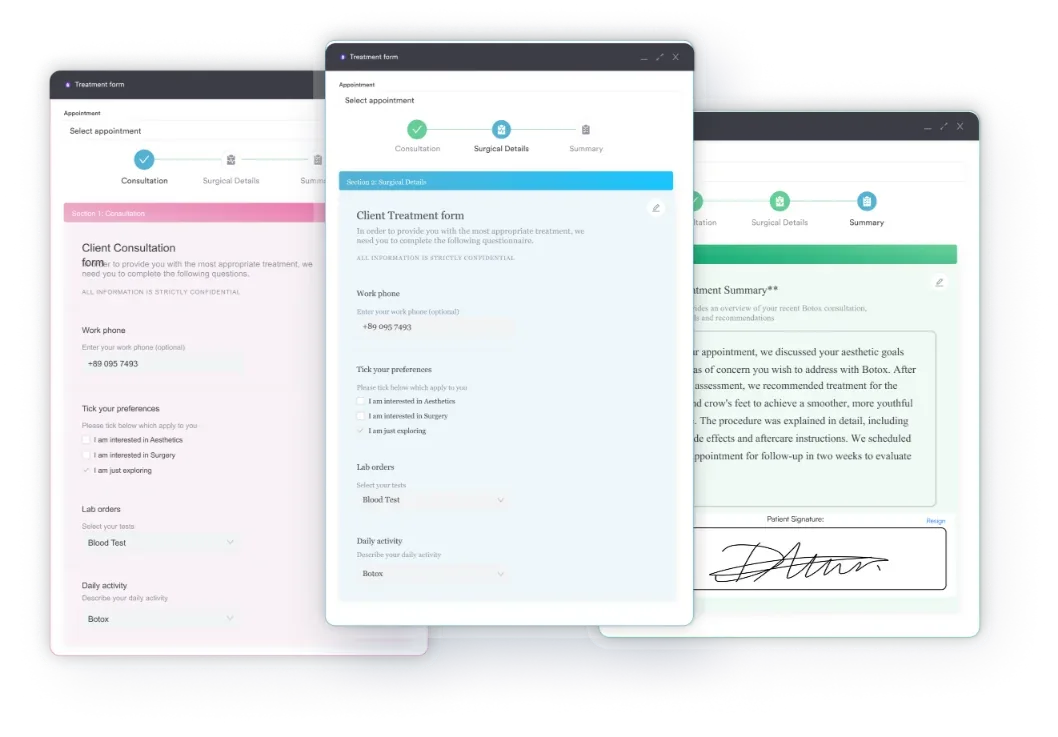
Practices that want more structure around clinical notes can use Pabau’s mental health EMR software, designed for therapy and psychiatry workflows. It sits inside one system for running your therapy practice, alongside scheduling and billing.

Book a demo to see how Pabau stores forms, notes and follow-up tasks in one place for your team.

Decide your follow-up rules before the first patient fills in the template. Agree which totals or answers trigger a fuller assessment, a referral or a review date, and write them down.
That turns a one-off questionnaire into a record you can compare across sessions and staff. The cost is review time, because a screening nobody reads adds paperwork without improving care.
Book a demo to see how Pabau sends trauma screenings before the first session and keeps each result next to the follow-up plan.

Need a fuller first-visit intake? Psychiatry intake form gives you a structured first-visit intake to pair with trauma screening.
Writing up the session afterward? SOAP note for mental health structures the note that records your screening findings and plan.
Documenting presentation during the interview? Mental status exam template helps you record appearance, mood and thought content alongside the screening.
Moving from screening to treatment? ABCDE journal PTSD worksheet gives patients a structured way to work through trauma-related thoughts between sessions.
A trauma response test is a screening questionnaire that records how a person responds to traumatic experiences. It is a screening aid and does not confirm a PTSD or trauma disorder diagnosis.
No, a trauma response test is a screening tool, while PTSD is diagnosed through a clinical assessment against DSM-5 criteria. Screening results can prompt a fuller evaluation.
The Pabau Trauma Response Test template is free to download. Some validated instruments are also free, such as the VA National Center for PTSD self-screen.
Clinicians read scores alongside the interview and clinical context, then document referral and follow-up decisions. A score alone does not establish a diagnosis.