Antipsychotic medication list
An antipsychotic medication list is a structured reference that organizes psychi...

2
Last Updated: Oct 13, 2026

The template records bedtime, wake time, night awakenings, naps, caffeine, alcohol, medication timing, and a morning quality rating.
Patients complete it each morning for two weeks before the diagnostic or CBT-I planning appointment.
Those entries give you sleep efficiency, and anything under 85% points toward sleep restriction therapy.
Paper suits the first two weeks, while a digital form adds morning reminders and entries that land in the chart.
A diary is only worth assigning if it comes back, so hand it out at booking and collect it before the follow-up.
Daily rows for bedtime, wake time, sleep quality, naps, caffeine and alcohol intake, medications, and mood. The template also carries the four computed metrics: sleep onset latency, wake after sleep onset, total sleep time, and sleep efficiency.
Download templateA sleep diary is a daily record of when a patient slept, how long they slept, and what they did in the hours before bed. Download the printable sleep diary above, hand it over at the first appointment, and you have two weeks of usable data by the follow-up.
Below you will find what each field is for and how to turn two weeks of entries into a sleep efficiency figure. You also get the thresholds that decide your next step. The last section covers the part that decides whether any of it happens, which is getting the completed diary back.
A sleep diary is a structured daily log of sleep, completed each morning over two weeks. Clinicians use it to assess insomnia, circadian rhythm problems, and daytime sleepiness before committing to a treatment plan.
The point of a morning entry is that recall decays fast. Ask a patient on Thursday how long they slept the previous Saturday. What comes back is an average of their beliefs about their sleep.
Sleep medicine specialists, primary care physicians, therapists, and nurses all use the same instrument. It also sits inside mental health EMR software and client record management systems, where entries are read alongside the rest of the patient’s file. Many practices file it as one input into the wider biopsychosocial assessment, alongside the psychological and social history.
Every field earns its place by changing a clinical decision. The table below pairs each entry with the reason it is on the page. That makes the form easy to explain to a patient in under a minute.
Five numbers come out of the raw times, and each one maps to a different treatment decision. The final column is the part most reference tables leave out.
Average the five numbers across the whole two weeks rather than reading single nights. One bad Tuesday tells you nothing, whereas a two-week mean of 68% efficiency tells you exactly where to start.
Complete the entry within an hour of waking, before coffee and before email. Accuracy falls away through the day, and a diary filled in at lunchtime is closer to a memory test than a record. Morning completion also supports patient compliance with the rest of the treatment plan.
A worked example. A patient logs a 23:00 bedtime and a 07:00 wake-up, so time in bed is 8 hours, or 480 minutes. They estimate 45 minutes to fall asleep and 75 minutes awake in the night.
Total sleep time is 480 minus 45 minus 75, which is 360 minutes, or 6 hours. Sleep efficiency is 360 divided by 480, multiplied by 100, giving 75%.
Benchmarked against the 85% threshold, 75% means this patient lies in bed awake for two hours every night. A standard sleep restriction step sets the sleep window close to actual sleep time, with a floor of five hours. The window then widens in 15-minute increments once efficiency holds above 85% for a week.
Cognitive behavioral therapy for insomnia (CBT-I) is the first-line treatment for chronic insomnia, and the diary is what makes it personal to the patient. Therapists often call the completed form the CBT-I sleep diary. It sets the sleep window, tracks the response, and decides when to widen the window again.
The Consensus Sleep Diary (CSD) is the standard because a panel of insomnia researchers agreed on one fixed field set. Carney and colleagues published it in the journal SLEEP in 2012. Fixed fields mean two clinicians reading the same diary calculate the same numbers.
Informal logs drift. They record bedtime and wake time, then skip sleep onset latency or lump night awakenings into a single tick box. Both omissions remove the figures CBT-I actually runs on.
A consensus sleep diary app is simply a phone version of those same fields. CBT-i Coach, the free app from the US Department of Veterans Affairs, is the best-known example. Several practice systems now build the same variables into digital intake forms. Check the field list before you recommend one, because plenty of sleep apps track a different set entirely.
A diary is worth assigning only if it comes back filled in. The steps below build the hand-off into appointments your practice already runs, instead of leaving it as homework nobody follows up. The same hand-off routine works for other structured logs, such as an ADHD symptom tracker for younger patients.
Walking into the room with efficiency already calculated changes the opening line. Instead of asking how their sleep has been, you can tell them that 75% of their time in bed is sleep. Then you set out the plan. Clinics carrying a heavy admin load and watching for clinician burnout feel that difference most.
When a diary comes back with only three nights logged, resist restarting the two weeks. Three nights plus two minutes of questions about the missing ones is usually enough to tell whether the problem is onset, maintenance, or schedule. Restarting mostly buys another two weeks of the same partial data.
Use paper for the first two weeks and digital for everything after that. A printed sleep diary PDF needs no login, so the patient can start the night you hand it over. Once treatment starts and you need weekly comparisons, a digital form stops the manual re-keying.
That third row is the one worth explaining to patients. A wearable will happily contradict the diary, and the honest answer is that CBT-I targets perceived sleep, which the device cannot see.
Free paper versions are easy to find. The Sleep Foundation sleep diary and the versions published by academic sleep centers all cover the same core fields. Practices running psychology practice software usually move patients onto a digital form once the baseline two weeks is done.
A sleep log that records only times will tell you which nights were bad. It will not tell you why. Six behavioral fields turn the same page into something you can act on inside a ten-minute review.
Published templates handle this section differently. An AASM sleep diary keeps the behavioral fields tight and clinical. A printable sleep journal written for consumers usually leaves free-text room for the day’s events. Our printable sleep log sits between the two, with fixed fields plus one comment line per night.
Two weeks is the convention for a practical reason. A 2 week sleep diary covers both weekdays and weekends, so a Sunday-night bedtime drift reads as a pattern rather than an off night. One week hides exactly the variability you are looking for.
Reviewing the hygiene entries alongside the metrics also sharpens the counseling. Moving a caffeine cutoff to noon, or taking the television out of the bedroom, often shows up in the numbers within a week.
Refer to a sleep specialist when the diary shows breathing symptoms, leg movements, or insomnia that four weeks of CBT-I has not moved. Those referrals hold up because the diary carries two weeks of dated evidence rather than an impression.
Most practices hand out the diary on paper and hope. Reception prints it and the patient takes it home. Two weeks later it either arrives creased in a bag or it does not arrive at all. Whoever sees the patient then spends consultation time typing the numbers in.
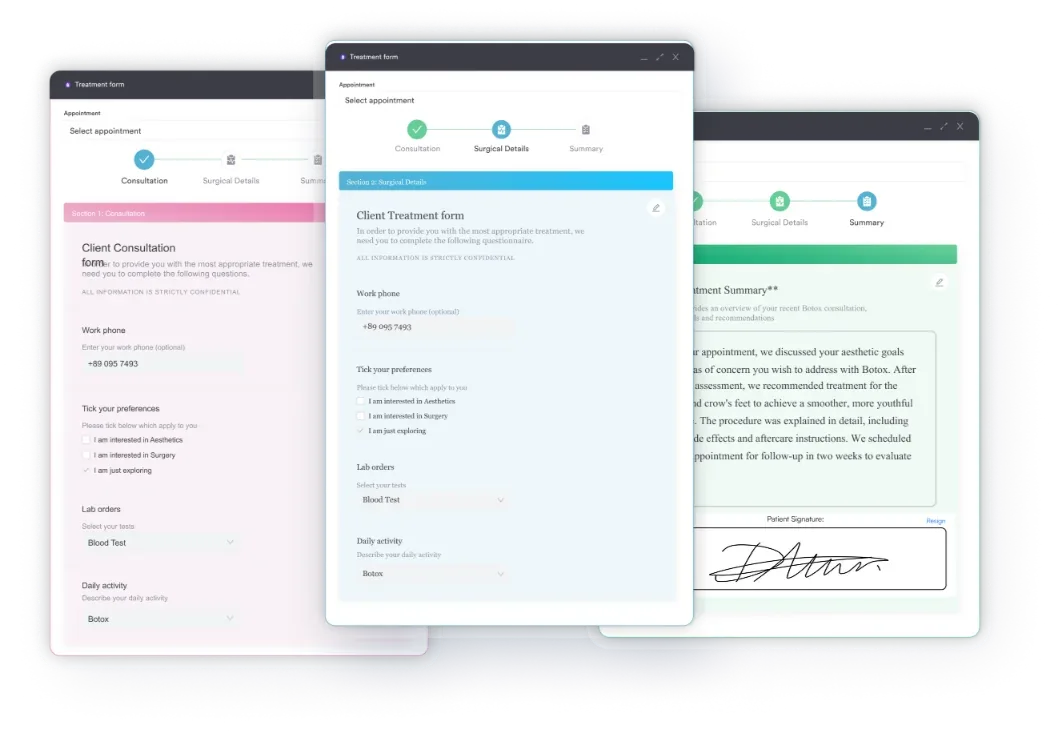
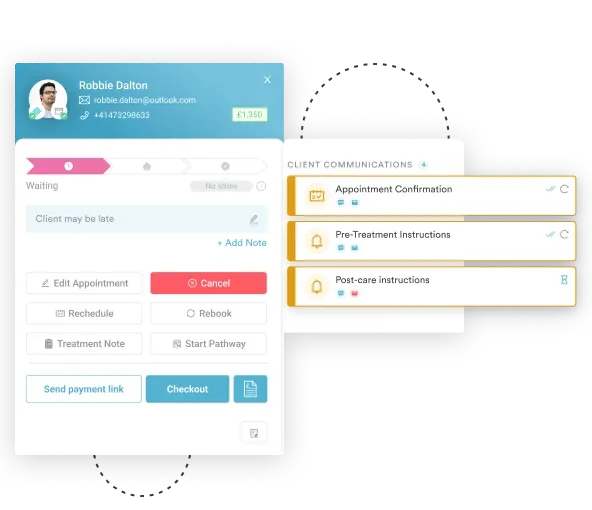
Practice management software like Pabau closes that loop. The diary goes out as a digital form attached to the appointment. It reaches the patient with the booking confirmation rather than at the end of the visit.
An automated workflow then sends the morning prompt by SMS or email for the full two weeks. Completed entries land in the client record, so the clinician opens the two-week picture in the chart before the patient sits down.
Notes made during the review sit against the same record. Pabau Scribe, our AI scribe, can draft the write-up while you talk the patient through the numbers. The outcome is a follow-up spent on the treatment plan instead of on data entry.

Pabau sends the diary as a digital form, prompts the patient every morning, and files each entry in their record. Your clinician opens a full two-week picture in the chart instead of chasing paper at the door.

Download the template, hand it out at booking rather than at the door, and treat the return date as part of the appointment. That single change does more for your data quality than any redesign of the form itself.
The trade-off worth remembering is that a diary measures perception, not physiology. That is a feature when you are running CBT-I, and a limitation the moment breathing symptoms appear. Read it for patterns and thresholds, then refer when the pattern points somewhere a diary cannot go.
Once the diary is coming back reliably, the remaining work is administrative. Book a demo to see how Pabau assigns sleep diaries, chases completion, and files the entries in the patient’s record.

Need something to hand the patient after you read the diary? Sleep hygiene handout sets out the wind-down changes worth trying before anything else.
Ready to start structured CBT-I? CBT for sleep worksheet gives the patient the thought records that run alongside the diary.
Want a severity score next to the diary? Insomnia Severity Index is a seven-item scale with cutoffs you can repeat at every review.
Need a one-month view of sleep quality? Pittsburgh Sleep Quality Index scores seven components from a single questionnaire.
Supporting a client managing bipolar disorder? bipolar workbook offers mood tracking charts, CBT-based worksheets, and relapse prevention planning for bipolar disorder.
A sleep diary is a daily record of bedtime, wake time, night awakenings, naps, caffeine, alcohol, medication, and sleep quality. Fill it in within an hour of waking, every day for two weeks before the appointment. Morning entries are far more accurate than recall at the visit.
Two weeks is the standard before a diagnostic or CBT-I planning appointment. Two weeks covers both weekdays and weekends, so schedule drift shows up as a pattern. If you are tracking treatment response, keep going for the full course of therapy, usually eight to twelve weeks.
No, a diary cannot diagnose sleep apnea, but it does flag who needs testing. Entries such as loud snoring, waking gasping, or morning headaches after eight hours in bed justify a referral. The diagnosis itself requires overnight polysomnography.
Sleep efficiency is total sleep time divided by time in bed, multiplied by 100. A patient in bed eight hours who sleeps six has an efficiency of 75%. At or above 85% is typical, and below 85% points toward sleep restriction therapy.
Yes. The Consensus Sleep Diary uses a fixed field set agreed by insomnia researchers, so two clinicians reading it calculate the same numbers. Informal logs often skip sleep onset latency and wake after sleep onset. Those are the two figures CBT-I depends on.
Yes, provided the app records the same fields as the paper version. Apps add morning reminders and calculate the metrics for you, which lifts completion rates. Check that entries can be exported or shared securely before recommending one to a patient.
Slightly. A teen version keeps the same core fields but adds school start time, weekend catch-up sleep, and evening screen use. Adolescents commonly run a delayed body clock. A two-week log covering weekdays and weekends is what separates a schedule problem from insomnia.