Anja Dodevska
Ethical consent form: free template and what to add
An ethical consent form is a written record that a patient or participant agreed...

2
Last Updated: Oct 26, 2026
Free PDF 2 pages, print-ready Clinician-reviewed
A spouse consent form is a signed document that lets a patient’s spouse see their medical records, receive updates, or help with care decisions. HIPAA gives a spouse no automatic right to that information, so the signed form is what lets your practice share it.
Most medical uses need only the patient’s signature, with no notary. Retirement plan waivers under federal law are the exception, and patients sometimes bring those in too. Download the free template below, adapt it to your practice, and collect it at intake.
A ready-to-use form with sections for patient and spouse details, the scope of spousal authorization, consent declarations, witness signatures, and a legal compliance block.
Start from scratch, or upload this PDF or any form you already use, and Pabau's AI Form rebuilds it with tick boxes, text fields and a signature. Attach it to the treatment once, and every patient gets it on time.
AI Form rebuilds the consent, history and aftercare forms you already use. You review each one, then publish.
Patients complete forms on their phone before they arrive, so the front desk stops retyping paper.
Every signed form is versioned and attached to the treatment record, ready when you need it.
Set how long a consent stays valid. Returning patients skip forms they have already signed.
Supports HIPAA and GDPR compliance AES-256 encryption 4.8 on G2 4.7 on Capterra Trusted by 4,000+ practices worldwide

A spouse consent form is the patient’s written permission for their spouse to see records or help with care decisions.
HIPAA gives spouses no automatic right to a partner’s records, so copies or ongoing access need the patient’s signed authorization.
Medical uses rarely need a notary, while ERISA retirement-plan waivers need a notary public or plan representative as witness.
Filing the signed form on the patient record means staff can confirm a spouse’s access in seconds when they call.
A spouse consent form is a patient’s written permission for their spouse to access their health information or act on their behalf. It records exactly what the spouse may see or do, for how long, and when the patient signed.
Unlike a general treatment consent form, which covers the patient’s own care, this form names a second person. Many practices ask the spouse to countersign as well. That signature doesn’t create the permission, but it shows the spouse understood the limits of their access.
The reason a spouse is asking decides which form you need and who has to sign it. These are the situations practices run into most often.
Under HIPAA, the patient controls their own health information. HIPAA does not automatically grant spouses access, so being married gives a partner no right to clinical notes, test results, or treatment history.
The rule does leave some room. A provider may share information relevant to a spouse’s involvement in care, such as during a consultation, if the patient doesn’t object. Copies of records and ongoing access are different, and they need a signed HIPAA authorization form or a legal power of attorney.
Treat a spouse’s request like any other third-party request. Before releasing anything, staff should find the patient’s signed authorization and check its scope, for example “records from the past 12 months only”.
Each field below closes off a question someone could raise later. Use our medical form best practices as a reference alongside this list.
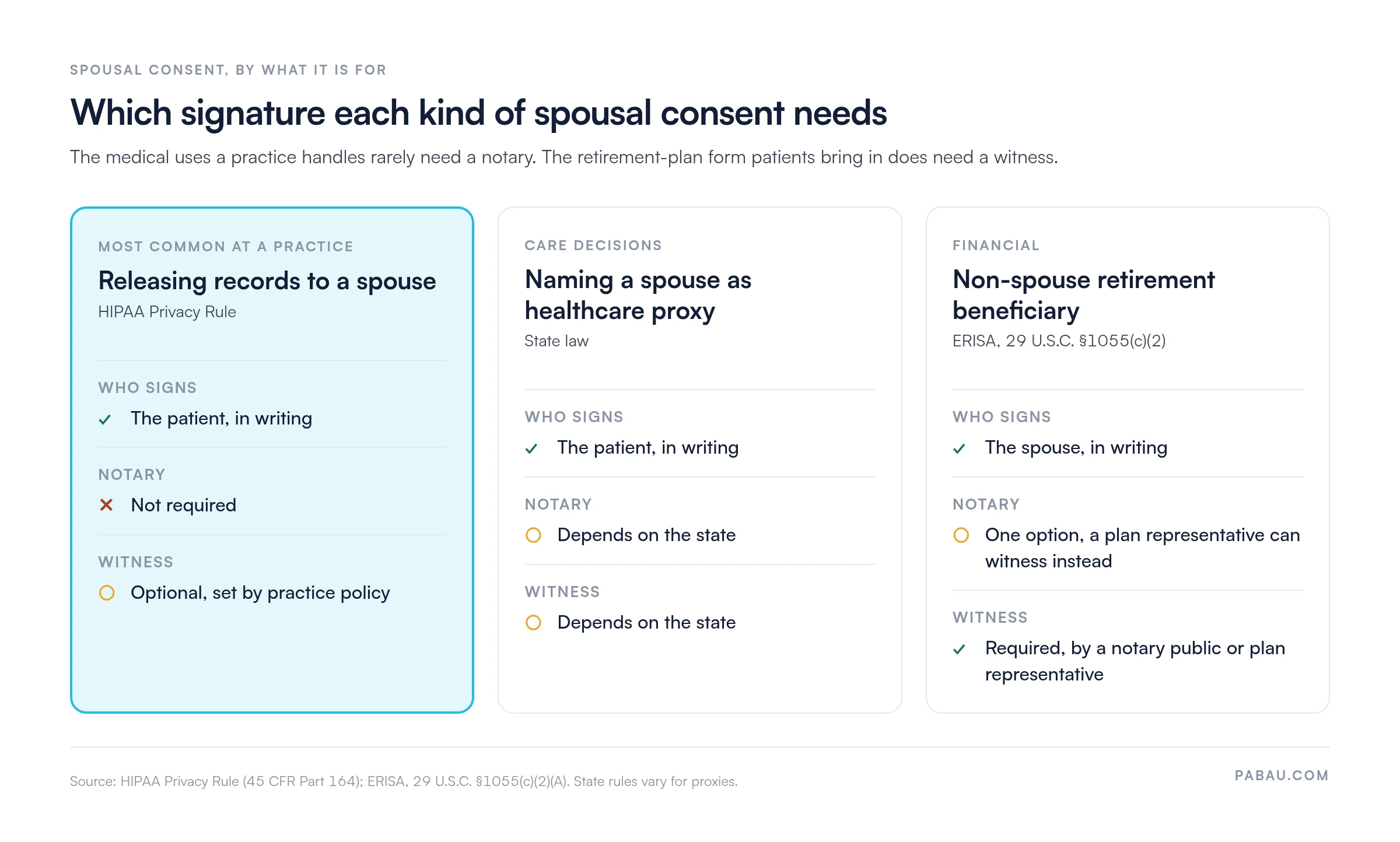
Usually not, but it depends on what the form is for. For releasing medical records under HIPAA, notarization isn’t required, and the patient’s signature is enough.
Retirement plan beneficiary changes work differently. Under ERISA, federal law requires written spousal consent, witnessed by a notary public or a plan representative. Banks and other financial institutions often ask for notarization on documents about assets or inheritance.
The comparison below shows which signature each kind of spousal consent needs.
Including a notary block on your form costs nothing, even if you rarely use it. If a state rule or an outside institution asks for notarization later, the patient won’t have to sign a new form.
Med spas, aesthetic practices, and dermatology practices often ask for spousal acknowledgment before laser treatments, injectables, or cosmetic surgery. It documents that both partners understand the risks, costs, and recovery time.
Family medicine practices use the form so a spouse can get information during a hospital stay. Mental health providers may use it to let a spouse handle prescription refills or hear about therapy progress. Integrative medicine, IV therapy, and regenerative medicine practices use it to coordinate care within a family.
Compliance and legal protection: A signed form shows the patient authorized the disclosure. If a complaint or audit follows, you can show exactly what the patient agreed to and when.
Faster answers for families: When the form is already on file, staff can answer a spouse’s call straight away. Nobody has to chase the patient for permission first.
Clear limits for spouses: A structured form spells out what the spouse can and can’t see. That reduces misunderstandings and disputes after treatment.
Audit readiness: Digital consent records carry a timestamp, which gives inspectors a clear trail. Paper forms can be misfiled, while a digital copy stays attached to the patient record.
Store signed spouse consent forms where only authorized staff can open them, such as the patient record in your practice software. Review who has access at least once a year, and check access logs regularly so you can show an auditor who viewed each form.
Practices that collect spousal consent on paper end up printing, signing, scanning, and filing every form by hand. Originals get misplaced, and nobody can quickly prove when a form was signed.
In Pabau, the practice management platform we build, the consent form goes to the patient as a secure link before the visit. The patient signs on their own phone, and the signed copy is timestamped and saved to their record. Compliance management tools then keep that record ready for an inspection.
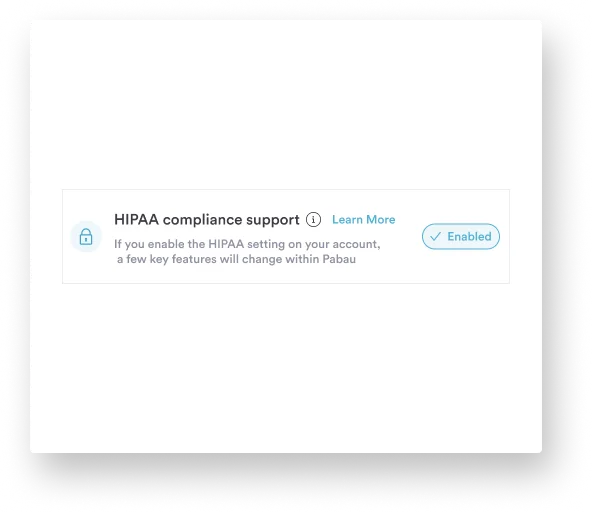
Forms are built once and reused for every patient. Automated form collection sends them with the booking confirmation, so the signed consent is on file before the spouse ever calls.
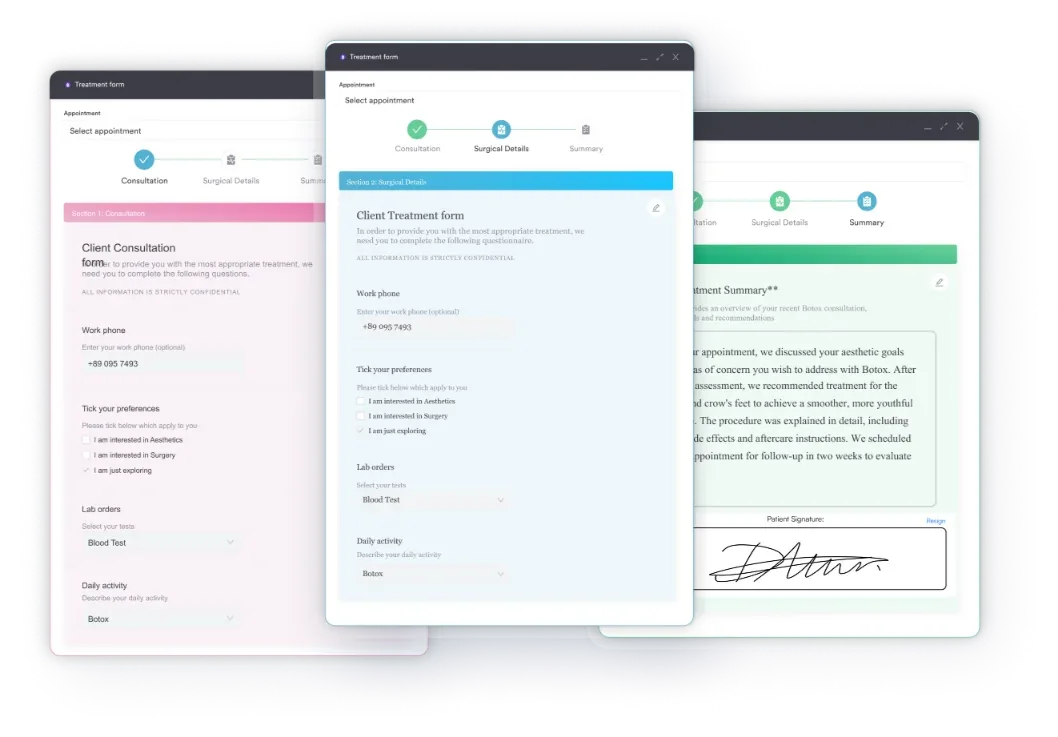

Pabau sends the consent form before the visit and files the signed copy on the patient record. Staff can confirm a spouse’s access in seconds.

For most practices, spousal consent is a records question, not a notary question. Get the patient’s signature on a form with a clear scope and an end date, and you can answer a spouse’s call with confidence.
Keep a notary block on the form for the rare case that needs one, and send retirement-plan waivers back to the plan administrator. The habit that matters most is checking the signed scope before anyone shares anything.
Book a demo to see how Pabau collects spousal consent before the visit and keeps it one click away on the patient record.

Releasing records to someone other than a spouse? Medical release form covers HIPAA’s required elements for any third-party disclosure.
Sharing therapy or counseling notes? Authorization for release of confidential information handles disclosures that need tighter limits than general records.
Planning for care if the patient can’t speak for themselves? Medical directive form records the patient’s treatment wishes alongside the proxy they name.
Need consent for the treatment itself? Medical consent form for adults documents informed consent before a procedure goes ahead.
A spouse consent form is a signed authorization that lets a patient’s spouse see their records or help with care decisions. Practices keep it on file so they can share information without breaching HIPAA.
You need one when a spouse asks for copies of records or ongoing updates, or when a patient wants their spouse to act for them. Some practices also ask for it before elective procedures.
For releasing medical records under HIPAA, no notary is needed, and the patient’s signature is enough. Retirement plan waivers under ERISA need the spouse’s written consent, witnessed by a notary public or a plan representative. State law can add requirements, so a notary block on the form is a sensible safeguard.
Include the patient’s name and date of birth, the spouse’s name and contact details, and the scope of access. Add an expiration date or event, the patient’s signature and date, and a revocation statement. A spouse acknowledgment and witness block are optional extras.
Yes. The patient can revoke the authorization in writing at any time. Revocation stops future disclosures but does not undo information the practice already shared while the form was valid. Record the revocation date on the patient record so staff stop releasing information.
HIPAA gives a spouse no automatic right to a partner’s records. A provider may share information relevant to a spouse’s involvement in care if the patient doesn’t object. Copies of records or wider access need the patient’s written authorization.