Getting along with siblings worksheet
A getting along with siblings worksheet is a printable that helps children and t...

3
Last Updated: Oct 23, 2026

The downloadable journal entry prompts template is a blank one-page clinical log, not a library of pre-written prompts.
Each entry records the date and time, the situation or trigger, an intensity rating from 0 to 10, and the action taken.
Two open fields at the foot of the form capture patterns noticed over the period and questions for the next appointment.
The sample prompts on this page are article content, so you choose which one to assign and record the response in the log.
Practice management software like Pabau holds completed logs in the client record, so between-session work stays visible at review.
A blank one-page clinical log for recording journaling entries between appointments. Rows capture the date and time, the situation or trigger, and an intensity rating from 0 to 10. The form closes with notes on the action taken, patterns noticed, and questions for the next appointment.
Download templateJournal entry prompts turn reflective writing into information a clinician can act on. This free template is the record-keeping half of that work. It is a single-page entry log, so a client writes down what happened, how strong it felt, and what they did next.
The file itself holds no pre-written prompts. It is a blank form. The prompt lists further down this page are article content, and you pick the ones that fit the client. Pair a prompt with the log and the answer arrives in a shape you can review at the next appointment.
This guide covers what sits on the form, how to run it in session, and which prompts suit anxiety, gratitude, goal setting, and self-discovery work.
The template is one page. It carries a short header block, one entry log, and two reflection fields, in that order.
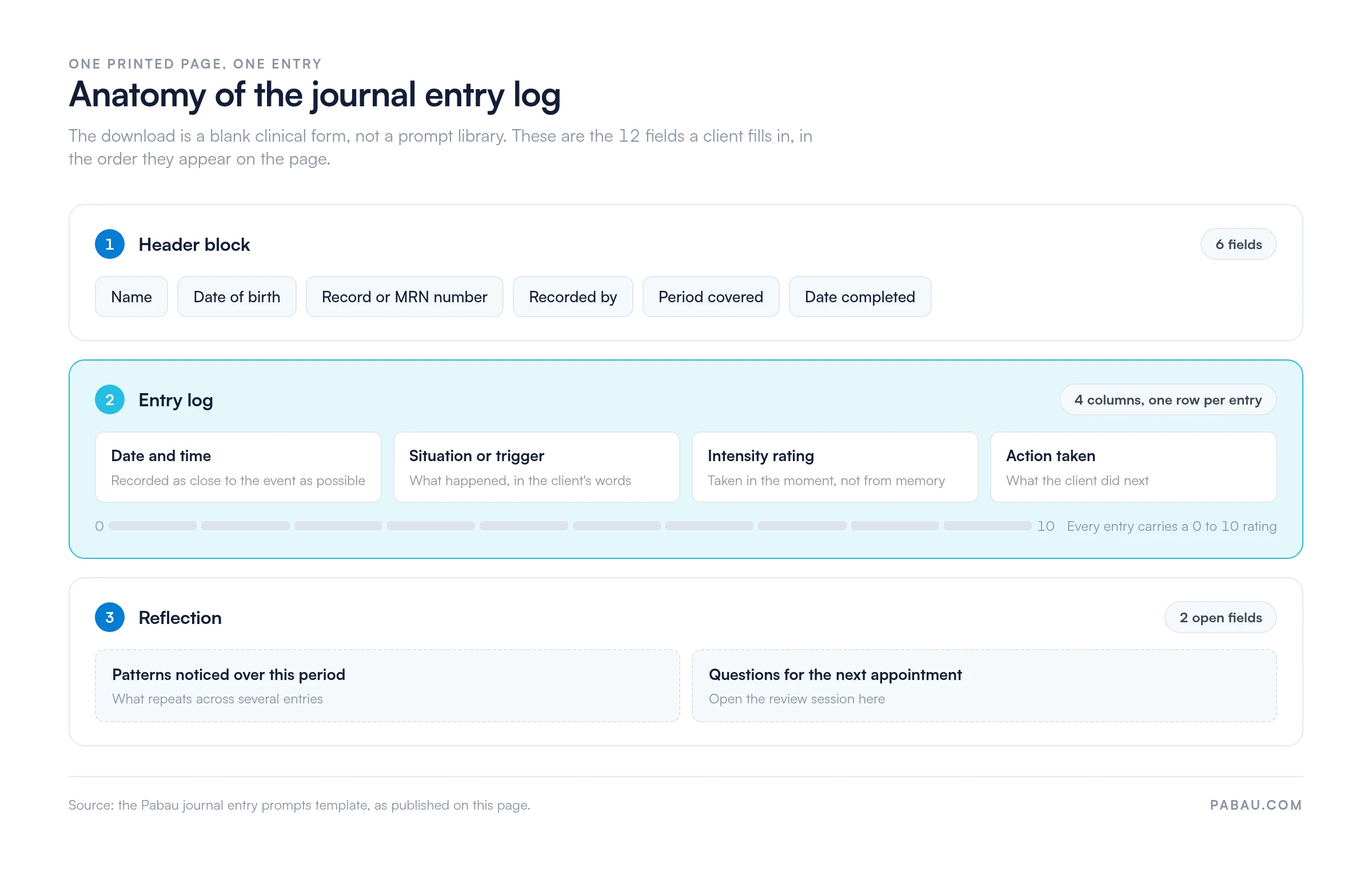
The form asks for one row per entry, recorded as close to the event as possible. It also asks for the intensity rating at the moment it is observed rather than from memory. That instruction earns its place, because a rating recalled days later drifts toward the client’s mood on the day they write it.
Some writers find a row per event too much to keep up. A printable mood tracker works the other way, asking for one mood rating per day.
One printed page holds one entry. A week of daily journaling therefore needs a sheet per day, or the same fields held in a digital form that timestamps each submission. Decide which route you want before you hand the log out, so the client is not left photocopying it.
A journal entry prompt is a question or statement that gives reflective writing a subject. Free-form journaling starts from a blank page. A prompt points the writer at one theme, such as anxiety, gratitude, or a decision they are avoiding.
Prompts do three clinical jobs. They remove the blank-page hesitation that stops people writing at all. They keep entries comparable, so a clinician can read six weeks of them side by side. They also frame emotional expression as a task rather than a confession.
That framing helps clients who are new to therapeutic writing. In mental health EMR software, prompts often sit in the client portal so reflective work happens between sessions.
The strongest prompts are open-ended and invite an honest answer. Ask what emotion is present in the body right now, rather than asking whether the client feels okay. A closed question gets a one-word entry and the log stays empty.
Five steps take the form from handout to clinical record:
Individuals using the log without a clinician can still run step five alone. Re-read the entries a week later and mark what has shifted in the intensity ratings.
None of the prompts below are inside the PDF. They are here so you have something to assign alongside the blank form. Copy one onto the sheet, or paste it into a digital version of the same fields.
Morning and evening variants give the habit an anchor. A morning prompt sets intention, such as asking which quality the writer wants to hold onto today. An evening prompt closes the loop by asking what they learned about themselves.
The Five Minute Journal puts that two-sitting rhythm in print. Its morning page asks for three gratitudes and one intention, and the evening page records what went well.
Warn clients that writing about difficult material can raise distress for a while. That rise is processing, not deterioration. Give them a clear instruction to make contact if the distress goes past what they can settle on their own.
Work by Emmons and McCullough found that weekly gratitude journaling produced sustained mood gains, while daily entries risked feeling forced. One prompt-guided session a week is enough to hold the habit. Add a second only if the client asks for it.
Goal prompts work best when the log is already running. The intensity ratings and the patterns field show the client what has changed. The next goal then becomes a judgment rather than a guess.
The four lists above hold fewer than thirty questions, so someone journaling daily works through them inside a month. A year of daily prompts gives you one question for every date on the calendar.
Journaling has a reasonable evidence base as a complementary practice. The expressive writing studies led by James Pennebaker found that structured writing about difficult experience improved emotional and physical health measures. The American Psychological Association treats journaling as a supportive tool for anxiety, grief, and self-awareness rather than a treatment in its own right.
Journaling supports care. It does not replace psychotherapy, medication, or crisis support, and the log should never be the only support standing between a client and help.
Practitioners fit journaling into clinical workflows in several ways:
The session note is where the log meets the record. A short quote from the client’s own entry evidences between-session work far better than a line saying homework was completed. Our guide to social work SOAP notes shows where that quote belongs.
The log suits any practitioner who wants dated, comparable entries rather than loose notes:
Anyone using dedicated therapy practice management software can rebuild these fields as a portal form. Responses then land in the clinical record with a timestamp, and the reminder goes out without anyone chasing it.
Comparable entries. Every client records the same six fields, so two logs from different months can be read against each other. That is difficult with free-form notebooks.
Defensible documentation. A dated log with a named recorder and a period covered is evidence of between-session work. That matters when a payer or an auditor asks what happened between visits.
Client autonomy. The form gives clients something concrete to do with a difficult moment, which helps most when appointments are weeks apart.
Less preparation. The clinician chooses a prompt and hands over a ready form, instead of designing a tracking sheet for each client.
Better engagement. A named form asked for by a clinician gets completed more often than a general suggestion to journal about feelings.
Sequence prompts by treatment stage. Assign anxiety and regulation prompts early, while the client is still building distress tolerance. Move to values and goal prompts once the intensity ratings on the log start to settle. The ratings themselves tell you when that shift has happened, so the decision rests on the client’s record rather than on a hunch.
A paper log only helps if it comes back. Often it does not, or it arrives folded in a bag three weeks later with the dates guessed. The clinician then retypes whatever is legible into the note, and the intensity ratings lose their timing.
Practice management software like Pabau closes that loop. The same six fields can be built as a digital form and sent to the client portal on a schedule you set.
Each entry is timestamped when the client submits it. Completed entries attach to the client record, next to appointments, notes, and consent forms. The review at the next session then starts from the data rather than from a search.
Pabau Scribe, our AI scribe, then drafts the session note from the conversation. The themes a client raised in their log reach the record without an hour of evening charting. Reminders, stored responses, and notes sit in one system, and every subscription includes all of it.

Pabau sends journaling prompts through the client portal, timestamps every response, and files it in the client record. Clinicians open the next session with the patterns and questions already in front of them.

Treat this template as the container, not the content. The download gives you a dated, rateable record of one journaling entry. The clinical value comes from the prompt you choose to put on it and the conversation you have about the two closing fields.
Print it if paper suits the client, and duplicate it for a longer stretch. If you are running this across a caseload, rebuild the same fields digitally instead. Paper logs get lost, and an intensity rating written from memory is worth much less than one written in the moment.
The choice between paper and portal is really a choice about whether the log comes back. Book a demo to see how Pabau sends journaling prompts, timestamps every response, and files it in the client record.

Need room for longer entries? Self-reflection journal gives clients open pages for reflections that will not fit one row of a log.
Working on gratitude between sessions? Daily gratitude journal sets a lighter cadence for the gratitude prompts on this page.
Want the thought behind the feeling? Thought record worksheet breaks one situation into the thought, the evidence against it, and the response.
Running DBT skills work? DBT journal tracks skills practice and urges alongside the emotion rating.
Tracking mood across weeks, not moments? Daily mood chart plots the pattern that the log’s intensity ratings only hint at.
No. The PDF is a blank one-page log. Its fields cover the date and time, the situation or trigger, and an intensity rating from 0 to 10. It also has space for notes on the action taken, patterns noticed, and questions for the next appointment. The sample prompts on this page are article content, so you choose one and write it on the form.
Write what is true in the moment, including emotions, thoughts, fears, and plain observations. Entries are unfiltered and there is no correct answer. Working from a prompt, answer it honestly and do not edit yourself as you go.
There is no evidence-backed quota. Emmons and McCullough found that weekly gratitude journaling sustained mood gains, so once a week is a reasonable floor. Consistency matters more than frequency, and sessions of 15 to 20 minutes balance depth against sustainability.
A diary records what happened. A journal explores what it meant, which is why prompts ask about feeling, pattern, and interpretation. The log in this template sits closer to a journal, because it asks for intensity and patterns rather than events alone.
There is no minimum or maximum. A prompted entry often runs 200 to 500 words, while free-form entries run longer. The quality of the reflection matters more than the word count, and 10 to 20 minutes is a workable session.