Mental health self-care checklist
A mental health self-care checklist is a structured daily tool for tracking the ...

5
Last Updated: Oct 20, 2026

Self regulation worksheets are structured therapeutic tools that help clients build emotional control, coping strategies, and behavioral awareness.
The download covers DBT skills, grounding techniques, impulse control, and the Zones of Regulation framework.
Children need visual formats, teens need peer-relevant scenarios, and adults need worksheets that carry life complexity.
Completed worksheets double as progress-monitoring artifacts for treatment plan objectives and IEP goals.
Practice management software like Pabau keeps worksheet responses, session notes, and progress tracking in one client record.
A practitioner-ready set covering DBT emotion regulation, grounding scripts, impulse control planners, and Zones of Regulation check-in cards. Age-specific feelings worksheets for children, teens, and adults are included.
Download templateSelf regulation worksheets are therapeutic tools that give clinicians a structured way to teach emotional control, impulse management, and coping skills. They work with children learning to name difficult feelings, teens practicing decision-making, and adults managing stress and anxiety. The worksheet is the scaffolding clients use in session and at home.
This guide covers what the worksheets contain, how to introduce them in session, and which formats fit which clients. The download above pulls four proven approaches into one toolkit. You get DBT emotion regulation skills, grounding techniques, impulse control strategies, and the Zones of Regulation framework.
Self regulation worksheets are clinical documents that help clients notice their emotional states, identify triggers, and practice a coping response. They are built for licensed professionals, not for the general public. Therapists, counselors, psychiatrists, school psychologists, and clinical social workers use them inside structured sessions or as between-session homework.
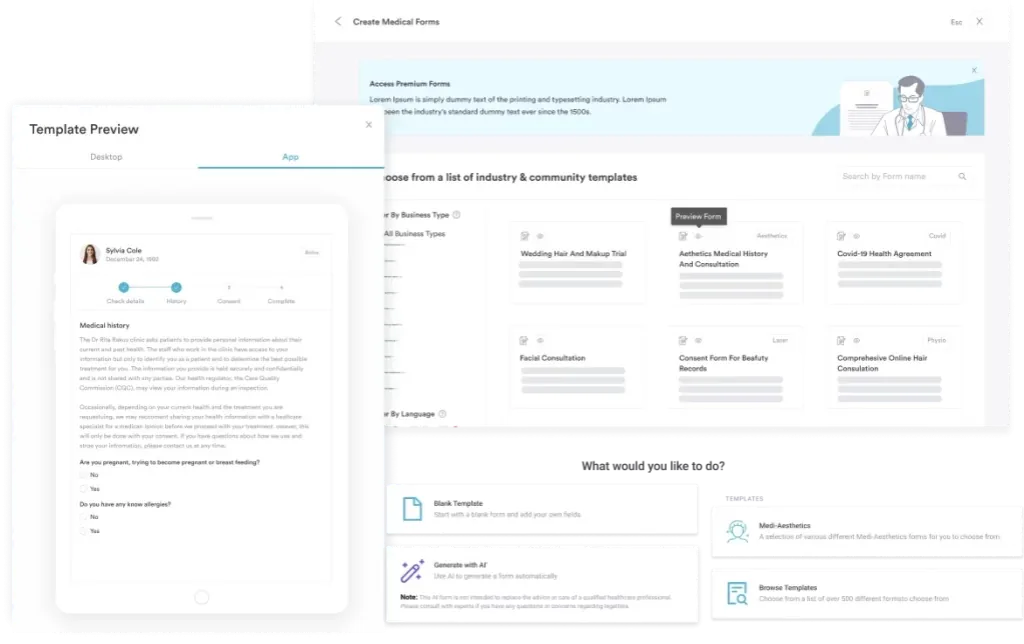
Most of these sheets now travel to the client as a digital form rather than a photocopy.
The American Psychological Association defines emotional regulation as the ability to control your own emotional state. That control shows up in ordinary behaviors. A client rethinks a provocation to take the heat out of it, hides visible distress, or shifts attention onto a calming thought.
Self regulation worksheets turn that definition into four steps. Name the feeling, identify what triggered it, choose a coping strategy, then record the outcome.
Emotional dysregulation turns up in every age group and every clinical setting. Children with ADHD struggle with impulse control. Teens face identity confusion and peer pressure that spike anxiety. Adults carry work stress, relationship conflict, and chronic health conditions. School staff, therapists, and parents all need something practical to reach for when emotions run high.
Self-regulation sits at the center of social-emotional learning (SEL) frameworks. CASEL, the Collaborative for Academic, Social, and Emotional Learning, treats it as a core competency. Clients who build the skill early show better academic performance and fewer behavioral incidents. They also report stronger peer relationships and lower anxiety in adulthood.
Dialectical Behavior Therapy (DBT), developed by Marsha Linehan at the University of Washington, combines cognitive-behavioral techniques with acceptance and validation. Its emotion regulation module teaches clients to understand what an emotion is doing and reduce their vulnerability to it. From there, they learn skills for when feelings run intense.
Worksheets grounded in DBT emotion regulation cover:
DBT worksheets are evidence-based for emotion dysregulation in borderline personality disorder, substance use disorders, self-harm, and suicidal ideation. Clinicians also adapt them widely for general anxiety, depression, and impulse control. If you want the module on its own, the DBT therapy worksheet covers it in more depth.
Grounding techniques anchor a client to the present moment. That interrupts the stress response and takes the edge off panic or dissociation. The download includes four structured grounding exercises:
Clinicians use the 5-4-3-2-1 technique widely for anxiety and panic. The worksheet walks the client through each step, names the biological purpose, and leaves room to record which method worked. That purpose is activation of the parasympathetic nervous system, which is what slows the heart rate back down.
Self-regulation is one skill, but the format that reaches a seven-year-old will not hold an adult’s attention. The three groups differ in format, framework, and what the worksheet is actually building.
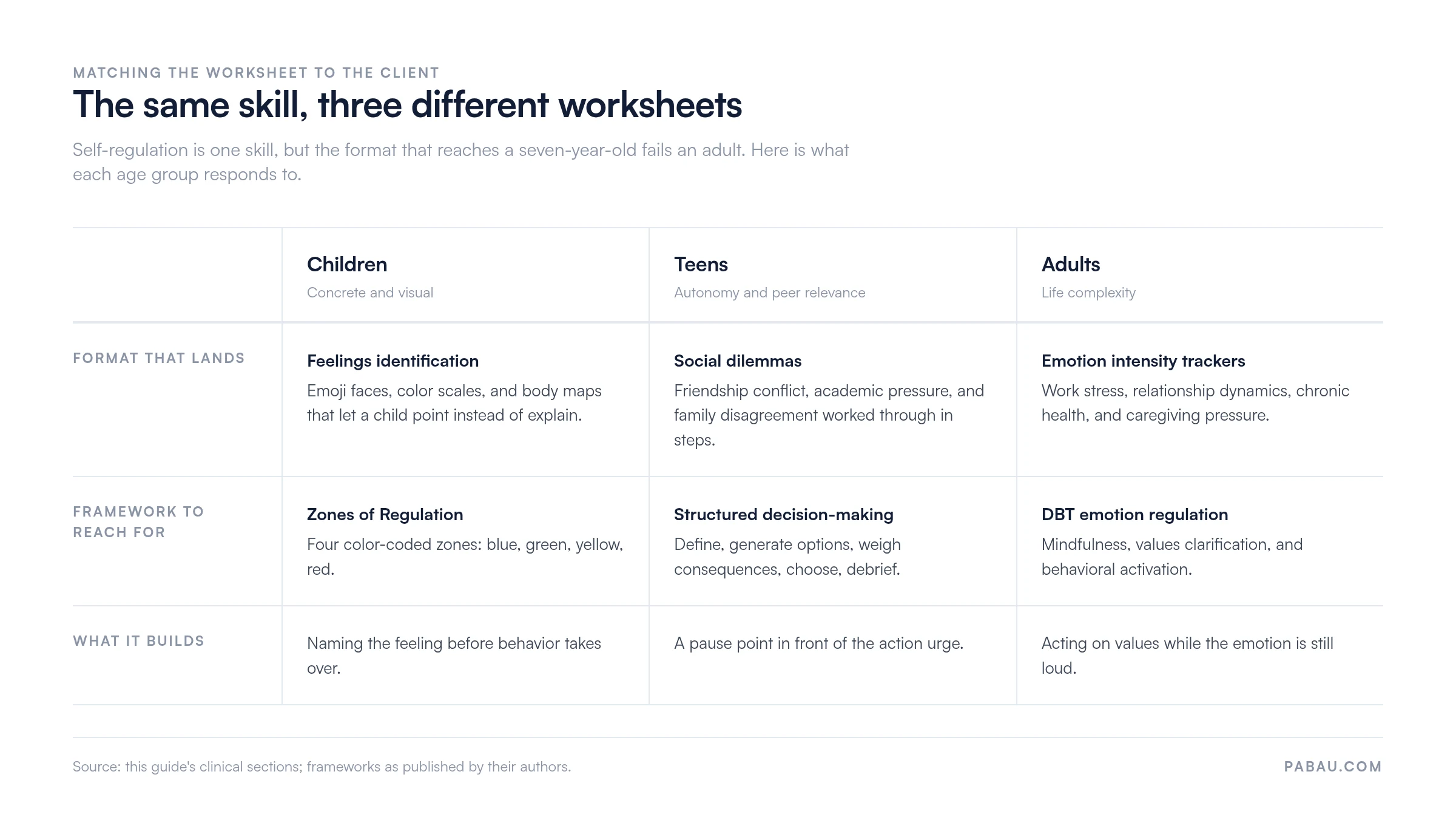
For children: Concrete and visual is what works. Feelings identification sheets use emoji faces, color scales, or body maps so a child can point instead of explain. The Zones of Regulation framework, built by occupational therapist Leah Kuypers, sorts feelings into four color-coded zones that kids remember easily.
For teens: Adolescents respond to worksheets that respect their autonomy and feel peer-relevant. Decision-making sheets walk through a real social dilemma in five steps. Define the problem, generate options, weigh consequences, choose an action, then debrief. Impulse control worksheets build a deliberate pause into that sequence, which the still-developing adolescent prefrontal cortex does not supply on its own.
For adults: Adult worksheets assume a complicated life. Work stress, relationship dynamics, chronic health, aging parents, and money pressure all show up in the same week. Emotion regulation sheets for adults usually fold in mindfulness, values clarification, and behavioral activation. The client learns to act on their values while the emotion is still loud.
The Zones of Regulation is a proprietary framework, and it is close to ubiquitous in schools and therapy practices. The four zones help a client name their current state and pick a strategy that fits it:
Zones printables include zone identification cards, a strategy chart per zone, check-in logs, and conversation guides for teachers, therapists, and parents. Many clinicians run them alongside the worksheets above, so the client has both the language and the structure.
For clinicians working in schools, completed worksheets become part of the Individualized Education Program (IEP) record under the Individuals with Disabilities Education Act (IDEA). Students with ADHD, autism, anxiety diagnoses, or emotional and behavioral disabilities often carry IEP goals aimed at emotional regulation and impulse control.
The same sheet works as a teaching tool and as a progress-monitoring artifact. Two example goals show how that reads on paper:
Data from worksheet completion feeds straight into IEP progress reports and the annual review meeting.
Five steps take a worksheet from a piece of paper to something the client actually uses:
When a full worksheet is too much for a client, an emotional regulation checklist gives them a lighter weekly check-in instead.
Documentation matters just as much. Keep completed worksheets in the client record, with consent and the usual privacy safeguards, as evidence of skill practice and progress toward treatment goals. Practice management for therapists stores the sheet and the client’s responses in the chart, so the session note points at the work itself.
These roles reach for self-regulation worksheets most often:
Across all of those roles, the worksheets do three things. They cut preparation time, because the intervention is already structured. They raise engagement, because a concrete tool feels achievable. And they leave a record that shows change.
Self-regulation is not a one-time lesson. The client learns the skill in session, practices at home, meets a live trigger, adjusts, and slowly builds a faster response. Worksheets scaffold that long arc. They give the client a portable reference, the therapist a teaching medium, and both a shared language for emotion work.
Research from the Collaborative for Academic, Social, and Emotional Learning shows that structured social-emotional interventions reduce anxiety, depression, and behavior problems.
The same programs improve academic performance and peer relationships. Emotion regulation training is one part of that package, and worksheets are a low-cost way to deliver it at scale.
There is a second message in the handover. Giving a client a worksheet says that emotions are normal, that struggling with them is normal, and that a map exists. Repeated over months, that message is what builds resilience.
Paper is still the default handover. The client fills the sheet in at home, forgets it, or brings it back creased. The therapist then retypes the useful parts into the session note. The completed sheet ends up in a folder nobody opens at the next review.
Practice management software like Pabau turns that worksheet into a digital form. You send it from the client’s record, they complete it on a phone, and the answers come back into the chart. That removes the retyping step and the lost-sheet problem.
The payoff shows up at review time. Because each response is stored against the appointment, you can show a client’s progress across eight weeks without digging through a folder. For a school-based caseload, that same record is what an IEP progress report needs.

Pabau turns your self-regulation worksheets into digital forms clients complete on a phone. Responses land in the client record beside the session note, so progress reviews take minutes.

The judgment worth carrying out of this guide is simple. A worksheet only works when you introduce it in session, tie it to something the client actually said, and review what came back. Handed over cold, it is paper.
So download the collection, pick the one or two sheets that match your next client, and leave the rest. Trying to run five frameworks at once is how worksheets turn into homework nobody does.
One trade-off is worth remembering. Structure helps the client and produces the documentation, but the relationship still does the work. Psychology practice software handles the filing so you can spend the session on the client.
Book a demo to see how Pabau shares worksheets and stores the responses in one client record.

Watching your own regulation slip? Therapist burnout signs, causes, and prevention covers how your emotional regulation protects the presence your clients rely on.
Need protocols for the moments worksheets cannot hold? Crisis intervention strategies for clinicians walks through step-by-step responses to high-acuity emotional episodes.
Working with a client at risk? Mental health safety plan gives you a structured plan to complete with them before the crisis arrives.
Need to document what the worksheet showed? SOAP note for mental health template gives you a structure for turning session material into a defensible note.
Self regulation is the ability to manage and respond to emotional experiences in healthy ways. It matters because dysregulation sits underneath most mental health, behavioral, and social problems. That covers anxiety, depression, impulse control, and relationship conflict. Therapy that teaches self regulation gives clients a way to interrupt the emotion-behavior cycle.
Yes, with adaptation. Children need visual, concrete formats such as the Zones of Regulation or emoji feelings charts. Teens do better with peer-relevant scenarios like social conflict and decision-making. Adults want worksheets that carry life complexity, so values, mindfulness, and behavior change. The download includes age-appropriate options for each group.
Yes. Emotion regulation training is a core component of evidence-based therapies. That includes DBT for borderline personality disorder, self-harm, and suicidality, plus CBT for anxiety and depression. School-based social-emotional learning programs use it for prevention. Multiple meta-analyses show that structured emotion regulation interventions reduce symptoms and improve functioning.
Introduce one worksheet in session, assign one as between-session homework, then review it at the next appointment. As the client practices, they should need the sheet less often. The goal is internalizing the skill, not building a worksheet habit. Frequency depends on severity, motivation, and whether you are handling an acute crisis or building long-term resilience.
Resistance usually signals a mismatch between the tool and the client. Explore it together. Is the format too complex, the language unfamiliar, or the timing wrong? Then switch to a different worksheet style, simplify the instructions, or practice the skill in session before you assign it. Worksheets work when they feel relevant rather than imposed.