Pabau Engage inbox

Pabau Engage is here: every patient conversation in one inbox.

Learn more
Book a demo Book a demo
☰
Compliance and security

OSHA inspection checklist: Free PDF + what inspectors check first

Avatar photo Anja Dodevska
Last Updated: October 7, 2026

An OSHA inspection checklist is a self-audit form for finding workplace hazards, confirming compliance with OSHA standards, and fixing problems before an inspector arrives. It covers PPE, emergency plans, fire safety, hazard communication, recordkeeping and training, plus the hazards specific to your industry.

The stakes are set by the Occupational Safety and Health Administration. Penalties reach $16,550 per serious violation and $165,514 per willful or repeated violation, adjusted annually. A dated record of hazards you found and fixed yourself shows good faith and can reduce penalty severity.

Found our content helpful?

Download your free OSHA inspection checklist

A printable sign-off form for each self-inspection. It records the standard being evidenced, the responsible owner, findings and corrective actions, plus any item left open with its deadline.

Download template
Key takeaways

Key takeaways

An OSHA inspection checklist is a self-audit that records each hazard, the standard it breaks, and the corrective action that fixes it.

Inspectors usually ask for the OSHA 300 log first, then written programs and training records, so have those ready before the walkaround.

Every workplace checks PPE, emergency plans, fire safety, HazCom, recordkeeping and training, then adds its own hazards, such as forklifts or bloodborne pathogens.

Run a full walkthrough monthly on high-risk sites and quarterly on moderate-hazard ones, with shorter daily and weekly checks in between.

A dated history of hazards you found and corrected yourself shows good faith and can reduce penalty severity if OSHA issues a citation.

What is an OSHA inspection checklist?

The checklist measures your workplace against OSHA standards (29 CFR 1910 for general industry, 29 CFR 1926 for construction). It documents the hazards you find, confirms your written programs exist, and shows that required training is current.

Your own safety lead or a qualified consultant completes it, not a government inspector. That makes it a rehearsal you control. Any deficiency it turns up can be corrected before an OSHA compliance officer walks through the door.

Why a regular self-inspection pays off

Without a routine self-inspection, hazards stay hidden until someone is hurt or an inspector cites them. A checklist used on a schedule changes that in four ways:

  • Fewer fines and citations: Deficiencies you identify and correct before an inspection show good faith and can reduce penalty severity.
  • Fewer workplace injuries: Systematic hazard checks catch risks before they harm employees.
  • Faster inspector visits: Having the OSHA 300 log, training records and written programs ready speeds up the opening conference.
  • A stronger safety culture: Visible compliance work signals that leadership takes safety seriously.

How to run a self-inspection

A self-inspection follows six steps, from naming an owner to filing the signed form:

  1. Assign a safety leader. Name a safety officer, manager or qualified team member to own the schedule and the corrective actions.
  2. Set a frequency. Inspect monthly in high-hazard settings such as construction or manufacturing, and quarterly or semi-annually elsewhere.
  3. Walk the site systematically. Document conditions area by area, including offices, production floors, chemical storage, electrical systems and fall-hazard zones.
  4. Note hazards and corrective actions. For each finding, record what you saw, the standard it breaks, and the fix with a completion deadline.
  5. Follow up and close. Track each corrective action to completion, update training records, and file the signed checklist with your safety documentation.
  6. Connect it to your safety program. Feed findings into your emergency action plan, hazard communication program and periodic management reviews.

The full walkthrough is only one layer. Some items need checking every shift, and some deadlines fall once a year, as the cadence below shows.
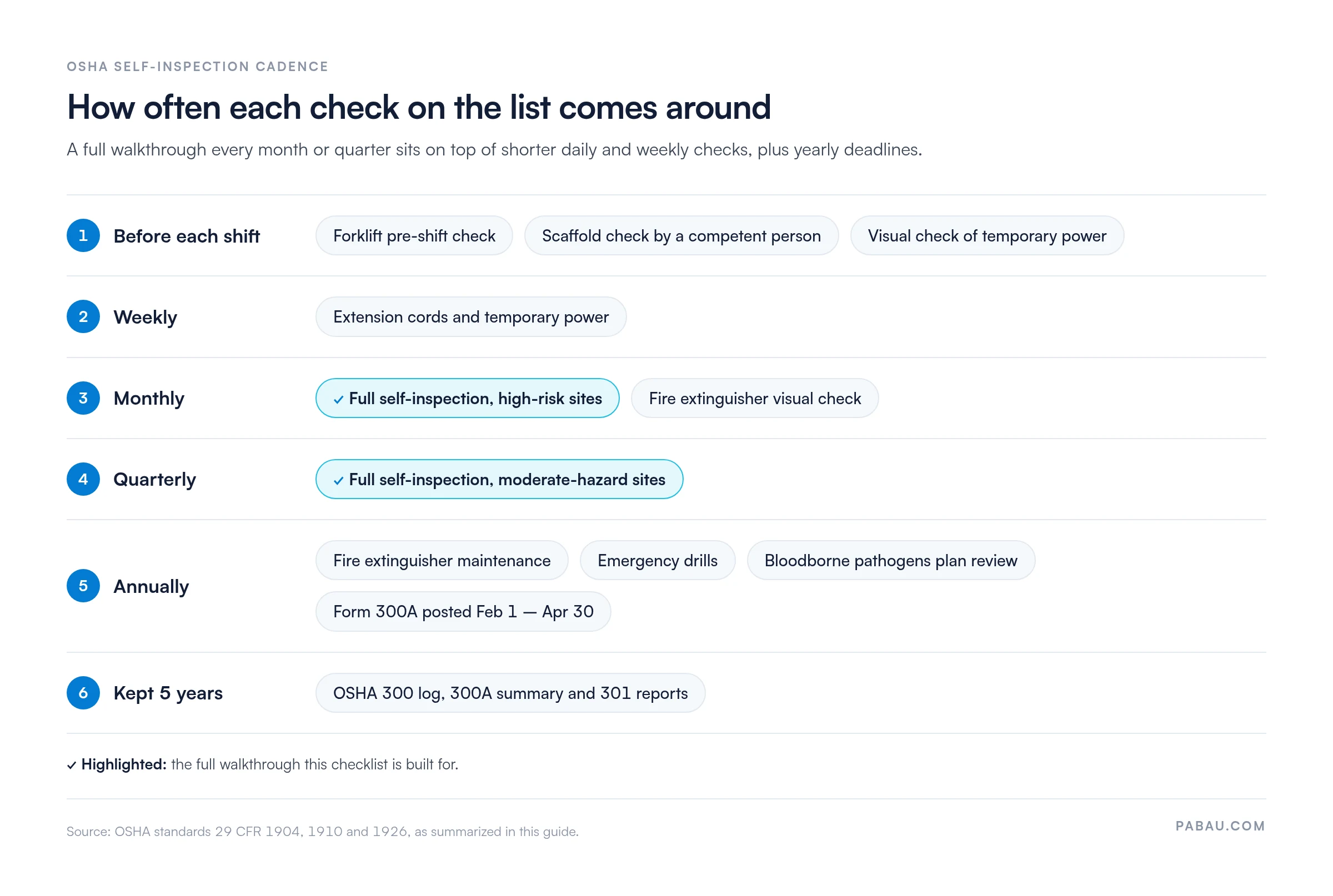
OSHA self-inspection cadence
Shift-by-shift and weekly checks sit underneath the full walkthrough, while posting and retention deadlines run on the calendar. Frequencies follow the OSHA standards cited in this guide.

Items every workplace should check

These items apply across all industries and come up in every OSHA inspection. If your written emergency plan is missing or out of date, our OSHA emergency action plan template covers the required elements.

Compliance area Checklist items
Personal protective equipment (PPE) Required PPE identified for each job. Equipment available and in good condition. Training on proper use documented, with fit-testing where required.
Emergency action plan Written plan in place, evacuation routes marked, and emergency numbers posted. Drills held at least annually, with procedures for assisting people with disabilities.
Fire safety Fire extinguishers visually checked monthly and maintained annually. Exit signs illuminated, fire alarm tested, and no blocked exit routes.
Recordkeeping (OSHA 300 log) Injury and illness log maintained, and Form 300A posted from February 1 to April 30 each year. Access procedures documented and records kept for five years.
Hazard communication (HazCom) Safety Data Sheets (SDS) accessible and GHS labels on all containers. Employee HazCom training documented, and SDS updated within 90 days of product changes.
Training documentation Records of required safety training, from orientation to equipment- and hazard-specific sessions. Trainer credentials verified, with dates and content documented.

Construction site hazards to add

Construction sites fall under OSHA’s construction standards (29 CFR 1926), with stricter requirements for fall protection, excavation, scaffolding and electrical work. Add these items if your workplace involves construction activities:

  • Fall protection: Fall arrest systems, guardrails, safety nets or warning lines installed and inspected regularly. Workers trained on their use and limitations.
  • Ladders and climbing equipment: Portable ladders in good repair, set at a 4:1 angle, secured at the top where required, with non-slip rungs.
  • Scaffolding: Built to design specifications, with guardrails on all open sides and daily inspections by a competent person.
  • Excavation and trenching: Soil type tested and proper sloping or shoring used. Atmospheric monitoring in confined spaces, with a competent person on-site.
  • Electrical safety: Ground-fault circuit interrupter (GFCI) protection on temporary wiring, tools properly grounded, and clearance kept from overhead power lines.

Forklift and powered industrial truck safety

If your facility operates forklifts, OSHA requires daily pre-shift inspections (29 CFR 1910.178) and operator certification. Daily checklist items include:

  • Brakes function properly, with no leaks or soft pedal.
  • Steering is responsive, with no excessive play.
  • Hydraulic systems are intact and cylinders are not leaking.
  • Forks, chains and lifting mechanisms are inspected for damage.
  • Lights, horn and warning beepers work.
  • Hydraulic, coolant and fuel or battery levels are adequate.
  • Operator certification is current.

Electrical safety and lockout/tagout checks

Electrical hazards and poor energy control are cited consistently. Make sure your lockout/tagout (LOTO) procedures are documented and your electrical systems pass these checks:

  • LOTO program: Written energy control program in place and authorized employees trained. Locks, tags, chains and devices properly maintained.
  • Electrical panels: Main and subpanels clearly labeled, breakers identified, and access unobstructed, with no unauthorized modifications.
  • Grounding and bonding: Metal equipment properly grounded and three-prong cords in use. Extension cords inspected for damage before use.
  • Arc flash safety: High-energy areas marked, appropriate PPE available, and the arc flash assessment documented.
  • Temporary power: GFCI protection in place and cords kept away from water and chemicals, with a visual inspection before each use.

Extra checks for medical practices

Medical and aesthetic practices answer to OSHA’s Bloodborne Pathogens Standard (29 CFR 1910.1030) wherever staff handle blood, needles or other sharps. Inspectors in healthcare settings ask for these records alongside the general items above:

  • Exposure control plan: Written, accessible to staff, and reviewed and updated at least once a year.
  • Hepatitis B vaccination: Offered at no cost within 10 working days of assignment to every employee with occupational exposure.
  • Bloodborne pathogens training: Given at assignment and repeated annually, with dates and attendees recorded.
  • Sharps containers: Closable, puncture-resistant, leakproof and labeled or color-coded, and never allowed to overfill.
  • Sharps injury log: Kept by every employer that must maintain the OSHA 300 log.

What OSHA inspectors check first

OSHA inspections follow a predictable opening sequence. Knowing what inspectors prioritize helps you prepare:

  1. Opening conference. The inspector meets management to explain the scope and purpose of the inspection.
  2. Request the OSHA 300 log. This is almost always the first document inspectors ask for. They review the prior three years of recorded injuries and illnesses.
  3. Review written programs. Expect questions on the emergency action plan, hazard communication, lockout/tagout, bloodborne pathogens (healthcare) and fall protection (construction).
  4. Inspect training records. Inspectors look for proof that required training was completed, with dates and attendees.
  5. Walkaround inspection. A tour of the facility checks physical hazards, PPE compliance, housekeeping and safety signage.
  6. Closing conference. The inspector discusses findings, any citations, and timelines for corrective actions.

Having the 300 log, training records and written programs organized and on hand signals preparedness and often shortens the inspection. Check that your OSHA Form 300A summary was signed and posted on time, because it sits right next to the log.

Most common OSHA violations to watch for

OSHA’s annual list of most-cited standards shows the same patterns across industries. Give these high-risk areas priority on your checklist:

Violation type Prevention via checklist
Fall protection Inspect harnesses before use, verify guardrails at 4+ feet, and confirm tie-off points are secure. Document the competent-person audit.
Hazard communication Keep the SDS binder current, verify GHS labels on all containers, and confirm employees can access and understand chemical hazards.
Scaffolding Have a competent person inspect before each shift, check guardrails and platform spacing, and document the sign-off.
Electrical hazards Inspect extension cords and temporary power weekly, ensure GFCI protection in wet areas, and verify panel labeling and access clearance.
Machine guarding Confirm pinch points, rotating shafts and cutting surfaces are guarded, and that operators are trained on lockout/tagout before maintenance.

Adapting the checklist to your workplace

After downloading, tailor the form to your operation:

  • Add industry-specific hazards, since construction, warehousing, healthcare and manufacturing each carry their own risks.
  • Insert your facility’s key areas, equipment models and emergency contacts.
  • Match the inspection frequency to your hazard level: monthly for high-risk sites, quarterly for moderate ones.
  • Record an owner and a completion date against each corrective action, so every fix has someone accountable for it.
  • Make your safety leader the checklist owner, responsible for scheduling, completing and filing inspections.

File completed checklists with your written safety programs, which an OSHA handbook brings together in one place. If OSHA inspects, three years of self-inspections with corrective actions demonstrates good faith.

Where Pabau fits in your practice’s compliance records

An OSHA walkthrough covers your building, equipment and staff training. A medical practice also answers for its patient records under HIPAA, and those come up in audits and reviews too.

Pabau, the practice management platform we build, keeps that side organized. Role-based permissions control who can view, edit or export patient information. Treatment notes record the practitioner who wrote them, and clinical photos carry automatic date and time stamps.

Each action in the system leaves an audit trail, so you can show what happened and when without digging through paper files. Pabau’s compliance software for practices also stores pre- and aftercare messages in the patient record as evidence of what each patient was told.

Keep patient records audit-ready with Pabau

Pabau’s secure access permissions, time-stamped documentation and treatment notes keep patient records organized and traceable. Book a demo to see how it supports your next review.

Pabau practice management dashboard

Conclusion

Use the checklist on a fixed schedule, not in the week before an inspection. A monthly or quarterly walkthrough finds a blocked exit or an outdated SDS while it is still a cheap fix.

The effort never stops, but each signed and dated record adds to a history that can reduce penalty severity if OSHA ever cites you. Start with what inspectors ask for first: the 300 log, your written programs and your training records.

Book a demo to see how Pabau keeps your practice’s patient records just as ready for review.

Continue your research

Continue your research

Documenting an incident? Incident report form shows what to include when you record a workplace or patient incident.

Handling patient data too? HIPAA risk assessment walks through the security review practices need alongside OSHA checks.

Frequently asked questions

What does an OSHA inspector look for during an inspection?

OSHA inspectors first request your OSHA 300 log of injuries and illnesses. They then review written safety programs, such as the emergency action plan, hazard communication and fall protection. During the walkaround, they check PPE compliance, hazard identification, training records and physical conditions. The most-cited violations include fall protection, hazard communication, scaffolding, electrical safety and machine guarding.

How do I prepare for an OSHA inspection?

Run regular self-inspections with this checklist and document every corrective action. Keep your OSHA 300 log current and organize training records by employee and topic. Make sure SDS binders are complete and accessible. Confirm that required written programs, such as the emergency action plan, hazard communication and lockout/tagout, are current. Having these materials ready speeds up the inspection.

What are the most common OSHA violations?

Fall protection, hazard communication, scaffolding, electrical hazards and machine guarding consistently rank among the top violations. They appear on OSHA’s annual most-cited list year after year. A self-inspection checklist targeting these five areas catches the highest-risk deficiencies most employers face.

What records does OSHA require employers to keep?

Most employers must keep the OSHA 300 log, OSHA 301 incident reports and the Form 300A annual summary for five years. Form 300A must be posted from February 1 to April 30 each year. Also keep records of safety training, competent-person qualifications, equipment inspections and corrective actions.

What happens if you fail an OSHA inspection?

If an inspection finds violations, the inspector issues citations. Other-than-serious violations carry lower penalties. Serious violations, which create a substantial probability of death or serious harm, carry higher fines. Willful or repeated violations carry the highest penalties. You can contest citations, and you must show corrective action by the abatement deadline. A documented history of finding and fixing similar hazards can reduce penalty severity.
Found our content helpful?
×