Antipsychotic medication list
An antipsychotic medication list is a structured reference that organizes psychi...

2
Last Updated: Oct 13, 2026

A mindfulness journal is a daily record of what you notice in your thoughts, feelings, and body, written without judgment.
Mindfulness journaling supports emotional regulation and mental clarity, and both MBSR and MBCT use reflective writing alongside formal practice.
This worksheet is a single page of four columns, filled in at the end of the day in about five minutes.
Practice management software like Pabau helps teams share the worksheet with patients as a digital form and follow it up by message.
A one-page daily reflection log with columns for the date, the day’s experiences, the mindful moments you noticed, and the lessons you took from them. Print it for the waiting room or send it to patients after a session.
Download templateA mindfulness journal is a short daily record of what you noticed in your thoughts, feelings, and body. In practice, the worksheet below turns that into one printable page a patient can finish in about five minutes at the end of the day.
The form itself is deliberately bare. Specifically, it gives you four columns and no prompts, which feels freeing to some patients and paralyzing to others.
So this guide covers both halves of the job. You get the download, a walkthrough of each column, and prompt banks for mornings, evenings, and anxious days.
A mindfulness journal is a dedicated space where patients write thoughts, feelings, and sensations in a non-judgmental way. A traditional diary narrates events, but this format stays with present-moment awareness instead, noticing what is happening right now without trying to change it or score it as good or bad.
The core principle is straightforward. First, you observe your inner experience as it unfolds. A thought arises and you notice it. Then an emotion surfaces and you acknowledge it. Finally, physical sensations appear and you name them. That habit of non-judgmental observation is what builds emotional resilience over time.
Mindfulness journaling also differs from therapy journaling, because it does not ask the writer to process past trauma or solve a problem. It cultivates present-moment awareness instead. That skill sits at the center of MBSR (Mindfulness-Based Stress Reduction) and MBCT (Mindfulness-Based Cognitive Therapy).
Research suggests mindfulness journaling delivers measurable benefits across emotional regulation, anxiety management, and cognitive function. Mental health professionals recommend it as a complement to therapy, because it carries the work of a session into the days between appointments.
For healthcare professionals, the same practice works against burnout and compassion fatigue. In fact, brief daily writing of five to ten minutes correlates with improved emotional regulation and lower occupational stress.
Starting takes almost no setup, which is why this works well as a first step for patients who are new to mindfulness.
If sitting still to write feels difficult, a mindfulness walk worksheet gives patients a moving version of the same exercise. Often, people notice far more on their feet than at a desk.
The worksheet is one page with four columns, and its instructions ask you to complete it at the end of each day. Approach it with an open, non-judgmental attitude, and leave a column blank when nothing comes to mind.
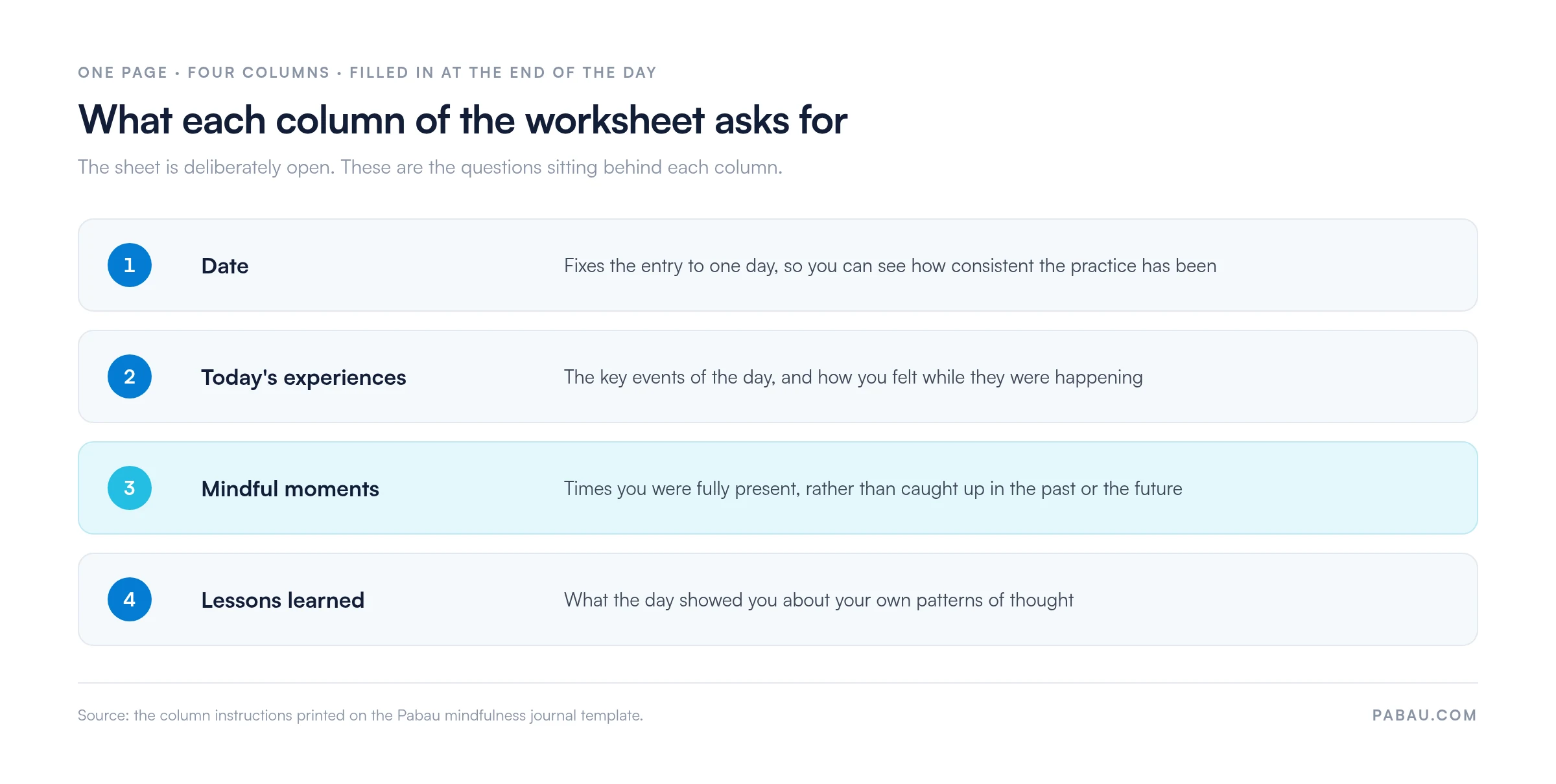
There is no right or wrong way to complete the sheet. It works best alongside a consistent mindfulness practice such as meditation. In particular, patients who are new to mindfulness usually get more from it with a trained professional guiding them.
Prompts move a patient past the blank column. The worksheet carries none of its own, so keep a set like the ones below beside it. These draw on MBSR and cognitive therapy frameworks, and they work on their own as well.
Some patients do better when the prompts are chosen for them. The Intelligent Change journal fixes four prompts across a morning and an evening sitting, so the choice is already made.
Use these when anxiety makes open writing hard. A grounding techniques worksheet is the better starting point when the feeling is too strong to write through at all.
Clinicians, therapists, nurses, and practitioners carry specific occupational stressors. Decision density is high, emotional labor is constant, and there is little recovery time between appointments. As a result, journaling creates a structured decompression point inside the clinical day.
Many practices build a five-minute writing slot into their staff wellness programs. Taken at the start or the end of a clinical session, it helps practitioners:
That last point matters more than it looks. Notably, therapist burnout builds quietly over months, and a written record of how the week felt is often the first thing to show the pattern.
Practices running on therapy practice management software can store the worksheet with their other patient forms. Patients and staff then reach it from the same place, instead of hunting for a printout somebody left in a drawer.
Consistency beats perfection. For example, five minutes every day outweighs thirty minutes twice a month. These habit strategies help the practice survive a difficult week.
Gratitude and emotional regulation are complementary practices supported by DBT and positive psychology research. Gratitude retrains attention toward what went well. Emotional regulation prompts help a patient name a difficult feeling and work with it.
A patient who responds well to the gratitude prompts may do better with a dedicated daily gratitude journal running alongside this worksheet.
Mindfulness journaling is a wellness and stress-management practice, not a medical treatment. It is designed to complement professional mental health care rather than replace it. Anyone experiencing clinical anxiety, depression, PTSD, or another mental health condition should work with a qualified professional. Overall, use this worksheet as an adjunct to that treatment.
Most practices hand this worksheet over as a printout at the end of a session. It goes into a bag, and nobody sees it again until somebody remembers to ask at the next appointment. Either way, the practice has no record of whether the patient used it.
Rebuild the four columns as a digital form in Pabau and the workflow changes. The form goes out after the appointment, the patient completes it on a phone, and the answers file themselves onto the client record. The therapist opens the record before the next session and reads what the patient actually wrote.
The follow-up runs from the same place. Automated email and SMS reminders nudge the patients who have not filled it in, and the next appointment is booked against the same record. Nobody on your team spends their morning chasing paper.

Pabau turns the mindfulness journal into a digital form you can send after a session. Patients complete it on a phone, and the answers file straight onto the client record. Reminders chase the ones who forget.

The worksheet is bare on purpose, and that is its strength. Four open columns let a patient write what actually happened, instead of steering them toward the answer a busier form expects.
It also means the discipline has to come from somewhere else. Pick one time of day, keep the sheet visible, and accept that some entries will run three lines long. Three weeks of short entries is worth more than one immaculate week.
If you are handing it to patients, decide now how it comes back to you. Book a demo to see how Pabau sends wellness forms out, files the answers on the client record, and reminds the patients who forget.

Want a CBT-leaning alternative? The thought journal records the situation, the thought, and the feeling, so a patient can test their own thinking.
Need a wider weekly review? The self-reflection journal steps back from the single day and asks what the last week changed.
Working through DBT skills? The DBT journal tracks skills practice and emotion intensity between sessions.
Want something to read aloud in session? The mindful breathing script gives you a short guided exercise to open or close an appointment.
Patients stuck in their heads? The body scan meditation script walks them through physical sensation from head to toe.
A mindfulness journal is a structured reflective tool where you write thoughts and feelings without judgment to build present-moment awareness. A diary narrates events. A mindfulness journal stays with what is happening right now, noticing sensations, emotions, and thoughts as they arise without trying to change them.
Yes. Mindfulness journaling supports anxiety management by interrupting rumination and grounding awareness in the present moment. Frameworks such as MBSR and MBCT include expressive writing as a core component. Journaling complements professional mental health treatment rather than replacing it. Anyone experiencing clinical anxiety should combine it with therapy or medical support.
Write whatever arises, including thoughts, feelings, physical sensations, and observations. The worksheet carries no prompts of its own, so use the prompt sets above as scaffolding, or write freely. There is no right or wrong content. The practice is about noticing and naming your inner experience, not producing polished prose.
Yes. Brief daily journaling of five to ten minutes helps clinicians process emotional activation between appointments. It also surfaces burnout signals early and keeps them present across a full clinical day. Many practices build mindfulness journaling into staff wellness programs as a structured decompression tool.