Antipsychotic medication list
An antipsychotic medication list is a structured reference that organizes psychi...

2
Last Updated: Oct 13, 2026

A suicide prevention worksheet guides a clinician through structured risk assessment and collaborative safety planning with a client who has suicidal thoughts.
The Stanley-Brown Safety Planning Intervention is the most widely adopted model, covering warning signs, coping strategies, support contacts, and crisis resources.
Completing the form with the client, in their own words, matters more than which template you choose.
Store the finished plan in the client record with a date, a version, and a review reminder.
Practice management software like Pabau attaches the plan to the record and logs who opened it, which supports HIPAA audits.
A ready-to-use form covering risk and protective factors, personal warning signs, coping strategies, reasons for living, and crisis contacts. Print it, or complete it on screen with a client and save it to their record.
Download templateA suicide prevention worksheet is a structured form that guides a clinician through suicide risk assessment and safety planning with a client. It turns an informal conversation into a documented plan the client can use when suicidal thoughts escalate.
Most worksheets follow the Stanley-Brown Safety Planning Intervention, the model behind nearly every evidence-based safety plan in use today. The download above gives you that structure, ready to use.
Below you will find how to complete the form with a client and how to adapt it by age and setting. The second half covers what happens after the session, when the finished plan has to stay current, findable, and auditable inside your client records.
A complete worksheet covers six sections. Work through them in order, because each one feeds the next.
The Stanley-Brown model asks the client to write the warning signs and coping strategies in their own words. Clients recall a plan they wrote far better than one handed to them.
Recent bereavement often needs its own tool alongside the plan, not just an entry on the risk factor line. An adult grief worksheet gives the client structured prompts to work through between safety plan reviews.
Follow a set sequence, so nothing gets missed when the session turns emotionally intense.
Age, cognitive capacity, and setting all change how the form should be used.
The standard format works as written for adults in therapy, counseling, or primary care. You can complete it in session, or send it home for the client to finish before the next visit.
For clients with chronic suicidality, keep dated versions instead of overwriting one plan. Sitting version one from March next to version two from June shows which coping strategies held and how the warning signs shifted. A psychiatric evaluation template usually comes first in the assessment sequence.
Simplify the language for teens. “Upset feelings” lands better than “depressive symptoms”, and a shorter form holds attention better than a complete one.
Prompt for peer support alongside family, so best friends and school counselors appear on the contact list. Keep the examples concrete, such as texting a named friend or playing a specific playlist at 2 AM when sleep will not come. Involve a parent or guardian where that is appropriate and clinically indicated.
The Zero Suicide Initiative is an organizational framework that treats safety planning as a system-wide step rather than one clinician’s judgment call. Organizations adopting it embed screening, safety planning, and follow-up at every care touchpoint.
That makes the worksheet the bridge between screening and treatment. It answers two audit questions at once. Did anyone ask about suicide risk, and did anyone act on the answer? The CQC rating scale applies that test to providers in England, grading a service on how safely it identifies risk and acts on it.
Within a Zero Suicide system, the plan has to travel. A safety plan written in a first therapy session should be visible to the emergency clinician who sees that client three weeks later. That depends on mental health EMR software holding one shared client record.
Many clinicians complete the worksheet as a standalone PDF, print it, and hand the client a copy. The plan then exists in two places that never talk to each other, and neither of them is the client record.
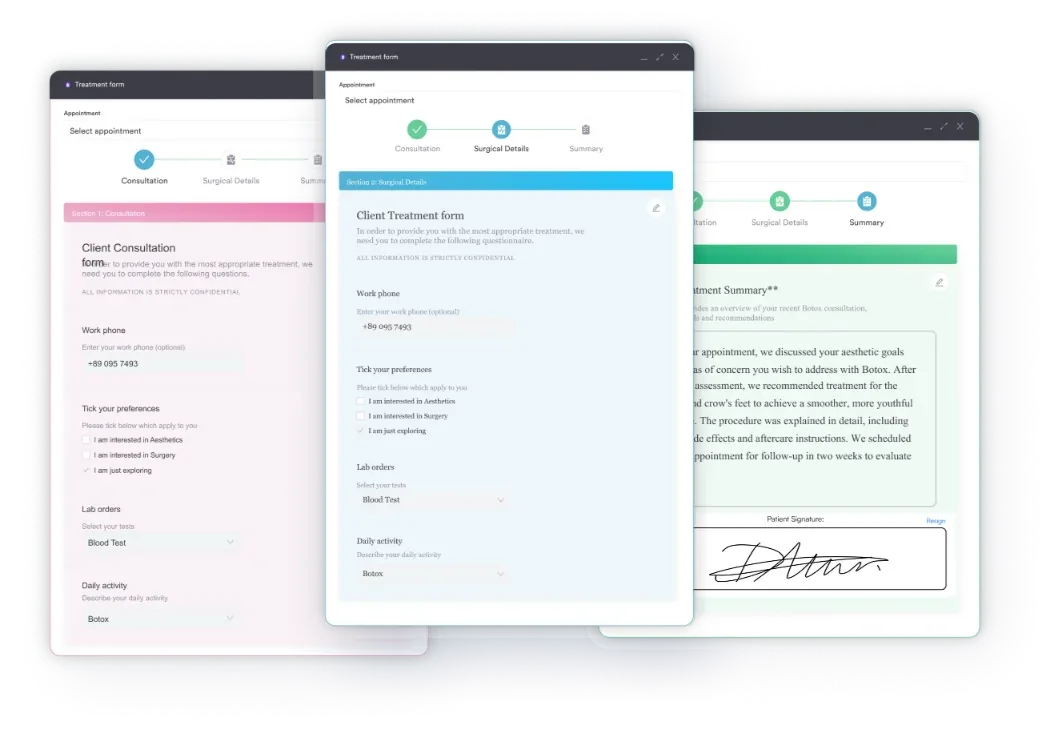
Practice management software like Pabau attaches the completed worksheet to the client file, timestamps it, and cross-references it in the session note. Four things follow from that:
Get the surrounding paperwork right too. Your notice of privacy practices should already tell clients how sensitive records are handled. The guidance on safer clinical notes covers how to write about suicidal ideation precisely and defensibly.
Two national resources sit either side of the worksheet. The NIMH ASQ toolkit supplies validated screening questions to run before it. SAMHSA publishes the national policy context, including the 988 Suicide and Crisis Lifeline.
Every worksheet needs current crisis numbers on it, written where the client will look first.
Clients outside the US need their own regional line, such as Samaritans in the UK on 116 123. Where a plan may involve a hospital admission or a period without capacity, a medical power of attorney is worth discussing alongside the worksheet.
Safety planning takes something out of the clinician too. Have crisis intervention strategies in place for your own team before a session goes badly.
The form adapts to settings beyond a one-to-one outpatient session.
In group therapy, a simplified version works as a psychoeducation exercise for every member. Check first that your group therapy informed consent covers what gets shared with the group. In community mental health centers, complete it at intake to set a baseline, then revisit it at each follow-up. School counselors can run a teen-friendly version as part of a risk assessment.
Check the client is somewhere private before you start. Agree a backup plan in case the session destabilizes them. Send the completed worksheet through secure messaging rather than plain email.
The Stanley-Brown Safety Planning Intervention has been evaluated in multiple randomized controlled trials. It is endorsed or adopted by SAMHSA, the Department of Veterans Affairs, the 988 Suicide and Crisis Lifeline, and the Zero Suicide Initiative. The NIMH ASQ remains the reference brief screening instrument.
A worksheet does not prevent suicide on its own. It sits inside a full clinical approach that includes accurate diagnosis, evidence-based psychotherapy, medication management where indicated, and ongoing monitoring. It never substitutes for a thorough clinical interview, a proper risk assessment, or admission when risk is imminent.
The completed worksheet documents that assessment and planning happened, which matters clinically and legally. Your therapeutic relationship and your own clinical judgment still carry the weight.
In most practices a safety plan lives as a PDF on a shared drive. Sometimes it is a scan attached to an email, or a photocopy in a paper file. Nobody is certain which version is the latest. When a colleague picks the client up, the plan gets hunted down or written again from scratch.
Practice management software like Pabau holds the worksheet as a digital form inside the client record. The client completes their own sections through the portal, before or during the session. The finished plan then saves against their file with a date and a version number. The system flags any plan older than six months for review.
For a group running therapy practice management across several clinicians, that means any colleague opening a record sees the current plan in seconds. The access log already shows who viewed it and when, so you can answer a HIPAA request without reconstructing anything.

Pabau holds safety planning worksheets as digital forms inside the client record, with dated versions, review reminders, and a full access log. Your team sees the current plan the moment they open the file.

Pick a worksheet built on the Stanley-Brown structure and use it as a script for a conversation, not a form to process. The clinical value comes from the client naming their own warning signs and their own reasons to stay.
What decides whether the plan still helps in six months is where it lives afterwards. A safety plan a colleague cannot find at 9 PM on a Friday is not protecting anyone.
So keep one version, in the client record, with a date on it and a review already scheduled. Book a demo to see how Pabau stores safety planning worksheets against the client record and flags the ones due for review.

Need the finished document clients take home? Suicide safety plan template is the client-facing plan this worksheet feeds into, ready to save straight to the record.
Working with an adolescent client? Safety Plan For Teenagers Template adapts the same Stanley-Brown structure with simpler language and space for parent involvement.
Setting up the relationship before risk work starts? Counseling informed consent form covers what to disclose about confidentiality limits before a safety plan is ever needed.
The worksheet is the form the clinician works through to assess risk and plan ahead. The safety plan is what comes out of it, written in the client’s own words. One is the process, the other is the document the client keeps.
Any mental health professional conducting suicide risk assessment, including therapists, counselors, psychiatrists, psychiatric nurses, social workers, and primary care clinicians. It is standard of care in behavioral health, and expected in organizations implementing Zero Suicide.
Yes, with simpler language and fewer sections. Teen versions lean on peer support and concrete coping steps, with parent involvement where that is clinically indicated. Avoid clinical jargon and use examples a teenager recognizes.
Every six months at minimum for stable clients. Review it sooner if risk escalates, circumstances change, or the client has used the crisis plan. Checking it at every session is better practice.
The SPI is an evidence-based safety planning model developed by Barbara Stanley and Gregory Brown. It covers warning signs, coping strategies, people to contact, and crisis resources, all identified with the client. It is endorsed or adopted by SAMHSA, the Department of Veterans Affairs, the 988 Suicide and Crisis Lifeline, and the Zero Suicide Initiative.
Therapist Aid, Psychology Tools, and the NIMH all publish free downloads, and the template at the top of this page is free too. Check that whichever you choose follows the Stanley-Brown structure.