CPT code 21011: Excision of soft tissue tumor of the face
CPT code 21011: Official descriptor and procedure overview CPT code 21011, as pu...

Last Updated: Oct 8, 2026
Billable Code Specific Code
S21.429A is the billable ICD-10-CM code for laceration with foreign body of unspecified back wall of thorax with penetration into thoracic cavity, initial encounter.
Let Pabau's smart automation suggest the right codes, reduce claim denials, and keep your practice compliant—effortlessly.
Automate repetitive tasks and focus on what matters most—your patients.
Reduce coding errors and ensure compliance with the latest regulations.
Clean claims, fewer denials, and faster reimbursements.
Powerful insights and reporting to help your practice thrive.
HIPAA compliant SOC 2 certified GDPR-compliant Trusted by 4,000+ clinics worldwide

S21.429A covers laceration with foreign body of the unspecified back wall of thorax, with penetration into the thoracic cavity, initial encounter.
This is a penetrating chest wall injury, so the record must confirm the wound breached the pleural space. A superficial back wall wound is S21.229A instead.
The 7th character A means initial encounter. Switch to D once active treatment ends, and to S for a late effect of the wound.
Use S21.429A only when the side is undocumented. If the note names the right or left back wall, code S21.421A or S21.422A.
Code the associated intrathoracic injuries alongside it, such as traumatic pneumothorax S27.0 or hemothorax S27.1. Those diagnoses drive the MS-DRG.
Practice management software like Pabau links to the Claim.MD clearinghouse, so coded thoracic injury claims submit electronically with real-time eligibility verification.
ICD-10 code S21.429A covers a laceration with a retained foreign body on the unspecified back wall of the thorax. In this case, the wound penetrated the thoracic cavity, and the 7th character A marks the initial encounter.
It is a fully billable, encounter-specific ICD-10-CM code. Specifically, the 2026 edition took effect on October 1, 2025. In addition, it is valid on all HIPAA-covered transactions wherever a principal or secondary diagnosis code is required.
In particular, three documentation problems account for most denials on these claims. Specifically, the note omits the foreign body, carries the wrong encounter character, or leaves the side of the back wall unstated. Sound medical billing workflows for traumatic injuries close all three off before submission.
The National Center for Health Statistics and CMS maintain the code jointly. In addition, both bodies publish it under the ICD-10-CM Official Guidelines for Coding and Reporting.
The code sits in the S21.4 subcategory, which covers open wounds of the back wall of the thorax with penetration into the thoracic cavity. Consequently, penetration makes this a more serious injury than a surface chest wall laceration, and it changes both the procedure coding and the DRG.
Each element of the full description carries a distinct coding decision. As a result, misreading any one of them produces a different code.
Two elements cause most of the trouble. For example, coders read “thorax” as the front of the chest, and they treat penetration as an assumption rather than a documented finding. Neither shortcut survives an audit, because a different code family covers each of those scenarios.
The unspecified qualifier is the third weak point. For instance, emergency notes often document “left posterior chest wall”, which makes S21.429A wrong and S21.422A correct. As a result, defaulting to the unspecified code when the side is charted invites payer scrutiny.
Four S21 families describe a laceration with foreign body of the chest wall. Specifically, they differ on two points. One is which wall the wound sits on. The other is whether the wound entered the thoracic cavity.
Read the wall and the penetration status off the clinical note before you open the tabular list. In short, those two facts narrow the choice to one family, and laterality then fixes the sixth character.
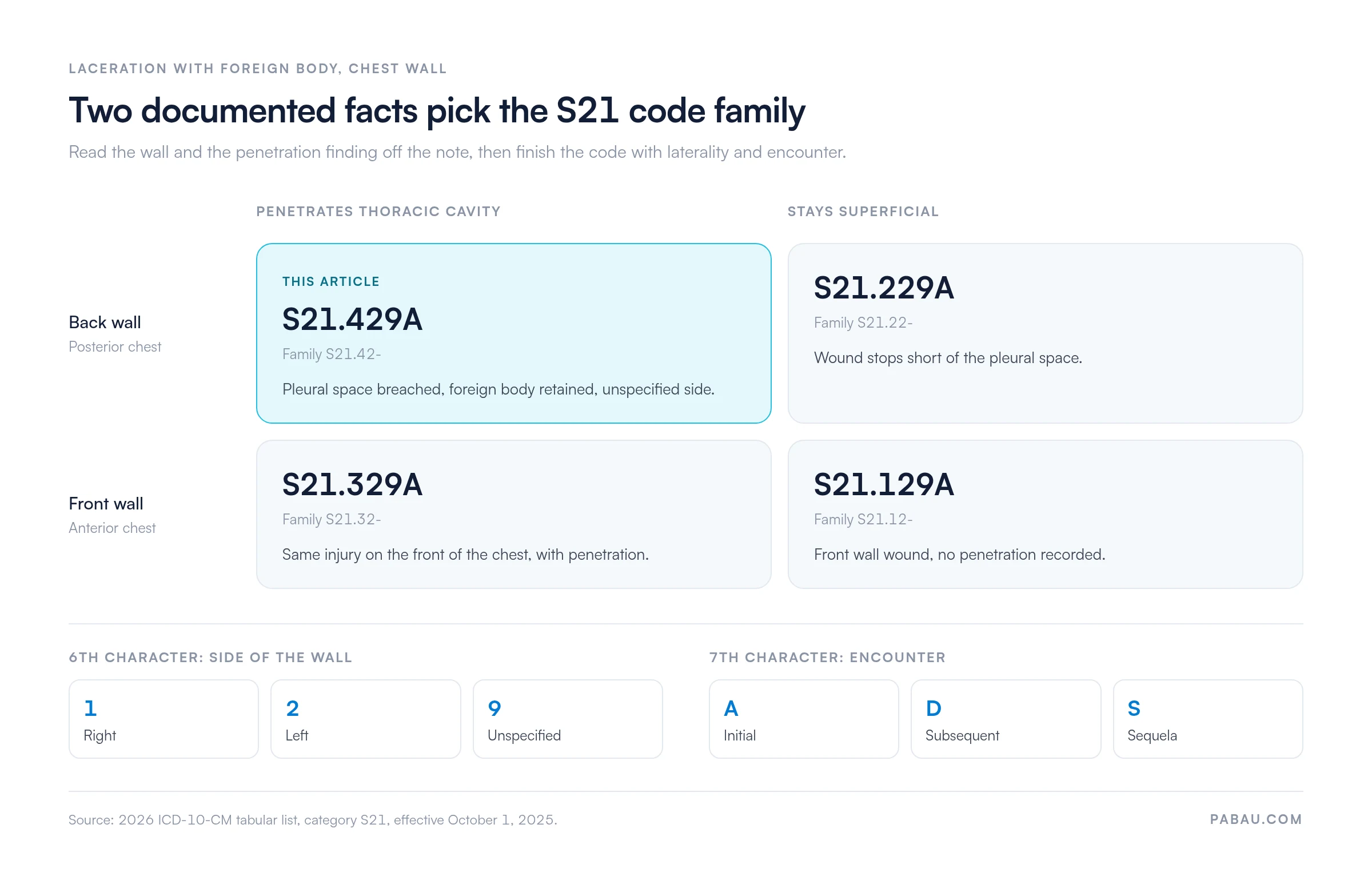
S21.429 requires a 7th character. Indeed, without it the code is invalid and the claim will reject. The three valid extensions and when to apply each are shown below.
A common error is keeping S21.429A across every visit for the same wound. Once the patient moves into routine follow-up, D is correct, the way S24.3XXD reports a later encounter for a thoracic nerve injury. Those follow-up visits often sit with an outpatient physical therapy practice rather than the trauma team.
In addition, the character decides whether a POA indicator is needed. Injury codes with a 7th character of D or S sit on the CMS present-on-admission exempt list, while the A codes do not.
Knowing where S21.429A sits in the hierarchy helps coders navigate to sibling codes when laterality, wound type or penetration status differs.
Coders working inside S21.42- face one decision. Is the side documented? If it is, use the specific code. If it is not, use the unspecified code.
Three neighboring groups round out the penetrating back wall subcategory.
S51.029S applies the same sequela character in another laceration with foreign body family, so encounter selection carries across injury categories.
In this case, S21.429A describes the chest wall wound only. Because the wound entered the thoracic cavity, the tabular list carries a “code also” instruction for every injury found inside. In fact, those additional codes usually matter more to the DRG than the wound code itself.
Notably, one Excludes1 note applies. Partial traumatic amputation of the thorax is S28.1, and it is never reported with an S21 code for the same injury.
External cause codes describe how the wound happened, and the mechanism detail usually comes off the incident form completed at presentation. In this case, ICD-10-CM sets no national mandate for reporting them. However, many state registries and payers do require them, so check the rules that apply to your practice.
For inpatient stays, S21.429A groups under the CMS MS-DRG grouper. Version 43.0 took effect on October 1, 2025 for FY2026, and version 43.1 took effect on April 1, 2026. Cite the version your facility is running, because the grouping logic changes each year.
In particular, under v43.0 the code maps to five MS-DRGs. Two are 913 and 914, traumatic injury with and without an MCC. The other three are 963, 964 and 965, covering other multiple significant trauma across the MCC, CC and no-CC splits.
Which one applies depends on the whole claim, not on the wound code alone. The grouper reads every coded diagnosis and procedure, so a documented pneumothorax or rib fracture can move the case. Reimbursement then varies by payer, wage index and the CC or MCC split.
Indeed, S21.429A is not present-on-admission exempt. As a result, a POA indicator is required on the inpatient claim. A wound sustained before arrival takes the Y indicator. However, only the D and S variants of the code sit on the CMS exempt list.
For instance, practices submitting electronically through the Claim.MD integration can validate POA indicators and code combinations at submission. As a result, that cuts the manual check burden on coding staff, and payer edits come back fast enough to correct and resubmit.
Run the DRG check through the CMS grouper rather than a lookup table. A table shows what the wound code alone can group to. The grouper also reads the associated pneumothorax, hemothorax and rib fracture codes. That is where most of the payment difference on a penetrating chest injury sits.
S21.429A is a diagnosis code and describes the injury. The treatment is reported separately with CPT. Because the wound penetrated the thoracic cavity, the likely procedures are wound exploration, chest drainage and, in severe cases, thoracotomy.
The wound exploration code carries most of the bundling risk. In fact, CPT 20101 already includes enlargement of the wound, extension of the dissection, debridement, foreign body removal and control of minor bleeding. Therefore, adding 10120 or a repair code for the same wound bills work that 20101 covers.
Two rules decide the rest. If major repair requires a thoracotomy or laparotomy, the specific thoracic code replaces 20101. If the closure needed no exploration or extended dissection, an integumentary repair code applies instead.
In this case, simple repair codes 12001-12007 run from wounds of 2.5 cm or less through wounds over 30.0 cm, coded by size. They rarely fit this diagnosis, because a wound that reached the pleural space is not a superficial closure.
Tube thoracostomy is designated a separate procedure. As a result, it is not reported on its own when an open thoracic procedure is performed on the same side at the same session. Therefore, check the operative note before you add 32551.
Verify pairings against current AMA guidance using the AAPC crosswalk tool. Similarly, the same split shows up in IVF CPT codes and every other specialty. In short, the CPT code reports what was done, and the ICD-10 code reports what was treated.
The record must support every element of the code description. Otherwise, a claim carrying S21.429A can be denied on submission or challenged on audit.
In general, for broader standards across injury billing, medical billing compliance requirements set out how the Official Guidelines apply to the whole clinical record.
Five patterns account for most claim issues on penetrating back wall wounds.
A working denial management process catches these before the payer does. In particular, a pre-submission review that checks wall, penetration, laterality, encounter type and associated injuries removes the most predictable denial reasons. Indeed, the denial codes tied to unspecified diagnoses are both the most common and the most avoidable.
Build a five-point checklist for S21 thorax claims. Confirm the wall, the penetration finding, the laterality and the encounter character. Then confirm every associated intrathoracic injury is coded. Running it on each claim catches the front-and-back mix-up that produces the wrong code family.
Getting S21.429A right depends on clinical detail reaching the coder. In fact, the chart, the operating note and the billing tool often live in separate systems. As a result, a pleural violation recorded in the operating room never reaches the person selecting the code.
Pabau is practice management software with claims management built in, so the clinical note and the claim sit in one platform. Consequently, the coder reads the record and prepares the claim in the same workflow. As a result, wall, penetration status, foreign body and encounter type are all visible at the point of code selection.
Claims then route through the Claim.MD clearinghouse, which checks required fields and code combinations and returns payer edits in real time. That matters most on trauma claims, where a missing associated diagnosis is the difference between payment and rework.

The same problem shows up outside the trauma bay, in sports medicine practices and the outpatient teams that pick up follow-up encounters. Indeed, submitting a clean claim first time cuts the administrative cost of rework. In addition, Pabau supports electronic 837P submission, real-time eligibility verification and ERA processing across the whole claim lifecycle.

Pabau connects your clinical documentation directly to claims submission via Claim.MD – so coding teams spend less time chasing errors and more time on patient care. See how it works with a personalised walkthrough.

In short, S21.429A rewards a note that commits to specifics. The wall, the retained foreign body and the pleural breach each have to appear in writing. Without all three, the claim belongs to a different code family.
Above all, the unspecified side is the one element worth settling internally. Coders default to it, and payer edit software flags it. Therefore, agree a rule with your clinicians about when the chart has to name a side.
For example, code the associated pneumothorax, hemothorax and rib fractures alongside the wound, and the DRG reflects what the patient presented with. Otherwise, leaving them off means the claim understates a serious injury.
Overall, Pabau keeps the clinical note, the laterality, the penetration finding and the encounter type visible while the claim is prepared. That is what makes billing predictable on trauma work. To see how it handles ICD-10 documentation and claims submission end to end, book a demo.

Coding an injury where the note names the side? S42.452A shows how a laterality-specific injury code is built and documented.
Need the sequela character in another injury family? S69.91XS walks through when active treatment ends and S becomes correct.
Losing operative detail before it reaches the coder? Best medical transcription software compares the tools that get clinical dictation into the record.
Looking for clearinghouse integration guidance? Claim.MD clearinghouse guide walks through how the clearinghouse connection supports clean ICD-10 claim submission and ERA processing.
S21.429A is the ICD-10-CM code for laceration with foreign body of the unspecified back wall of the thorax. The wound penetrates the thoracic cavity, and A marks the initial encounter. In addition, it is a billable code in the 2026 ICD-10-CM edition, effective October 1, 2025.
Yes. S21.429A is a fully specified, billable ICD-10-CM code and can be reported as a principal or secondary diagnosis on HIPAA-covered claims. Indeed, its billable status is confirmed in the CDC and NCHS ICD-10-CM tabular list.
Back wall. S21.429A describes the posterior chest wall, and the wound must have penetrated the thoracic cavity. In contrast, the front wall equivalents are S21.129A without penetration and S21.329A with penetration, so check the wall before you code.
Use S21.429A only when the record genuinely cannot establish which side of the back wall was wounded. If the note documents the right side, S21.421A is correct. If it documents the left side, S21.422A is correct.
The record must document the wound as a laceration and name the retained foreign body. In addition, it must place the wound on the posterior thoracic wall and confirm penetration into the thoracic cavity. Finally, it must show this is the initial active-treatment encounter, and code any associated intrathoracic injury.