CPT code 21011: Excision of soft tissue tumor of the face
CPT code 21011: Official descriptor and procedure overview CPT code 21011, as pu...

Last Updated: Oct 8, 2026
Billable Code Specific Code
S24.3XXD is the billable ICD-10-CM code for injury of peripheral nerves of thorax, subsequent encounter.
The code sits in the same S24 category as the thoracic spinal cord codes, and it shares their XX placeholder shape. That resemblance is why it lands on claims that document a cord syndrome, where a level-specific cord code belongs instead.
Let Pabau's smart automation suggest the right codes, reduce claim denials, and keep your practice compliant—effortlessly.
Automate repetitive tasks and focus on what matters most—your patients.
Reduce coding errors and ensure compliance with the latest regulations.
Clean claims, fewer denials, and faster reimbursements.
Powerful insights and reporting to help your practice thrive.
HIPAA compliant SOC 2 certified GDPR-compliant Trusted by 4,000+ clinics worldwide

ICD-10 Code S24.3XXD means injury of peripheral nerves of thorax, subsequent encounter, and it is not a spinal cord code
Anterior cord syndrome of the thoracic cord is coded in the S24.13- family, which is level specific and runs from S24.131 to S24.139
The 7th character D marks the follow-up phase, so use S24.3XXA during active treatment and S24.3XXS for a late effect
The two X placeholders in positions 5 and 6 are structurally required, and dropping them produces a code that does not exist
Practice management software like Pabau turns the coded invoice into an electronic claim and tracks its status through our Claim.MD integration
S24.3XXD sits in ICD-10-CM Chapter 19, which covers injury, poisoning and certain other consequences of external causes. It is a billable code, valid for HIPAA-covered electronic transactions. The descriptor has not changed since the first ICD-10-CM release on October 1, 2015.
The code is unchanged in the FY2026 tabular list published by the Centers for Medicare and Medicaid Services (CMS). Individual Medicare Administrative Contractors (MACs) may still attach their own documentation requirements through a local coverage determination.
S24.3XXD is a seven-character code, and every position carries a distinct meaning. All seven characters have to be present for the code to be complete. Here is what each segment does:
The decimal point falls after the third character and belongs to the official code notation. Write the code as S24.3XXD in the medical record and in any printed documentation. Electronic claim formats and the CMS-1500 form drop the decimal, so the same code transmits as S243XXD. You can confirm the character structure in the CDC ICD-10-CM browser tool.
S24.3 classifies traumatic injury to the peripheral nerves of the thorax. Those are the nerves running in the chest wall itself, chiefly the intercostal nerves and their cutaneous branches. The ICD-10-CM Alphabetic Index routes the entry for injury of a peripheral nerve of the thorax straight to S24.3.
Typical documented causes include rib fracture, blunt or penetrating chest trauma, and nerve injury following thoracotomy or chest tube placement.
The code is not a spinal cord code, and it carries no level specificity. Category S24 also holds the thoracic spinal cord codes, the nerve root code and the sympathetic nervous system code. All of them share one category heading. That shared heading is what leads coders to the wrong subcategory.
The tabular list also carries an Excludes2 note for injury of brachial plexus, which is coded to S14.3 instead.
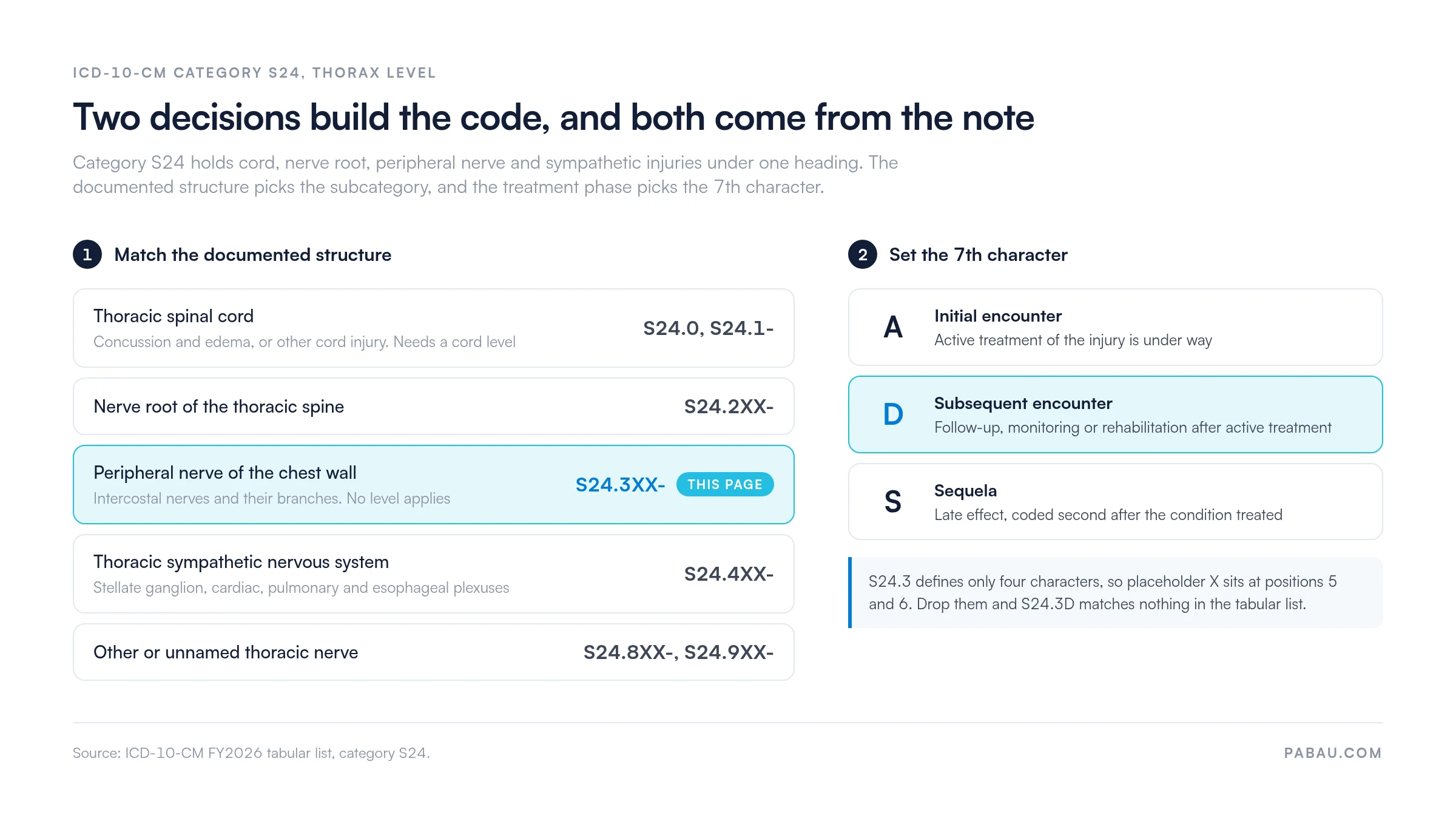
Match the documented structure to the subcategory before you build the code:
The 7th character then sets the treatment phase, so every S24 claim rests on two decisions.
Anterior cord syndrome of the thoracic spinal cord is coded in the S24.13- subcategory, not in S24.3. This is the single most common mis-assignment in the S24 category, and it changes the clinical meaning of the claim completely. S24.13- is level specific, so the sixth character records where the cord lesion sits. Each code then takes the same 7th character for encounter type.
Two tabular notes govern this family. The first tells you to code to the highest level of thoracic spinal cord injury. The second explains that S24.0 and S24.1 refer to the cord level, not the bone level. A cord lesion can also affect nerve roots at and below that level. Query the provider for the level before you fall back on S24.139D.
Read the sixth character before you accept a syndrome name. If the record says anterior cord syndrome, Brown-Sequard syndrome or a complete lesion, the code lives in S24.1- and needs a cord level. S24.3XXD has no level, because a peripheral nerve of the chest wall does not have one.
The 7th character is the most consequential decision on this claim, and the wrong one is a routine denial trigger. Subsequent encounter does not mean the second visit in the calendar sense. It means the patient has moved past the active treatment phase for the injury itself.
Category S24 offers only these three characters. Fracture categories run much longer lists that also record healing status, which is how a radial neck nonunion lands on S52.136N. A peripheral nerve code has no equivalent option, so anything past the follow-up phase is a sequela.
Common mistake: some coders keep S24.3XXA on every outpatient visit because the patient is still being seen. The ICD-10-CM Official Guidelines tie A to active treatment, not to visit count. Once the acute phase closes and the encounter becomes monitoring or rehabilitation, D is the correct character. The same reading runs across the injury chapters, so a healing wrist dislocation takes S63.004D.
The two X characters at positions 5 and 6 are not optional. Every code in category S24 needs a 7th character, but S24.3 only defines four characters of clinical content. ICD-10-CM fills positions 5 and 6 with the placeholder X so the encounter character lands in position 7. This is a structural rule, not a clinical qualifier.
Drop the placeholders and you produce S24.3D, a five-character string that does not exist in the tabular list. Depending on how the payer adjudicates, the result is a front-end rejection or a request for a corrected claim. Either way, someone reworks it. Solid claim denial management starts with a structural check on every injury code before submission.
Count the characters before the claim goes out. S24.3XXD has seven characters plus the decimal. If your string is shorter, a placeholder X is missing, and the code will not match the tabular list.
Category S24 covers injury of nerves and spinal cord at thorax level. Choosing correctly means separating cord injuries from nerve root, peripheral nerve and sympathetic injuries. The table below lists the subsequent encounter codes most often considered alongside S24.3XXD, plus the other two encounter types for S24.3 itself.
Thoracic spinal cord injury has no central cord syndrome subcategory. That option exists only at the cervical level, under S14.12-. If a thoracic record documents central cord syndrome, query the provider rather than forcing the code into S24.
S24.3XXD is valid for HIPAA-covered electronic transactions. It is accepted on Medicare Part B outpatient claims, Part A inpatient records and Medicaid claims in most states. The documentation has to name the injured structure, because the whole code choice turns on it. A note that records chest wall nerve injury supports S24.3XXD, while a note that records a cord syndrome does not.
Chapter 19 asks for a secondary code from Chapter 20 to identify the cause of the injury. Category S24 carries a code also note on top of that. Report any associated fracture of a thoracic vertebra, open wound of the thorax or transient paralysis alongside the nerve code.
An open chest wall wound with a retained foreign body sits in S21.4, coded as S21.429A on the initial encounter. Match the encounter character across both codes when the patient comes back. Building those companion codes into your medical billing workflow keeps the claim complete on first submission.
S24.3XXD is a diagnosis code, so it never stands alone on a claim. It supports the CPT code for whatever service the visit delivered. The codes below come up regularly in chest wall nerve injury follow-up, and each one still has to be supported by the note. CPT descriptors change annually, so confirm the current year before you submit.
The subsequent encounter character exists for the post-acute phase. Once the patient leaves acute care, outpatient visits that manage the chest wall nerve injury take S24.3XXD. That covers pain management review, physical therapy practice visits and repeat electrodiagnostic testing. Rib injuries from contact sport bring the same visits into a sports medicine practice.
One exception matters. If the patient is readmitted for active treatment of the injury itself, that admission reverts to S24.3XXA. A surgical revision or a new repair both qualify. Active treatment of the injury means A, and the monitoring or rehabilitation phase means D.
Aftercare Z codes are not used for traumatic injuries. Injury codes carry their own encounter character instead, so S24.3XXD replaces any aftercare code you might reach for on a post-surgical follow-up. Confirm the payer’s clean claim requirements before you bill the visit.
Record the moment active treatment closes. A discharge summary line saying the patient is moving to outpatient follow-up gives every later claim a documented basis for the D character. That is exactly what a payer asks for on review.
Coding an injury code correctly is only half the job. The code then has to reach the payer from the clinical note without being retyped. That handoff is where practices lose time. Many teams finish the note in one system, then rekey the diagnosis and procedure codes into a billing tool. Checking what happened next means logging into a clearinghouse portal.
Practice management software like Pabau keeps the whole chain on one record. The diagnosis and procedure codes you select sit on the appointment and its invoice.
Pabau’s claims management software then turns that invoice into an electronic CMS-1500 claim. Our Claim.MD integration sends the claim to thousands of US payers and runs real-time eligibility checks. Electronic remittance advice comes back against the claim it settles.
For a practice billing S24.3XXD across several MACs, that matters on the follow-up. Every claim keeps its status in Pabau, from submission through acceptance, payment or denial. You can see which encounters need rework without leaving the patient record. The result is fewer rekeying errors and a shorter path from visit to payment. Wider medical billing compliance guidance sits in our dedicated guide.

Pabau’s claims management software builds the electronic claim from the invoice you already raised. Our Claim.MD integration submits it and tracks every status change, so denials surface early.

S24.3XXD rewards one habit above all others. Read the documented structure before you read the category heading. Category S24 puts cord, nerve root, peripheral nerve and sympathetic injuries under a single title, and the shared placeholder shape makes them look interchangeable. They are not, and a peripheral nerve code on a cord injury misstates the patient’s condition as well as the claim.
So work in this order. Confirm the injured structure, then pick the subcategory. Add a cord level if that subcategory needs one. Set the encounter character from where the patient sits in treatment. The trade-off worth remembering is that S24.9XXD is always available and almost never the right answer. A provider query costs less than a reworked claim.
To see how Pabau moves coded visits straight into electronic claims and tracks them to payment, book a demo.

Coding the chest wound alongside the nerve injury? ICD-10 code S21.429A covers laceration with a foreign body in the back wall of the thorax.
Need the same 7th character logic on a joint injury? ICD-10 code S63.004D walks through an unspecified wrist dislocation at follow-up.
Working with fracture codes that record healing status? ICD-10 code S52.136N explains the nonunion 7th characters on a radial neck fracture.
Want to reduce denial rates on trauma diagnosis codes? Denial codes in medical billing maps the common CARC codes to corrective actions.
ICD-10 Code S24.3XXD is a billable ICD-10-CM diagnosis code for injury of peripheral nerves of thorax, subsequent encounter. It applies to follow-up visits for a chest wall nerve injury once the active treatment phase has ended.
No. Anterior cord syndrome of the thoracic spinal cord is coded in the S24.13- subcategory, which is level specific. Use S24.131D through S24.134D when the cord level is documented, and S24.139D when it is not. S24.3XXD covers peripheral nerves of the chest wall instead.
The 7th character D designates a subsequent encounter, meaning active treatment has ended and the patient is in routine care, monitoring or rehabilitation. Character A applies during active treatment, and character S applies to a sequela of the original injury.
Every code in category S24 requires a 7th character, but subcategory S24.3 only defines four characters of clinical content. ICD-10-CM inserts placeholder X characters at positions 5 and 6 so the encounter character lands in position 7. Omitting them creates an invalid code.
S24.2XXD covers injury of nerve root of the thoracic spine and S24.4XXD covers injury of the thoracic sympathetic nervous system. Thoracic spinal cord injuries sit in S24.0 and S24.1-, and both need a documented cord level.