HCPCS code J1245: Diphenhydramine injection billing guide
HCPCS code J1245: Definition and quick reference HCPCS code J1245 is the Level I...

Last Updated: Nov 10, 2026
V2628 is the HCPCS Level II code for fabrication and fitting of ocular conformer.
HCPCS code V2628 is the Level II code used to bill a custom-fabricated plastic prosthetic eye supplied to a patient following enucleation, evisceration, or orbital exenteration. Coders and DMEPOS suppliers routinely confuse V2628 with its neighbor V2629 ("other type"), and that one-digit error is among the most common reasons prosthetic eye claims are denied on first submission.
Let Pabau's smart automation suggest the right codes, reduce claim denials, and keep your practice compliant—effortlessly.
Automate repetitive tasks and focus on what matters most—your patients.
Reduce coding errors and ensure compliance with the latest regulations.
Clean claims, fewer denials, and faster reimbursements.
Powerful insights and reporting to help your practice thrive.
HIPAA compliant SOC 2 certified GDPR-compliant Trusted by 4,000+ clinics worldwide

HCPCS code V2628 applies specifically to a custom plastic prosthetic eye, distinguishing it from stock prostheses and from V2629, which covers non-plastic or other-type prosthetic eyes.
Only DMEPOS-enrolled suppliers, typically certified ocularists or prosthetic device suppliers, may bill V2628. Ophthalmology practices billing professional services on a CMS-1500 cannot use this code.
Every V2628 claim requires a laterality modifier (LT or RT) plus an NU or RP modifier, a supporting ICD-10 diagnosis code, a physician order, and documented proof of the underlying surgical procedure.
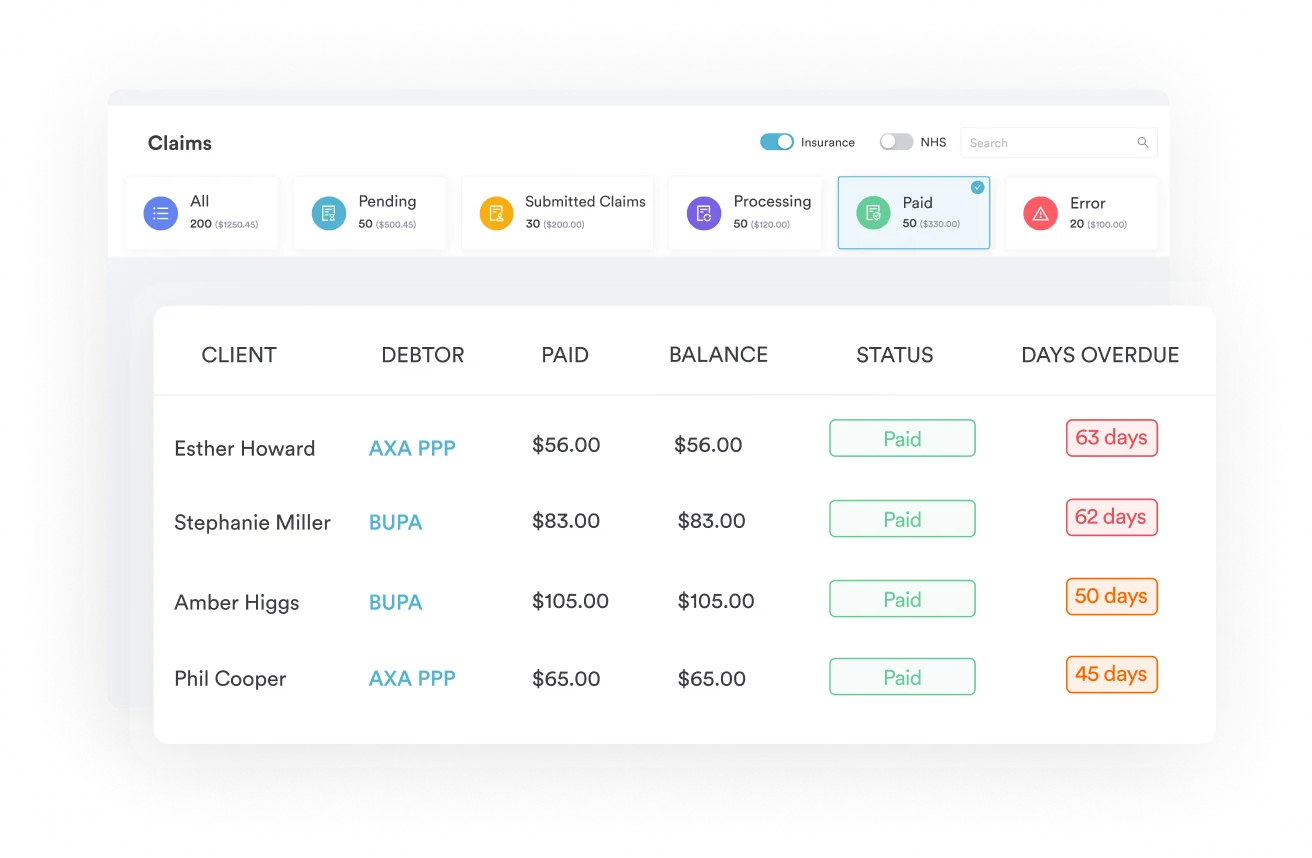
Pabau’s claims management software helps ocularist practices and DMEPOS suppliers track claim status, flag missing modifiers before submission, and manage denial workflows from one dashboard.
HCPCS code V2628 is the Level II alphanumeric code maintained by the Centers for Medicare and Medicaid Services (CMS) for a prosthetic eye made of plastic, custom-fabricated to fit an individual patient’s ocular socket. The “custom” designation in the descriptor is not incidental. It is the clinical and billing distinction that separates V2628 from stock prosthetic eye codes and from V2629, which covers other material types.
V2628 sits within the V2600-V2629 series of HCPCS codes covering low vision aids and ocular prosthetic devices. It is billed on a DMEPOS claim, not on a professional services claim form.
V2628 covers the supply of one custom-fabricated plastic prosthetic eye delivered to a patient whose eye has been surgically removed or whose socket requires prosthetic restoration. Custom fabrication means the prosthesis is individually made and fitted to the patient’s specific socket dimensions and cosmetic characteristics by a certified ocularist.
An ocular conformer is a smooth, clear shell placed in the socket immediately after surgery to maintain socket shape during the healing period. It is not a cosmetic prosthesis and is never billed under V2628. Failing to separate the conformer and the custom prosthesis onto different claims is a common unbundling error that triggers audits.
The single most common coding error on prosthetic eye claims is selecting V2629 when V2628 is correct, or vice versa. The distinction is material type and fabrication method: V2628 is plastic and custom; V2629 is any other type. When the prosthesis is glass, acrylic of a non-plastic classification, or any material outside the plastic category, V2629 applies.
When an ocularist’s invoice specifies plastic and custom fabrication, V2628 is the correct code. If the documentation does not confirm the material as plastic, bill V2629 and note the actual material in the claim notes field.
V2628 is a DMEPOS code, which means only suppliers enrolled in Medicare as DMEPOS suppliers may bill it. This is a hard eligibility rule. Ophthalmology physician practices billing professional services on the Medicare Physician Fee Schedule cannot bill V-series HCPCS codes for prosthetic devices.
Proper understanding of medical billing workflows at the supplier level prevents the common error of a physician practice billing the device code alongside the professional service, which triggers CO-4 or CO-11 denials.
Every V2628 claim requires at least one ICD-10-CM diagnosis code that establishes medical necessity. Payers validate that the diagnosis supports the need for a prosthetic eye. Missing or mismatched diagnosis codes are the second most common denial cause after incorrect code selection.
Z89.011 and Z89.012 are the most commonly accepted codes under DME MAC Local Coverage Determinations (LCDs) for prosthetic eye coverage. The laterality in the ICD-10 code must match the laterality modifier on the HCPCS code. A claim with Z89.011 (right eye) but modifier LT (left) will deny on mismatch.
HCPCS code V2628 requires two modifier types on every claim: A laterality modifier identifying which eye received the prosthesis, and a supply status modifier indicating whether this is a new device or a replacement. Submitting V2628 without both modifiers is one of the fastest paths to a CO-4 denial.
Apply LT or RT first, then NU or RP as the second modifier. Some DME MACs require the modifiers in this exact sequence. Confirm your MAC’s Local Coverage Determination for any jurisdiction-specific sequencing rules before submission.
Documentation failures cause more V2628 denials than incorrect code selection. A clean claim for a custom plastic prosthetic eye requires the following records to be on file before submission, not assembled after a denial.
Under medical billing compliance requirements, all documentation must be retained for a minimum of seven years and must be available for MAC audit requests. Some LCDs require a detailed written order (DWO) rather than a standard prescription. Check your DME MAC’s specific LCD for the required documentation format.
Run a documentation checklist before submitting any V2628 claim: physician order dated before delivery, operative report on file, ocularist fitting notes confirming custom fabrication, laterality confirmed in both the ICD-10 code and HCPCS modifier, and supplier invoice showing delivery date. Catching a missing document pre-submission costs minutes; catching it post-denial costs weeks.
Medicare Part B does not require prior authorization for the initial supply of a custom prosthetic eye under most DME MAC LCDs. The National Coverage Determination (NCD 150.1) covers artificial eyes, and coverage is considered medically reasonable and necessary following surgical eye removal.
Replacement frequency is a different matter. Most DME MAC LCDs allow one replacement prosthetic eye every five years under Medicare, absent documented medical necessity for earlier replacement. Replacement before the five-year limit requires documentation of one of the following conditions.
Medicaid programs have varying prior authorization requirements. Several state Medicaid programs require prior authorization for any prosthetic eye supply, including initial provision. Confirm requirements with the specific state Medicaid MAC before submission. Private payers also vary. Many commercial plans require prior authorization and have different replacement frequency limits, sometimes as short as three years.
HCPCS code V2628 is reimbursed under the Medicare Part B DMEPOS Fee Schedule, not the Physician Fee Schedule. Rates are set by CMS and updated annually. The CMS Physician Fee Schedule search tool covers professional services. For DMEPOS allowables, use the CMS DMEPOS fee schedule files published each year on the CMS website.
Key reimbursement facts for V2628 under Medicare Part B.
Use the AAPC HCPCS code lookup to cross-reference V2628’s descriptor and confirm the current status of the code for the billing year. For current-year allowable amount lookups, the PGM Billing HCPCS lookup tool pulls directly from CMS published data.

Pabau’s claims management software tracks submission status, flags modifier errors before they reach the payer, and centralises denial resolution so your team spends less time on rework and more time on patients.

HCPCS code V2628 has a predictable set of denial patterns. Most practices that bill prosthetic eye codes regularly see the same five or six denial reasons cycling through their AR. Understanding the root cause of each denial shapes the resolution strategy and, more importantly, shapes the pre-submission workflow that prevents recurrence. Tracking denial management patterns across V2628 claims is the fastest way to identify systemic documentation gaps.
See the full denial code reference for CARC/RARC code definitions and resolution workflows. For V2628 specifically, the laterality mismatch and wrong-code errors together account for the majority of first-pass denials in most ocularist practices.
Understanding where HCPCS code V2628 sits in the clinical timeline prevents the most common workflow-level billing errors: Billing the custom prosthesis too early, bundling separate service codes, and missing interim codes that apply before V2628 is appropriate.
Pabau’s claims management software supports this multi-step workflow by allowing practices to attach documentation to individual claims, track stage-by-stage claim progress, and flag incomplete records before submission. For practices managing both the clinical and billing sides of prosthetic eye supply, centralising the documentation against the claim record cuts the rework time when a denial arrives.
Set the service date on a V2628 claim to the date the prosthesis was delivered to the patient, not the date fabrication began. CMS and DME MACs use the delivery date as the claim date of service. Backdating to the fabrication start date causes automatic rejection on date-of-service edits.
HCPCS code V2628 is a narrow, specific code: Plastic, custom-fabricated prosthetic eye, billed by an enrolled DMEPOS supplier, supported by a physician order, laterality modifiers, a matched ICD-10 diagnosis, and documentation confirming custom fabrication. Most denials come from a small set of preventable errors: Wrong code (V2629 instead of V2628), missing or mismatched modifiers, and documentation assembled after the fact.
Practices that build a pre-submission documentation checklist around V2628’s requirements, track replacement frequency limits per patient, and manage denials through a structured workflow reduce their AR days and rework. Pabau’s claims management software helps DMEPOS suppliers and ocularist practices do exactly that. Book a demo to see how the workflow fits your practice.

Need a broader DMEPOS billing reference? Revenue cycle management guide covers the end-to-end billing workflow from patient encounter to payment posting.
Getting repeat denials across your claim portfolio? Denial management in healthcare explains how to categorise, track, and systematically reduce denial rates.
Want a cleaner first-pass claim rate? What makes a clean claim walks through the elements every DMEPOS claim needs to pass payer edits on first submission.
HCPCS code V2628 covers the supply of a custom-fabricated plastic prosthetic eye provided to a patient following surgical eye removal (enucleation, evisceration, or exenteration). It applies only to custom plastic devices, not stock prostheses and not prostheses made from other materials.
V2628 covers prosthetic eyes that are both plastic in material and custom-fabricated for the individual patient. V2629 covers all other types, including prostheses made from glass or other non-plastic materials, or any custom type not classified as plastic. When the ocularist’s fabrication notes confirm plastic material and custom construction, V2628 is correct; otherwise, bill V2629.
Every V2628 claim requires a laterality modifier (LT for left eye, RT for right eye) and a supply status modifier (NU for new equipment on initial supply, RP for replacement). Submitting V2628 without modifiers causes a CO-4 denial. The laterality in the modifier must also match the laterality in the linked ICD-10 diagnosis code.
Under most Medicare DME MAC Local Coverage Determinations, one replacement prosthetic eye is covered every five years. Earlier replacement requires documented medical necessity, such as irreparable damage, significant socket changes, or pediatric growth. Medicaid and commercial payers may have different frequency limits.
Only CMS-enrolled DMEPOS suppliers may bill V2628. This includes certified ocularists and prosthetic device suppliers with active DMEPOS accreditation. Ophthalmology physician practices billing professional services cannot bill V-series HCPCS codes on a CMS-1500; the device code must be billed by the enrolled supplier.
The primary supporting diagnosis codes are Z89.011 (acquired absence of right eye) and Z89.012 (acquired absence of left eye) for post-surgical cases, and H84.01 or H84.02 for clinical anophthalmos by laterality. The ICD-10 laterality must match the LT or RT modifier on the V2628 claim line.