CPT code 89346: Annual oocyte storage billing guide
What is CPT code 89346? CPT code 89346 describes storage of oocyte(s), per year,...

Last Updated: Nov 6, 2026
V2786 is the HCPCS Level II code for a specialty occupational multifocal lens, per lens. It is an add-on to the base bifocal or trifocal spectacle lens code. A double-segment bifocal with a second near segment at the top of the lens is the classic example.
Medicare denies V2786 as noncovered, even when the base lens qualifies after cataract surgery. Each lens still goes on its own claim line with RT or LT. Contact lenses and prism belong to other codes, such as V2500-V2599 and V2715.
Let Pabau's smart automation suggest the right codes, reduce claim denials, and keep your practice compliant—effortlessly.
Automate repetitive tasks and focus on what matters most—your patients.
Reduce coding errors and ensure compliance with the latest regulations.
Clean claims, fewer denials, and faster reimbursements.
Powerful insights and reporting to help your practice thrive.
HIPAA compliant SOC 2 certified GDPR-compliant Trusted by 4,000+ clinics worldwide

HCPCS code V2786 is a per-lens add-on for a specialty occupational multifocal spectacle lens, billed with the base bifocal or trifocal code.
V2786 is an eyeglass lens code. Contact lenses use V2500-V2599, and prism goes to V2715 or V2718.
Medicare denies V2786 as noncovered, even when the base lens is covered after cataract surgery.
Each lens goes on its own claim line with RT or LT and one unit, the rule Medicare applies to every refractive lens code.
Vision plans and commercial payers set their own V2786 rules, so check the benefit before the lenses are ordered.
HCPCS code V2786 is defined by the Centers for Medicare & Medicaid Services (CMS) as “Specialty occupational multifocal lens, per lens.” Its short descriptor is “Occupational multifocal lens.”
The code has been in effect since January 1, 2004, in the V2700-V2799 range of HCPCS Level II miscellaneous vision codes.
V2786 describes a design feature, and it never stands alone on a claim. You report the base bifocal or trifocal code first, then add V2786 for the same lens. The base lens, frame and other add-on codes are listed in our HCPCS code library.
Three parts of the descriptor carry most of the billing weight:
Because V2786 is a vision supply code, Medicare claims for it go to the DME MAC for the patient’s region. The practice bills it as a DMEPOS supplier, not under the Physician Fee Schedule.
V2786 covers the occupational design feature of a multifocal spectacle lens. It applies when the lens is made for a specific working distance or gaze position that a standard bifocal or trifocal does not serve.
Lenses typically billed with V2786:
UnitedHealthcare’s Spectera vision plan lists V2786 among its bifocal lens codes as an “occupational double segmented” lens. Mechanics working under a car and electricians wiring a ceiling are the patients who usually need one.
Items excluded from V2786:
Billing V2786 next to the base lens code is correct coding, not unbundling. CMS lists V2786 among the add-on features “billed in addition to codes for the basic lens.” A V2786 line always needs a base lens line for the same eye beside it.
Most V2786 claim problems start on the claim line itself. Work through these steps for every occupational lens you dispense:
For a pair of occupational bifocals, those steps produce four claim lines. The chart below shows them with the Medicare outcome on each line.
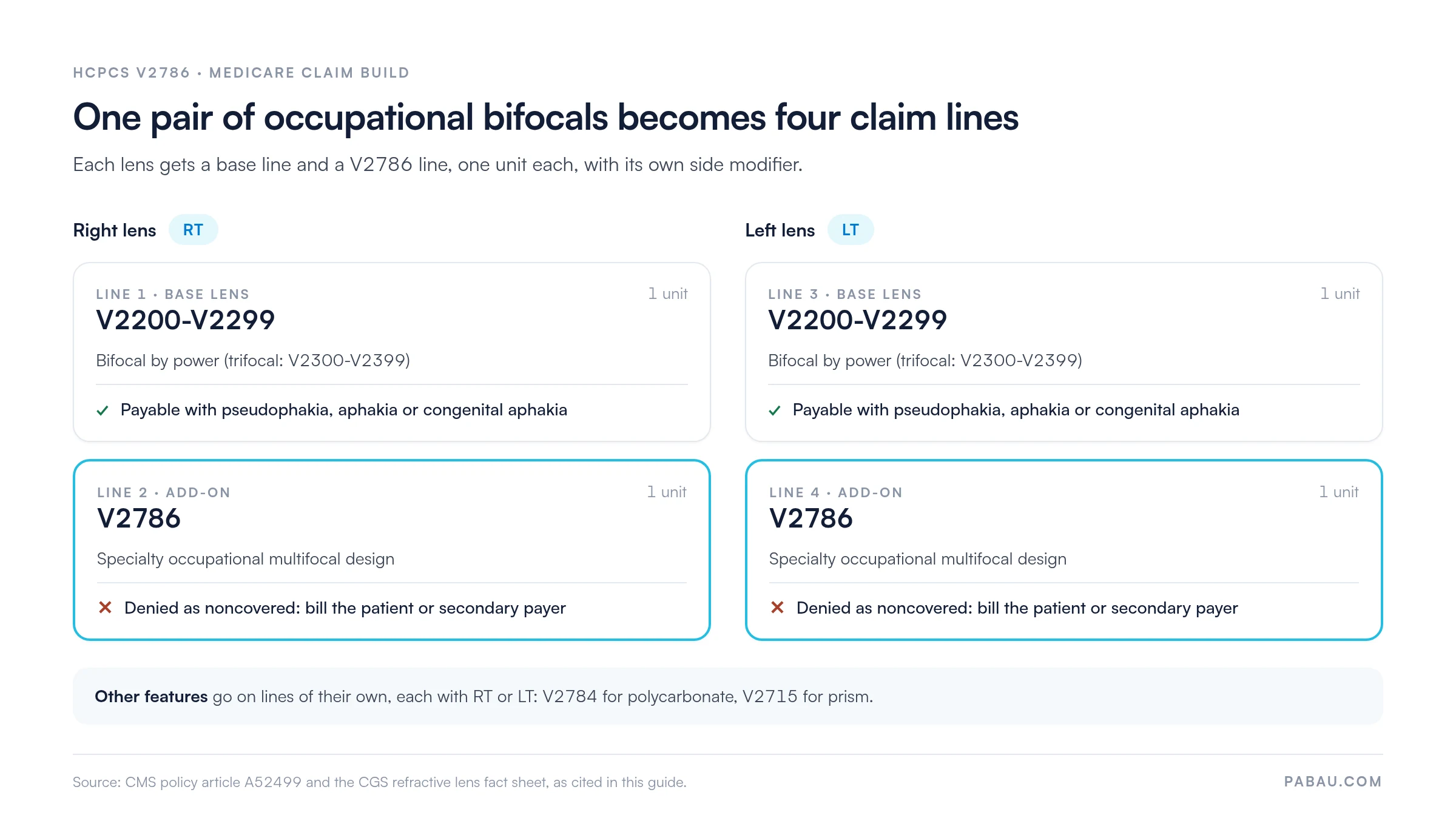
Link each line to the diagnosis that supports it. Commercial plans and Medicaid managed care set their own unit and modifier formats, so check the plan’s billing manual before the first claim.
Code the lens from the lab order, not from the frame style. If the order shows a second near segment at the top of the lens, V2786 belongs on the claim. If it shows a standard flat-top bifocal, it does not.
Every V2786 claim needs an ICD-10-CM diagnosis that supports a multifocal lens. Presbyopia is the usual reason a patient needs a second near segment, so H52.4 appears on most occupational lens claims.
For Medicare, the base lens is covered only for pseudophakia, aphakia and congenital aphakia. Those diagnoses support the base lens line, but they do not make the V2786 line payable.
Medicare: Part B covers one pair of eyeglasses or contact lenses after each cataract surgery with an intraocular lens, as a prosthetic device. CMS policy article A52499 states that “Specialty occupational multifocal lenses (V2786) will be denied as noncovered.”
That denial sits in the policy’s non-medical-necessity rules. It is not a reasonable-and-necessary decision, so documentation of a job-related need does not change it. The covered base bifocal is still paid when the diagnosis qualifies.
Modifiers on a Medicare claim: RT or LT is required on V2786, as on every lens code in the policy. V2786 is not among the five lens codes that need KX, GA, GY or GZ, according to the CGS refractive lens fact sheet. Those five are V2744, V2745, V2750, V2780 and V2784.
Practices often add GY to a noncovered line when a secondary payer wants a Medicare denial first. GY tells the DME MAC the item is excluded or falls outside any Medicare benefit. The mandatory ABN covers reasonable-and-necessary denials, so it does not apply here. A voluntary written notice still shows the patient the charge before the lenses are ordered.
Medicaid: Coverage is set by each state. Some programs pay occupational lenses with prior authorization, and others exclude them. Check the state vision provider manual for V2786 before dispensing.
Vision plans and commercial payers: Plans such as UnitedHealthcare Spectera accept V2786 as a bifocal lens code. Whether the plan pays it or the member pays for it as a lens option depends on the benefit, so confirm it each plan year.
Tell a Medicare patient at the fitting that the occupational segment will be their cost. A written estimate for the V2786 lines, signed before the order goes to the lab, prevents most billing disputes at pickup.
V2786 is often confused with codes that sound similar but describe something else. The table sorts them by what each code describes.
Practical rule: ask what each code describes. A polycarbonate double-segment bifocal carries its base bifocal code, V2786 for the design and V2784 for the material. A prism prescription in the same lens adds V2715, never a contact lens code.
Solid documentation protects the practice in an audit and explains the patient’s bill. For HCPCS code V2786, the record set typically includes these items:
Practices that align their billing compliance workflows with each payer’s rules catch a missing record before the claim goes out.
Most V2786 denials fall into a short list of errors. The table maps each one to its cause and fix.
Practices with repeat denials benefit from a structured denial management process that tracks reason codes. Knowing what a clean claim looks like for each payer removes most of these triggers at the source.
An appeal will not overturn Medicare’s noncoverage of V2786, because the policy itself excludes the lens. Appeal only when the claim was coded or processed in error, such as a covered base lens denied with it.
A claim rejected for a missing modifier is usually returned as unprocessable, with no appeal rights. Correct it and resubmit it. A processed denial follows the five Medicare appeal levels:
Optical billing teams often send lens claims and then check payer portals by hand. A denied V2786 line can sit unnoticed that way, long after the glasses have gone home and the patient balance has gone unbilled.
Pabau’s billing and practice software submits claims electronically and tracks each one’s status next to the patient record. Its claims management shows which lens lines are pending, paid or denied. Your team can then bill the patient for a noncovered line, or correct and resubmit a rejected one.

Pabau submits your optical claims and tracks their status next to the patient record, so a denied V2786 line is billed or fixed quickly. See how it fits your practice.

V2786 is a small code with a fixed Medicare answer. Code the occupational design as an add-on to its base lens, and give each eye its own line. Keep it apart from prism and contact lens codes.
The decision that settles the bill happens at the fitting. A Medicare patient who knows the occupational segment is their cost pays it without a dispute. A vision plan patient needs the same check against their benefit. Book a demo to see how Pabau tracks your lens claims from submission to payment.

Is the lens a progressive instead? HCPCS code V2781 explains the progressive lens add-on and how to bill it.
V2786 is the HCPCS Level II code for a specialty occupational multifocal lens, per lens. It is an add-on billed with the base bifocal or trifocal lens code for spectacle lenses built for a work task.
No. V2786 describes a spectacle lens design. Contact lenses use codes in the V2500-V2599 range, billed per lens.
No. Prism in a spectacle lens is billed with V2715, and a Fresnel press-on prism with V2718. A lens that has both prism and an occupational design takes both codes on separate lines.
No. CMS policy article A52499 states that V2786 will be denied as noncovered. Medicare can still pay the base lens after cataract surgery, so bill the base lens and V2786 on separate lines.
Medicare requires RT or LT, with each lens on its own line and one unit. V2786 does not need KX, GA or GZ. Some practices add GY when a secondary payer wants a Medicare denial first.
No. The mandatory ABN applies to items Medicare may deny as not reasonable and necessary, and the V2786 denial is not one of those. A voluntary written notice still helps the patient see the charge before ordering.