HCPCS Code V2755: UV lens billing guide
HCPCS Code V2755: Quick reference HCPCS Code V2755 reports a UV-protective lens,...

Last Updated: Nov 6, 2026
V2788 is the HCPCS Level II code for presbyopia correcting function of intraocular lens.
It reports the noncovered function of a presbyopia-correcting IOL implanted in place of a conventional lens during cataract surgery. That covers multifocal, extended depth of focus (EDOF) and accommodating lenses. Medicare pays for the conventional lens portion, and the patient pays for the presbyopia-correcting function. Astigmatism correction is reported separately with V2787.
Let Pabau's smart automation suggest the right codes, reduce claim denials, and keep your practice compliant—effortlessly.
Automate repetitive tasks and focus on what matters most—your patients.
Reduce coding errors and ensure compliance with the latest regulations.
Clean claims, fewer denials, and faster reimbursements.
Powerful insights and reporting to help your practice thrive.
HIPAA compliant SOC 2 certified GDPR-compliant Trusted by 4,000+ clinics worldwide

V2788 reports the presbyopia-correcting function of an IOL, such as a multifocal, EDOF or accommodating lens. Toric, astigmatism-correcting lenses use V2787.
Medicare pays for the conventional lens portion of the implant, and the patient pays for the presbyopia-correcting function under CMS Ruling 05-01.
An ABN is not required, because the presbyopia-correcting function falls outside any Medicare benefit category. The patient must still be told the cost in writing before surgery.
The lens charge is split into two lines: the covered conventional portion and the noncovered V2788 portion. Putting the whole charge on V2788 overbills the patient.
Pabau’s claims management software keeps the insurer claim and the patient’s upgrade charge against the same patient record.
HCPCS Code V2788 reports the presbyopia-correcting function of an intraocular lens (IOL) implanted during cataract surgery. It covers the part of a multifocal, extended depth of focus (EDOF) or accommodating lens that Medicare does not pay for. Medicare pays for the conventional lens portion of the implant, and the patient pays for the presbyopia-correcting function.
V2788 describes one function of the implant, and the lens itself is coded separately. Confirm the current descriptor at the CMS HCPCS overview each year, since HCPCS descriptors are updated annually.
V2788 covers the presbyopia-correcting function of any IOL that gives the patient a range of vision a conventional monofocal lens cannot. The lens must be implanted in place of a conventional IOL, at the patient’s request, during cataract surgery.
Covered by V2788: the presbyopia-correcting function of lenses such as these.
Not covered by V2788:
A toric presbyopia-correcting lens, such as a PanOptix Toric, carries both functions. Check your Medicare Administrative Contractor’s (MAC’s) instructions on reporting V2788 and V2787 together before the first case.
The code’s history explains much of the confusion around it. When CMS first allowed patients to pay for toric lenses in 2007, V2788 was used for both premium functions. V2787 was later created for astigmatism correction, and CMS now states that V2788 is no longer valid for A-C IOL charges. Older charge masters and guides can still carry the mix-up.
V2788 reports a presbyopia-correcting function, and V2787 reports an astigmatism-correcting function. What the lens corrects decides the code. Price and brand play no part.
Practical decision rule: pull the operative note and the implant sticker, then ask what the lens model corrects. A lens sold to reduce dependence on reading glasses takes V2788. A lens sold to neutralize corneal astigmatism takes V2787. A lens that does both carries both functions, so follow your MAC’s instruction for that combination.
V2788 is billed as a noncovered line beside the covered cataract surgery. Medicare pays for the surgery and the conventional lens portion, and the patient pays for the presbyopia-correcting function. The surgeon bills the professional service separately, with CPT 66984 for routine cataract surgery or 66982 for complex cases.
Step-by-step Medicare billing workflow:
In an ambulatory surgical center or hospital outpatient department, the conventional lens, reported with V2632, is packaged into the facility payment. The facility still reports the split, so CMS rate-setting sees the cost of the covered lens. The CMS Medicare Vision Services fact sheet lists the cataract and IOL codes involved.
A well-structured superbill that separates the covered lines from the patient-paid V2788 line makes the split easy to follow. It also cuts the questions patients ask at checkout.
CMS Ruling 05-01, issued in May 2005, governs how Medicare handles presbyopia-correcting IOLs. A P-C IOL does two jobs at once. It replaces the cloudy lens, which Medicare covers, and it corrects presbyopia, which glasses or contact lenses would otherwise do and Medicare does not cover.
In practice, that splits one surgery into lines with two different payers, each with its own code.
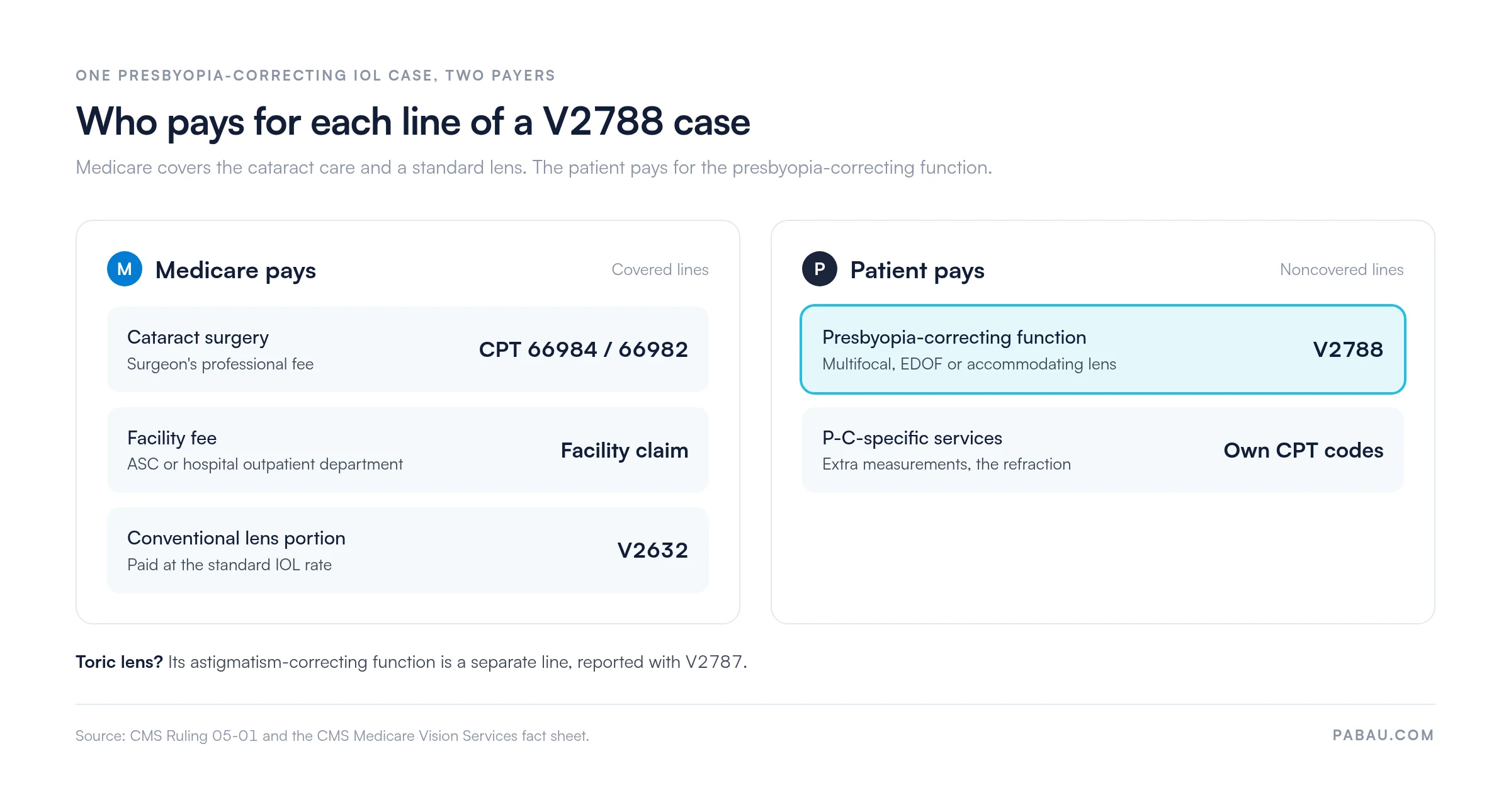
What Medicare covers:
What the patient pays:
An ABN is not required for V2788. The presbyopia-correcting function falls outside any Medicare benefit category, so the patient’s liability does not depend on a signed notice.
CMS still expects the patient to be told, before the procedure, that Medicare will not pay for these services. Many practices issue a voluntary ABN or their own financial agreement to record that conversation.
The patient’s right to a conventional lens never changes. A surgeon cannot make cataract surgery conditional on the patient buying a premium lens.
Hold the cost conversation at the preoperative consultation, well before the day of surgery. A patient choosing a P-C IOL needs time to compare the lens options and the price. Store the signed financial agreement against the patient record with its date.
Medical billing compliance for V2788 rests on two records. One proves the cataract surgery was necessary, and the other proves the patient chose the P-C function and agreed to pay for it. A clean claim needs both in the chart before the surgery date.
Required documentation checklist:
Commercial payers often ask for the same package as Medicare. Some also require prior authorization for any premium IOL, so check benefits with each commercial payer before scheduling the procedure.
Most V2788 problems come from a small number of repeating errors. Building a standard denial management workflow around these scenarios stops the same mistakes from cycling through.
Each CARC in the table, with its usual fix, is explained in our guide to denial codes.
Use the AAPC HCPCS code lookup to cross-check the descriptor and its coding notes before you resubmit a corrected V2788 claim.
Commercial payers and Medicare Advantage (MA) plans handle V2788 differently from traditional Medicare, and the rules vary by plan. Insurance eligibility verification at the preoperative visit should cover premium IOL benefits, prior authorization, and plan-specific billing rules.
Key commercial payer differences:
Build a payer matrix for the plans most common in your patient population. Track which require authorization and which set their own patient-charge rules, so the surprises stop at the front desk.
Ask three questions on every benefits call for a P-C IOL case. Does the plan recognize HCPCS V2788? Is prior authorization required? What may the practice charge the patient for the presbyopia-correcting function? A generic eligibility check rarely surfaces these answers.
A P-C IOL case creates two bills for one lens: a claim to the payer and a charge to the patient. Many ophthalmic practices track the patient portion in a spreadsheet beside the billing system. That is where split charges get missed or doubled.
Pabau, the practice management platform we build, keeps the claim, the invoice and the signed cost agreement against one patient record. Its claims management software submits claims through the Claim.MD clearinghouse, checks eligibility, and posts remittances against that record.

Digital forms collect the patient’s signed financial agreement at the consultation, so the cost disclosure is on file before the surgery date. When the remittance comes back with V2788 as patient liability, the patient’s balance is already waiting at checkout.

Pabau keeps the payer claim, the patient’s upgrade charge and the signed cost agreement against one patient record. Your team submits clean claims and collects the V2788 portion without manual reconciliation.

V2788 is one of the few codes a practice bills knowing Medicare will not pay it. Its job is to show where the covered cataract care ends and the patient’s choice begins. Code it on the lens function, split the charge, and have the cost agreement signed before surgery.
The costly mistakes are the old ones: toric lenses coded as V2788 and whole lens charges pushed onto the patient. A checklist run at the consultation prevents both. Book a demo to see how Pabau handles premium IOL billing from consultation to checkout.

Need a clearinghouse reference for ophthalmic claims? Medical claims clearinghouse guide explains how clearinghouses validate and route HCPCS claims to Medicare and commercial payers.
Building out your revenue cycle knowledge? Revenue cycle management overview covers the end-to-end process from eligibility verification through payment posting.
HCPCS Code V2788 covers the presbyopia-correcting function of an intraocular lens implanted during cataract surgery. That includes multifocal, trifocal, EDOF and accommodating lenses such as PanOptix, TECNIS Symfony and Crystalens AO. The conventional lens portion is reported separately with V2632.
V2788 reports the presbyopia-correcting function of an IOL, and V2787 reports the astigmatism-correcting function of a toric IOL. What the lens corrects decides the code. Price and brand play no part. A toric presbyopia-correcting lens carries both functions, so check your MAC’s instructions for that combination.
Medicare covers the cataract surgery and the conventional lens portion of a presbyopia-correcting IOL. It does not cover the presbyopia-correcting function reported with V2788, which the patient pays for under CMS Ruling 05-01. The patient must be told the cost before the procedure.
No. The presbyopia-correcting function falls outside any Medicare benefit category, so an ABN is not required. CMS still expects the patient to be told in writing, before surgery, that Medicare will not pay for it. Many practices use a voluntary ABN or their own signed financial agreement.
Yes. V2788 goes on its own line on the facility or supplier claim, beside V2632 for the conventional lens portion. The surgeon bills the professional service separately with CPT 66984 or 66982. V2788 is reported once, by the entity that supplied the lens.
Often, yes. Some commercial and Medicare Advantage plans require prior authorization for any premium IOL. A few also set their own rules on what the patient may be charged. Verify benefits and authorization with each plan before the procedure.