CPT code 59618: Cesarean after attempted VBAC billing guide
CPT code 59618 bills a cesarean after a VBAC attempt CPT code 59618 is the globa...

Last Updated: Nov 4, 2026
V2210 is the HCPCS Level II code for spherocylinder, bifocal, plus or minus 4.25 to plus or minus 7.00d sphere, over 6.00d cylinder, per lens. It bills one bifocal spectacle lens, so each eye goes on its own claim line.
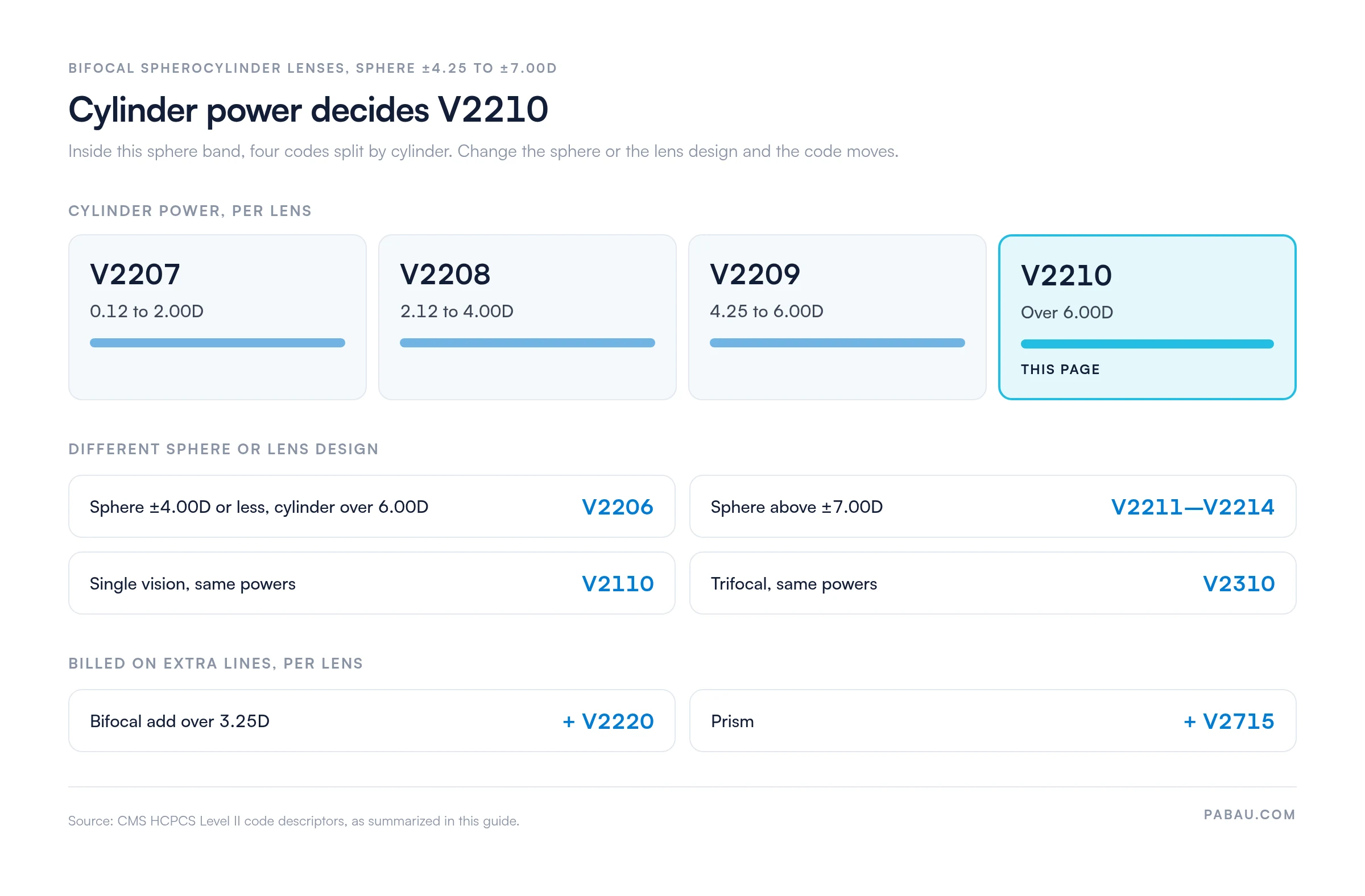
The code closes the V2207-V2210 group of bifocal spherocylinder lenses. Within that sphere band, cylinder power decides the code. A cylinder of 4.25 to 6.00D is V2209, and anything over 6.00D is V2210. Medicare Part B pays for it only after cataract surgery or for aphakia.
Let Pabau's smart automation suggest the right codes, reduce claim denials, and keep your practice compliant—effortlessly.
Automate repetitive tasks and focus on what matters most—your patients.
Reduce coding errors and ensure compliance with the latest regulations.
Clean claims, fewer denials, and faster reimbursements.
Powerful insights and reporting to help your practice thrive.
HIPAA compliant SOC 2 certified GDPR-compliant Trusted by 4,000+ clinics worldwide

HCPCS code V2210 covers one spherocylinder bifocal lens with a sphere of ±4.25 to ±7.00D and a cylinder over 6.00D.
V2209 shares the same sphere band, so cylinder power alone decides between the two codes.
Medicare Part B covers V2210 only after cataract surgery or for aphakia, billed per lens by an enrolled DMEPOS supplier.
Each claim needs a linked ICD-10-CM diagnosis such as Z96.1 and the ophthalmologist’s written order on file.
An add over 3.25D is billed with V2220, and prism with V2715, on separate lines for each lens.
HCPCS code V2210 bills one spherocylinder bifocal lens with a sphere of ±4.25 to ±7.00D and a cylinder over 6.00D. Medicare covers it only after cataract surgery or for aphakia, one claim line per eye.
The Centers for Medicare and Medicaid Services (CMS) maintains the code as part of HCPCS Level II. That is the alphanumeric code set for supplies, prosthetics, orthotics, and services not represented in CPT. Vision codes run from V2020 through V2799. V2210 sits in the bifocal range, V2200 through V2299, and closes the V2207-V2210 group.
The quick-reference data for HCPCS code V2210 is as follows:
V2210 covers one spherocylinder bifocal lens. The lens corrects sphere (myopia or hyperopia) and cylinder (astigmatism) in the distance portion. A separate near segment carries the reading add. The sphere power must fall within plus or minus 4.25 to 7.00 diopters, and the cylinder must be over 6.00 diopters.
Both conditions must be met at once. A bifocal with sphere +5.00D and cylinder 6.50D fits V2210. The same sphere with a 5.00D cylinder belongs to V2209, and a sphere of +7.50D moves the lens to V2211-V2213. Cylinder over 6.00D is uncommon, so check the lab order before you select this code.
The bifocal range is divided into power bands. Choosing the wrong band is the most common coding error for this lens type. The table below maps each spherocylinder bifocal code to its official sphere and cylinder band, as published by CMS.
The most frequent mix-up is between V2210 and V2209. Both share the same sphere band (±4.25 to ±7.00D), so cylinder power is the only differentiator. V2209 applies when cylinder runs from 4.25D to 6.00D, and V2210 applies when it is over 6.00D.
The second mix-up is lens type. The same powers in a single vision lens are V2110, and in a trifocal they are V2310. Verify the cylinder value and the lens design on the dispensing record before finalizing the code. The map below puts both checks, and the two add-on codes, on one page.
Several lens types and optical services fall entirely outside V2210 regardless of the sphere power:
Medicare Part B covers HCPCS code V2210 only through a narrow post-surgical pathway. The coverage conditions, per the CMS Medicare Benefit Policy Manual, Chapter 15, §120 (Prosthetic Devices), are:
Read the Refractive Lenses LCD (L33793) and policy article A52499 before the claim goes out. The DME MACs publish them jointly, and they ask for documentation the national manual does not list. A claim denied for missing documentation cannot be corrected after adjudication without a formal appeal.
Every V2210 claim submitted to Medicare or most commercial payers must carry at least one ICD-10-CM diagnosis code that establishes medical necessity. The diagnosis pointer on the CMS-1500 form (Box 24E) must link the procedure code to its supporting diagnosis.
Commonly accepted diagnosis codes for V2210 include:
Where the record names the cataract that led to surgery, H25.9 covers an age-related cataract the notes do not specify further. Verify all ICD-10-CM codes against the current CMS ICD-10-CM update file before billing.
Codes are updated annually on October 1, and an expired code on a claim produces an automatic denial. The diagnosis pointer in Box 24E must reference the specific diagnosis that justifies the lens, not an unrelated secondary condition listed on the claim.
Missing documentation is a common reason V2210 claims are denied. The following items must be in the patient record and available for audit before the claim is submitted:
Good medical billing compliance practice means keeping these documents for at least seven years from the date of service. That matches CMS record retention guidelines for DMEPOS suppliers.
Medicare reimburses V2210 through the DMEPOS fee schedule, which CMS updates each January and corrects quarterly. Allowable amounts vary by state, so a supplier in California receives a different allowable than one in Mississippi for the same code.
A quoted figure goes stale at each update. Instead, download the current file from the CMS DMEPOS fee schedule page. Find the V2210 row, then read the allowable listed for your state.
Key reimbursement mechanics to understand:
Tracking allowed amounts by code and state is part of revenue cycle management. A fee hardcoded into the billing system and never updated leaves the practice underbilling, or writing off the difference on every claim.
For traditional Medicare (Fee-for-Service), V2210 does not appear on CMS’s published list of DMEPOS items that require prior authorization. That list sets the items covered by the CMS Prior Authorization Program for certain DME. However, three conditions still warrant checking before dispensing:
The absence of a PA requirement in traditional Medicare does not eliminate the need for a physician’s written order. That order is a documentation requirement distinct from prior authorization and applies regardless of payer.
V2210 denials cluster around five root causes. The table below maps each cause to its likely remittance remark code and the corrective action:
Practices with high V2210 denial rates often lack a pre-submission checklist that flags the five conditions above before the claim leaves the office. A structured denial management process catches these errors at the source, before they reach an appeal.
Several codes commonly appear alongside V2210 on the same claim, most often the frame code V2020. Knowing which combinations are permitted, and which trigger NCCI edits, prevents unnecessary denials.
Prism never replaces the lens code. Report V2715 on its own line for each lens that carries it.
Verify specific edit pairs against the current tables on the CMS NCCI edits page. NCCI edits are updated quarterly, so an edit that does not exist in Q1 may be added in Q2. A quarterly NCCI review on the billing compliance calendar prevents mid-year claim failures.
Use the RT and LT modifiers consistently on every bilateral vision claim. Billing two units of V2210 without laterality modifiers triggers an automatic denial under Medicare’s same-day, same-code duplicate claim edit. The modifier tells Medicare each line represents a distinct eye.
Optical practices billing HCPCS code V2210 under Medicare juggle four documents per claim. The dispensing record, the physician order, the surgical confirmation and the claim form all have to agree.
Pabau, the practice management platform we build, keeps those records on one patient file. Its optical practice claims software lets billing staff confirm a file is complete before the claim goes out, instead of after a denial.
Practices using Pabau can track claim status and flag incomplete records against a pre-submission checklist. They can also log denial reason codes on patient records for an audit trail. Running the end-to-end billing workflow in one system cuts the manual handoffs where documentation errors start.

Pabau helps optical practices and DMEPOS suppliers document HCPCS code requirements, track claim status, and reduce denials across Medicare and commercial payers.

Code V2210 from the dispensed lens, not from memory of the prescription. The cylinder on the dispensing record decides between V2209 and V2210, and the add decides whether V2220 joins the claim.
Before the claim goes out, check the surgery date, the ophthalmologist’s order and a linked diagnosis such as Z96.1. A practice that checks those at dispensing spends far less time on appeals. Book a demo to see how Pabau keeps the order, the dispensing record and the claim on one patient file.

Cylinder measured at 4.25 to 6.00 diopters instead? HCPCS code V2209 covers the same sphere band one cylinder step down, the code most often confused with V2210.
Patient moving from a bifocal to a trifocal lens? HCPCS code V2310 explains how spherocylinder trifocal lenses are billed and documented.
Dispensing a single vision lens at a similar prescription? HCPCS code V2110 covers the single vision spherocylinder equivalent and its power bands.
Want fewer rejections on DMEPOS lens claims? Our Claim.MD clearinghouse review shows how electronic claim routing catches errors before a claim reaches the payer.
HCPCS code V2210 bills one spherocylinder bifocal lens. Its sphere runs from plus or minus 4.25 to 7.00 diopters, and its cylinder is over 6.00 diopters. Under Medicare Part B, it applies to lenses dispensed after cataract surgery or for aphakia. It does not cover single vision or trifocal lenses, frames, or other powers.
V2210 and V2209 share the same sphere band (plus or minus 4.25 to 7.00D) but differ on cylinder. V2209 applies when the cylinder runs from 4.25 to 6.00D, while V2210 applies when it is over 6.00D. V2207 and V2208 cover the lower cylinder bands within the same sphere range.
Yes, Medicare Part B covers V2210 as a one-time benefit following cataract surgery with an intraocular lens implant, or for aphakia. The claim must be submitted by a CMS-enrolled DMEPOS supplier, and a physician’s written order must be on file. Routine vision correction is excluded from Medicare Part B coverage.
The most common denial causes are coding the wrong power band and missing or mislinked ICD-10 diagnosis codes. Others are billing through a non-enrolled DMEPOS supplier, a missing physician order, and exceeding the once-per-qualifying-event frequency limit. Each denial reason maps to a specific CARC code on the remittance advice.
The most commonly accepted ICD-10-CM codes are Z96.1 (presence of intraocular lens, after cataract surgery with IOL implant) and H27.00-H27.02 (aphakia). The chosen code must be linked to V2210 via the diagnosis pointer in Box 24E of the CMS-1500 claim form. Verify codes against the current CMS ICD-10-CM update file annually.
Yes. V2210 can be billed with V2020 (standard frame) and with a second unit using RT/LT modifiers for bilateral dispensing. When the bifocal add is over 3.25D, V2220 is reported per lens in addition. The same lens cannot also be billed as single vision (V2110). Verify current NCCI edits quarterly, as combinations are updated regularly.