HCPCS Code L1904: Ankle orthosis billing and coverage guide
HCPCS Code L1904: Code descriptor and device specifications HCPCS Code L1904 des...

Last Updated: Oct 23, 2026
V2715 is the HCPCS Level II code for prism, per lens. It applies when a prescriber orders prism ground into or fused into a spectacle lens. Prism in both lenses is billed as 2 units, not 1.
That unit rule drives most underpayments on this code, followed closely by mix-ups with V2710 for slab-off prism. Getting both right protects the add-on payment on top of the base lens claim. Below, you'll see how the claim moves, which diagnoses support it, and what to check before you submit.
Let Pabau's smart automation suggest the right codes, reduce claim denials, and keep your practice compliant—effortlessly.
Automate repetitive tasks and focus on what matters most—your patients.
Reduce coding errors and ensure compliance with the latest regulations.
Clean claims, fewer denials, and faster reimbursements.
Powerful insights and reporting to help your practice thrive.
HIPAA compliant SOC 2 certified GDPR-compliant Trusted by 4,000+ clinics worldwide

V2715 is billed per lens, so prism in both lenses is 2 units, never 1 unit for the pair.
Slab-off prism has its own code, V2710, and press-on Fresnel prism is V2718, so the lab order decides the code.
V2715 always rides on a base spectacle lens code, such as V2100-V2199 for single vision or V2200-V2299 for bifocals.
Medicare covers prism lenses only as post-cataract prosthetic eyewear, and its DME contractors want RT and LT on separate lines.
Every claim needs a binocular diagnosis, such as H51.11 convergence insufficiency, plus prism power and base direction on the Rx.
HCPCS code V2715 is a Level II supply code in the V-code range V2020-V2799 (vision services). The Centers for Medicare and Medicaid Services (CMS) maintains it through the annual HCPCS update. The official descriptor is “Prism, per lens.”
That short descriptor settles two billing questions. Coverage applies to each lens, not to the pair. And the code covers prism built into a spectacle lens by any method except slab-off, which has its own code, V2710.
V2715 covers prismatic correction incorporated into a spectacle lens. Lens material (glass or plastic) doesn’t change the code, and neither does lens design (single vision, bifocal or progressive).
The prism can be ground in or fused. Either way, the code applies when a licensed prescriber orders prism for a documented binocular vision problem.
Common clinical indications that support V2715 billing include:
The prescription must state the prism power in prism diopters and the base direction (base-in, base-out, base-up or base-down). Medical necessity review looks for both on the claim’s supporting record.
Most coding substitutions involve one of the five supply types below. Each one needs a different code or isn’t separately billable at all:
V2715 and V2710 are the two prism codes billers confuse most often. Both describe prism on a spectacle lens, and both are billed per lens. What separates them is the type of prism the lab produced.
So check the lab invoice and the dispensing order before you pick a code. A “slab-off” note or a bicentric grinding fee means V2710, and a press-on Fresnel membrane means V2718.
The chart below maps each lab order to its code and its unit count.
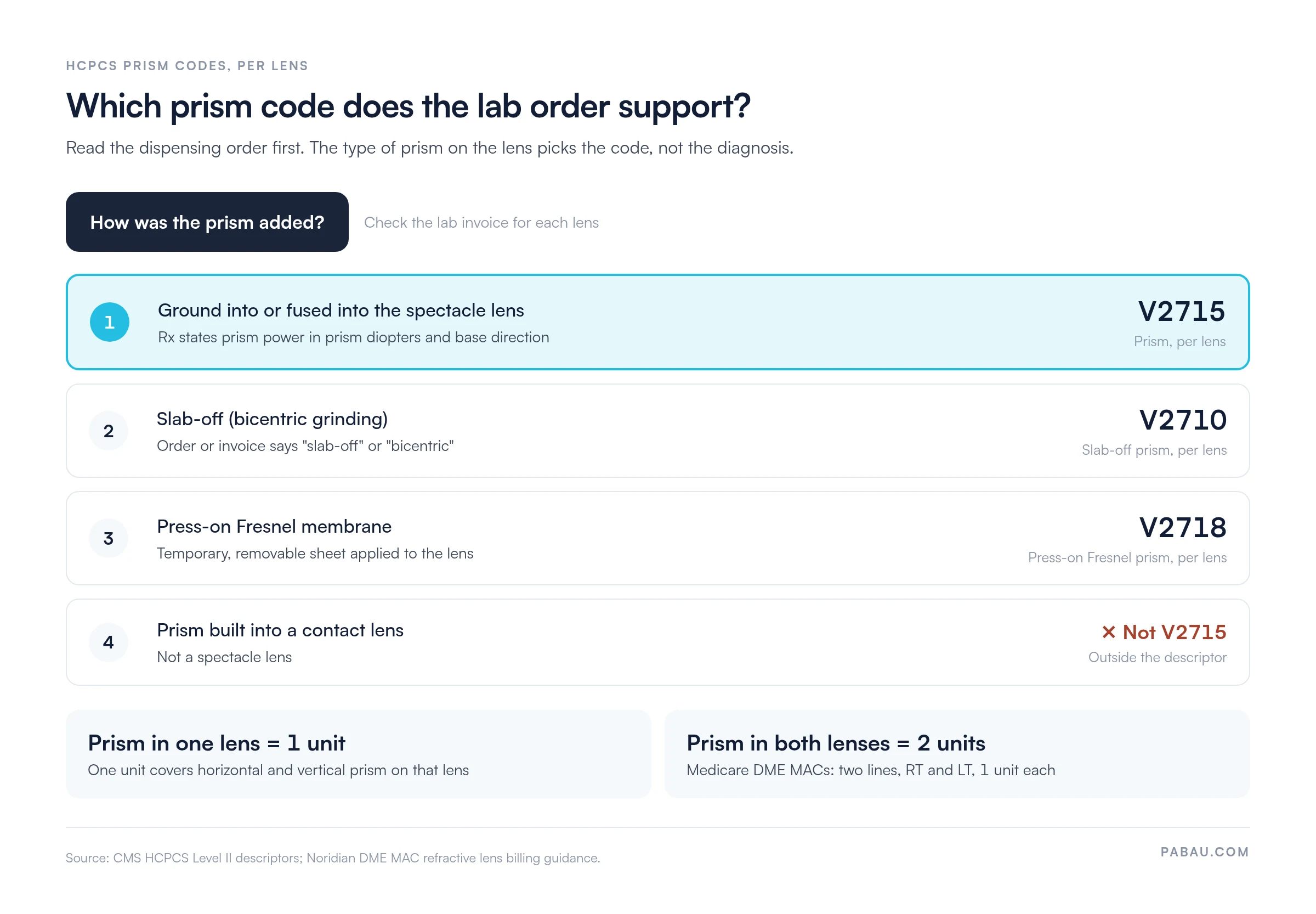
Report V2715 per lens. Prism in both lenses of a pair is 2 units, while prism in one lens is 1 unit. Billing 1 unit for a bilateral pair is the most common underbilling error with this code.
Follow these rules on every prism claim:
A prism claim passes through more hands than most optical claims. Knowing where each check happens tells you where a denial started.
Most rework starts at step 3 or step 4. Without the invoice, nobody can prove the prism type, and a wrong unit count gets the line rejected or underpaid.
Medicare Part B excludes routine eyeglasses, standard prism lenses included. That exclusion holds even when the patient has a diagnosis that supports medical necessity, which surprises many billing teams.
The exception is post-cataract prosthetic eyewear. After cataract surgery with an intraocular lens (IOL), Part B covers one pair of eyeglasses or contact lenses. Prism can be part of that pair. Coverage is limited to one pair per surgery and requires:
Outside that exception, Medicare denies V2715 as non-covered routine vision care. Run insurance eligibility verification before you dispense prism lenses to a Medicare patient. When coverage is uncertain, have the patient sign an Advance Beneficiary Notice (ABN) first.
Each state decides Medicaid coverage for prism lenses, and the rules vary widely. Some programs cover medically necessary prism for binocular dysfunction, strabismus or post-surgical needs. Others leave prism out of the vision benefit or cover it only for pediatric enrollees.
Check your state Medicaid provider manual for its optometric code list. Rhode Island EOHHS, for example, lists V-codes including V2715 in its optometric fee schedule, but not every state does. Never assume coverage carries over from one state program to another.
Private payers fall into two groups for prism billing:
After unit errors, thin documentation is the next most common reason V2715 claims are denied. Payers audit optical supply claims against the same medical billing compliance standards as any other claim, so the file has to stand on its own.
A complete V2715 file holds five documents:
Every V2715 claim needs a diagnosis that shows medical necessity. These ICD-10-CM codes cover the binocular and eye-movement conditions prism lenses most often treat.
Codes ending in a dash need more characters before they’re billable, usually for the eye involved. Confirm each code against the current ICD-10-CM fiscal year, because a retired or revised code triggers a denial on its own.
When H52.31 (anisometropia) is the primary diagnosis and the lab made slab-off rather than conventional prism, switch to V2710. The ICD-10 code doesn’t decide which prism code applies. The type of prism dispensed does, so audit the lab order before choosing.
V2715 denials follow a predictable pattern. Most match one of the six reasons below, and each has a fix you can apply before submission.
Track denial rates by code and by payer over a rolling 90 days, so these patterns show early. Repeated V2715 denials from one payer usually point to a modifier or documentation rule nobody has mapped into the workflow. A list of common denial codes helps you read the reason on each remittance.
From there, a steady denial management process turns each code into a fix. Grounding in medical billing fundamentals also helps your team separate correctable errors from claims that were never covered.
Many optical billing teams still build prism claims by hand. They retype the Rx details into the claim, look up the lens codes, then chase each claim through a payer portal.
Pabau, the practice management platform we build, pre-fills the claim from the patient record and checks required claim fields before it sends. Its end-to-end claims management submits through integrations such as Claim.MD in the US, then tracks each claim through to remittance.
The coding decision stays with your team. Pabau doesn’t choose between V2715 and V2710 or set unit counts, but it removes the retyping and status chasing around those decisions.

Pabau pre-fills each claim from the patient record and checks required fields before sending. It then tracks optical supply claims through to remittance.

V2715 is easy to bill well once a few habits are in place. Count prism by lens, read the lab invoice before choosing between V2715, V2710 and V2718, and match the diagnosis to the binocular condition.
Do that and the add-on stops leaking revenue, whether the claim goes to a vision plan, a medical plan or Medicare after cataract surgery. The trade-off is a few extra minutes at dispensing, which costs far less than reworking a denied claim.
Book a demo to see how Pabau carries optical claims from the patient record through to remittance.

Billing a slab-off lens instead? HCPCS code V2710 explains when bicentric grinding replaces conventional prism and how to document it.
Fitting a temporary prism first? HCPCS code V2718 covers press-on Fresnel prism membranes, billed per lens.
Is the prism going on a progressive lens? HCPCS code V2781 covers the progressive lens code billed alongside the prism.
Wondering how clean claims reduce rework? What makes a clean claim outlines the checks billing teams run before submitting optical supply codes.
Need a system for handling denials? Denial management in healthcare covers investigating, appealing and preventing denials across your practice.
Yes. V2715 remains an active HCPCS Level II code for 2026, with the descriptor “Prism, per lens.” Check the quarterly CMS HCPCS update each year, because descriptors and payer policies can change.
Post-cataract eyewear claims go to the DME Medicare Administrative Contractor (DME MAC) for the patient’s region, not the Part B MAC. They follow the Refractive Lenses LCD, L33793, and its policy article A52499.
Bill the base lens code first, then V2781 for the progressive lens, then V2715 for the prism. All three are per lens. Many payers treat progressive lenses as a non-covered upgrade, so check the plan before billing V2781.
No. V2715 is an add-on to a spectacle lens, so the claim must also carry the base lens code. A prism line on its own reads as incomplete and is usually denied.
No. V2715 describes prism in a spectacle lens. Prism built into a contact lens falls outside the descriptor, so check the payer’s contact lens codes instead.