

HCPCS Code G0163: Skilled nursing observation and assessment
What is HCPCS Code G0163? HCPCS Code G0163 is a deleted Level II code for skille...

Last Updated: Oct 15, 2026
HCPCS code S0512 is the Level II code for a daily wear specialty contact lens, billed per lens. A pair therefore goes on the claim as two units.
The payer decides whether it gets paid. Commercial plans, Medicaid and workers' compensation programs accept S-codes, while traditional Medicare pays none of them. Send S0512 to Medicare Fee-for-Service and the claim is denied, however strong the documentation. The sections below follow the claim from code choice to remittance, including prior authorization, supporting diagnoses and the denials worth planning around.
Let Pabau's smart automation suggest the right codes, reduce claim denials, and keep your practice compliant—effortlessly.
Automate repetitive tasks and focus on what matters most—your patients.
Reduce coding errors and ensure compliance with the latest regulations.
Clean claims, fewer denials, and faster reimbursements.
Powerful insights and reporting to help your practice thrive.
HIPAA compliant SOC 2 certified GDPR-compliant Trusted by 4,000+ clinics worldwide

HCPCS code S0512 reports one daily wear specialty contact lens, so a pair is billed as two units.
Traditional Medicare doesn’t pay S-codes, so S0512 belongs on commercial, Medicaid and workers’ compensation claims.
S0512 sits beside S0500 disposable, S0514 color and S0515 scleral lenses, while S0504 to S0510 aren’t contact lenses at all.
When a payer asks for medical necessity, link a billable diagnosis such as H18.603 for bilateral keratoconus.
Check the payer’s accepted code set and prior authorization rules before you order, because both cause avoidable S0512 denials.
HCPCS code S0512 is the Level II code for a daily wear specialty contact lens, billed per lens. It belongs to the S-code series (S0000-S9999), the temporary national codes published in the HCPCS file from the Centers for Medicare and Medicaid Services (CMS). Private insurers, Medicaid plans and workers’ compensation programs use them. Medicare doesn’t.
Within that series, S0512 sits in the vision supplies range, S0500-S0596. These are the attributes you’ll need when you set the code up in your fee schedule.
The descriptor names a daily wear lens with a specialty design. It sets no custom fabrication or medical necessity requirement of its own. Each payer decides which lens designs count as specialty, so read the plan’s vision policy before you code.
S0512 shares its range with codes that look alike on a fee schedule. Several of them aren’t contact lenses at all, which trips up new billers.
Here’s the quick rule. If the payer accepts S-codes and treats the lens as a specialty daily wear design, use S0512. If the payer lists V-codes for contact lenses, pick the matching code from V2500-V2599 instead.
A disposable lens bills as S0500 on the same payers, and a color lens as S0514. The chart below runs both decisions in order, payer first and lens second.
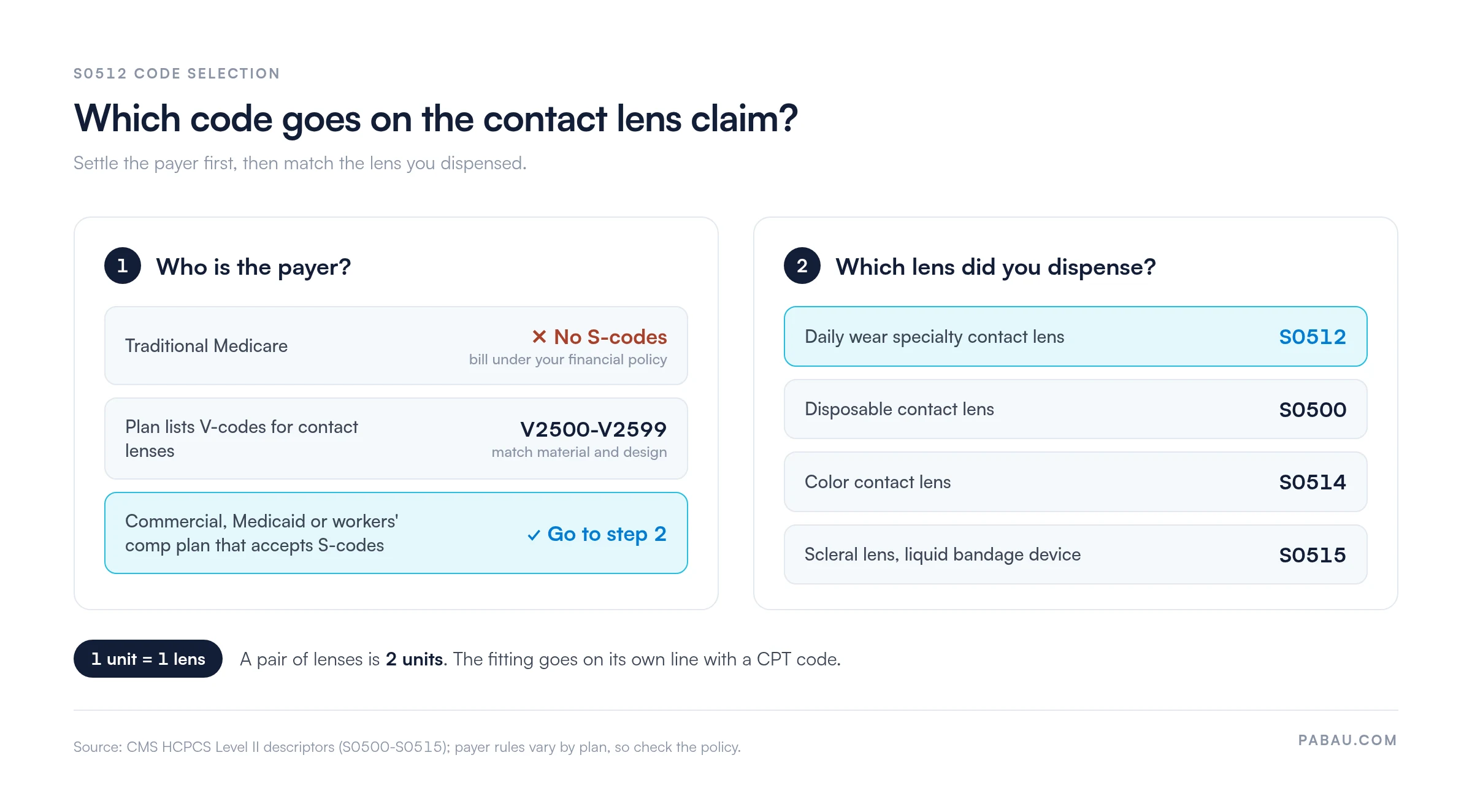
Traditional Medicare doesn’t pay HCPCS code S0512 or any other S-code, because the S series was built for private payers and Medicaid. Extra documentation won’t change the outcome under Medicare Fee-for-Service.
Medicare Advantage plans set their own vision benefits. Some accept S-codes, while others want V-codes, so check the plan’s provider manual first.
Medicaid coverage varies by state and by managed care plan. Some programs list vision S-codes in their fee schedules, and others leave them out. Confirm S0512 against the state’s current schedule, or ask the plan directly.
Prior authorization for S0512 isn’t universal, but many managed care and commercial plans want it for specialty lenses. Check every payer, every time. Run insurance eligibility verification before the fitting visit, and record any PA rule on the appointment.
When a plan needs a PA, send these with the request:
Route the request to the plan’s vision benefit manager if it has one. Many commercial plans carve vision out to a separate company. A PA sent to the general medical line can stall for days.
A clean S0512 claim follows the same five steps every time. Skip one, and the remittance usually tells you which.
The lens and the fitting travel separately. S0512 covers the lens itself, while the fitting is a professional service billed with its own CPT code.
A patient with keratoconus in both eyes is fitted for specialty daily wear lenses. Her commercial plan accepts S-codes and requires prior authorization. The practice secures the PA number, then orders one lens per eye.
The claim shows S0512 with two units, linked to H18.603, keratoconus, unspecified, bilateral. The PA number goes in item 23 of the CMS-1500. The keratoconus fitting sits on its own line as CPT code 92072.
A correct unit count still fails if the diagnosis doesn’t justify the lens. The S0512 descriptor doesn’t call for any particular diagnosis. Many payers still want one that explains why a standard lens won’t do. The codes below are common examples, not a list the code itself defines.
Code to the full billable level. H18.60 is a parent code and can’t go on a claim. A bare refractive diagnosis such as H52.10, myopia, unspecified eye, usually won’t satisfy a medical necessity policy on its own.
Before you code S0512, open the payer’s vision policy and confirm your diagnosis appears on its covered list. If it doesn’t, gather more clinical detail before submission rather than appealing after a denial.
With the code, the PA and the diagnosis lined up, one last pass catches the slips that force a resubmission. Good medical billing compliance means each item below is settled before the claim leaves the practice.
Denial management for S0512 starts with the reason code on the remittance. Each pattern below has a known fix, and our guide to medical billing denial codes covers the wider CARC and RARC set.
Once a claim clears those checks, the next question is what it pays. Medicare gives S0512 pricing indicator 00, so there’s no Physician Fee Schedule amount to anchor to. Each payer sets its own allowance instead.
To confirm the current descriptor and status, check the AAPC entry for S0512 at each quarterly HCPCS update.
S0512 problems usually start before submission. An unchecked payer rule, a missing PA number or the wrong unit count does the damage. Those checks belong to your front desk and billing team, using the checklist above.
Pabau, our practice management and billing platform, handles what happens once the claim is ready. Its claims management software sends claims electronically through its integrated clearinghouse, which for US practices is Claim.MD. Your billers stop re-keying claims into separate portals, so their time goes into getting each claim right.

Pabau submits your claims electronically through its integrated clearinghouse, Claim.MD for US practices. Your team spends less time in payer portals and more time on clean claims.

S0512 rewards the practice that checks the payer first. The code is narrow, one daily wear specialty lens per unit, and Medicare won’t pay it. When these claims fail, the cause usually sits upstream: the wrong payer, a missing PA or a mismatched diagnosis.
So move the payer check into booking. Confirm S-code acceptance, the lens limit and any PA rule at the first call. Your billers then code a claim that has already been cleared.
Book a demo to see how Pabau sends those clean S0512 claims to the payer without re-keying.

Need to understand how clearinghouse submissions work? Medical claims clearinghouse guide explains how electronic claims reach each payer.
Want to reduce your overall denial rate across all codes? Denial codes in medical billing covers CARC and RARC code meanings and the appeal strategies that clear them fastest.
Submitting S0512 on a superbill? Superbill guide covers the required fields and where HCPCS codes go on the form.
Dispensing sports or safety lenses too? HCPCS code S0510 billing guide covers non-prescription safety, athletic and sunglass lenses.
Some payers want them. Bill one unit per lens and add RT or LT to show which eye each lens is for. Other plans prefer a single line with two units, so check the payer manual before you submit.
S0512 covers the lens only, so the fitting goes on its own line. A corneal lens fitting for both eyes is CPT 92310, a corneoscleral fitting is 92313, and an initial keratoconus fitting is 92072.
The plan’s lens limit decides. Vision policies usually cap lenses per benefit period. A replacement inside that window often needs a documented reason, such as a prescription change, loss or damage.
Yes. S0512 has been in the HCPCS Level II file since July 1, 2001, and it remains active. Temporary S-codes can be deleted or replaced, so check each quarterly HCPCS update.
Usually, yes. IRS Publication 502 counts contact lenses needed for medical reasons as a qualified medical expense. That helps when a plan denies the lens or the patient has traditional Medicare only. Give a written cost estimate before you order.




