HCPCS code C1731: Catheter billing, OPPS reimbursement, and denial guide
HCPCS code C1731: Official descriptor and code series context HCPCS code C1731 i...

Last Updated: Oct 8, 2026
S0514 is the HCPCS Level II code for a color contact lens, billed per lens.
S-codes are temporary national codes for non-Medicare payers, so Medicare will never reimburse S0514. Denials usually trace back to three errors. Billers route the claim to Medicare, submit one unit for a pair, or leave the laterality modifier off the line.
Let Pabau's smart automation suggest the right codes, reduce claim denials, and keep your practice compliant—effortlessly.
Automate repetitive tasks and focus on what matters most—your patients.
Reduce coding errors and ensure compliance with the latest regulations.
Clean claims, fewer denials, and faster reimbursements.
Powerful insights and reporting to help your practice thrive.
HIPAA compliant SOC 2 certified GDPR-compliant Trusted by 4,000+ clinics worldwide

S0514 describes a color contact lens billed per lens, so each lens dispensed is its own unit of service.
Medicare does not recognize HCPCS S-codes, so submit S0514 only to Medicaid and commercial payers.
Most payers require a laterality modifier, and a missing LT or RT is the most common denial trigger.
Only S0500, S0512 and S0514 in the S05xx range are contact lens codes; S0504 to S0510 cover eyewear lenses.
Pabau’s claims management software supports HCPCS S-code billing, including payer eligibility checks before submission.
HCPCS Code S0514 is the HCPCS Level II code for a color contact lens, billed per lens. Its official descriptor reads “Color contact lens, per lens.”
S-codes are temporary national codes created outside the Medicare program. They let Medicaid agencies and private insurers identify services and supplies that CPT does not capture. America’s Health Insurance Plans (AHIP) maintains the S-code set under the CMS HCPCS framework.
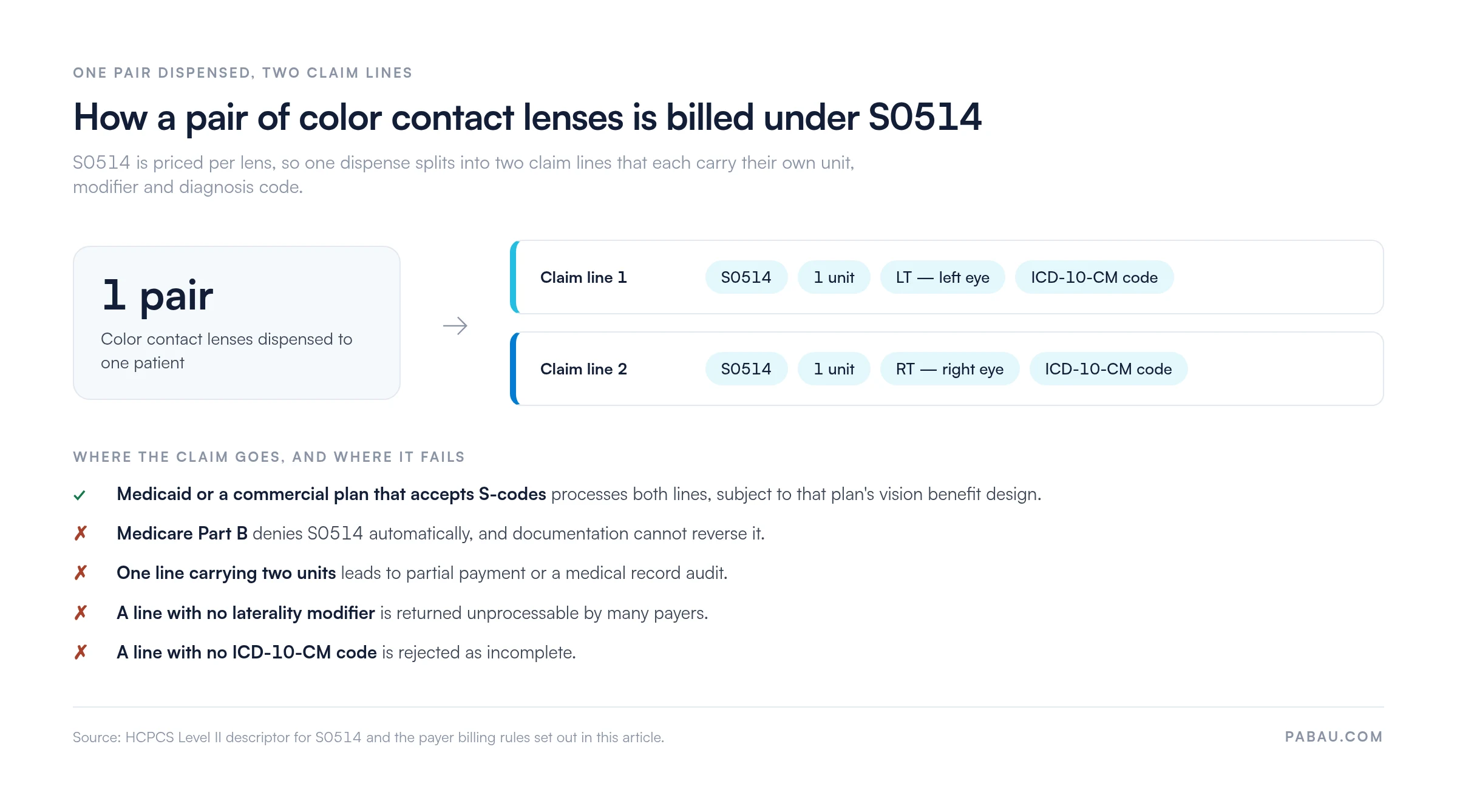
The “per lens” wording decides how many units go on the claim. Dispensing a pair of color contact lenses takes two units, one for the left lens and one for the right. A single unit submitted for both lenses leads to partial payment or a medical record audit. Each unit carries the matching laterality modifier, covered in the modifiers section below.
Optometrists and ophthalmologists are the main billers of S0514. They report it when dispensing color contact lenses in a clinical setting where a payer, rather than the patient, covers vision materials.
The code applies to cosmetic color lenses and to medically indicated tinted lenses, provided the dispensing provider holds a payer contract that recognizes S-codes. Run insurance eligibility verification before submitting S0514, because coverage for color lenses varies widely even among payers that accept S-codes in general.
S0514 does not cover clear contact lenses, which are billed under S0500 or S0512. It also does not cover contact lens fitting services, which are reported separately under the applicable CPT code. The code pays for the lens itself, dispensed one lens at a time.
Payer recognition of S0514 splits cleanly along program lines. Medicare Part B does not recognize HCPCS S-codes, so a claim sent there denies automatically.
Medicaid programs in most states accept S-codes, though coverage for color lenses depends on each state’s vision benefit design. Commercial insurers vary. Most major plans that include a vision benefit will process S0514, but prior authorization rules and frequency limits differ by plan.
S-codes and CPT codes serve different functions on a claim, and different bodies maintain them. The American Medical Association owns and updates CPT codes each year, while AHIP maintains S-codes for non-Medicare payers.
For optometry practices billing contact lens codes, knowing which system applies to which claim prevents misrouted submissions. You can search the full HCPCS Level II code set using the AAPC Codify HCPCS lookup.
A single visit can carry both a CPT code for the fitting service and S0514 for the lens product on the same claim. The payer has to accept S-codes, and both services need clinical documentation behind them. Some payers bundle the product into the fitting fee, so check the contact lens benefit policy before unbundling.
Accurate S0514 billing means matching the claim’s unit count, modifiers, and diagnosis codes to the clinical documentation on file. Practices that separate dispensing from billing submit the wrong unit count often, because the dispenser records the lens while the biller works from a template. Records that run from the point of dispensing through to claim submission keep the two in step.
The diagram below traces one pair of lenses through to the two claim lines a payer expects. It also shows where the common rejections come from.
Practices that generate a superbill at the point of dispensing should add S0514 to the template with a built-in laterality prompt. That prompt catches the modifier omission behind most payer rejections. Capturing the prescription details and the lens type at check-in keeps the documentation ahead of billing rather than behind it.
Modifiers are required on most S0514 claims to specify laterality and other claim-level details. Payers do not all require the same set, so check the modifier policy before submission.
Run the eligibility check against the vision benefit, not only the medical benefit, before dispensing color lenses. Many commercial plans carry a vision rider with its own co-pay structure and frequency limits for contact lens materials. Billing the medical benefit when a vision benefit applies, or the reverse, triggers a coordination-of-benefits denial. A 60-second check at the front desk catches it.
Every S0514 claim line needs a supporting ICD-10-CM diagnosis code. That code establishes medical necessity, or records the clinical context for dispensing a tinted lens. The diagnoses below are the ones most often paired with S0514 on color lens claims. Individual payer policies can restrict coverage to specific diagnoses, so confirm the medical policy before billing.
For cosmetic color lenses dispensed without an underlying medical diagnosis, coverage is decided plan by plan. Many commercial vision plans cover them under the materials benefit with no medical diagnosis required. That coverage is set out in the plan document rather than in a payer medical policy. Document the prescribing provider’s clinical rationale either way.
S0514 is a non-Medicare S-code, so no published Medicare Physician Fee Schedule rate exists for it. Each Medicaid program and commercial payer sets its own allowed amount, which makes a universal figure impossible to state.
Rates also move each year as payers update their fee schedules. You can look up plan-specific rates through the CMS list of CPT and HCPCS codes and cross-reference it with individual payer portals.
The S05xx range mixes contact lens codes with eyewear lens and frame codes, so picking one from memory is risky. Only S0500, S0512 and S0514 describe contact lenses, while codes such as S0510 cover non-prescription eyewear lenses. Billing S0514 for a lens that is not tinted is an incorrect code assignment and can trigger an audit. The table below covers the range, and you can check the full HCPCS code list before assigning a lens code.
Rigid gas permeable lenses fall outside the S05xx range too. Extended wear designs are billed under HCPCS V2513 instead.
Most S0514 denials are preventable. The errors below account for the majority of avoidable rejections on color contact lens claims. Sorting your rejections by root cause shows which of them costs the practice most, and how often it happens.
Optometry and ophthalmology practices with high contact lens volumes need billing software that handles HCPCS S-codes natively. The S0514 workflow has four points where manual entry introduces error. Those points are the unit count, the modifier, the diagnosis code, and the payer the claim is routed to.
Practice management software like Pabau runs those four checks before the claim leaves the practice. One recorded dispense creates one claim line per lens, prompts for LT or RT, and stops a submission routed to Medicare. Handling those steps inside software that scrubs claims before submission cuts the per-claim review burden and shortens the path to payment.
Where patient records, scheduling, and documentation live in the same system, the clinical note feeds the claim directly. Dropping that re-entry step removes the point at which unit and diagnosis errors usually start. A clean first submission is the fastest way to cut days in accounts receivable on contact lens materials.

Pabau’s claims management tools support HCPCS S-code workflows, payer eligibility checks, and clean-claim submission for optometry and ophthalmology practices.

S0514 rewards a practice that fixes the workflow rather than the individual claim. The same three errors repeat in batches, so a front-desk eligibility check and a laterality prompt on the dispense screen repay the setup effort quickly. Reworking each denial by hand never does.
The trade-off worth remembering is that S-code coverage is decided plan by plan, never nationally. Confirm the color lens benefit before the lens leaves the practice and the claim usually goes out clean. Book a demo to see how Pabau builds those checks into contact lens billing.

Need to understand how clean claims reduce your days in AR? Clean claim submission guide explains what payers check before processing and how to pass those edits first time.
Wondering how denial categories map to specific billing errors? Denial codes in medical billing covers the CARC and RARC codes that appear on remittances when S-code claims reject.
Want to verify HCPCS eligibility before the patient arrives? Insurance eligibility verification walkthrough covers the steps for checking vision benefit coverage in real time.
HCPCS Code S0514 is used to bill for a color contact lens on a per-lens basis. Optometrists and ophthalmologists report it when dispensing colored or tinted contact lenses to patients whose Medicaid program or commercial payer recognizes HCPCS S-codes. Each lens dispensed is a separate unit of service.
No. Medicare does not recognize HCPCS S-codes, including S0514. S-codes are temporary national codes maintained by AHIP for Medicaid and commercial payers only. Submitting S0514 to Medicare Part B produces an automatic denial that documentation cannot reverse.
Commonly paired ICD-10-CM codes include H18.9 (disorder of cornea, unspecified), H26.9 (cataract, unspecified), Z96.1 (presence of intraocular lens), and H53.14 (photophobia). For cosmetic color lenses with no underlying medical condition, coverage follows the plan’s vision benefit structure rather than a diagnosis requirement.
The most commonly required modifiers are LT (left side) and RT (right side), which identify laterality for each lens billed. Some Medicaid programs also require KX (medical necessity criteria met) or NU (new equipment). Modifier requirements vary by payer, so check the plan’s billing guidelines before submission.
Most state Medicaid programs accept HCPCS S-codes, including S0514. Coverage for color contact lenses depends on each state’s vision benefit design. Some states cover medically indicated tinted lenses only. Others include cosmetic color lenses under the materials benefit. Confirm with the state Medicaid fee schedule or provider portal before billing.
Bill two units of S0514, one for each lens. Put the LT modifier on the left-eye line and the RT modifier on the right-eye line. Do not submit a single unit for both lenses. Each claim line carries the supporting ICD-10-CM diagnosis code and any further modifiers the payer requires.