Pabau Engage inbox

Pabau Engage is here: every patient conversation in one inbox.

Learn more
CPT Code

CPT code 37191 – IVC filter placement


Code Definition

37191 is the CPT code for insertion of an intravascular vena cava filter by endovascular approach. It includes vascular access, vessel selection, radiological supervision and interpretation, intraprocedural roadmapping, and imaging guidance (ultrasound and fluoroscopy), when performed.

It applies to permanent and retrievable filters alike. Payers expect a confirmed DVT or PE and a documented reason anticoagulation can't be used or has failed.

Section
10004-69990 Surgery
Subsection
33016-37799 Cardiovascular system
Code range
37184-37218 Transcatheter procedures
Billable
No
Code also known as
vena cava filter insertion, endovascular IVC filter, inferior vena cava filter placement
Save time. Improve accuracy. Get paid faster.
Automate coding with Pabau

Let Pabau's smart automation suggest the right codes, reduce claim denials, and keep your practice compliant—effortlessly.

  • AI-powered code suggestions
  • Real-time compliance checks
  • Faster claims, fewer denials
Why practices choose Pabau
Save hours every week

Automate repetitive tasks and focus on what matters most—your patients.

Improve accuracy

Reduce coding errors and ensure compliance with the latest regulations.

Get paid faster

Clean claims, fewer denials, and faster reimbursements.

Grow with confidence

Powerful insights and reporting to help your practice thrive.

HIPAA compliant SOC 2 certified GDPR-compliant Trusted by 4,000+ clinics worldwide

Key takeaways

Key takeaways

CPT code 37191 reports insertion of a vena cava filter, with vascular access, vessel selection, imaging guidance and radiological S&I included.

Repositioning (37192) and retrieval (37193) have their own codes, and IVUS (37252/37253) can’t be reported with 37191.

Coverage depends on a confirmed DVT or PE plus a documented reason anticoagulation can’t be used or has failed.

In 2026, Medicare pays about $191 in a facility and about $1,885 in an office, before geographic adjustment.

Pabau tracks prior authorization on the case and submits 837P claims through Claim.MD.

CPT code 37191 covers IVC filter insertion, imaging included

CPT code 37191 covers endovascular insertion of an intravascular vena cava filter, with the imaging included. Its official descriptor adds “vascular access, vessel selection, and radiological supervision and interpretation, intraprocedural roadmapping, and imaging guidance (ultrasound and fluoroscopy), when performed.”

The descriptor is maintained by the AMA’s CPT Editorial Panel within the Surgery / Cardiovascular System section. It has a 0-day (000) global period under the Medicare Physician Fee Schedule.

So one code pays for the whole placement. These are the facts to confirm before you code the case.

FieldDetail
Code37191
CPT sectionSurgery / Cardiovascular System / Transcatheter Procedures
Global period0 days (000), verify annually in the MPFS
Imaging guidanceBundled, can’t be reported separately
Related codes37192 (repositioning), 37193 (retrieval)
LateralityNot applicable (single midline structure)

Every step of the placement sits inside the one code

The procedure starts with percutaneous venous access, most often through the femoral or jugular vein. The interventionalist guides a catheter to the vena cava and deploys the filter under live imaging. These components are all bundled into 37191:

  • Vascular access, including venipuncture and sheath insertion
  • Vessel selection and catheter navigation to the vena cava
  • Fluoroscopic and ultrasound guidance
  • Radiological supervision and interpretation (S&I)
  • Intraprocedural roadmapping
  • Filter deployment

Filters come in two clinical types. Permanent filters suit patients with a lifelong contraindication to anticoagulation, while retrievable filters give temporary protection. CPT code 37191 covers either type and doesn’t change with the filter’s brand or model.

Placement, repositioning and retrieval each have their own code

The 3719x family follows an IVC filter through its whole life, and each code describes a separate clinical event. Picking the wrong one is a common reason interventional radiology claims bounce.

CodeDescriptor (summary)Clinical triggerCommon coding error
37191Insertion of intravascular vena cava filterNew filter placed in this patientUsing 37191 when a previously placed filter is only repositioned
37192Repositioning of previously placed intravascular vena cava filterFilter deployed but malpositioned, corrected without removalUsing 37191 (insertion) when the filter was already in place and only moved
37193Retrieval of intravascular vena cava filterRetrievable filter removed once the VTE risk has passedAssuming 37191 and 37193 can never be billed on the same date of service

Same-day billing of 37191 and 37193 depends on the payer. Some allow it with modifier -59 when a failed retrieval is followed straight away by a new filter. Others deny the pair outright, so check the payer’s policy before you send both codes.

Medical necessity hinges on why anticoagulation won’t work

Coverage for CPT code 37191 depends on matching the payer’s medical necessity criteria. Policies vary by MAC jurisdiction and plan, so treat these as the common covered indications rather than a universal rule.

  • PE with a contraindication to anticoagulation: the patient can’t receive therapeutic anticoagulation because of documented bleeding risk or another contraindication.
  • Recurrent PE despite adequate anticoagulation: documented therapeutic anticoagulation, followed by a confirmed repeat embolism.
  • Proximal DVT with a barrier to anticoagulation: thrombus in the iliofemoral or femoral segment, with the barrier documented.
  • High bleeding risk with acute VTE: patients who need urgent surgery or have active hemorrhage alongside a VTE.

On the claim, the diagnosis is what carries that story. A pulmonary embolism codes to I26, and an acute DVT of the leg often codes to I82.409 when the vein isn’t specified. Pair it with the code for the contraindication, such as a recent hemorrhage.

Not covered: prophylactic placement without a confirmed DVT or PE. Trauma teams sometimes request a filter for high-risk patients, but payers usually deny those claims without an active VTE diagnosis.

Commercial criteria tend to mirror Medicare’s, though some plans set stricter rules for retrievable filters. The CMS Physician Fee Schedule search tool is a good place to confirm how Medicare treats the code.

Pro Tip

Before scheduling a non-emergent 37191, pull your MAC’s current policy for IVC filter placement and the patient’s plan rules. Criteria differ in how they define a contraindication to anticoagulation. Build a pre-procedure checklist from that policy and attach the matching notes to the authorization request.

The operative note has to show six things

Thin operative notes are a leading cause of 37191 denials. A clean claim depends on these elements appearing in the record before anyone codes the case.

Before the procedure

  • A confirmed diagnosis: DVT on venous duplex ultrasound or venogram, or PE on CT pulmonary angiography or V/Q scan.
  • The specific contraindication to anticoagulation, stated in the physician’s note, such as intracranial hemorrhage or recurrent PE on therapy.
  • A physician order that documents medical necessity.
  • Signed patient consent that names the procedure.

In the operative note

  • Access site (femoral vein, jugular vein or another approach)
  • Filter type and brand deployed
  • IVC diameter measurement confirming the filter size
  • Imaging confirmation of filter position relative to the renal veins
  • Final filter position (infrarenal is standard, so document a suprarenal site and its reason)
  • Completion imaging result and any complications

A note that only says “IVC filter placed without complication” won’t survive payer review. Use medical billing compliance standards to build an operative note template that prompts for each element.

How a 37191 claim moves from procedure to payment

Most 37191 claims follow the same five steps. Each one has its own failure point, so it helps to know where the claim usually stalls.

  1. Scheduling. Check whether the plan needs prior authorization, and record the auth number and dates. Emergent placements need the urgency documented instead.
  2. Procedure and note. The physician documents the indication, the six operative elements and any moderate sedation time.
  3. Coding. Report 37191 alone for the placement. Add 99152-99153 only when the proceduralist documents moderate sedation.
  4. Setting check. Match the place of service to where the filter went in, because the facility and office rates differ about tenfold.
  5. Submission and remittance. Send the 837P, then work the remittance. A denial goes back to step 2 or 3, rarely to the payer.

Only a handful of modifiers ever apply to 37191

37191 is a surgical code with no professional or technical split (PC/TC indicator 0), so -26 and -TC never apply. The modifiers you’ll actually use are few.

ModifierWhen to useBilling scenario
-59Distinct procedural servicePayer-permitted same-day 37191/37193 only
-XUUnusual non-overlapping serviceA more specific alternative to -59 where the payer accepts X modifiers for that same-day pair
-52Reduced servicesProcedure started but not completed, such as access failure before filter deployment

Laterality modifiers (-LT, -RT) don’t apply either. The vena cava is a single midline structure, so bilateral modifiers are never appropriate here.

Imaging, IVUS and venography are all bundled

Knowing what’s bundled prevents the most avoidable denials. CPT guidance treats imaging guidance as part of all three codes in the 37191-37193 family.

ServiceStatus with 37191Coding note
Fluoroscopic guidanceBundled, don’t bill separatelyIncluded in the descriptor, and NCCI edits enforce it nationally
Fluoroscopic guidance for vascular access (77001, 76000)Bundled, don’t bill separatelyImaging guidance and S&I are part of the 37191 descriptor
Catheter introductionBundledAccess and vessel selection are named in the descriptor
IVUS (37252/37253)Bundled, don’t report with 37191-37193CPT guidance (CPT Assistant, May 2016) includes IVUS in 37191, 37192, 37193 and 37197
Venacavography (75825)Bundled, don’t report with 37191-37193Venography, caval, inferior, with serialography, radiological S&I. The imaging is included in 37191
Moderate sedationSeparately reportableReport 99152-99153 (99151 under age 5) when the proceduralist documents it

The AAPC Codify CPT lookup summarizes the NCCI edits for each code. Check it when a companion code looks like it might bundle into 37191.

2026 Medicare pays about $191 in a facility and $1,885 in an office

Medicare pays CPT code 37191 from the Medicare Physician Fee Schedule (MPFS), which CMS updates each year in its final rule.

The figures below are 2026 national values before geographic adjustment. Verify current rates in the CMS Physician Fee Schedule look-up before you quote payer contracts.

RVU componentFacility RVUNon-facility RVU
Work RVU (wRVU)4.354.35
Practice expense RVU0.7351.45
Malpractice RVU0.640.64
Total RVU5.7256.44
National payment (2026, CF $33.4009)~$191~$1,885

Work and malpractice are identical in both settings, so practice expense explains the whole difference in payment.
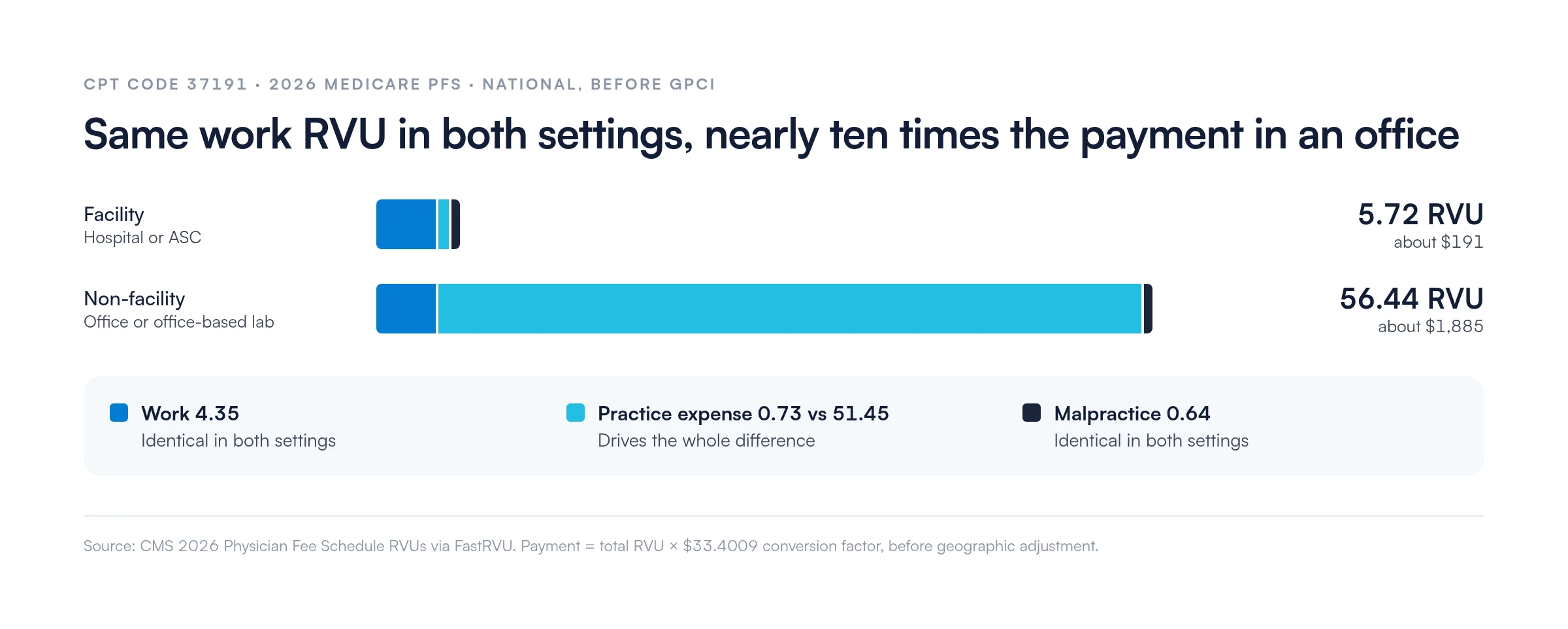
Stacked bars of CPT 37191 2026 Medicare RVUs
The physician’s work RVU doesn’t change with the setting, but office practice expense lifts the payment nearly tenfold. Figures are CMS 2026 MPFS values via FastRVU.

Use the FastRVU 2026 RVU lookup tool to apply the geographic adjustment for your MAC locality. Rates in Alaska, California and New York differ noticeably from national values.

In a hospital outpatient department, the facility side is paid under the Outpatient Prospective Payment System (OPPS), where the APC assignment sets the hospital’s payment. The physician still bills the facility rate. A medical claims clearinghouse checks the 837P data elements before the claim reaches the MAC.

Six denial patterns, and the fix for each

Most 37191 denials fall into six patterns, and each has a fix you can apply before submission. Track the ones you see with a denial management workflow, and decode payer reasons with this guide to medical billing denial codes.

Denial reasonRoot causeCorrective action
Insufficient medical necessityDiagnosis doesn’t meet payer criteria, or the contraindication isn’t documentedAttach the imaging report confirming VTE and the physician note naming the contraindication
Incomplete operative noteMissing access site, filter brand, IVC diameter or final positionUse a structured operative note template, and require each element before the note is signed
Bundling errorFluoroscopy, S&I, IVUS or venacavography billed alongside 37191Remove 77001, 76000, 37252/37253 and 75825 from the claim, and check the NCCI edit table
Prior auth not obtainedThe plan needed pre-authorization that wasn’t securedCheck auth requirements at scheduling, and document emergent status when urgent placement skips it
Incorrect modifier-59 or -XU used outside a payer-permitted same-day 37191/37193 scenarioDrop the modifier unless the payer’s policy allows the pair
Place-of-service mismatchPOS code doesn’t match where the procedure was performedVerify POS 11 (office), 21 (inpatient) or 22 (outpatient hospital) against the encounter record

Before you submit: A 37191 checklist

Run through this list on every claim. It takes a couple of minutes and catches the issues behind most of the denials above.

  • The diagnosis code confirms DVT or PE, and a second code supports the contraindication.
  • The physician note names why anticoagulation can’t be used or has failed.
  • The operative note shows access site, filter type, IVC diameter, final position and completion imaging.
  • No 77001, 76000, 75825, 37252 or 37253 sits on the same claim.
  • No -26, -TC or laterality modifier is attached.
  • The place of service matches the setting, so the facility or non-facility rate applies correctly.
  • The prior authorization number is on the claim when the plan requires one.

Mistakes that turn a clean 37191 claim into a denial

A few errors come up again and again. Each one looks harmless at coding time.

  • Reporting the imaging twice. Venacavography and IVUS feel like separate studies, but 37191 already pays for them.
  • Copying a radiology habit. Adding -26 to a surgical code with no professional component gets the line rejected.
  • Billing a prophylactic filter as routine. Without a confirmed VTE diagnosis, most payers treat it as not medically necessary.
  • Quoting last year’s rate. RVUs and the conversion factor change every January, so refresh fee schedules annually.

This table covers the codes you’re likely to meet on an IVC filter placement encounter, including the ones that can’t go on the same claim.

CodeDescriptor (summary)Billable with 37191?Notes
37191IVC filter placement (endovascular)Primary codeIncludes imaging guidance and vascular access
37192IVC filter repositioningNo (mutually exclusive)Use when the filter was already placed and is only repositioned
37193IVC filter retrievalPayer-dependent (with -59)Same-day placement and retrieval is rare, so verify payer policy
75825Venography, caval, inferior, with serialography, unilateral or bilateral, radiological S&INo (bundled)Imaging and S&I are included in 37191
99152-99153Moderate sedation by the proceduralistYes, when documentedUse 99151 for patients under age 5
99213-99215Office E/M (established patient)Yes (separate encounter or with -25)Bill a pre-procedure visit only when it’s significant and separately documented

Pro Tip

Check the 37191 claim against the current NCCI edit table before submission every time, not only when companion codes are on it. CMS updates NCCI edits quarterly, so a pair that passed last year may not pass now.

How Pabau keeps 37191 claims moving

Interventional practices often track authorizations in a spreadsheet and key claims by hand, then find a missing auth number only when the denial arrives.

Pabau, the practice management platform we build, keeps that work on the patient’s case instead. The prior authorization code, dates and sessions are tracked there, with a warning when one is missing. The CPT code attached to the service lands on the claim line, and the claim won’t send until required fields are complete.

In the US, Pabau’s streamlined claims management software submits 837P claims through Claim.MD, runs eligibility checks and posts ERA remittances. Your team sees each 37191 claim’s status without logging in to a separate portal.
Automate claims through Healthcode
Pabau’s claims management sends 37191 claims with the authorization already on the case, so a missing auth number surfaces before submission.

Send IVC filter claims with the auth attached

Pabau tracks prior authorization on the patient’s case and submits 837P claims through Claim.MD, with eligibility checks and ERA posting. See how it fits interventional radiology and vascular practices.

Pabau claims management dashboard

Conclusion

Most 37191 denials trace back to paperwork. The code itself is simple, because one line pays for access, imaging and deployment.

So put your effort into the record. Confirm the VTE diagnosis, name the contraindication, and keep IVUS and venacavography off the claim. Check the place of service too, since the office rate is nearly ten times the facility rate.

Book a demo to see how Pabau keeps the authorization on the case and sends your 37191 claims through Claim.MD.

Continue your research

Continue your research

Billing the hospital side of a filter placement? HCPCS code C1880 covers the vena cava filter device on the facility claim.

Want to understand how the claims lifecycle works end to end? Medical billing fundamentals covers the full workflow from superbill creation to payment posting.

Looking to cut rework on insurance claims? Claims management software from Pabau tracks authorizations and submits claims from the patient record.

Frequently asked questions

Which ICD-10-CM codes support CPT 37191?

Most claims pair 37191 with a confirmed VTE diagnosis, such as I26.- for pulmonary embolism or I82.4- for acute lower-extremity DVT. Add a code for the reason anticoagulation won’t work, or Z79.01 when PE recurred on therapy.

Does the 37191 payment include the filter itself?

In an office, yes. The non-facility practice expense covers the supplies the practice buys, which is why that rate is so much higher. In a hospital, the physician gets the facility rate, and the hospital reports the device with HCPCS C1880.

Is moderate sedation included in CPT 37191?

No. When the proceduralist provides moderate sedation, report 99152 for the first 15 minutes and 99153 for each extra 15 minutes. Use 99151 for patients under age 5. Sedation from a separate anesthesia provider goes on that provider’s claim.

Does 37191 cover a superior vena cava filter?

Yes. The descriptor names a vena cava filter without limiting it to the inferior vessel, so 37191 applies to either site. Document the site, approach and indication clearly, since SVC placement is uncommon.
Avatar photo
Monika Lazarevska
Content Writer

Monika Lazarevska writes content for owners and healthcare professionals who want clear, no-fluff content that actually helps them run their practice better. With a background in storytelling and SEO, she knows how to make even the driest topics worth reading. Off the clock, you'll find her in a café somewhere in Europe, probably with a good book and an even better coffee.
×