CPT Code 35820: Exploration for postoperative hemorrhage (thorax)
CPT Code 35820: Official descriptor and clinical overview CPT Code 35820 is defi...

Last Updated: Nov 13, 2026
43845 is the CPT code for biliopancreatic diversion with duodenal switch (BPD/DS), performed as an open operation. Its official descriptor is a gastric restrictive procedure with partial gastrectomy, pylorus-preserving duodenoileostomy and ileoileostomy (50 to 100 cm common channel) to limit absorption.
Claims for this code are often denied for three reasons. Billers confuse it with 43846 (Roux-en-Y gastric bypass), pair it with the wrong ICD-10 diagnosis, or submit without confirmed prior authorization.
Let Pabau's smart automation suggest the right codes, reduce claim denials, and keep your practice compliant—effortlessly.
Automate repetitive tasks and focus on what matters most—your patients.
Reduce coding errors and ensure compliance with the latest regulations.
Clean claims, fewer denials, and faster reimbursements.
Powerful insights and reporting to help your practice thrive.
HIPAA compliant SOC 2 certified GDPR-compliant Trusted by 4,000+ clinics worldwide

CPT 43845 covers open biliopancreatic diversion with duodenal switch: a partial gastrectomy plus a pylorus-preserving duodenoileostomy and ileoileostomy, billed as one line.
It is not a Roux-en-Y gastric bypass, which is 43846 or 43847, and laparoscopic BPD/DS usually goes to unlisted 43659 per payer policy.
E66.01 leads the diagnosis list, with the matching Z68 BMI code and every documented comorbidity listed after it.
Medicare covers 43845 under NCD 100.1, and facilities no longer need Center of Excellence certification for dates of service on or after September 24, 2013.
Pabau’s claims management software tracks prior authorizations and routes claims electronically through Claim.MD.
CPT code 43845 reports an open biliopancreatic diversion with duodenal switch (BPD/DS), with both the restrictive and the malabsorptive halves billed as one procedure.
AAPC’s CPT 43845 listing places it under Other Procedures on the Stomach (43800-43999), inside the digestive system surgery range. Its official descriptor is a gastric restrictive procedure with partial gastrectomy, pylorus-preserving duodenoileostomy and ileoileostomy (50 to 100 cm common channel) to limit absorption.
In plain terms, the surgeon removes part of the stomach, divides the duodenum just past the pylorus and joins it to the ileum. A second anastomosis, the ileoileostomy, leaves a short common channel where food meets bile. The AMA’s CPT code set owns the descriptor, and our CPT codes library lists the neighboring stomach procedures.
CPT 43845 bundles the partial gastrectomy and the duodenoileal reconstruction into a single billable unit. Split them onto separate claim lines and the National Correct Coding Initiative (NCCI) edits deny the claim. That includes the sleeve gastrectomy code, 43775, which NCCI bundles into 43845.
Some work at the same session still falls outside the code. The right-hand column below is what you report separately, with the appropriate modifier.
43845 describes the open procedure. Laparoscopic BPD/DS is commonly reported with unlisted 43659 per payer policy. Single anastomosis duodeno-ileal bypass with sleeve (SADI-S) is split the same way.
Some payers accept 43845 because SADI-S still creates a duodenoileal anastomosis. Others want 43659, since SADI-S uses one anastomosis rather than the two the descriptor implies.
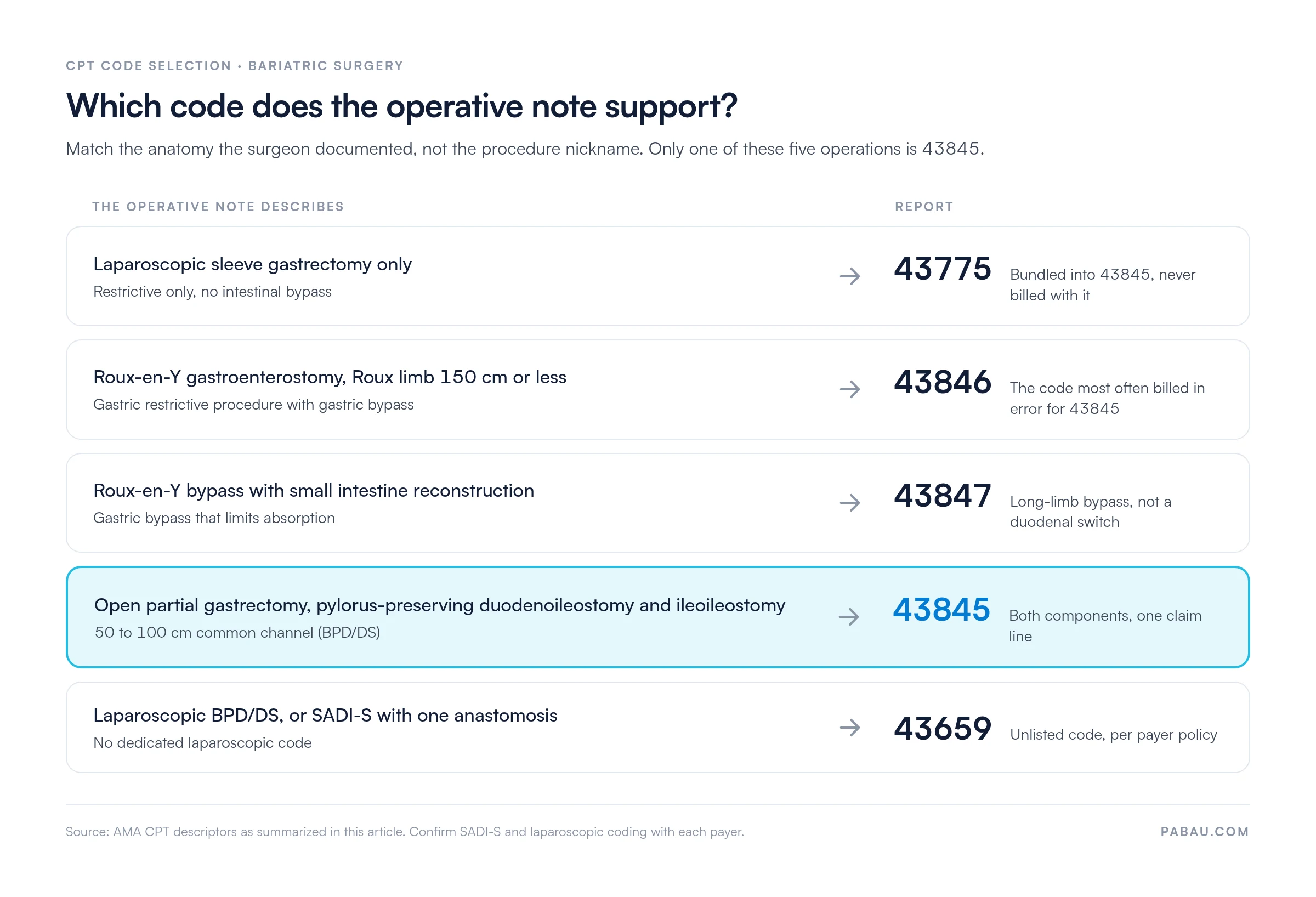
The most common code-selection error on these claims is reporting 43846 for a duodenal switch. The two operations differ in anatomy, mechanism and anastomosis configuration.
A wrong pick also changes the expected payment and the NCCI edits that apply. Read the operative note for the anatomy, then match it against the five options below.
E66.01 (morbid obesity due to excess calories) is the primary diagnosis for a CPT 43845 claim. Report E66.09 (other obesity) or the nonspecific E66.9 as primary, and most payers deny for medical necessity.
Those codes don’t meet their clinical criteria for bariatric surgery. Clear medical billing documentation of the obesity class keeps the diagnosis right from chart to claim.
List every documented comorbidity as a secondary ICD-10 code on a 43845 claim. Payers weigh the full comorbidity burden in medical necessity reviews. A sparse diagnosis list is a common reason auditors downcode or deny bariatric claims after payment.
The operative report is the most scrutinized document in a 43845 audit. It must show that the surgeon performed both the gastric restriction and the intestinal bypass.
A report that describes only the gastrectomy, with no duodenoileal anastomosis, won’t support 43845 and gets downgraded to 43775. Sound billing compliance requirements mean the chart backs both components before the claim goes out.
Nearly every commercial payer and Medicare Advantage plan requires prior authorization for 43845. Submitting without a confirmed approval is the most common denial cause for this code. Requirements vary by payer, so never lean on an approval another payer issued for the same patient.
Most commercial payers build their criteria around these thresholds. Confirm each one against the payer’s current medical policy.
Medicare’s National Coverage Determination (NCD 100.1) covers bariatric surgery for beneficiaries with a BMI of 35 or more and at least one obesity-related comorbidity. Facilities are no longer required to be certified, since NCD 100.1 dropped that condition for dates of service on or after September 24, 2013.
Traditional Medicare doesn’t require prior authorization for 43845. Medicare Advantage plans set their own rules and commonly do.
Medicare covers CPT code 43845 under NCD 100.1 for beneficiaries who meet the BMI and comorbidity criteria above. The surgeon’s professional claim goes on the CMS-1500 (837P), and the hospital bills its facility charges on the UB-04.
The 2026 Medicare Physician Fee Schedule (MPFS) values for CPT 43845 are below. They are national amounts before the geographic practice cost index (GPCI) is applied. Use the CMS Physician Fee Schedule lookup tool or the FastRVU 2026 lookup tool for your locality’s rate.
Commercial rates for 43845 often run above Medicare, but they vary widely by market and contract. Check the contracted rate in each payer agreement before you estimate expected payment.
Modifier selection on a 43845 claim affects both payment and audit exposure. Claims management software like Pabau helps your biller track the claim from the encounter to submission. Check modifier rules against the operative note.
A duodenal switch claim starts months before surgery. Each step below hands something to the next one, and a weak link shows up later as a denial.
A 43845 claim needs three things in place: an approved authorization, exact diagnosis coding and complete operative documentation. Miss any one and the claim comes back denied. Structured denial management workflows catch these problems before submission rather than after the remittance arrives.
CMS NCCI edits bundle the sleeve gastrectomy code (43775) into 43845, so billing both on the same date of service brings an automatic denial. Pabau routes claims through the Claim.MD clearinghouse for electronic submission and remittance. Verify NCCI edits in the CMS tool before billing any second code on the same claim as 43845.
Build a 43845 claim template in your practice management system. Pre-populate E66.01 as the primary ICD-10 code, make the authorization number a required field, and flag the claim for surgeon sign-off before submission. That one template targets the two denial causes in the table above that start at the front desk.
Bariatric billing usually lives across a spreadsheet of authorizations, a shared inbox and the surgeon’s dictation queue. That’s where an approval number goes missing or a claim leaves before sign-off.
In Pabau, the authorization code, its dates and the approved sessions sit on the patient’s case, with a warning when one is missing. Claims go out electronically through Claim.MD as CMS-1500/837P files, with eligibility checks before the visit and ERA remittances posted back.
Your team sees each 43845 claim’s status in one place, so a denial gets worked while the global period is still open.

Pabau tracks each prior authorization on the patient’s case and routes claims electronically through Claim.MD. Your billing team spends its time on complex cases rather than chasing paperwork.

Most 43845 denials trace back to a decision made before the claim was built. Someone read “duodenal switch” and picked a bypass code, or scheduled the case before the authorization cleared.
Make the operative note the deciding document. If it names an open partial gastrectomy, both anastomoses and a 50 to 100 cm common channel, bill 43845 with E66.01 first. If it doesn’t, query the surgeon before you code.
To see how Pabau tracks authorizations and routes bariatric claims through Claim.MD, book a demo.

Billing the laparoscopic Roux-en-Y instead? CPT code 43644 covers the laparoscopic gastric bypass with a short Roux limb.
Need to understand how claims move from your EHR to a payer? Revenue cycle management explained walks through the full claim lifecycle from coding to payment posting.
Getting denials on complex surgical claims? Clean claim requirements covers the fields and edits that prevent remittance-stage rejections.
Need a reference for the 837 file your clearinghouse submits? 837 EDI file overview explains the transaction set structure and common submission errors.
Usually not. 43845 describes the open procedure. Many payers want laparoscopic BPD/DS reported with unlisted code 43659, so check the payer’s policy before you code the case.
43845 is a duodenal switch: part of the stomach is removed and the duodenum is joined to the ileum. 43846 is a Roux-en-Y gastric bypass with a Roux limb of 150 cm or less.
CPT 43845 carries a 90-day global period. Related follow-up visits in that window are included in the surgical payment, so don’t bill them separately.
Often, if the plan includes a bariatric benefit. Expect a BMI threshold, documented comorbidities, a supervised diet history and prior authorization. Medicare covers it under NCD 100.1 for a BMI of 35 or more with a comorbidity.
In 2026, CPT 43845 carries 28.74 work RVUs and 45.22 total facility RVUs. At the $33.4009 conversion factor, that’s about $1,510 before locality adjustment.
Yes, when it’s performed at the same session and not bundled by NCCI. Report 47600 with modifier 51, and check the current NCCI edits first.