HCPCS Code L2037: Knee ankle foot orthosis billing guide
HCPCS Code L2037: Official descriptor and device classification HCPCS Code L2037...

Last Updated: Oct 21, 2026
L2108 is the HCPCS Level II code for ankle foot orthosis, fracture orthosis, tibial fracture cast orthosis, custom fabricated.
It describes a below-knee brace made for one patient to stabilize a tibial fracture. Its descriptor names no casting material, which separates it from L2106, the thermoplastic version. Prefabricated tibial fracture orthoses bill as L2112, L2114, or L2116 instead.
Let Pabau's smart automation suggest the right codes, reduce claim denials, and keep your practice compliant—effortlessly.
Automate repetitive tasks and focus on what matters most—your patients.
Reduce coding errors and ensure compliance with the latest regulations.
Clean claims, fewer denials, and faster reimbursements.
Powerful insights and reporting to help your practice thrive.
HIPAA compliant SOC 2 certified GDPR-compliant Trusted by 4,000+ clinics worldwide

HCPCS code L2108 describes a custom-fabricated ankle-foot orthosis for a tibial fracture, made for one patient from a cast, impression, or scan.
L2108 is an ankle-foot orthosis, so it never crosses the knee. Knee-ankle-foot orthoses bill from the KAFO codes in the L2000 to L2038 range.
L2106 is the thermoplastic custom version. L2112, L2114, and L2116 are the prefabricated soft, semi-rigid, and rigid fracture orthoses.
Tibia and fibula fracture codes from ICD-10-CM category S82 support L2108. Neurological diagnoses such as stroke or multiple sclerosis do not.
Claim validation in Pabau, the practice management platform we build, flags a missing modifier or diagnosis before an L2108 claim goes out.
HCPCS code L2108 is the Level II code for a custom-fabricated tibial fracture cast orthosis. The full CMS descriptor reads: ankle foot orthosis (AFO), fracture orthosis, tibial fracture cast orthosis, custom-fabricated. Three parts of that wording decide whether the code fits:
The first error to rule out is reading L2108 as a knee-ankle-foot orthosis. Every code from L2106 to L2116 is an AFO for a tibial fracture, so none of them braces the knee.
L2108 covers one narrow device. Sorting the inclusions from the exclusions at intake prevents most miscoded tibial fracture claims.
All five tibial fracture orthosis codes describe the same anatomy. The right code depends on how the device was fabricated and on the closing words of each descriptor, compared side by side below.
Fabrication splits the family first. L2106 and L2108 are custom fabricated, while L2112, L2114, and L2116 arrive prefabricated with fitting and adjustment included.
On the custom side, the casting material decides the code. A thermoplastic device bills as L2106, and a custom device in another material bills as L2108. On the prefabricated side, the choice turns on whether the orthosis is soft, semi-rigid, or rigid.
The decision path below runs the three checks in order, starting with whether the device crosses the knee.
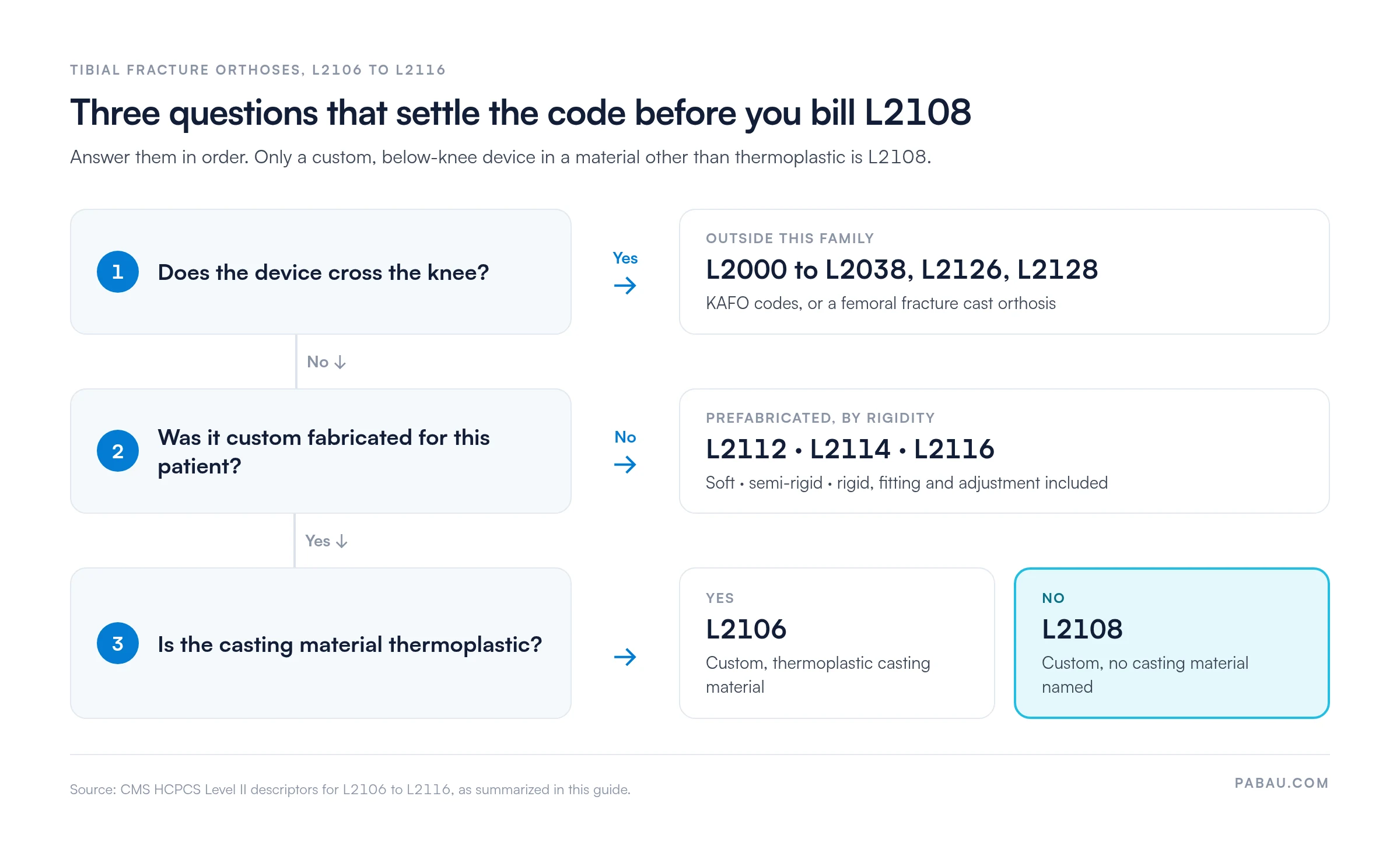
Before assigning L2108, confirm from the fabrication records that the device was made for this patient. Then check that its casting material is not thermoplastic.
A reference or billing tool that describes L2108 as a double-upright knee-ankle-foot orthosis is wrong. Double-upright KAFOs bill from the L2000 to L2038 range, and a claim built on that description will not match the device delivered.
Payers need a fracture diagnosis to establish medical necessity for L2108. The supporting codes come from ICD-10-CM category S82, fracture of lower leg, including ankle.
The table lists the most common pairings. Check the DME MAC’s Local Coverage Determination (LCD) and policy article before billing, since covered lists can change.
Diagnoses such as cerebral palsy, multiple sclerosis, ALS, stroke, or lumbar radiculopathy do not support L2108. Those conditions call for a general AFO or KAFO, coded from a different range. Our ICD-10 reference for billers carries the full S82 fracture set.
Medicare Part B covers L2108 under its braces benefit when the claim documents medical necessity. The DME MAC for the beneficiary’s state processes the claim. Key coverage conditions include:
Before delivering an L2108 orthosis to a Medicare beneficiary, confirm two things. The supplier’s DMEPOS number must be active. The fabrication records must also show the device was made for this patient in a material other than thermoplastic.
CMS expects a complete documentation trail behind every L2108 claim. A missing element is grounds for denial, and an order dated after delivery cannot be fixed later.
Modifier selection on L2108 claims draws close audit attention. The table covers the modifiers a supplier may need and what happens when each one is missing.
For bilateral tibial fractures, both LT and RT must appear on the claim. Follow your DME MAC’s bilateral billing instruction for the line and unit format.
The enrolled supplier submits L2108 on the CMS-1500 claim form or the electronic 837P transaction. The ordering practitioner does not bill the device unless that practice is the enrolled supplier. Key submission points include:
Track the electronic remittance advice for every L2108 line. When the same adjustment code repeats across claims, the cause usually sits in one step of the workflow.
A clean claim on L2108 carries the code that matches the casting material, a laterality modifier, a valid order, and an S82 fracture diagnosis.
L2108 denials cluster around a short list of coding and documentation failures, so a working denial management process pays off on this code.
Medicare’s five-level appeals process applies to denied L2108 claims. Documentation denials usually resolve at the first two levels:
Three later levels follow: an Administrative Law Judge hearing, the Medicare Appeals Council, and federal district court. The hearing and court levels require a minimum amount in controversy, set each year.
An L2108 claim depends on records created at different moments. The order comes from the treating practitioner, the casting notes from fabrication, and the receipt from delivery. When those live in separate systems, an unsigned order only surfaces on a remittance advice weeks later.
With Pabau’s software for cleaner claims, each claim opens pre-filled from the patient’s invoice and is validated before submission. CMS-1500 claims go out through Claim.MD, and eligibility checks run before the visit.
The claims dashboard then follows every L2108 line from Pending to Paid. When a payer rejects a claim, Pabau shows the reason, so staff can correct it and resubmit with the patient’s records at hand.

Pabau validates each claim before submission and tracks it through to payment. Missing modifiers and diagnoses get caught early, so fewer claims come back denied.

L2108 is a custom-fabricated tibial fracture cast orthosis, and each billing decision follows from that. The device stops below the knee, was made for one patient, and uses a casting material other than thermoplastic.
A claim that matches the device to that descriptor, pairs an S82 fracture code, and carries a complete order is ready for payer review. Settling the code at intake costs far less than appealing a denial afterward.
To see how Pabau validates each claim and tracks it through to payment, book a demo with the team.

Need to understand how clearinghouse submission works for DME claims? Medical claims clearinghouse guide walks through how electronic claim submission, edits, and payer routing work from end to end.
Seeing consistent remittance denial codes you cannot decode? Denial codes in medical billing breaks down the most common CARC and RARC codes with action steps for each.
Want to understand electronic remittance and ERA processing? Electronic remittance advice (ERA) explained covers 835 transaction processing, posting, and reconciliation workflows.
Is the fracture orthosis crossing the knee? HCPCS code L2126 explains the custom femoral fracture cast orthosis and when it applies.
HCPCS code L2108 covers a custom-fabricated ankle-foot orthosis for a tibial fracture, built for one patient from a cast, impression, or scan. Its descriptor names no casting material. It does not cover knee-ankle-foot orthoses, prefabricated braces, or AFOs for neurological conditions.
Both are custom-fabricated tibial fracture cast orthoses. L2106 specifies thermoplastic type casting material, while L2108 names no material. A custom device made from thermoplastic bills as L2106, and one made from another material bills as L2108.
No. L2108 is an ankle-foot orthosis that treats a tibial fracture below the knee. Knee-ankle-foot orthoses bill from the KAFO codes in the L2000 to L2038 range, and femoral fracture cast orthoses bill as L2126 or L2128.
Fracture codes from ICD-10-CM category S82 support L2108, especially tibial shaft (S82.2-), proximal tibia (S82.1-), and distal tibia (S82.3-) fractures. Neurological diagnoses such as stroke or multiple sclerosis do not support this code.
Yes, Medicare Part B covers L2108 under its braces benefit when the device is medically necessary and the claim is documented. The supplier must be enrolled as a DMEPOS supplier. The beneficiary pays the Part B deductible and 20% coinsurance.
Frequent causes include a code that does not match the device and a missing or incomplete written order. An absent LT or RT modifier and a non-fracture diagnosis are common too. A pre-submission check of fabrication records and modifiers prevents most of them.