

HCPCS code E0198: Water pressure pad billing guide
HCPCS code E0198 is a water pad for a standard mattress HCPCS code E0198 is the ...

Last Updated: Oct 13, 2026
L2128 is the HCPCS Level II code for knee ankle foot orthosis, fracture orthosis, femoral fracture cast orthosis, custom fabricated.
The brace is built for one patient over a cast, impression or digital model of that limb. Most denials trace to one of three errors. A stock brace gets billed under a custom-fabricated code, the detailed written order is missing, or proof of delivery is absent.
Let Pabau's smart automation suggest the right codes, reduce claim denials, and keep your practice compliant—effortlessly.
Automate repetitive tasks and focus on what matters most—your patients.
Reduce coding errors and ensure compliance with the latest regulations.
Clean claims, fewer denials, and faster reimbursements.
Powerful insights and reporting to help your practice thrive.
HIPAA compliant SOC 2 certified GDPR-compliant Trusted by 4,000+ clinics worldwide

HCPCS code L2128 covers a custom-fabricated femoral fracture cast orthosis, while the prefabricated versions bill under L2132, L2134 and L2136.
L2126 is custom fabricated too, and its descriptor is the one that names thermoplastic type casting material.
Medicare coverage follows LCD L33686, so a claim needs a physician order, a detailed written order, proof of delivery, and a documented functional limitation.
After incomplete documentation, missing or mismatched modifiers such as KX, GA and RT or LT are the most common cause of L2128 denials.
Practice management software like Pabau captures the documentation, runs eligibility checks, and tracks denials across HCPCS L-code claims.
The Centers for Medicare & Medicaid Services (CMS) publishes the official descriptor for HCPCS code L2128. It reads: knee ankle foot orthosis, fracture orthosis, femoral fracture cast orthosis, custom fabricated.
Two phrases in that descriptor carry the coding decision. “Custom fabricated” means the supplier builds the brace for one patient over a cast, impression or digital model of that limb. “Femoral fracture cast orthosis” places it in the fracture-brace family that spans the thigh, knee, ankle and foot.
The descriptor names no material, and that omission is deliberate. L2126 is the code that names thermoplastic type casting material, so L2128 carries the custom-fabricated braces that description does not cover.
Clinically, the orthosis immobilizes the femur, knee, ankle and foot while a fracture heals. Femoral shaft fractures are the usual indication. Tibial plateau fractures and other lower-limb instability that needs full-leg support also qualify where the record supports it.
A tibial fracture brace that stops below the knee is an ankle-foot orthosis, not a KAFO. The custom-fabricated thermoplastic version bills as L2106.
L2128 sits in a five-code range of femoral fracture cast orthoses. Two of those codes are custom fabricated and three are prefabricated, and that split is what decides the claim. The table below pairs each code with its official descriptor. Check it against the device actually delivered before billing.
There is no L2130 in this family. The range runs L2126, L2128, L2132, L2134 and L2136, so a claim submitted under L2130 rejects as an invalid code. The closest neighbor to L2128 is L2126, and choosing between the two is a materials question rather than a custom-versus-stock one.
A knee-ankle-foot orthosis that is not a fracture brace sits outside this family, in the L2000 to L2038 range. The custom-fabricated full-plastic, double-upright brace in that range bills under L2036.
The expensive error in this family runs the other way. Billing L2128 for a brace that came from stock is upcoding, because a fitted stock brace belongs under L2132, L2134 or L2136. Auditors read the fabrication records, so the distinction is verifiable.
CMS separates orthoses into three construction categories: custom fabricated, prefabricated and fitted, and off-the-shelf. L2128 and L2126 sit in the first. The other three codes in the family sit in the second and third.
PDAC stands for the Pricing, Data Analysis and Coding contractor. It verifies whether a supplier may bill a specific manufacturer product under a given HCPCS code, and that verification is device-specific. Check the current PDAC coding verification guidance before billing a new product under this code.
Medicare Part B covers L2128 under the brace benefit, and the claim goes to the DME MAC for the patient’s region. LCD L33686 governs coverage and applies to every ankle-foot and knee-ankle-foot orthosis. The LCD sets out four conditions, and the record has to document all four.
The ICD-10-CM diagnosis codes below commonly support medical necessity for L2128 claims. Each has to appear in the physician order and in the detailed written order. A diagnosis code on its own does not establish coverage, so the record must also show a functional limitation consistent with it.
Pulling the diagnosis from the current ICD-10-CM code set matters more than it looks. A deleted or unspecified code weakens the necessity argument before a reviewer has read the clinical note.
Always use the most specific fracture code available. Laterality drives modifier selection, RT for right and LT for left. It has to match across the ICD-10 code, the physician order and the claim.
Bill the initial fracture ICD-10 code (7th character A) at supply. If the device is still in use at follow-up, move to the subsequent encounter code (7th character D). Mismatched encounter characters between the diagnosis code and the claim date are a documented audit trigger for KAFO claims.
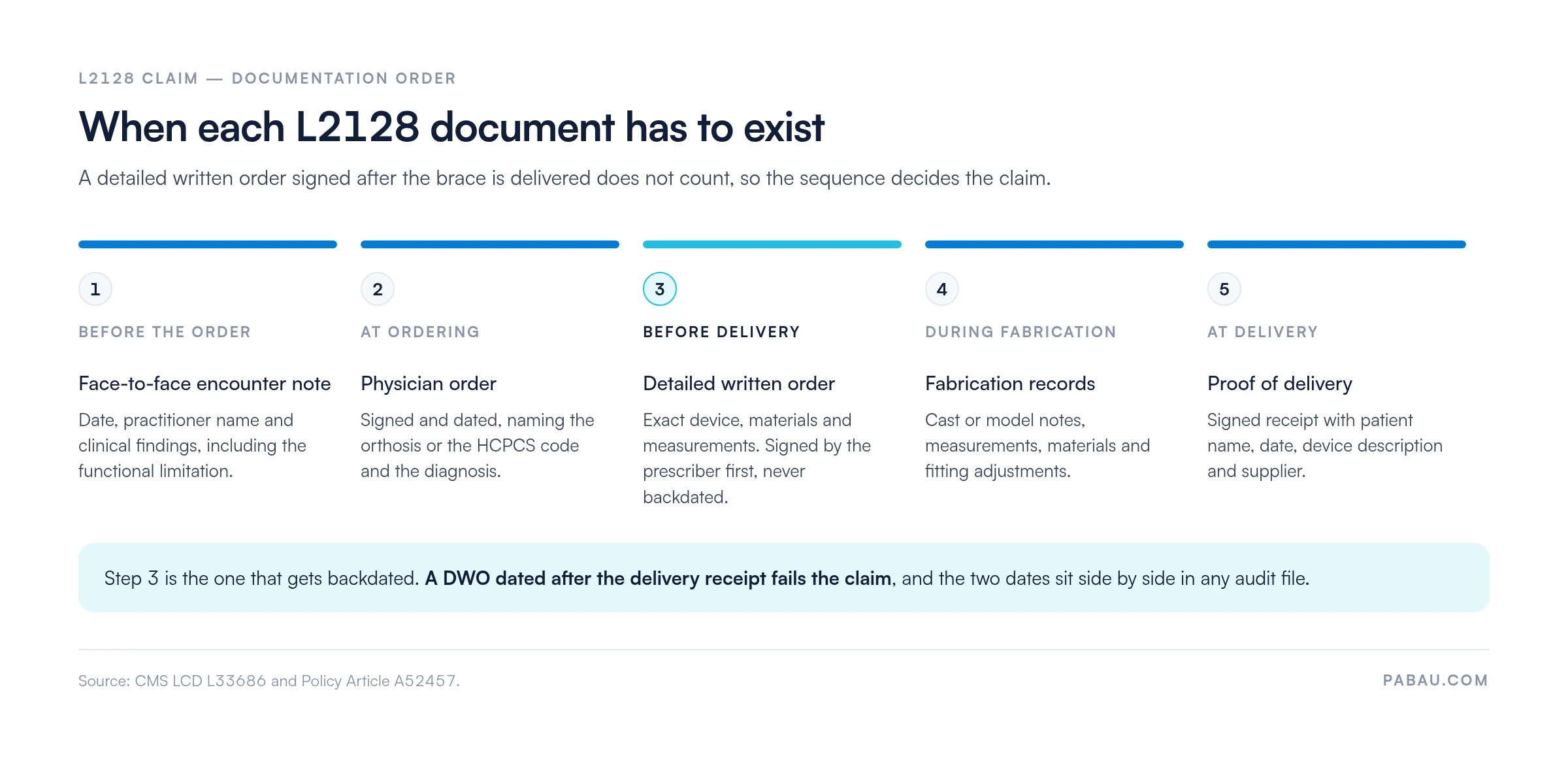
CMS Policy Article A52457 sets out the documentation a KAFO claim needs. Miss one element and the Medicare Administrative Contractor has grounds to deny on first pass. Build the checklist into the ordering workflow before fabrication begins.
The order in which you create those documents matters as much as the list itself, because two of them are only valid if they predate delivery.
PDAC product coding verification applies when a supplier wants confirmation that they may bill a specific manufacturer product under L2128. A supplier makes a fully custom-fabricated brace for one patient, so verification works differently here than it does for stock products. If the device incorporates a manufacturer-supplied prefabricated component, check current PDAC guidance before billing. Billing without verification where the payer requires it can bring full recoupment plus overpayment interest.
L2128 denials cluster around three root causes: wrong code selection, incomplete documentation, and modifier errors. Each has a distinct corrective action, and a pre-billing check can catch each one before submission.
Remittance advice comes back carrying CARC and RARC reason codes. Mapping each one to a corrective workflow is what turns an L2128 rejection into a resubmission rather than a write-off.
Medicare Fee-for-Service does not require prior authorization for L2128 as a standing rule. Medicare Advantage is a different matter. Each plan sets its own requirements, and many apply authorization to custom-fabricated KAFO codes because those codes reimburse more. You cannot appeal a denial for missing authorization on medical necessity grounds alone.
Commercial payers vary by plan and by contract year. Verify eligibility and authorization before fabrication begins. On a device built for one patient, a late check turns into a write-off nobody can resell.
Medicare prices L2128 from the DMEPOS fee schedule, not from the physician fee schedule. CMS sets allowables annually, and they vary by payment locality. They change every January 1, so a claim billed from last year’s file will not reconcile.
Download the current CMS DMEPOS fee schedule and read the allowable for your locality. The patient generally owes 20% of that allowable once they meet the Part B deductible, unless a supplemental plan picks it up.
Suppliers and orthotics practices billing HCPCS L codes carry a documentation load that grows with claim volume. Fabrication records, detailed written orders, delivery receipts and authorization tracking all have to be in order before a claim leaves the office. Most teams hold them across a shared drive, an email thread and the billing system.
Pabau is practice management software with claims tools built into the same record. Its software for billing teams centralizes documentation capture, runs eligibility checks before the appointment, and pulls denial reasons off remittance advice for structured follow-up. So the DWO, the delivery receipt and the claim all sit against one patient rather than three systems.
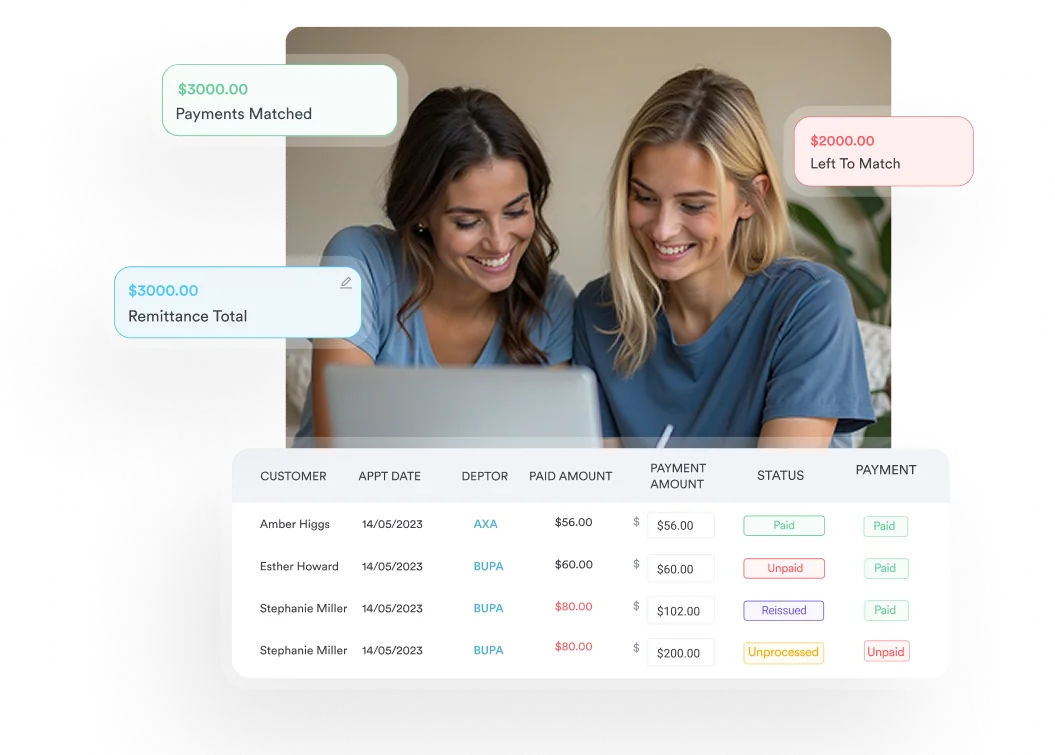
Orthotics and rehab practices that order KAFO devices for post-surgical and fracture patients meet the same seam between the clinical note and the claim. Capturing HCPCS codes, modifiers and diagnosis codes in one structured record cuts transcription errors at submission. Denial tracking then flags unresolved L2128 claims before the filing deadline closes.
Run a weekly aging report filtered to HCPCS L codes. Custom-fabricated KAFO claims carry higher dollar values than the prefabricated codes in the same range. They also age out faster when a documentation deficiency goes unresolved. Catching a missing DWO in week two costs far less than a late appeal at 90 days.

Pabau’s claims management tools help suppliers and billing teams capture orthosis documentation, run eligibility checks, and track denial reasons in one place. See how it fits an L-code billing workflow.

L2128 is one of the more documentation-intensive DMEPOS codes to bill correctly. The claim stands or falls on proving the brace was custom fabricated for one patient rather than fitted from stock. LCD L33686, the detailed written order, modifier accuracy and proof of delivery are the four checkpoints where these claims fail.
Get the documentation chain in order before fabrication starts and most L2128 denials never happen. Remittance tracking closes the loop on the ones that do. To see how Pabau handles HCPCS L-code workflows from order to payment, book a demo.

Need to understand denial management for DMEPOS claims? Denial management in healthcare covers the denial lifecycle, CARC/RARC codes, and how to build a structured appeals process.
Want a clean claim checklist for HCPCS submissions? Billing compliance requirements outlines the documentation standards that keep DMEPOS claims off the recoupment list.
Billing other orthosis codes? Revenue cycle management fundamentals explains how to structure DMEPOS billing workflows from order to payment posting.
HCPCS code L2128 covers a custom-fabricated femoral fracture cast orthosis that spans the knee, ankle and foot. The supplier builds the brace for one patient over a cast, impression or digital model of that limb. A prefabricated brace fitted from stock bills under L2132, L2134 or L2136 instead.
Yes, Medicare Part B covers L2128 under the brace benefit once the record meets the LCD L33686 criteria. The record needs a documented condition requiring the device, a physician order, and a detailed written order signed before delivery. Proof of delivery and a documented functional limitation complete the file. Medicare Advantage plans set their own authorization and coverage rules.
Medicare Fee-for-Service does not require prior authorization for L2128 as a general rule, though many Medicare Advantage plans do. Commercial payers vary by contract. Verify the requirement with the plan before fabrication begins. You cannot correct a denial for missing prior authorization after the fact.
PDAC coding verification confirms that a supplier may bill a manufacturer product under a specific HCPCS code. A supplier builds a fully custom-fabricated L2128 brace for one patient, so verification works differently than it does for stock products. If the device includes a prefabricated component, check current PDAC guidance before billing. The DMEPDAC website publishes product-specific coding advisories.



