HCPCS code P9058: Red blood cells, leukocytes reduced, CMV-negative, irradiated
HCPCS code P9058: Official descriptor and key attributes HCPCS code P9058 report...

Last Updated: Oct 26, 2026
L1860 is the HCPCS Level II code for a knee orthosis (KO), modification of supracondylar prosthetic socket, custom-fabricated (SK). Medicare policy describes it as a jointless, custom-made plastic orthosis that prevents knee hyperextension in patients who walk.
Medicare covers L1860 only for knee instability caused by genu recurvatum, coded M21.861, M21.862 or Q68.2. The record must also show why a prefabricated orthosis such as L1850 will not work.
Let Pabau's smart automation suggest the right codes, reduce claim denials, and keep your practice compliant—effortlessly.
Automate repetitive tasks and focus on what matters most—your patients.
Reduce coding errors and ensure compliance with the latest regulations.
Clean claims, fewer denials, and faster reimbursements.
Powerful insights and reporting to help your practice thrive.
HIPAA compliant SOC 2 certified GDPR-compliant Trusted by 4,000+ clinics worldwide

L1860 is a custom-fabricated, jointless plastic knee orthosis that prevents knee hyperextension in patients who walk.
Medicare covers L1860 only for an ambulatory patient with knee instability from genu recurvatum, plus a documented reason a prefabricated orthosis will not work.
Only three ICD-10-CM codes support L1860: M21.861, M21.862 and Q68.2. Unspecified laterality and amputation status codes are not on the list.
Every L1860 claim line needs KX, GA or GZ plus RT or LT, and soft interfaces and straps billed alongside it are denied as bundled.
Claims management software such as Pabau validates each L1860 claim before submission and tracks its status afterward, so stalled claims get chased early.
HCPCS Code L1860 is the HCPCS Level II code for a knee orthosis (KO), modification of supracondylar prosthetic socket, custom-fabricated (SK).
The Medicare knee orthoses policy describes it as a custom-fabricated knee orthosis without joints, made of plastic or similar material. Its job is to prevent hyperextension of the knee in patients who walk.
L-codes cover orthotic and prosthetic procedures and devices within HCPCS Level II. L1860 is the last code in the knee orthosis series, which runs from L1810 to L1860. Ankle-foot orthoses begin in the L1900 range.
An L1860 orthosis blocks the knee from bending backward under load. That backward collapse, called genu recurvatum, makes a patient unstable during the stance phase of walking. A rigid, jointless shell holds the knee short of hyperextension so weight passes through a stable joint.
The descriptor takes its wording from prosthetics. In a below-knee prosthesis, a supracondylar socket extends above the femoral condyles to hold the limb. The orthosis applies that socket-style shape to a patient’s own leg, and each one is fabricated from a cast or measurements of that patient.
Some coding references have described L1860 as an elbow orthosis without joints. That description is wrong. Elbow orthoses are coded in the L3702 to L3766 range, and the off-the-shelf rigid elbow orthosis without joints is L3762. An elbow device billed as L1860 will fail the diagnosis edit, because no elbow diagnosis sits in the L1860 group.
Medicare covers L1860 when the patient meets three conditions, all set out in the Knee Orthoses LCD (L33318) used by the DME MACs:
The third condition needs the most evidence. If the record does not explain why a prefabricated orthosis will not work, Medicare denies the custom device as not reasonable and necessary.
The LCD gives three examples of a characteristic that supports a custom-fabricated knee orthosis:
The prefabricated alternative for the same diagnoses is the Swedish-type knee orthosis, coded L1850. A reviewer will ask why that off-the-shelf device was not enough, so the treating practitioner’s notes should answer it directly. The decision path below shows how the three coverage questions sort a claim between the two codes.
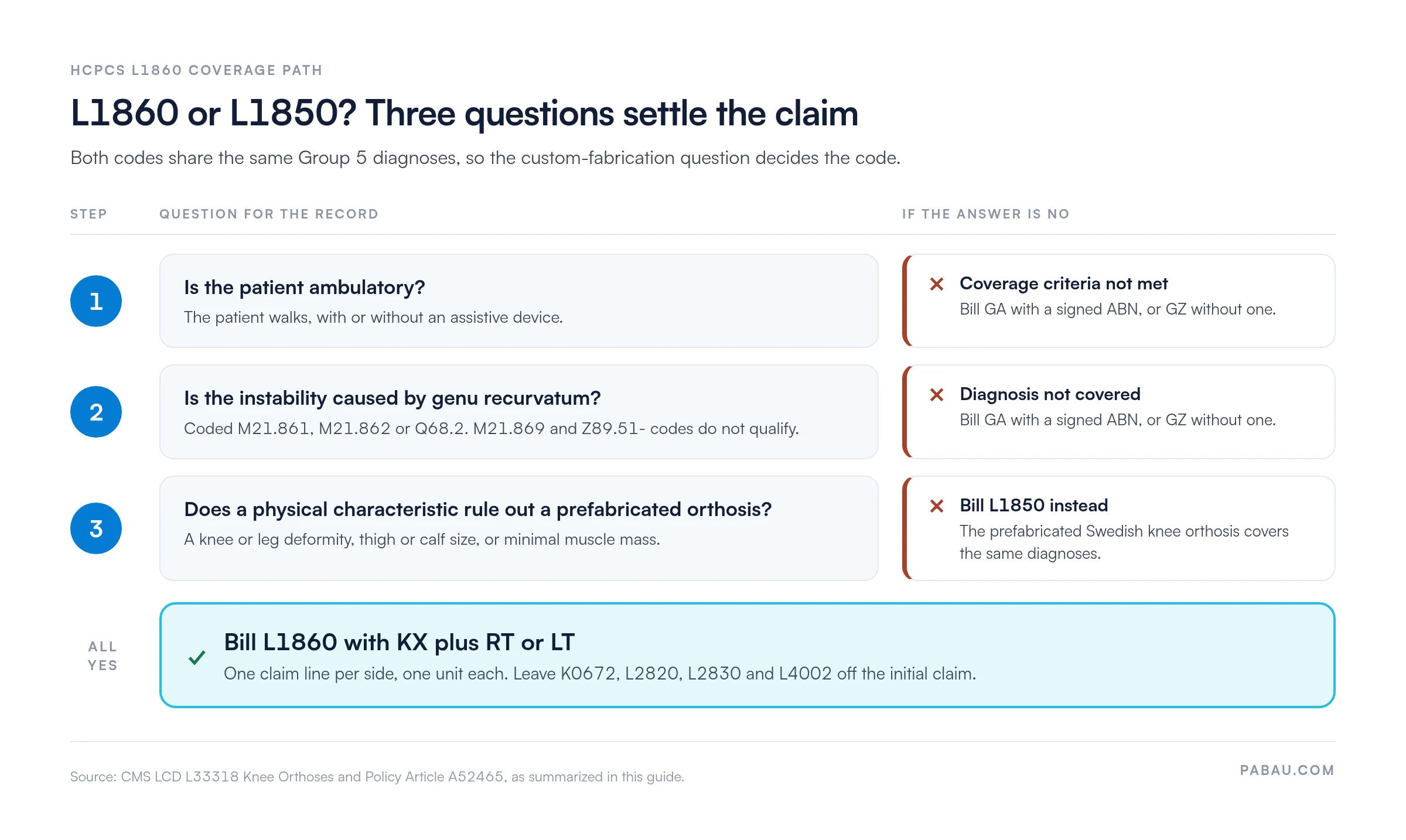
Only three ICD-10-CM codes support medical necessity for L1860. They form Group 5 in Policy Article A52465, a group L1860 shares with L1850. The supplier must put the diagnosis code on the claim line.
Two common picks fall outside the group. M21.869, the unspecified-laterality code, is not listed, so code the side every time. The below-knee amputation codes Z89.511, Z89.512 and Z89.519 are not listed either.
A Z89.51- code can still sit on the claim as a secondary diagnosis when it describes the patient. It cannot carry medical necessity for L1860 by itself. The listed code must also match the side billed with the RT or LT modifier.
An L1860 file has to show both why the patient needs a knee orthosis and why it had to be custom-made. These are the records a DME MAC reviewer looks for, and good medical billing compliance means each one is in place before you bill:
Write the hyperextension finding in measurable terms where you can, such as degrees of recurvatum seen on examination. A note that simply says “knee instability” does not tie the device to genu recurvatum.
L1860 is one of five custom-fabricated knee orthosis codes. Each has its own coverage path, so choosing the code is a clinical question as much as a coding one. The table compares L1860 with its closest neighbors.
L1850 and L1860 share the same three diagnoses, so the diagnosis never decides between them. The custom-fabrication criterion does. If the record names no deformity, limb size or muscle-mass reason, a reviewer will treat the patient as an L1850 candidate.
Every L1860 claim line needs a coverage modifier and a side modifier. A line with no KX, GA or GZ is rejected as missing information. A line with no RT or LT is rejected as incorrect coding.
For bilateral orthoses on the same date of service, bill two claim lines. Put RT on one and LT on the other, with one unit each. Using RTLT on a single line with two units is rejected.
Never put GA and GZ on the same L1860 line. GA says the patient signed an ABN and is liable if the claim is denied. GZ says there is no ABN, so the supplier absorbs the loss. Decide which applies before the claim goes out.
Four addition codes are included in the L1860 allowance. Billed with the base code, they are denied as not separately payable:
The initial issue includes either one nonremovable soft interface or two removable ones. K0672 is a replacement-only code, so it belongs on a later claim when a worn interface is replaced.
Medicare does not require prior authorization for L1860. It is absent from the CMS Required Prior Authorization List updated July 29, 2026. The knee codes on that list are L1832, L1833, L1843 to L1846, L1851 and L1852. L1860 is also absent from the face-to-face and written-order-prior-to-delivery list effective October 28, 2026.
Commercial and Medicare Advantage plans set their own rules, so confirm them through insurance eligibility verification before you cast the patient. A custom device cannot be returned to stock if the claim fails.
The Medicare allowance for L1860 comes from the DMEPOS fee schedule, which CMS updates each year and which varies by state. Look up the current amount on the CMS fee schedules page rather than relying on a published figure. Once the Part B deductible is met, the patient owes 20% coinsurance.
The table below lists the preventable errors behind L1860 denials. The denial codes on each remittance tell you which element failed. A denial management workflow turns those codes into fixes upstream.
An L1860 claim depends on records created by several people over several weeks. The practitioner writes the order and the clinical notes. The orthotist casts, fabricates and fits the device, and the biller then has to prove the whole chain on one claim line.
Pabau, the practice management platform we build, keeps the order, the clinical notes and the fitting records in one patient file. It also works as claims software for orthotists. Each claim is raised from the patient’s invoice and validated before it reaches your clearinghouse, so a missing code or detail gets flagged first.
Once a claim is submitted, its status sits on one dashboard, with days overdue shown on every row. Your biller can chase a stalled L1860 claim within days instead of waiting for a remittance.
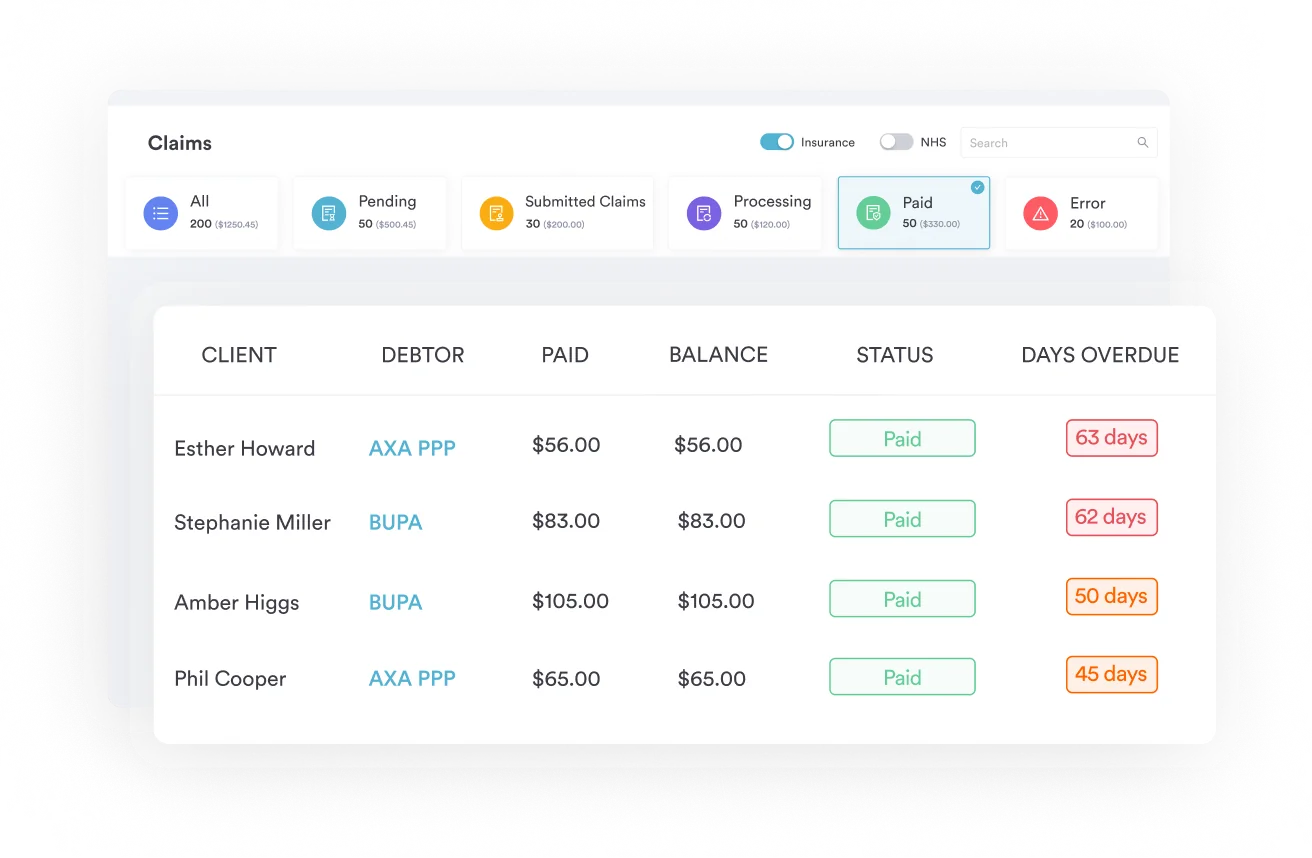

Pabau validates each claim before it leaves and tracks its status afterward. Your custom knee orthosis claims go out complete, and you can see where each one stands.

L1860 is a narrow code with a narrow path to payment. It pays for a custom plastic orthosis that stops a hyperextending knee in a patient who walks. Medicare accepts only three diagnoses for it, and the record has to explain why an off-the-shelf Swedish knee orthosis would not do.
So settle the custom-fabrication question before anyone casts the leg. If the practitioner’s notes cannot name the deformity, limb size or muscle-mass reason, the patient is an L1850 candidate. Billing L1860 then invites a denial on a device you cannot restock.
That check is easier when the order, the evaluation and the fabrication record live in one patient file. Book a demo to see how Pabau validates and tracks L1860 claims for orthotic and prosthetic practices.

Billing a custom knee orthosis with jointed uprights? HCPCS code L1844: custom knee orthosis billing guide explains the single-upright brace with an adjustable flexion and extension joint.
Need to immobilize the knee after surgery or injury? HCPCS code L1830: knee orthosis immobilizer billing guide covers the canvas immobilizer and the coverage criteria that also govern L1834.
Fitting a prefabricated orthosis with adjustable knee joints? HCPCS code L1832: prefabricated adjustable knee orthosis guide covers a knee code that, unlike L1860, sits on the Medicare prior authorization list.
Setting up as a DMEPOS supplier? How to get credentialed with insurance companies walks through the payer enrollment steps that come before any orthosis claim.
HCPCS Code L1860 describes a knee orthosis (KO), modification of supracondylar prosthetic socket, custom-fabricated (SK). Medicare policy defines it as a jointless, custom-made plastic knee orthosis. It prevents knee hyperextension in patients who walk.
No. L1860 is a knee orthosis code, the last in the L1810 to L1860 knee series. Elbow orthoses are coded from L3702 to L3766, and the off-the-shelf rigid elbow orthosis without joints is L3762.
Three codes support L1860: M21.861 and M21.862 for acquired genu recurvatum of the right or left knee, and Q68.2 for congenital deformity of the knee. They make up Group 5 in Policy Article A52465. M21.869, the unspecified-laterality code, is not on the list.
Not on the strength of the amputation alone. The codes Z89.511, Z89.512 and Z89.519 are not in the Group 5 list that supports L1860. Despite its prosthetic wording, L1860 is an orthosis for a hyperextending knee, and work on a below-knee prosthesis is coded in the L5000 range.
L1850 is a prefabricated, off-the-shelf Swedish knee orthosis, while L1860 is custom-fabricated. Both are covered for the same genu recurvatum diagnoses. L1860 also needs a documented physical characteristic that rules out a prefabricated device, such as a leg deformity or limb size.
Medicare does not require prior authorization for L1860. It is absent from the CMS Required Prior Authorization List updated July 29, 2026. Commercial and Medicare Advantage plans may still require it, so check before you cast the patient.
Each L1860 claim line needs KX, GA or GZ, plus RT or LT for the side. Use KX only when every coverage criterion is documented. Use GA with a signed ABN, or GZ without one, and bill bilateral orthoses on two lines.
The amount comes from the DMEPOS fee schedule, which CMS updates every year and which varies by state. Check the current figure on the CMS fee schedules page. The patient pays 20% coinsurance once the Part B deductible is met.