CCSD code G5100: Bypass of duodenum billing guide
CCSD code G5100 bills a bypass that leaves the duodenum in place CCSD code G5100...

Last Updated: Oct 16, 2026
HCPCS code L1844 is the Level II code for a custom-fabricated knee orthosis. The brace runs a single upright along the thigh and calf. It carries an adjustable flexion and extension joint, unicentric or polycentric, plus medial-lateral and rotation control. Varus/valgus adjustment is optional.
Fabrication is what separates L1844 from the codes around it. The brace has to be built for one patient from measurements, a cast, or a scan. A stock brace adjusted at the fitting is L1843 instead.
Let Pabau's smart automation suggest the right codes, reduce claim denials, and keep your practice compliant—effortlessly.
Automate repetitive tasks and focus on what matters most—your patients.
Reduce coding errors and ensure compliance with the latest regulations.
Clean claims, fewer denials, and faster reimbursements.
Powerful insights and reporting to help your practice thrive.
HIPAA compliant SOC 2 certified GDPR-compliant Trusted by 4,000+ clinics worldwide

HCPCS code L1844 covers a custom-fabricated knee orthosis with a single upright, an adjustable flexion-extension joint, and medial-lateral and rotation control.
Medicare pays only when the record shows documented instability, a signed written order, and fabrication evidence for that patient.
Billing L1844 for a prefabricated brace is the most common denial trigger, and L1843 is usually the correct code instead.
A bilateral fitting goes out as two claim lines, one carrying the RT modifier and one carrying LT.
Practice management software like Pabau keeps the order, the fabrication record, and the claim on one patient file.
HCPCS code L1844 covers a custom-fabricated knee orthosis with a single upright. The brace spans the thigh and calf. It carries an adjustable flexion and extension joint, unicentric or polycentric, plus medial-lateral and rotation control. Varus/valgus adjustment is optional.
CMS maintains L1844 as a Level II code, and the four Durable Medical Equipment Medicare Administrative Contractors (DME MACs) pay the claims.
The last two words of the descriptor, custom fabricated, drive most L1844 denials. A brace taken from a manufacturer’s line and adjusted at the fitting will not qualify, however well it ends up fitting.
So the first question on any L1844 claim is a simple one. Did someone build this brace for this patient from measurements, a cast, or a scan? If the answer is no, the device belongs to another code in the L18xx range.
Each attribute below has to be present in the delivered device. Miss one and the code changes.
The phrase “with or without varus/valgus adjustment” makes that one feature optional. A brace that controls medial-lateral and rotational instability without varus/valgus correction still codes to L1844, provided the other four attributes hold.
Medicare prices L1844 on the DMEPOS fee schedule, which CMS republishes every January. Look your allowable up in the CMS DMEPOS fee schedule files before quoting a figure to a patient, because locality adjustments move it.
Here is how the split works in practice. Say your jurisdiction’s allowable lands at $1,000. Medicare pays $800 once the deductible is met, and the patient owes the remaining $200. Ask about supplemental coverage at the fitting, since a Medigap policy usually absorbs that 20%.
Medicare Advantage plans price the code on their own terms and may add prior authorization. Read the plan policy before fabrication starts, not after. Medicaid coverage varies by state too.
Pull L1844 rates from the CMS DMEPOS fee schedule data files rather than a third-party lookup. CMS updates those files each January and lists payment amounts by jurisdiction. Store your local figure in your billing system, so nobody quotes a national average to a patient.
Local Coverage Determinations from each DME MAC, together with CMS Policy Article A52465, set the medical necessity bar for L1844. Wording varies by jurisdiction, so confirm which LCD covers the beneficiary.
These criteria are shared across all four regions:
Policy Article A52465 adds the supplier-side rules. The supplier has to be enrolled with CMS as a DMEPOS supplier. It also has to meet PDAC coding verification where that applies, and retain the documentation.
Chart entries such as “knee pain” or “OA” sink otherwise valid claims, because neither one describes instability or its effect on function.
Audits of custom-fabricated orthoses are routine, and missing paperwork is the finding that costs the most money. Build the file in this order.
Knee orthoses carry no Certificate of Medical Necessity, so never hold a claim waiting for one. Sound medical billing compliance practice means keeping the whole file for at least seven years from the date of service. Post-payment review reaches back well past the timely-filing window.
Not every knee diagnosis supports a custom-fabricated brace. The codes below turn up most often on L1844 claims that clear adjudication first time. Match the laterality to the side documented in the chart.
Pain-only codes such as M25.561 rarely survive review, because pain on its own does not establish instability. Read the LCD’s covered diagnosis list before fabrication starts, not after the denial lands.
The claim is built long before anyone types a code. A clean L1844 claim follows this sequence.
Step two is the one that decides the audit. Measurements filed on the day of the fitting are easy to produce two years later. Notes reconstructed from memory are not.
Two minutes at data entry beats an appeal months later. Confirm all six.
Make the fabrication note a required field in your billing workflow. No L1844 claim gets coded until someone confirms the measurements are in the chart. Flag any note that repeats template wording without patient-specific measurements. That is the first document a reviewer will ask to see.
Most L18xx denials start with the wrong neighbor. The HCPCS Level II codes around L1844 differ on two axes: how the brace was made, and what the descriptor says it controls.
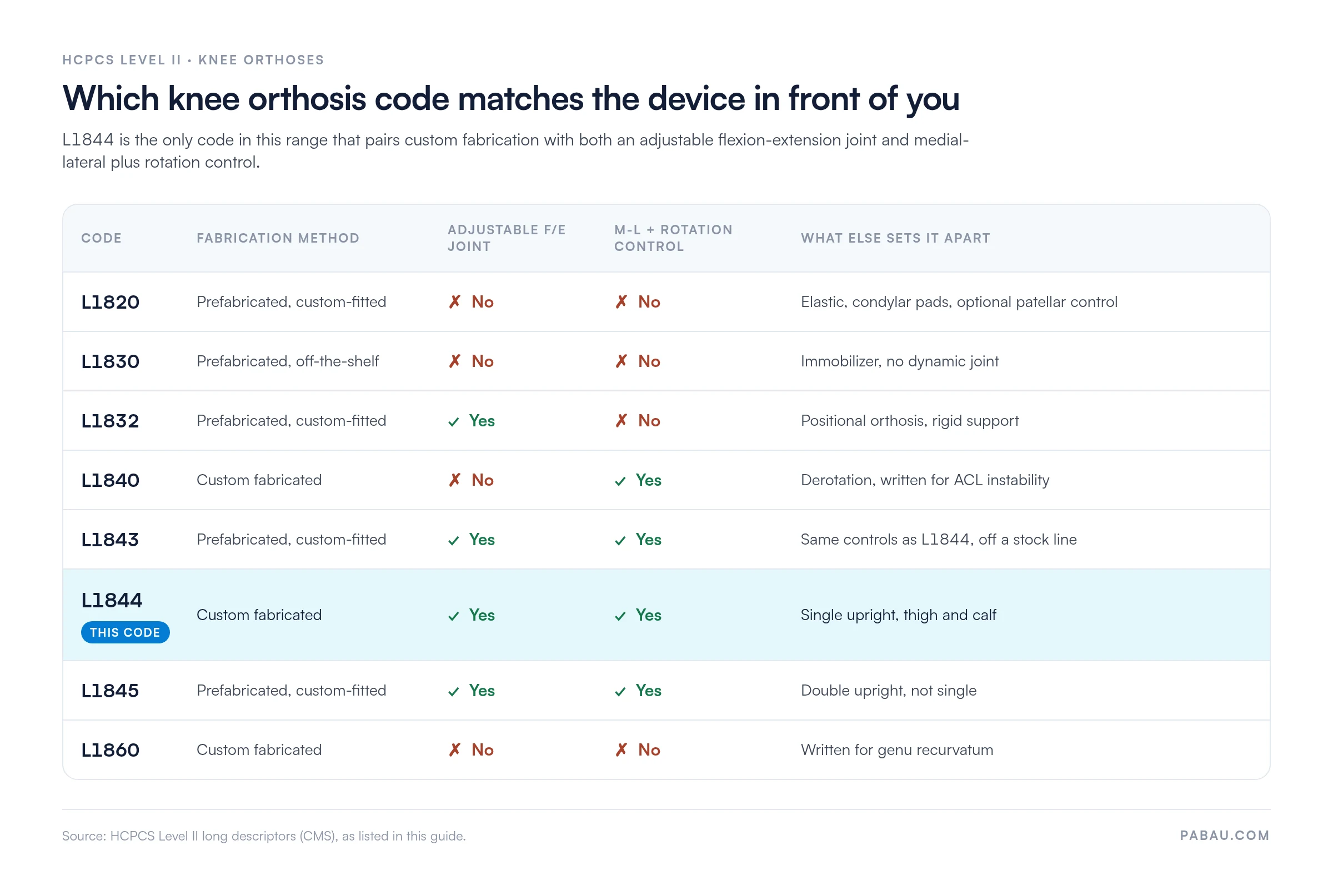
The table below adds the selection rule for each neighboring code.
The most frequent mix-up in practice is L1843. Both codes describe the same controls, and only the fabrication method separates them. Ankle-foot orthoses split along the same line, where code L1951 covers a prefabricated spiral brace customized at fitting. Read two descriptors side by side in the AAPC HCPCS code range tool whenever a device sits near that line.
L1840 is another custom-fabricated choice for the same knee, and its descriptor names derotation and anterior cruciate ligament control instead of an adjustable joint. The off-the-shelf floor is L1851, which covers the same single-upright adjustable-joint brace, so a stock device never bills as L1844.
Orthotic billing runs on documents that start out in different places. The order sits with the practitioner, the measurements with the fabricator, the delivery slip in a folder, and the claim in a billing system. When a reviewer asks for the file two years later, someone has to assemble it from all four.
Practice management software like Pabau keeps those records on one patient file. Notes, attachments and claims sit together, so fabrication evidence never drifts away from the claim it supports.
Pabau’s audit-ready claims management pre-fills the claim form from the record and checks that required fields are complete before it will send. US claims also carry eligibility checks, claim-status tracking, and remittance posting.
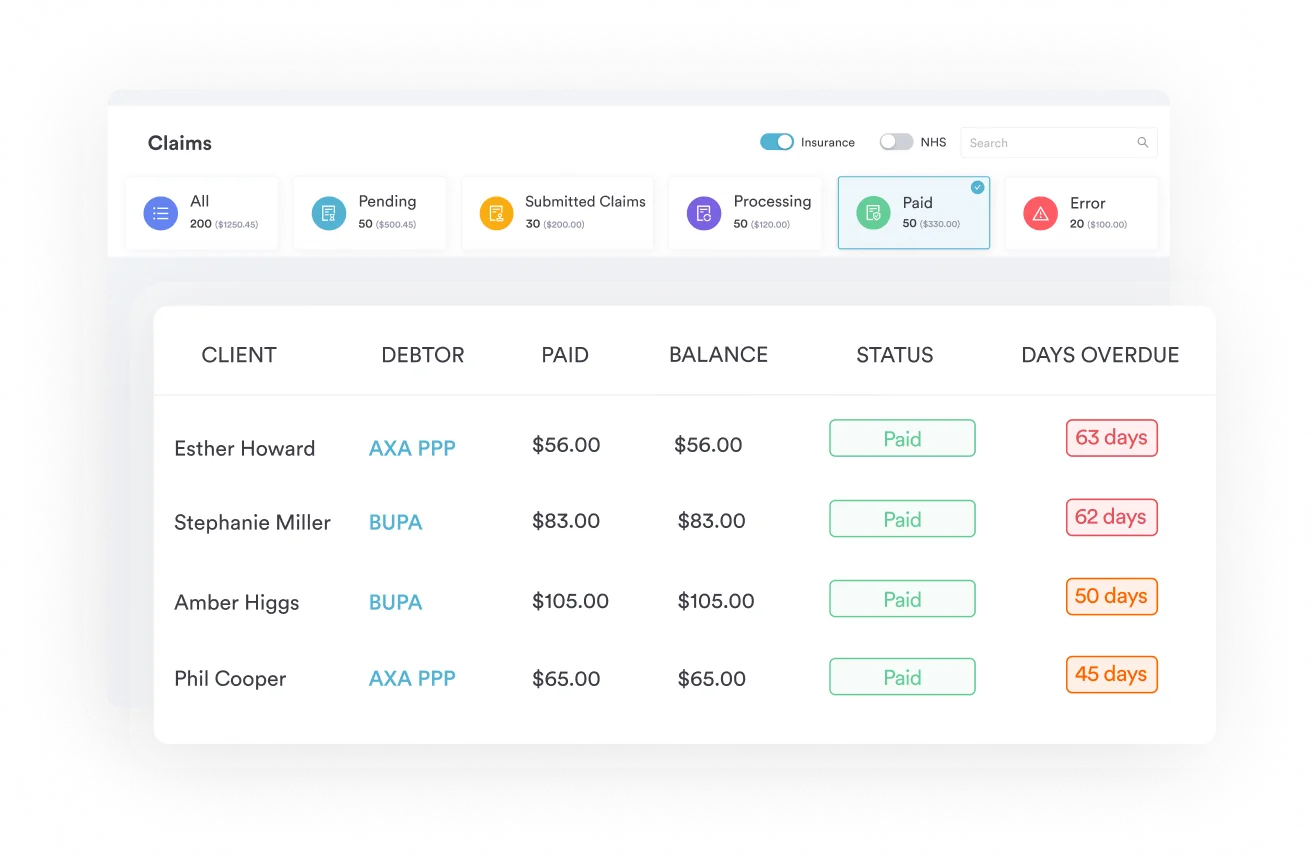
Code and modifier selection stays with your billing team. What the software handles is the evidence trail, so a documentation request becomes a search rather than a hunt through four systems.

Pabau keeps patient records, fabrication documentation, and claim submissions on one file. Orthotic and DME practices can then answer a documentation request without searching separate systems.

L1844 is a narrow code, and that is exactly what makes it auditable. Each clause in the descriptor has to be provable months after delivery. The single upright, the adjustable joint, the control features, and the custom fabrication all have to appear somewhere in the file.
Three habits carry most of the weight. Match the device to the descriptor before anyone codes it. Pair it with a diagnosis that documents instability. File the fabrication evidence on the day it is made, while the measurements are still in front of you.
If your team keeps rebuilding L1844 files out of four systems, that is the process worth fixing first. Book a demo to see how Pabau holds orders, fabrication records, and claims on one patient file.

Need to read the denial codes coming back on DME claims? Denial codes in medical billing explains the CARC and RARC codes your team will see on returned DMEPOS claims.
Want to tighten your orthotic billing compliance program? Medical billing compliance requirements covers the documentation, audit, and policy obligations that apply to DME suppliers.
Looking for the wider revenue cycle picture? Revenue cycle management walks through each stage, from patient registration to payment posting, with notes for DMEPOS workflows.
Fabrication. L1843 is a prefabricated brace customized to fit the patient, while L1844 is built for one patient from measurements, a cast, or a scan. The control features named in the two descriptors are the same.
No. A bilateral fitting goes out as two claim lines, one with RT and one with LT. There is no bilateral modifier for this code, and BO covers orally administered nutrition rather than orthoses.
Only a supplier enrolled with Medicare as a DMEPOS supplier. The treating practitioner documents the instability and signs the order, but the enrolled supplier submits the claim and keeps the records.
No. Knee orthoses have no CMN. DME MAC checklists ask for a Standard Written Order instead. A face-to-face encounter and a written order prior to delivery apply to L1843, L1845, L1851 and L1852.
Expect a denial on review. The signed order has to reach the supplier before delivery, so an order dated afterwards does not support the claim.
CMS publishes L1844 allowables in the DMEPOS fee schedule files each January. Amounts vary by jurisdiction, so check your own locality instead of quoting a national figure.