CPT code 33216: Single transvenous electrode insertion
CPT code 33216: Definition and official descriptor CPT code 33216 describes the ...

Last Updated: Oct 26, 2026
L1834 is the HCPCS Level II code for a knee orthosis without knee joint, rigid, molded to patient model, custom-fabricated. It covers a brace built from a cast or scan of one patient's leg to hold the knee still.
It sits in the L1810-L1860 knee orthosis range. The prefabricated, off-the-shelf version of the same rigid, jointless brace is L1836. A brace with knee joints, such as L1832 with its adjustable unicentric or polycentric joints, takes a different code. Assignment turns on two facts: the device has no joint, and it was custom-fabricated from a patient model.
Let Pabau's smart automation suggest the right codes, reduce claim denials, and keep your practice compliant—effortlessly.
Automate repetitive tasks and focus on what matters most—your patients.
Reduce coding errors and ensure compliance with the latest regulations.
Clean claims, fewer denials, and faster reimbursements.
Powerful insights and reporting to help your practice thrive.
HIPAA compliant SOC 2 certified GDPR-compliant Trusted by 4,000+ clinics worldwide

L1834 describes a rigid, jointless knee orthosis that is molded to a model of the patient and custom-fabricated. Its prefabricated, off-the-shelf counterpart is L1836.
Medicare coverage requires medical necessity documentation aligned with LCD L33318, including a physician order and proof of custom fabrication such as cast records or measurements.
The KX modifier is required on Medicare claims when all LCD L33318 criteria are met. Leaving it off is one of the most common reasons L1834 claims are denied.
Pabau’s claims management software supports HCPCS code entry, modifier attachment, and diagnosis linking to help reduce L1834 claim errors at submission.
HCPCS code L1834 is the code for a rigid knee brace with no knee joint, custom-fabricated from a cast or scan of one patient’s leg. It falls within the CMS HCPCS Level II orthotics range, in the L1810-L1860 knee orthosis section.
The table below shows the reference details coders need before submitting a claim. Our library of hcpcs codes covers the neighboring knee orthosis codes in the same format.
The descriptor has four defining elements. They are the knee orthosis (KO) category, no knee joint, rigid construction, and custom fabrication from a patient model. All four must be present in the device and documented in the patient record. A device missing any one of them belongs under a different code.
The descriptor is precise and each term carries a specific meaning under CMS and PDAC (Pricing Data Analysis and Coding Contractor) definitions. Getting the device right before coding is faster than appealing a denial.
PDAC provides coding verification for DMEPOS products. Suppliers can submit a product for PDAC review to confirm that its design and fabrication process support the L1834 assignment. A PDAC determination letter creates a defensible record in the event of a post-payment audit.
The exclusions are where most miscoding errors occur. None of the following qualify under L1834, regardless of marketing claims or fit quality.
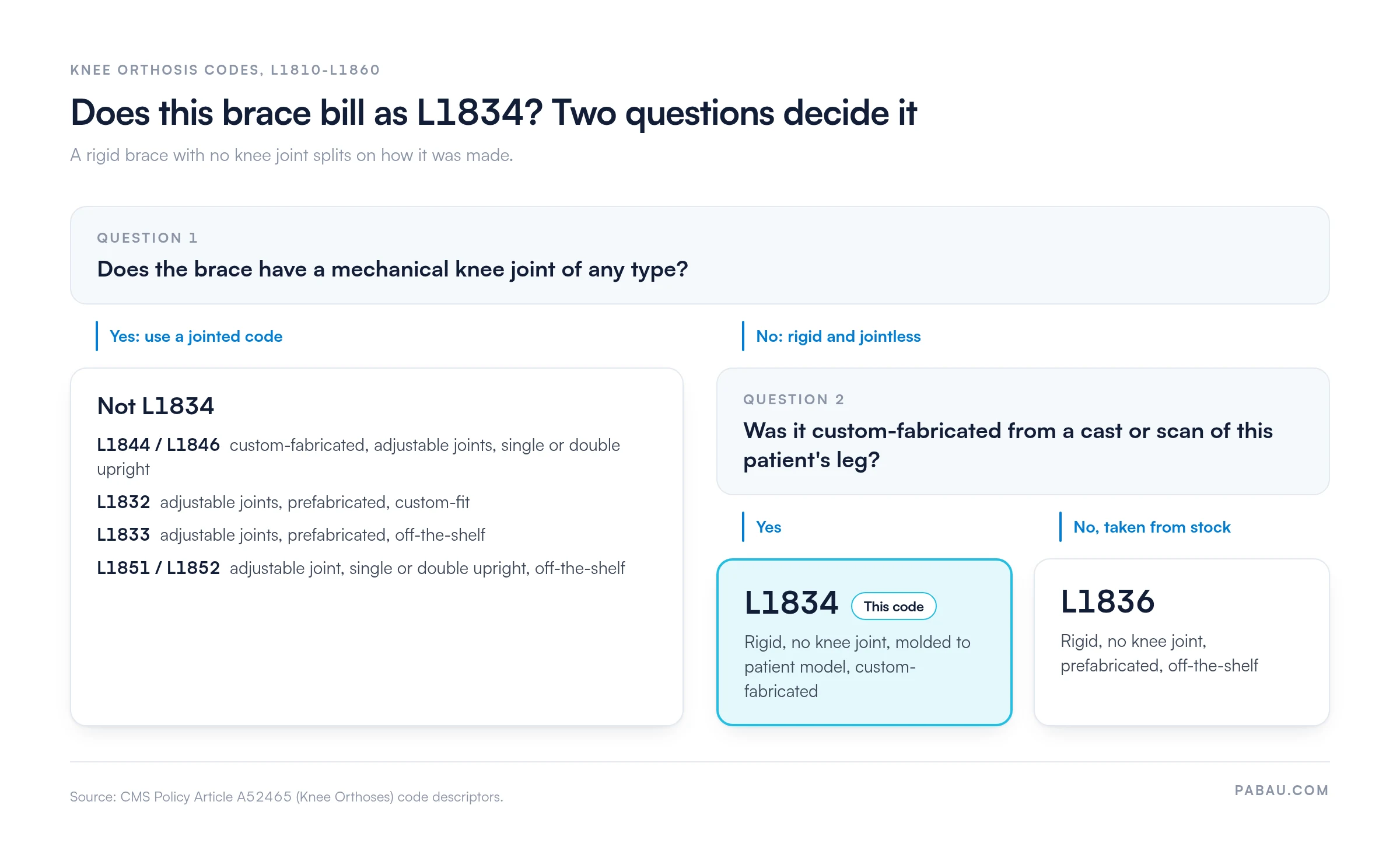
All five codes describe knee orthoses, but they split on two decisive variables. One is whether the brace has a knee joint, and the other is how it is made. The table sets L1834 against the four codes it is most often confused with.
Decision rule: If the device has a knee joint, it needs a jointed code, such as L1832 or L1833. If it is rigid and jointless but prefabricated, off-the-shelf, use L1836. If it is rigid, jointless, and custom-fabricated from a patient model, L1834 is the correct code. The diagram below runs the same two questions.
Medicare coverage for L1834 is governed by Local Coverage Determination L33318 (Knee Orthoses). The four DME MACs administer it. Noridian covers Jurisdictions A and D, and CGS Administrators covers the other two. Coverage requires all of the following conditions to be met.
Commercial payers frequently adopt LCD L33318 as their coverage standard, but terms vary. Always verify individual payer policies before assuming Medicare criteria apply identically.
Before fabricating an L1834 device, confirm the patient’s diagnosis appears on the LCD L33318 covered diagnosis list. Build a pre-delivery checklist: qualifying diagnosis verified, DWO signed and dated, face-to-face exam documented, cast or impression records retained. Claims rejected at pre-authorization or post-payment audit almost always trace back to one missing item on this list.
Noridian Medicare publishes a documentation checklist specifically for knee orthoses. The documents below are required before submitting an L1834 claim under Medicare. Missing any single item is enough for a medical review denial.
Retaining cast records is the single highest-value documentation habit for L1834 suppliers. Auditors ask for proof that a positive model was used in fabrication. A missing cast record can turn a paid claim into a full repayment demand.
Medicare does not currently require prior authorization for HCPCS code L1834 under the standard DMEPOS program. Some commercial payers and Medicaid managed care organizations do. PA requirements vary by payer, plan type, and state.
Verify with each payer before fabrication rather than assuming Medicare’s no-PA approach applies universally. When a payer requires PA, submit the physician order, clinical notes, and diagnosis documentation with the request.
Modifier selection on L1834 claims is not optional. The KX modifier is a hard requirement on Medicare claims where LCD L33318 criteria are met, and leaving it off triggers a denial.
Claims submitted without KX when Medicare criteria are met are automatically denied and require corrected claim resubmission. Claims submitted with KX when documentation does not support medical necessity create an overpayment liability. The modifier must reflect what the documentation actually shows.
The Medicare DMEPOS fee schedule allowable for L1834 is published annually by CMS and adjusted by geographic region using the fee schedule area.
Custom-fabricated orthoses are not competitively bid items under the current DMEPOS Competitive Bidding Program. Payment is therefore based on the fee schedule rather than a bid-determined rate.
Fee schedule amounts change each January 1. Hard-coding a dollar figure here would be misleading within months. Use the CMS DMEPOS fee schedule lookup tool to retrieve the current allowable for your jurisdiction.
Enter code L1834, select the current year, and choose your fee schedule area. The result shows the purchase allowable, because L1834 is paid as a lump-sum purchase.
Key reimbursement facts to note: Medicare pays 80% of the lesser of the supplier’s charge or the fee schedule allowable. The beneficiary is responsible for the 20% coinsurance and any unmet deductible.
A participating supplier accepts assignment on every Medicare claim, which makes the fee schedule amount the most it can collect.
L1834 denials cluster around a predictable set of documentation and coding errors. The table below maps each denial pattern to its resolution.
Effective denial management for L1834 starts before the claim is submitted. A pre-submission scrub checks for the KX modifier, confirms diagnosis mapping, and verifies the DWO date. It catches most of these errors before the payer sees them.
Build a five-point L1834 check into your claim scrubbing workflow. Confirm KX is present with documentation on file, and that an LT or RT modifier is attached. Check the DWO was signed before delivery and the casting records are filed. Finally, confirm the diagnosis is on the LCD L33318 covered list. Running this check before submission reduces first-pass denial rates on custom-fabricated KO claims.
Submitting a clean claim for L1834 requires linking the correct code, modifiers, and diagnosis before the claim leaves the system. Practice management software that supports HCPCS code entry with modifier fields reduces the manual errors that drive most L1834 denials.
In Pabau, the practice management platform we build, the claims management software supports HCPCS code entry, modifier attachment (KX, LT/RT, NU), and diagnosis code linking.
Attaching supporting documentation to the claim record before submission creates an auditable trail that covers the most common post-payment review requests for HCPCS code L1834.
Workflow steps for L1834 in a practice management system:
For practices billing across multiple payers, set L1834 up once with its modifier and diagnosis fields pre-mapped. Staff then stop re-keying the same fields on every claim, which is where most transcription errors start.

Pabau’s claims management tools support HCPCS code entry, modifier attachment, and documentation tracking so your DME and orthotics claims submit clean the first time.

Bill L1834 only when the brace is rigid, has no joint, and was built from a cast or scan of this patient’s leg. If any one of those fails, the right code sits elsewhere in the knee orthosis range, and billing L1834 anyway sets up a recoupment.
The coding choice is usually the easy part. Claims are lost on paperwork, such as a DWO signed after delivery or a cast record thrown out after fabrication. File each record as the brace is made, and an audit request can be answered from the file you already hold. Our guide to medical billing compliance covers the wider record-keeping rules.
Book a demo to see how Pabau ties each L1834 claim to its order, cast records, and modifiers before it goes out.

Looking for guidance on the full billing cycle for orthotics? Revenue cycle management explained maps the end-to-end process from order through payment posting.
Is the brace jointed and supplied from stock? HCPCS code L1833 covers the off-the-shelf positional knee orthosis with adjustable joints.
Billing a single-upright brace with rotation control? HCPCS code L1851 sets out the descriptor, modifiers, and documentation for that device.
HCPCS code L1834 covers a knee orthosis that is rigid, has no knee joints, and is custom-fabricated by molding directly to a patient model. All four descriptor elements must be present in the device and documented. Prefabricated devices, off-the-shelf braces, and jointed orthoses do not qualify.
L1834 has no knee joint and is custom-fabricated from a model of the patient. L1833 has adjustable unicentric or polycentric knee joints and is a prefabricated, off-the-shelf positional brace. A joint, or a brace taken from stock, rules out L1834.
You need a physician order, a detailed written order (DWO) completed before delivery, and face-to-face notes establishing medical necessity. Add cast or impression records proving the patient model, fabrication worksheets with measurements, and a signed delivery receipt. Missing cast records are the most common audit finding.
Yes. Medicare covers L1834 when the diagnosis is on the LCD L33318 covered list and the ordering physician documents medical necessity. The device must also meet the custom-fabricated definition. Medicare then pays 80% of the allowed amount, and the beneficiary pays 20% coinsurance after the deductible.
The most common reasons are a missing KX modifier, a detailed written order signed after delivery, and missing cast records. A diagnosis outside the LCD L33318 list, or a device that is not custom-fabricated, also leads to denial. Most denials are preventable with a pre-submission documentation checklist.
Medicare does not currently require prior authorization for L1834 under the standard DMEPOS program. Commercial payers and Medicaid managed care plans may require it, and the rules vary by payer and state. Verify each payer’s PA policy before fabricating the device.
PDAC verification is not universally required for L1834. Suppliers can still submit a product for PDAC review to confirm that its design supports the code. A PDAC determination letter provides a defensible record during post-payment audits and can strengthen appeals when coverage is disputed.