

HCPCS code E0198: Water pressure pad billing guide
HCPCS code E0198 is a water pad for a standard mattress HCPCS code E0198 is the ...

Last Updated: Oct 13, 2026
L1848 is the HCPCS Level II code for knee orthosis, double upright with adjustable joint, with inflatable air support chamber(s), prefabricated, off-the-shelf.
It describes a locking positional brace with an air bladder behind the knee, built for nonambulatory patients with knee flexion or extension contractures. L1848 is the off-the-shelf twin of L1847, and Medicare's Knee Orthoses LCD denies both codes as not reasonable and necessary.
Let Pabau's smart automation suggest the right codes, reduce claim denials, and keep your practice compliant—effortlessly.
Automate repetitive tasks and focus on what matters most—your patients.
Reduce coding errors and ensure compliance with the latest regulations.
Clean claims, fewer denials, and faster reimbursements.
Powerful insights and reporting to help your practice thrive.
HIPAA compliant SOC 2 certified GDPR-compliant Trusted by 4,000+ clinics worldwide

L1848 is an off-the-shelf, double-upright knee orthosis with an adjustable locking joint and an inflatable air chamber behind the knee.
It is the off-the-shelf twin of L1847, the same device when a qualified practitioner customizes it to fit at delivery.
The device is built for nonambulatory patients, typically to treat knee flexion or extension contractures.
Medicare’s Knee Orthoses LCD (L33318) denies L1848 as not reasonable and necessary, so KX never applies and an ABN decides who pays.
Pabau’s claims management helps you submit and track L1848 claims through Claim.MD, so each claim’s status stays visible.
HCPCS code L1848 describes a knee orthosis, double upright with adjustable joint, with inflatable air support chamber(s), prefabricated, off-the-shelf. It sits in the HCPCS Level II L-code series, which CMS maintains for orthotic and prosthetic devices.
The CMS Knee Orthoses policy article groups L1848 with L1831 and L1847. All three are prefabricated orthoses whose joints lock the knee into a set position. L1847 and L1848 differ from L1831 by adding an air bladder in the space behind the knee.
These braces are designed for patients who are nonambulatory. They are typically used to treat flexion or extension contractures of the knee, holding the joint at a chosen angle. Medicare denies L1848 under the Knee Orthoses LCD, so the claim goes out with GA or GZ, never KX.
L1847 and L1848 describe the same physical device. The policy article lists them as a corresponding code set, separated only by the fitting performed at delivery.
Neither code involves custom fabrication from a cast, scan or measurements. The choice turns on who adjusts the brace and how much adjustment it needs.
Billing L1847 when only minimal self-adjustment took place is incorrect coding. So is billing L1848 when a practitioner performed more than minimal adjustment. Base the code on the fitting that happened, and record it in the fitting note.
Medicare does not cover L1848. The Knee Orthoses LCD (L33318) states there is no proven clinical benefit to the inflatable air bladder in L1847 or L1848. Claims for either code are denied as not reasonable and necessary.
The denial applies whatever the diagnosis or documentation. Knee orthoses are a covered Medicare benefit category, so this is a medical necessity denial rather than a statutory exclusion. That distinction decides which modifier goes on the claim.
For the same clinical problem, the LCD covers the locking positional orthosis L1831 and the rigid orthosis L1836. They qualify when the patient has a knee flexion or extension contracture with at least 10 degrees of movement on passive range of motion testing.
L1848 is not on the CMS Required Face-to-Face Encounter and Written Order Prior to Delivery list. It is also absent from the DME MAC orthoses prior authorization list. A standard written order is still needed before the claim goes to Medicare.
Commercial and Medicare Advantage plans set their own rules. Some follow the Medicare position on air-chamber braces, so check the patient’s plan policy before you dispense.
No ICD-10-CM code creates Medicare coverage for L1848, because the LCD denies the code for every diagnosis. The codes below document the contracture and the nonambulatory status the device is designed for.
Code to the highest specificity the record supports. Match the side of the contracture to the RT or LT modifier on the claim line. Then check the payer policy for any covered diagnosis list.
Even an expected denial needs a complete file. The supplier has to show what was ordered, what was delivered, how it was fitted and what the patient agreed to pay. Strong medical billing compliance habits make that file routine.
The LCD’s joint laxity and imaging requirements belong to the ambulatory instability and osteoarthritis braces, such as L1832, L1843 and L1851. They do not apply to the L1848 contracture indication.
Every L1848 claim line needs a liability modifier and a side modifier. The policy article rejects knee orthosis claim lines that carry none of KX, GA or GZ as missing information.
KX is the base-code rule across the knee orthosis policy. Suppliers add it only when all LCD coverage criteria are met. With L1848, that condition never holds, so GA or GZ does the work instead, as the decision below shows.
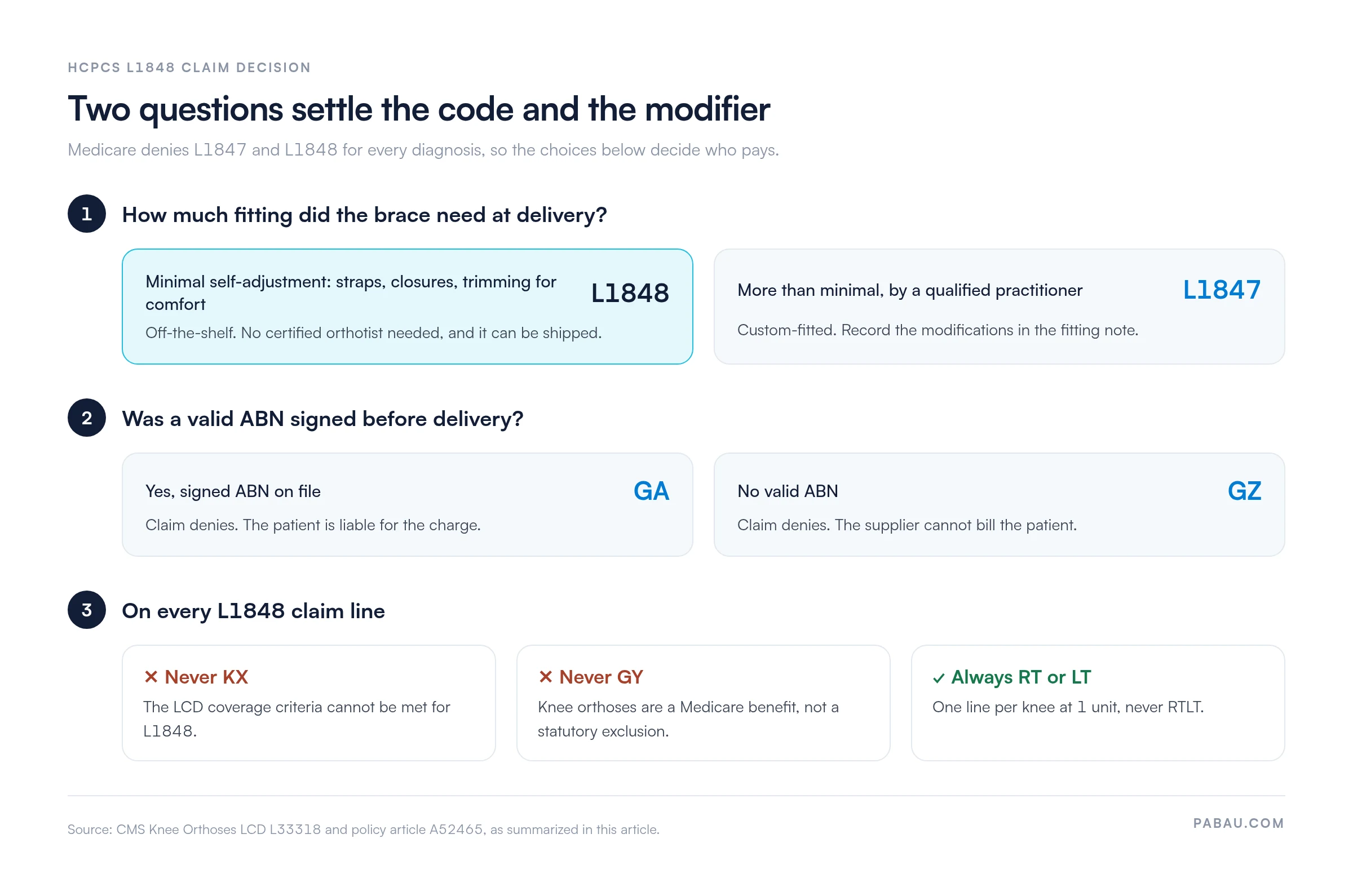
Decide the ABN before the brace leaves the building. A signed ABN on file lets you bill L1848 with GA and collect from the patient if Medicare denies. Without one, the same claim goes out with GZ and the cost stays with you.
The knee orthosis family splits on joint type, intended patient and fitting level. The table shows where L1848 sits beside the codes it is most often confused with. For codes outside this family, our HCPCS code library lists the rest of the L-series.
For contrast, see L1830 for the immobilizer and L1833 for the off-the-shelf adjustable positional brace. The custom-fabricated codes in this family are L1834, L1840, L1844, L1846 and L1860, not L1843 or L1851.
The policy article lists addition codes that can be built into an L1848 brace but are included in its allowance. Billing them alongside L1848 at initial issue earns a not separately payable denial.
Because Medicare denies the L1848 base code as noncovered, any L-coded addition billed with it is denied as noncovered too.
Most L1848 problems come from treating it like a covered knee brace. Effective denial management starts with knowing the claim will deny and deciding who carries the cost.
A clean L1848 claim follows the same path each time, from the order to the remittance. In Pabau’s billing software, claims management helps submit and track claims, so you can see where each L1848 claim stands.
An L1848 claim is simple to code but easy to mishandle. The order, the fitting note, the ABN and the claim often sit in different places. The modifier then gets chosen without the ABN in view.
Pabau, the practice management platform we build, keeps the patient record, clinical notes, signed forms and invoices together. Its claims management helps submit and track claims through Claim.MD, so you can follow each L1848 claim from submission to remittance.
The result is fewer claims lost between systems and a clear view of which denials are expected and which need follow-up.

Pabau helps orthotic practices and DME suppliers submit and track claims through Claim.MD, so every L1848 claim status stays visible.

L1848 is a coding question with a settled payment answer. Code it when an off-the-shelf air-chamber knee brace needs only minimal adjustment, and expect Medicare to deny it every time.
The decisions that matter come before delivery: whether L1831 would serve the patient, and whether a signed ABN is on file. Get those right, and a denied L1848 claim never lands as a surprise write-off.
To see how Pabau helps you submit and track clean claims, book a demo with our team.

Looking for a broader denial management framework? Denial management in healthcare covers how to structure a denial tracking and appeal workflow across claim types.
Want a documentation routine that survives an audit? Medical billing compliance outlines the records and audit-readiness habits that keep claims defensible.
Need a refresher on the full billing cycle? What is medical billing explains the end-to-end billing process from order through payment posting.
Is the patient a candidate for the covered alternative? HCPCS code L1836 covers the rigid knee orthosis Medicare pays for qualifying contractures.
Comparing the positional braces? HCPCS code L1833 explains the off-the-shelf adjustable positional orthosis and how it is billed.
L1848 describes a knee orthosis, double upright with adjustable joint, with inflatable air support chambers, prefabricated, off-the-shelf. It is a locking positional brace with an air bladder behind the knee, designed for nonambulatory patients with knee contractures.
No. LCD L33318 finds no proven clinical benefit to the inflatable air bladder. Claims for L1847 and L1848 are denied as not reasonable and necessary. Commercial plans set their own policies.
They describe the same device. L1848 applies when the brace needs only minimal self-adjustment at delivery. L1847 applies when a qualified practitioner trims, bends, molds or otherwise customizes it to fit the patient.
No. Suppliers add KX to a knee orthosis base code only when all LCD coverage criteria are met. Those criteria cannot be met for L1848, so use GA with a signed ABN, or GZ without one.
Add GA if a valid ABN was signed before delivery, or GZ if it was not. Add RT or LT for the knee treated. For both knees, bill two lines of 1 unit each.
Knee contracture codes M24.561, M24.562 and M24.569 document the indication, and Z99.3 or Z74.01 can support nonambulatory status. No diagnosis makes L1848 covered by Medicare, because the LCD denies it for every indication.
No. L1848 is not on the DME MAC orthoses prior authorization list or the CMS face-to-face and written order prior to delivery list. A standard written order is still needed before you submit the claim.
Medicare covers the locking positional orthosis L1831 and the rigid orthosis L1836 for knee contractures. The patient needs at least 10 degrees of movement on passive range of motion testing.



