CPT Code 50432: Nephrostomy tube placement billing guide
CPT Code 50432: Official description and procedure overview CPT Code 50432 is th...

Last Updated: Nov 13, 2026
L1847 is the HCPCS Level II code for a double-upright knee orthosis with an adjustable joint and inflatable air support chamber(s). It is a prefabricated item that has been trimmed, bent, molded, assembled, or otherwise customized to fit a specific patient by an individual with expertise.
The code is maintained by the Centers for Medicare and Medicaid Services (CMS) in the L-code range for orthotic procedures. It is a custom-fitted code, not a custom-fabricated one. A custom-fabricated double-upright thigh-and-calf knee orthosis is L1846. Medicare's Knee Orthoses LCD denies L1847 as not reasonable and necessary, so the claim turns on the expert fitting and the ABN.
Let Pabau's smart automation suggest the right codes, reduce claim denials, and keep your practice compliant—effortlessly.
Automate repetitive tasks and focus on what matters most—your patients.
Reduce coding errors and ensure compliance with the latest regulations.
Clean claims, fewer denials, and faster reimbursements.
Powerful insights and reporting to help your practice thrive.
HIPAA compliant SOC 2 certified GDPR-compliant Trusted by 4,000+ clinics worldwide

HCPCS Code L1847 is a prefabricated double-upright knee orthosis with an adjustable joint and inflatable air chambers. An individual with expertise customizes it to fit.
L1847 is not a custom-fabricated code. A double-upright thigh-and-calf knee orthosis built from casts or measurements is reported with L1846.
The air chamber is what separates L1847 from other double-upright codes. L1848 is the same design dispensed off the shelf, with no expert fitting.
Medicare’s Knee Orthoses LCD (L33318) denies L1847 as not reasonable and necessary, so Medicare claims carry GA with a signed ABN, or GZ without one.
Pabau’s claims management software submits claims through the Claim.MD clearinghouse and keeps the fitting note, ABN, and claim on one patient record.
HCPCS Code L1847 is a prefabricated knee orthosis with two uprights, an adjustable joint, and one or more inflatable air chambers. The CMS Knee Orthoses policy article (A52465) lists it as a prefabricated item customized to fit by an individual with expertise. It is a custom-fitted code, not a custom-fabricated one. The official descriptor reads:
Knee orthosis (KO), double upright with adjustable joint, with inflatable air support chamber(s), prefabricated item that has been trimmed, bent, molded, assembled, or otherwise customized to fit a specific patient by an individual with expertise.
Two words in the descriptor carry the coding decision: prefabricated and customized. The device starts as a stock item, and the expert fitting at delivery makes it L1847. Fabrication from patient casts or measurements belongs to a different code entirely, L1846, and that brace has no air chamber in its descriptor.
The L1847 base code describes the complete prefabricated brace as dispensed, including the expert fitting. CMS groups L1847 and L1848 with L1831, the locking positional knee orthosis. It separates them only by the air bladder behind the knee.
What the base code describes:
When the code fits: The brace in hand must have the air chamber and must have been fitted by an orthotist or similarly trained individual. A prescriber who orders a “hinged knee brace” without naming the air chamber has not described an L1847 device. Confirm the product and its HCPCS coding before you dispense it.
The fitting note should say what was changed on the brace and who did the work. That record proves the custom fitting. Without it, the same brace belongs on an L1848 claim.
Most L1847 coding errors come from billing a brace that does not match the descriptor. The boundaries below keep the claim on the right code.
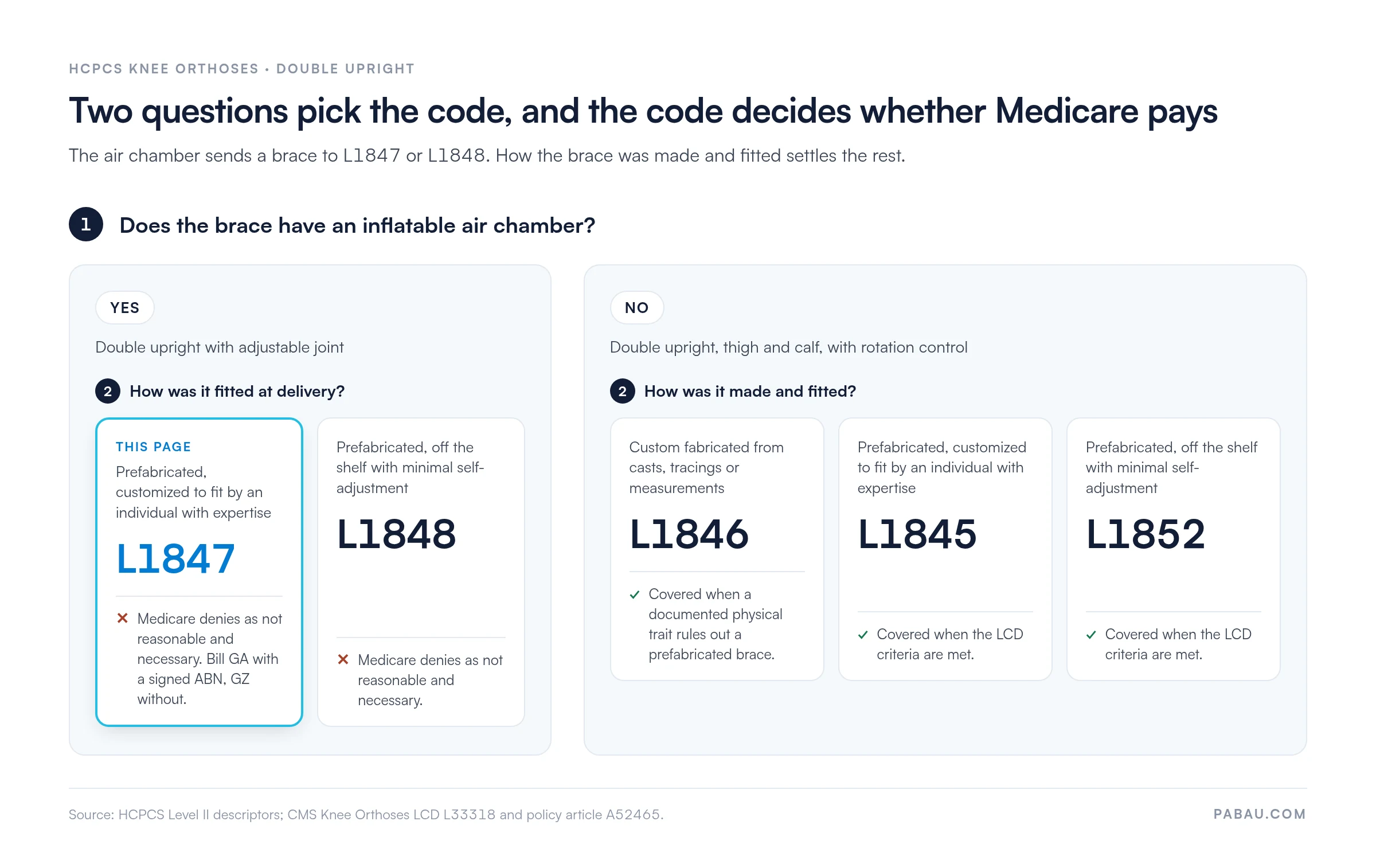
Two questions settle the code. Does the brace have an inflatable air chamber? And was it dispensed off the shelf, customized to fit by an expert, or custom fabricated? The table sets the double-upright and related codes against both axes.
L1847 and L1848 describe the same air-chamber brace. The only difference is the fitting at delivery. L1847 needs more than minimal self-adjustment, carried out by a certified orthotist or a similarly trained individual. L1848 needs only minimal self-adjustment and no expertise.
If the record shows no trimming, bending, molding, or assembly by an expert, the claim belongs on L1848. Brief strap adjustment or patient instruction does not qualify as customization.
This is the construction-type pair, and the most important distinction to get right. L1846 is a double-upright thigh-and-calf brace that is custom fabricated. It is made for one patient from clinically derived castings, tracings, measurements, or images.
L1847 starts as a prefabricated stock item and is then customized to fit. L1846 has no air chamber in its descriptor, and L1847 has no custom fabrication in its descriptor. Medicare also covers L1846 when the record shows a physical characteristic that rules out a prefabricated brace. L1847 has no such route to coverage.
L1845 and L1852 are double-upright thigh-and-calf braces with an adjustable flexion and extension joint and rotation control. Neither has an air chamber. L1845 is customized to fit, like L1847, while L1852 is off the shelf.
Construction type does not separate L1847 from L1845, because both are customized prefabricated braces. The air chamber and the joint description do. Bill the code whose descriptor matches the dispensed brace, then record that match in the fitting note.
Medicare does not cover L1847. The Knee Orthoses LCD (L33318) states there is no proven clinical benefit to the inflatable air bladder in L1847 or L1848. Claims for either code are denied as not reasonable and necessary.
The denial applies whatever the diagnosis or documentation. Knee orthoses are a Medicare benefit category, so this is a medical necessity denial rather than a statutory exclusion. That distinction decides which modifier goes on the claim.
Claims go to the DME Medicare Administrative Contractor (DME MAC) for the beneficiary’s state. CGS Administrators covers Jurisdictions B and C. Noridian Healthcare Solutions covers Jurisdictions A and D.
For patients who need a knee brace that Medicare will pay for, the LCD sets out other routes. It covers L1843, L1845, L1851, and L1852 after recent knee injury or surgery, for documented knee instability, or for qualifying osteoarthritis.
A custom-fabricated L1846 is covered when a documented physical characteristic rules out a prefabricated brace. The chart below sets each double-upright code beside its Medicare outcome.
Commercial payers and workers’ compensation: Commercial and Medicare Advantage plans set their own rules, and some follow the Medicare position on air-chamber braces. Workers’ compensation rules vary by state fee schedule. Check the patient’s plan policy and any prior authorization rule before you dispense.
Before dispensing an L1847 brace to a Medicare patient, explain that Medicare is expected to deny it and offer an Advance Beneficiary Notice (ABN). A signed ABN lets you bill with GA and collect from the patient. Without one, the claim goes out with GZ and the supplier carries the cost.
A denial is expected from Medicare, but the record still decides who pays. It also protects the claim if a commercial plan reviews it. Each item below belongs in the patient record before the claim goes out.
CMS updates its Required Face-to-Face Encounter and Written Order Prior to Delivery List and its DMEPOS prior authorization list periodically. Check both lists for the date of service before you dispense. Commercial payers often require prior authorization for orthoses, so submit the request with the clinical notes and the product details.
Suppliers submit L1847 on the CMS-1500 claim form or its electronic 837P equivalent. Every claim line needs a liability modifier and a side modifier. The policy article rejects knee orthosis lines that carry none of KX, GA, or GZ as missing information.
Bilateral billing: When a patient receives a brace for each knee, bill L1847 on two separate lines of one unit each. Put RT on one line and LT on the other. A single line with RTLT and two units is rejected as incorrect coding.
Claim form fields: Box 21 carries the ICD-10-CM diagnosis codes, and Box 24D carries L1847 with its modifiers. The date of service in Box 24A is the delivery date, not the order date. Box 33a carries the supplier’s billing NPI. Our clean claim submission guide covers the fields that most often go missing on an 837P file.
With Medicare, the denial itself is settled by the LCD. What a supplier controls is the code, the modifier, and whether the patient or the supplier ends up paying. Effective denial management workflows treat each item below as a pre-submission check.
A Medicare appeal on L1847 rarely succeeds, because the LCD denies the code whatever the record shows. Appeals are worth filing when the claim was coded or modified wrongly, or when a commercial plan denied a covered item. Our denial codes in medical billing reference explains the remittance codes that tell you which case you are in.
Log every denied L1847 line with its initial determination date, so the 120-day redetermination window never closes unnoticed.
Run a quarterly check of every L1847 claim against its fitting note and product record. Look for braces without an air chamber, braces with no expert fitting recorded, and Medicare lines billed without a signed ABN. Fixing the dispensing checklist is cheaper than chasing individual claims.
An L1847 claim depends on four records that often live in different places: the order, the fitting note, the ABN, and the claim itself. When they are split across paper files and a separate billing system, a missing ABN surfaces only after the denial.
Pabau’s practice management software keeps all four on one patient record. The fitting note and the signed ABN sit beside the order, and the billing team works from that record. Pabau’s claims management software submits claims through the Claim.MD clearinghouse, checks eligibility, tracks claim status, and posts remittances.
For an air-chamber brace, that means the expected Medicare denial is handled on purpose. The right modifier goes out, the right party is billed, and the supplier sees the outcome long before month-end reconciliation.

Pabau’s claims management software submits claims through the Claim.MD clearinghouse and keeps orders, fitting notes, and ABNs on the patient record. See how it handles orthotic billing.

L1847 is a narrow code: an air-chamber, double-upright brace that starts as a stock item and is fitted by an expert. Get the product and the fitting note right, and the code follows. If the brace was built from patient measurements, it is L1846.
For Medicare patients, the bigger decision comes before delivery. The LCD denies L1847 every time, so the ABN decides whether the patient or the supplier pays. A patient who needs Medicare to cover a brace is better served by a code the LCD covers. Book a demo to see how Pabau keeps orders, fitting notes, ABNs, and claims in one workflow.

Billing a custom-fabricated knee brace instead? HCPCS code L1844 covers a knee orthosis built for the patient, with its own documentation and coverage rules.
Billing the fitting and training visit for a new brace? CPT code 97760 explains how to report orthotic management and training, and when it is separately payable.
Need to show why the patient needs this specific brace? Our medical necessity letter template gives prescribers a structure that ties the diagnosis to the device ordered.
Preparing to contest a denied L1847 claim? The medical appeal form template sets out the claim details, denial reason and supporting evidence a payer expects to see.
HCPCS Code L1847 covers a prefabricated double-upright knee orthosis with an adjustable joint and one or more inflatable air support chambers. The brace is customized to fit the patient by an individual with expertise, such as a certified orthotist. The expert fitting is part of the code, so it is not billed separately.
No. L1847 is a prefabricated item that has been trimmed, bent, molded, assembled, or otherwise customized to fit a specific patient. A double-upright thigh-and-calf knee orthosis made from patient casts or measurements is reported with L1846. L1846 has no air chamber in its descriptor.
Both codes describe the same double-upright brace with an adjustable joint and inflatable air chambers. L1847 is customized to fit by an individual with expertise. L1848 is dispensed off the shelf with only minimal self-adjustment. Without a fitting note that records the customization, the brace belongs on L1848.
No. The Knee Orthoses LCD (L33318) states there is no proven clinical benefit to the inflatable air bladder in L1847 or L1848. Medicare denies both codes as not reasonable and necessary, whatever the diagnosis. Commercial and Medicare Advantage plans set their own rules.
A Medicare L1847 line carries GA when a valid ABN was signed before delivery, or GZ when it was not. KX never applies, because the coverage criteria cannot be met for this code. Every line also needs RT or LT, with one line per knee.
Keep the written order, the clinical notes, and a product record that shows the air chamber and adjustable joint. Add a fitting note naming what was customized and who did it, and the proof of delivery. For a Medicare patient you plan to bill, keep the signed ABN as well.