CPT Code 88346
CPT code 88346 is the billing code for immunofluorescence on a tissue specimen, ...

Last Updated: Nov 26, 2026
K0830 is the HCPCS Level II code for a Group 2 standard power wheelchair with a built-in seat elevator. It has a sling or solid seat and back, and it covers patients up to and including 300 pounds. The seat elevator is part of the base code, so it is never billed as a separate accessory.
The captain's chair version is K0831. From December 20, 2026, Medicare covers K0830 only when the revised Power Mobility Devices LCD criteria for seat elevation are met.
Let Pabau's smart automation suggest the right codes, reduce claim denials, and keep your practice compliant—effortlessly.
Automate repetitive tasks and focus on what matters most—your patients.
Reduce coding errors and ensure compliance with the latest regulations.
Clean claims, fewer denials, and faster reimbursements.
Powerful insights and reporting to help your practice thrive.
HIPAA compliant SOC 2 certified GDPR-compliant Trusted by 4,000+ clinics worldwide

K0830 is a Group 2 standard power wheelchair with a built-in seat elevator, a sling or solid seat and back, and a 300-pound weight capacity.
The seat elevator is part of the K0830 base code, so it is never billed as a separate accessory line.
Use K0831 for the captain’s chair version. K0835 and K0836 are single power option chairs, not seat elevator chairs.
From December 20, 2026, the revised Power Mobility Devices LCD covers K0830 only with a specialty evaluation and an ATP involved in choosing the chair.
K0830 is not on the CMS Required Prior Authorization List, so the documentation in the supplier’s file carries the whole claim.
HCPCS code K0830 describes a power wheelchair, group 2 standard, seat elevator, sling/solid seat/back, patient weight capacity up to and including 300 pounds. The seat elevation system comes built into the base. CMS wheelchair options and accessories guidance confirms there is no separate seat elevation code for this chair. The same chair with a captain’s chair seat is K0831.
K0830 sits in the K-code section of HCPCS Level II, the code set CMS maintains for durable medical equipment and supplies. Group 2 power wheelchairs serve patients who need more than a Group 1 chair. They lack the complex rehab features of the single and multiple power option bases.
K0830 describes one configuration. If the delivered chair differs from the descriptor on seat type, seat elevation, power options or weight capacity, a different code applies.
Covered under K0830:
Not covered under K0830:
Three features separate the Group 2 standard codes. They are the seat type, a built-in seat elevator, and a power seating option. Every row below matches the official CMS descriptor for that code. Confirm the code against the PDAC product listing for the exact model before billing.
The common error is treating K0830 as a captain’s chair code or as a power option code. It is neither. A captain’s chair with an elevator is K0831. A tilt or recline system makes the chair a single power option base, coded K0835 or K0836. Those bases are complex rehab chairs with their own coverage rules.
The grid below sets the six codes side by side, with the way each base bills seat elevation underneath.
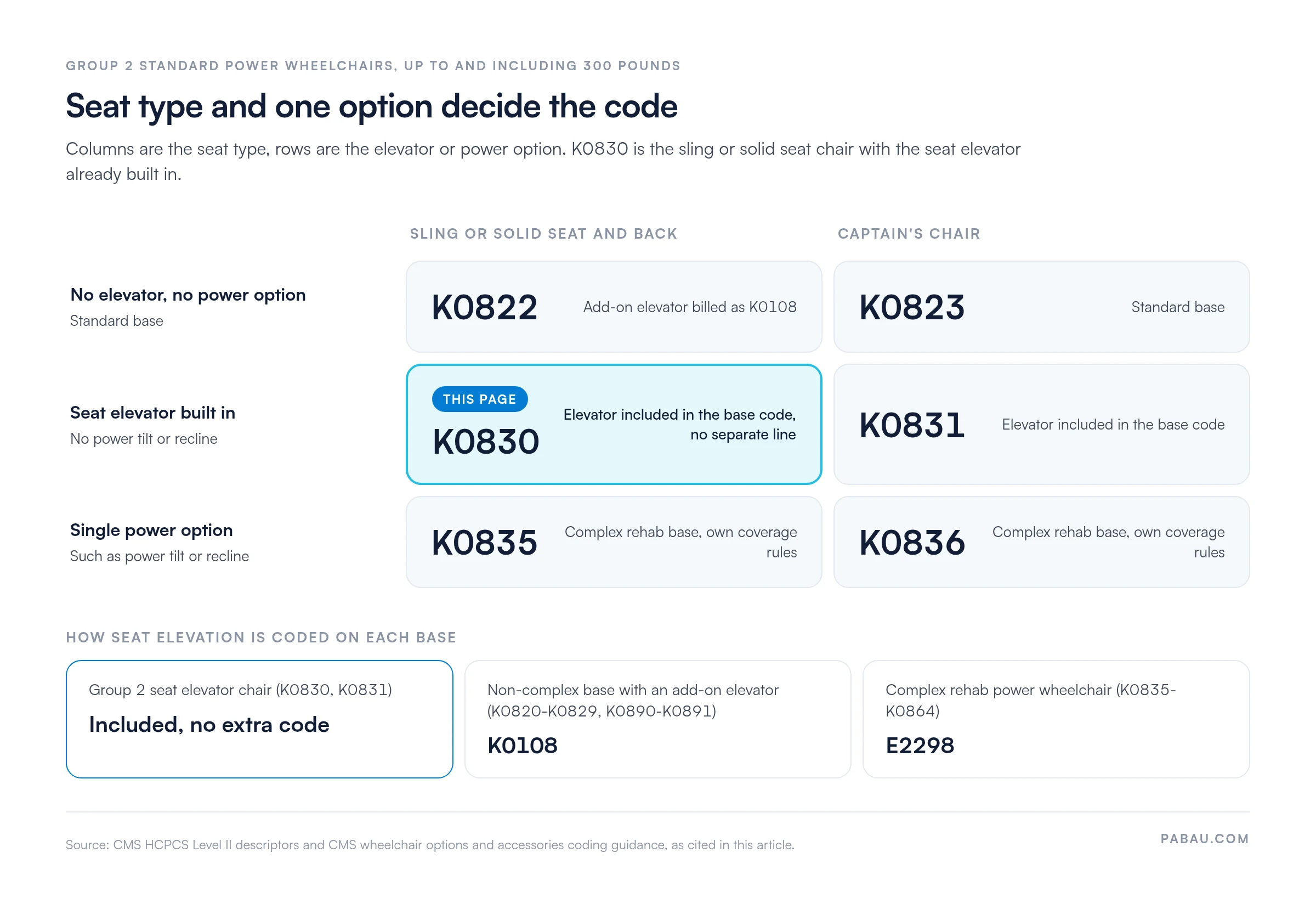
On a non-complex Group 2 standard chair, seat elevation is billed only through the base codes K0830 and K0831. The elevator is part of the chair the code describes, so adding an accessory line for it bills the same equipment twice. The separate seat elevation codes apply to other bases, as the CMS coding guidance sets out.
This is why the old advice to bill K0830 plus a seat elevation accessory produces denials. If the supplier fits an elevator to a K0822 base, the claim is K0822 plus K0108, not K0830. If the chair left the factory as a seat elevator model, the claim is K0830 alone.
Medicare coverage for K0830 changes on December 20, 2026. Until then, NCD 280.16 leaves coverage of Group 2 seat elevator chairs to the discretion of each DME MAC. The MACs proposed in February 2026 to deny K0830 and K0831 as not reasonable and necessary. After the comment period, they finalized coverage criteria instead.
Under the revised Power Mobility Devices LCD (L33789), a non-complex Group 2 seat elevator chair is covered when all of these criteria are met:
A K0830 claim that misses any criterion is denied as not reasonable and necessary. The last two criteria are new for a Group 2 standard chair, because K0822 and K0823 need neither a specialty evaluation nor an ATP.
Book the specialty evaluation before the supplier quotes the chair. The written report has to explain why seat elevation is needed, and the evaluator cannot work for the supplier. An evaluation added after delivery leaves the claim exposed on review.
Medicare does not tie K0830 to a list of covered diagnoses. The diagnosis has to explain the mobility limitation and the reliance on the arms for transfers or reaching. These are common supporting codes, not an approved list.
Pair the diagnosis with a face-to-face note that describes the transfers or reaching tasks. A diagnosis alone does not show why the patient needs the seat to rise.
Power wheelchairs do not use a Certificate of Medical Necessity. The K0830 file rests on a dated face-to-face encounter, a written order received before delivery, and, from December 20, 2026, the specialty evaluation.
Proper medical billing compliance for DME claims means keeping every source document and producing it on request. The specialty evaluation is the item most likely to be missing from older K0830 files.
K0830 does not need Medicare prior authorization. The CMS Required Prior Authorization List, updated July 29, 2026, names the Group 2 bases from K0820 to K0829 and from K0835 upward. It does not name K0830 or K0831.
Without a prior authorization step, nobody reviews the K0830 file before delivery. The documentation is judged after the claim is paid or on pre-payment review. Medicare Advantage plans and commercial payers set their own rules, so check each plan before delivery.
Accurate K0830 billing follows a fixed sequence, and skipping the PDAC check or the specialty evaluation is the fastest route to a denial. Claims management software can enforce this order by flagging missing documents before the claim reaches the DME MAC.
Reviewing what makes a clean claim before each DME submission cycle helps keep first-pass denials down.
Every K0830 claim line carries two kinds of modifier. One shows the rental month, and one shows whether the coverage criteria are met. Under policy article A52498, lines without KX, GA, GY or GZ are rejected as missing information.
K0830 is paid as a capped rental, and ownership passes to the patient after 13 continuous paid rental months. CMS has not set national fee schedule amounts for K0830. In its 2024 coding decision, CMS kept K0830 and K0831 in use and left the DME MACs to calculate local fee amounts.
Amounts change each year, so confirm the current figure with the DME MAC and the CMS DMEPOS fee schedule page before quoting a patient.
K0830 denials cluster around the seat elevator rules and the order of events. For a wider view of how to handle DME denials, see denial management in healthcare.
A denied K0830 claim moves through five appeal levels. Each one has a strict filing deadline, and missing it forfeits that appeal right.
Map each document to a specific LCD criterion in the appeal letter, starting with the specialty evaluation. Quote the reason code from the remittance advice, and check what it means in our list of medical billing denial codes.
A K0830 claim now depends on paperwork from three parties. The treating practitioner writes the face-to-face note and the order. A PT or OT writes the specialty evaluation, and the supplier’s ATP records the chair selection. When those sit in separate inboxes, the claim goes out with one of them missing.
Pabau, a practice management and billing platform, keeps the encounter note, the order and the evaluation in one patient record. Its digital forms capture the transfer and reaching findings the LCD asks for. Its claims management software then tracks each claim and its supporting documents through submission.
The result is a K0830 file that is complete before delivery, so you spend less time rebuilding it for a reviewer.

Pabau keeps face-to-face notes, orders and specialty evaluations with the claim they support. Your team sees what is missing before the chair is delivered.

Bill K0830 only for a sling or solid seat chair whose seat elevator came built in, and never add the elevator as a second line. From December 20, 2026, a K0830 claim pays only when the specialty evaluation and the ATP’s role are on file before delivery.
Suppliers who change their intake now will avoid a run of denials when the revised LCD takes effect. Book a demo to see how Pabau keeps K0830 documentation complete before delivery.

Need a broader overview of how DME claims flow through the billing cycle? Understanding revenue cycle management covers the end-to-end process from eligibility verification to payment posting.
Struggling with denial patterns across your DME claims? Denial codes in medical billing explains the most common CARC codes and how to address each one.
Want to understand what a clean DME claim looks like before submission? The superbill guide walks through how to build complete, submission-ready claim documentation.
Quoting a chair with power tilt instead? HCPCS code K0835 covers the single power option base and the coverage rules that come with it.
Billing a captain’s chair with no seat elevator? HCPCS code K0823 explains the standard Group 2 captain’s chair code.
HCPCS code K0830 covers a Group 2 standard power wheelchair with a built-in seat elevator and a sling or solid seat and back. It serves patients up to and including 300 pounds, and the seat elevator is part of the code. The chair model must be listed under K0830 by the PDAC.
The seat type is the only difference. K0830 has a sling or solid seat and back, and K0831 has a captain’s chair. Both are Group 2 standard seat elevator chairs for patients up to 300 pounds, and both include the elevator in the base code.
K0830 is a seat elevator chair with no power seating option. K0835 is a single power option chair, such as one with power tilt, and has no seat elevator in its descriptor. K0835 is a complex rehab base, so a seat elevator added to it is billed with E2298.
No. The seat elevation system is included in K0830, and CMS lists no separate seat elevation code for the Group 2 seat elevator wheelchair. K0108 applies to an add-on elevator on a non-complex base such as K0822. E2298 applies to complex rehab bases.
No. K0830 and K0831 are not on the CMS Required Prior Authorization List updated July 29, 2026. Other Group 2 bases are on it. Medicare Advantage and commercial plans set their own rules, so check each plan before delivery.
The leading reasons are a separate seat elevation line, a captain’s chair billed as K0830, and a model the PDAC has not listed under K0830. From December 20, 2026, a missing specialty evaluation or no documented ATP involvement will also lead to denials.
The Power Mobility Devices LCD (L33789) governs K0830. Its revision effective December 20, 2026 adds coverage criteria for Group 2 seat elevator chairs, K0830 and K0831. Until then, NCD 280.16 leaves their coverage to each DME MAC.