HCPCS code L1815: Deleted knee orthosis code and current alternatives
HCPCS code L1815 is a deleted Level II code for a prefabricated elastic knee ort...

Last Updated: Nov 2, 2026
K0822 is the HCPCS Level II code for a power wheelchair, group 2 standard, with a sling or solid seat and back. It covers patients up to and including 300 pounds. Medicare pays for it under LCD L33789 when a mobility limitation stops daily activities at home.
Most K0822 denials trace back to steps before delivery. The usual causes are an incomplete face-to-face examination or a standard written order not in place before delivery, or a missing prior authorization. A denied claim then faces up to five levels of appeal.
Let Pabau's smart automation suggest the right codes, reduce claim denials, and keep your practice compliant—effortlessly.
Automate repetitive tasks and focus on what matters most—your patients.
Reduce coding errors and ensure compliance with the latest regulations.
Clean claims, fewer denials, and faster reimbursements.
Powerful insights and reporting to help your practice thrive.
HIPAA compliant SOC 2 certified GDPR-compliant Trusted by 4,000+ clinics worldwide

HCPCS code K0822 covers a group 2 standard power wheelchair with a sling or solid seat and back, for patients up to 300 pounds.
The face-to-face exam must fall within 6 months before the written order, with notes and order reaching the supplier within 45 days of the exam.
A standard written order must be in place before delivery, and K0822 needs an affirmed prior authorization request in every state.
Add KX only when every LCD L33789 criterion is met and documented, and pair RR with KH, KI or KJ by rental month.
Pabau, the practice management platform we build, pre-fills the claim from the patient record and checks required fields before you send it.
HCPCS code K0822 is the Level II code for a group 2 standard power wheelchair with a sling or solid seat and back. It covers patients up to 300 pounds. The official CMS descriptor reads: Power wheelchair, group 2 standard, sling/solid seat/back, patient weight capacity up to and including 300 pounds.
Group 2 chairs sit in the middle of CMS’s performance groups. They suit patients who can’t manage a cane, walker or manual wheelchair at home, but who don’t need complex rehab seating. Group 3 and higher codes cover complex rehabilitative chairs with extra clinical requirements.
Medicare covers K0822 under LCD L33789 and its policy article A52498. Those two documents define coverage, so keep both open while you build the file.
Two details on the order pick the code: the seat and back type, and the patient’s weight. The table puts K0822 next to the group 2 codes it’s most often confused with, including the portable K0820. It also adds the neighboring group 1 code, K0813.
Two mix-ups cause most coding errors here. A chair with a captain’s chair seat and back belongs under K0823, however similar the base looks. A patient documented above 300 pounds needs the heavy-duty code, K0824.
Either error leaves the billed code out of step with the device on file. The claim is then denied, and you rebill under the correct code.
Under LCD L33789, coverage rests on function, not on the diagnosis alone. The medical record has to show each of these before the claim goes out:
The home test trips up new billers more than any other criterion. A patient who wants the chair mainly for shopping trips or appointments doesn’t meet it, even with a serious diagnosis. The note has to tie the chair to tasks inside the home.
Medicare requires a face-to-face examination by the treating practitioner within 6 months before the written order. The supplier must then receive the exam notes and the order within 45 days of the exam. This rule comes from Social Security Act Section 1834(a)(1)(E) and policy article A52498.
The exam notes should cover these points, in the practitioner’s own words:
After the exam, the same practitioner completes a Standard Written Order (SWO). K0822 is on the CMS list of items that need a Written Order Prior to Delivery (WOPD). The order must exist before the chair arrives.
The old Detailed Written Order no longer applies, since CMS retired it in 2020. If the order is dated after delivery, the claim fails, and no later signature fixes it.
Prior authorization trips up more K0822 claims than any modifier does. Here are the answers billers ask for most often.
Is prior authorization required everywhere? Yes. K0822 is on CMS’s Required Prior Authorization List, effective September 1, 2018, nationwide. It applies with every DME MAC.
What happens without it? A claim without an affirmed prior authorization request is denied. There’s no retrospective request to fall back on afterwards.
What if the request comes back non-affirmed? The supplier can fix the missing documentation and resubmit before delivery. Delivering without an affirmation means the claim will be denied.
Put the steps in order and the pattern is plain: four of the six happen before the chair leaves the warehouse. The timeline below shows where each document lands.
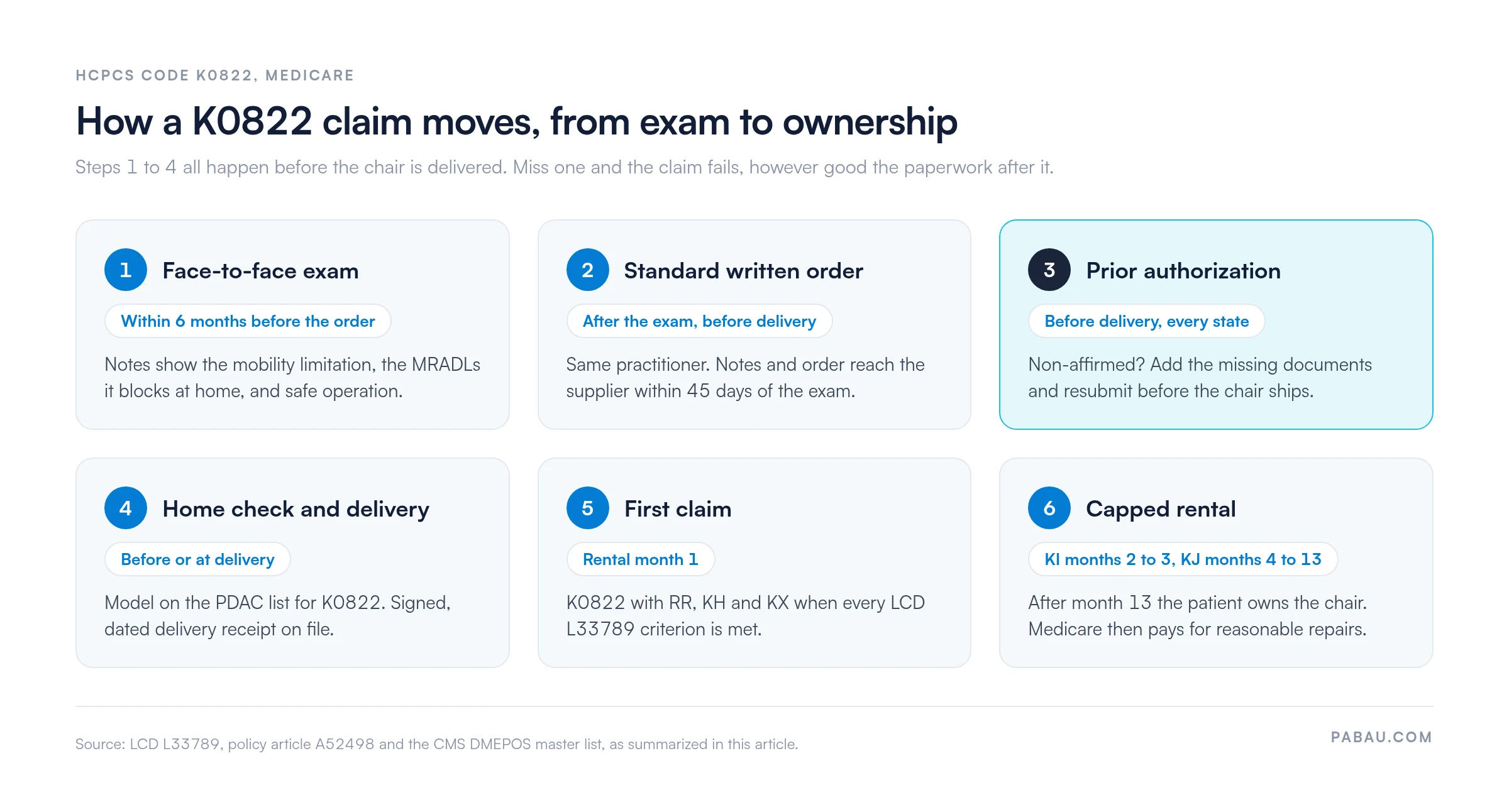
In practice, the sequence breaks at the handoffs. The exam notes reach the supplier late, or the order arrives before the exam is signed. Date-stamp each document when it lands, and the timeline checks itself.
Every K0822 claim carries KX when all LCD coverage criteria are met and documented. The rental modifiers then tell the MAC which month you’re billing.
KX and GA never sit on the same line. Use KX when the criteria are met, and GA or GZ when they aren’t. Without KX, automated edits deny the claim before a reviewer ever sees the file.
Medicare pays K0822 as a capped rental under Social Security Act Section 1834(a). Standard power wheelchairs lost their lump-sum purchase option in January 2011, so the chair is rented month by month.
Medicare pays a monthly rental for up to 13 months. After month 13, the patient owns the chair. From then on, Medicare pays for reasonable repairs and servicing of the patient-owned equipment.
The allowed amount comes from the DMEPOS fee schedule for the supplier’s location, and it varies by state. Check the current figure in the CMS DMEPOS fee schedule. The patient pays 20% coinsurance once the Part B deductible is met.
Sound medical billing compliance for K0822 means each document is in the file before the claim goes out. The table lists what auditors check and the items auditors commonly find missing.
Run this quick check on every file. It takes two minutes and catches the denials listed further down.
No diagnosis qualifies a patient for K0822 on its own. LCD L33789 and policy article A52498 define coverage through the MRADL criteria above, not through a list of approved conditions.
That said, certain diagnoses often appear on K0822 claims because they cause lasting mobility limits. Code the condition to full specificity, then let the exam notes show the functional impact.
Read the face-to-face note as the reviewer will. For each MRADL the patient can’t complete at home, the note should say why a cane, walker or manual chair won’t solve it. A strong diagnosis with a thin MRADL description is still a weak K0822 file.
Most K0822 denials can be prevented, and the same few causes come up again and again. Good denial management starts with matching each one to its fix.
Your remittance advice names the reason behind each rejection. Matching it against claim denial codes tells you whether to rebill or appeal.
Medicare’s five-level appeals process applies to denied K0822 claims. Each level has its own deadline, so diary the dates the day the denial arrives.
At each level, send a cover letter that quotes the LCD L33789 criteria and maps each one to a page in the file. Attach the exam notes, the dated SWO and any new clinical evidence. A medical appeal form keeps that letter consistent from one claim to the next.
The Pricing, Data Analysis and Coding (PDAC) contractor publishes the Product Classification List. It confirms which wheelchair models meet the technical specifications for each code.
A model that isn’t listed under K0822 can’t be billed as K0822, whatever the brochure says. Check the model on pdac.cms.gov before the order goes to the manufacturer, and keep a screenshot of the listing in the file.
Many practices still copy patient details, codes and dates into a claim form by hand. Each retyped field is a chance for a wrong code or a missing date.
Pabau’s cleaner claims management tools pre-fill the claim form from the patient record, so details flow straight from the chart. Built-in ICD-10, CPT and HCPCS lookup libraries help you find K0822 and the supporting diagnosis codes quickly.
Before you press Send, Pabau checks that the required claim fields are complete. In the US, claims go out through Claim.MD, with eligibility checks up front and ERA payments posted back to the patient record. Your team spends less time rekeying and more time chasing the documents only the practitioner can supply.
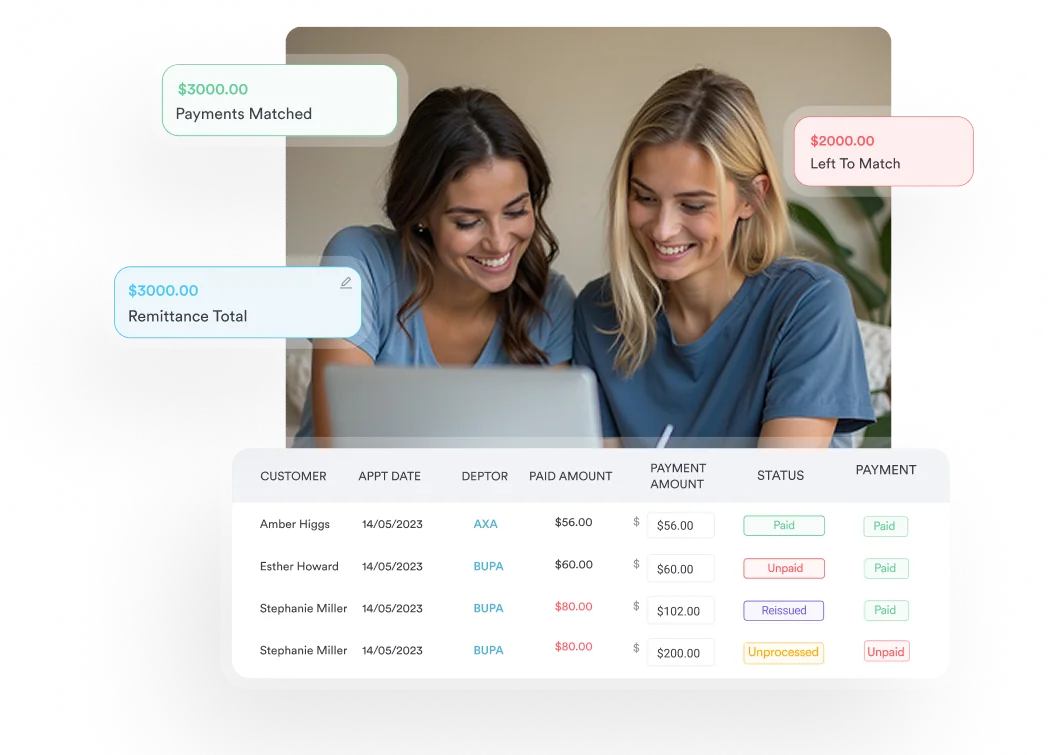

Pabau pre-fills claim forms from the patient record, offers ICD-10 and HCPCS lookup, and checks required fields before you send. US claims go through Claim.MD, with eligibility checks and ERA posting.

K0822 claims are won or lost before the chair ships. If the exam, the written order and the prior authorization line up in that order, the claim itself is the easy part.
So treat delivery as the deadline, not the claim date. Hold any chair whose file is missing a dated order or an affirmed request. A one-week delay costs far less than an appeal that runs through several levels.
Want claim forms that fill themselves from the patient record? Book a demo to see how Pabau helps your team send complete power wheelchair claims.

Billing the captain’s chair version? HCPCS code K0823 covers the group 2 standard chair with a captain’s chair seat and back.
Heavier patient, captain’s chair seat? HCPCS code K0825 explains the heavy-duty group 2 code for patients from 301 to 450 pounds.
Setting up prior authorization requests? The prior authorization process walks through a step-by-step workflow for practices.
Expecting Medicare to deny the chair? Medicare waiver template gives you a form for recording the patient’s acknowledgment before delivery.
New to the billing cycle? Medical billing explained covers the workflow from claim creation through payment posting.
A sling seat is a flexible fabric seat, while a solid seat uses a rigid base. Either one fits K0822. A padded automotive-style captain’s chair moves the chair to K0823.
A physician, physician assistant, nurse practitioner or clinical nurse specialist can perform it. The same practitioner must then complete the standard written order.
No. Scooters, which Medicare calls power-operated vehicles, have their own codes in the K0800 to K0812 range. A power wheelchair is covered when the patient can’t safely use a scooter at home.
Medicare generally replaces DME once its reasonable useful lifetime of five years has passed. It can replace a chair sooner if it’s lost, stolen or damaged beyond repair in a specific incident. A new prescription and updated documentation are needed.
Yes. Many commercial and Medicare Advantage plans follow similar rules, but they set their own prior authorization and documentation requirements. Check the payer’s policy before you order the chair.