CPT code 21011: Excision of soft tissue tumor of the face
CPT code 21011: Official descriptor and procedure overview CPT code 21011, as pu...

Last Updated: Oct 8, 2026
K0831 is the HCPCS Level II code for power wheelchair, group 2 standard, seat elevator, captains chair, patient weight capacity up to and including 300 pounds.
Two documentation problems account for most K0831 denials: a missing face-to-face evaluation record, and an incomplete certificate of medical necessity.
Let Pabau's smart automation suggest the right codes, reduce claim denials, and keep your practice compliant—effortlessly.
Automate repetitive tasks and focus on what matters most—your patients.
Reduce coding errors and ensure compliance with the latest regulations.
Clean claims, fewer denials, and faster reimbursements.
Powerful insights and reporting to help your practice thrive.
HIPAA compliant SOC 2 certified GDPR-compliant Trusted by 4,000+ clinics worldwide

HCPCS Code K0831 describes a group 2 standard power wheelchair with a captains chair seat and a seat elevator, billed under Medicare Part B.
Coverage requires a face-to-face evaluation by the treating physician, documented medical necessity, and compliance with the applicable local coverage determination (LCD).
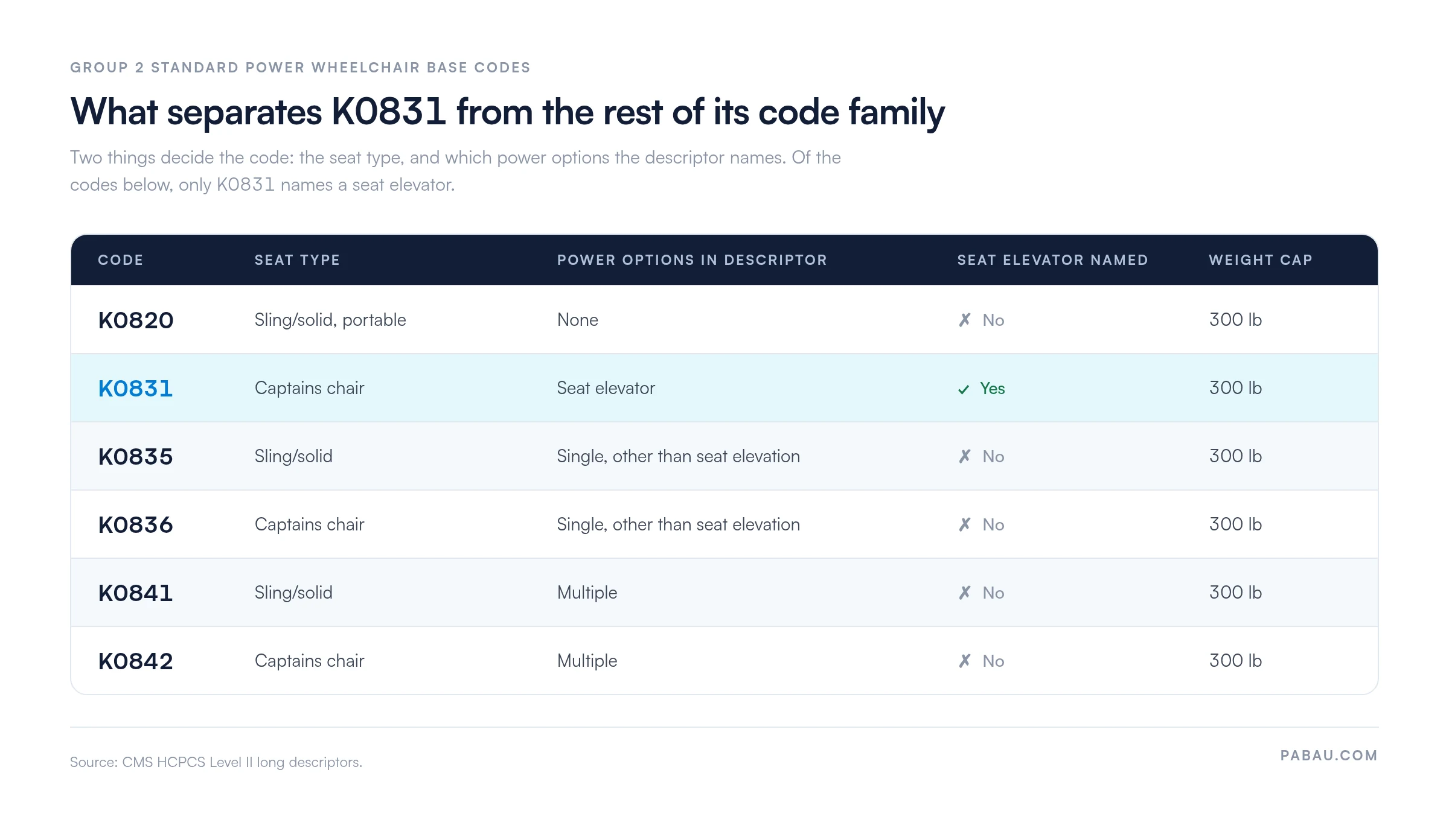
K0831 differs from K0835 in the power option: K0831 names the seat elevator, while K0835 covers a single power option other than seat elevation.
The full CMS descriptor, not a shortened version of it, is what decides between K0831, K0835, K0836, K0841 and K0842.
Practice management software like Pabau helps suppliers track prior authorization status, attach medical necessity records, and submit clean K0831 claims.
HCPCS Code K0831 is a Level II HCPCS code maintained by the Centers for Medicare & Medicaid Services (CMS). The official descriptor reads: Power wheelchair, group 2 standard, seat elevator, captains chair, patient weight capacity up to and including 300 pounds.
The code sits in the power mobility device (PMD) category within the durable medical equipment benefit of Medicare Part B.
Two elements of that descriptor do the work. A captains chair is an integrated seat and back, not a separate sling or solid seat and back. The seat type is therefore part of the code choice. The seat elevator is the named power option, which is why K0831 is not interchangeable with the other group 2 standard codes.
CMS organizes power wheelchairs into groups 1 through 5, based on performance characteristics and the severity of the beneficiary’s functional limitations. Group 2 sits in the middle of that range. It carries more stability and capability than a Group 1 chair. It also stops short of the complex rehabilitation features that define Groups 3 through 5.
“Standard” within Group 2 designates the base drive system. Standard bases use a four-wheel or mid-wheel-drive configuration, within the speed, turning radius, and obstacle-climbing specifications CMS sets for the group.
The seat elevator is what separates K0831 from the other Group 2 standard codes. That system raises the seat vertically, so the beneficiary can reach elevated surfaces and transfer more safely.
Medicare coverage for K0831 is governed by the local coverage determination (LCD) published by the beneficiary’s DME MAC. The power mobility devices LCD sets out the base power wheelchair requirements.
It adds separate criteria that must be met before seat elevation is covered. Coverage policy is revised periodically, so review the version that was active on the date of service rather than the one you read last year.
At a minimum, Medicare coverage for HCPCS Code K0831 typically requires the following:
Check the LCD before you submit, not after the denial arrives. Noridian publishes its power mobility devices LCD at med.noridianmedicare.com, and CGS publishes its coverage guidance at cgsmedicare.com. Reading the wrong contractor’s criteria for seat elevation is a common audit trigger.
Incomplete documentation is the leading cause of K0831 denials and post-payment audits. Medicare’s DME standards go beyond the record-keeping rules that apply to any patient chart. The claim has to prove both the base chair and the seat elevator were medically necessary. Every element below belongs in the record before the claim goes out.
Medicare reimburses K0831 under the DMEPOS fee schedule, which CMS updates annually. Rates vary by MAC jurisdiction, and by whether the supplier sits inside a competitive bidding area (CBA). Rural non-CBA locations may receive an adjusted rate under the rural adjustment policy.
The table below maps the rate structure rather than the dollar amounts, because the amounts change every January. Check the current allowable against the annual DMEPOS fee schedule files before you bill.
Power wheelchairs are normally paid under a capped rental methodology. Medicare pays a monthly rental rate for up to 13 continuous months of medical need, and ownership then transfers to the beneficiary. The supplier keeps servicing the equipment after the capped rental period ends.
Confirm whether the beneficiary’s address falls inside a CBA before billing. Competitive bid rates apply only to accredited suppliers holding a contract for that bid area.
CMS operates a prior authorization (PA) program for certain DMEPOS items, including some power wheelchairs. Whether K0831 falls within the current PA list depends on CMS policy on the date of service.
Verify its PA status with the DME MAC before the chair is dispensed. Checking eligibility and PA status before the face-to-face evaluation catches the requirement early, rather than on the day of delivery.
Where prior authorization is required, the process generally follows these steps:
A provisional affirmation from the MAC does not guarantee payment. The claim still has to meet every billing requirement on its own. Where a PA request is non-affirmed, the supplier can resubmit or appeal with additional documentation before dispensing the chair.
Billing K0831 correctly comes down to three fields: place of service, the rental or purchase modifier, and the diagnosis code that carries medical necessity.
An error in any of them produces a denial that takes weeks to unwind. Suppliers submit DMEPOS claims on the CMS-1500 form, or its electronic equivalent, the 837P transaction. The same clean claim submission standards that govern professional billing apply to this claim.
Three errors account for most K0831 rejections. They are a claim dated before the written order, the wrong rental modifier, and a missing PA control number. Each one produces a denial that needs a corrected claim or an appeal. Reading the remittance advice against the common denial codes narrows the cause quickly and cuts the rework.
Each code in the Group 2 power wheelchair family carries a distinct descriptor. Billing a neighboring code counts as a coding error. The AAPC HCPCS Level II code lookup lists the descriptors side by side. The table below covers the codes most often mistaken for K0831.
The line between K0831 and K0835 is the power option itself. K0831 names the seat elevator. K0835 covers a single power option other than seat elevation, such as a powered elevating leg rest.
Its seat is a sling or solid seat and back. K0836 is that same single power option on a captains chair. Where the chair carries two or more power options, the group 2 standard codes are K0841 and K0842.
Two variables therefore decide the code: the seat type, and which power option the descriptor names. The matrix below lays out both across the family.
There is no direct Group 3 equivalent of K0831. At Group 3 the seat elevation system is billed separately from the base chair, using an add-on code such as E2298. Check the chair’s configuration against the descriptor before coding, and use the manufacturer’s product coding letter where one exists.
Seat elevation reached the code set through the HCPCS Level II coding process. Stakeholders apply for a new or revised code, and CMS grants it where clinical evidence supports a distinct product category.
K0831 and its sibling codes were established that way. That history also explains why the seat elevator sits in the base descriptor at Group 2 but not at Group 3.
Industry sources, including HME Business and the VGM Group, reported a pause in CMS coding and funding decisions for seat elevation at Group 2. CMS was reviewing the clinical evidence at the time.
Before filing, check whether K0831 is currently payable and which LCD governs it, using CMS Change Request transmittals and the DME MAC coverage database. Policy for seat elevation has kept moving as CMS revisits its power mobility coding decisions.
Subscribe to your DME MAC listserv for billing alerts and coverage updates. Noridian and CGS both publish LCD revisions and billing guidance that change how K0831 is documented. A missed LCD revision is one of the most preventable causes of post-payment audit exposure.
Running K0831 claims by hand across a caseload creates a documentation bottleneck. A lapsed prior authorization turns a covered claim into a denial. So does an evaluation dated outside the window, or a delivery ticket nobody signed.
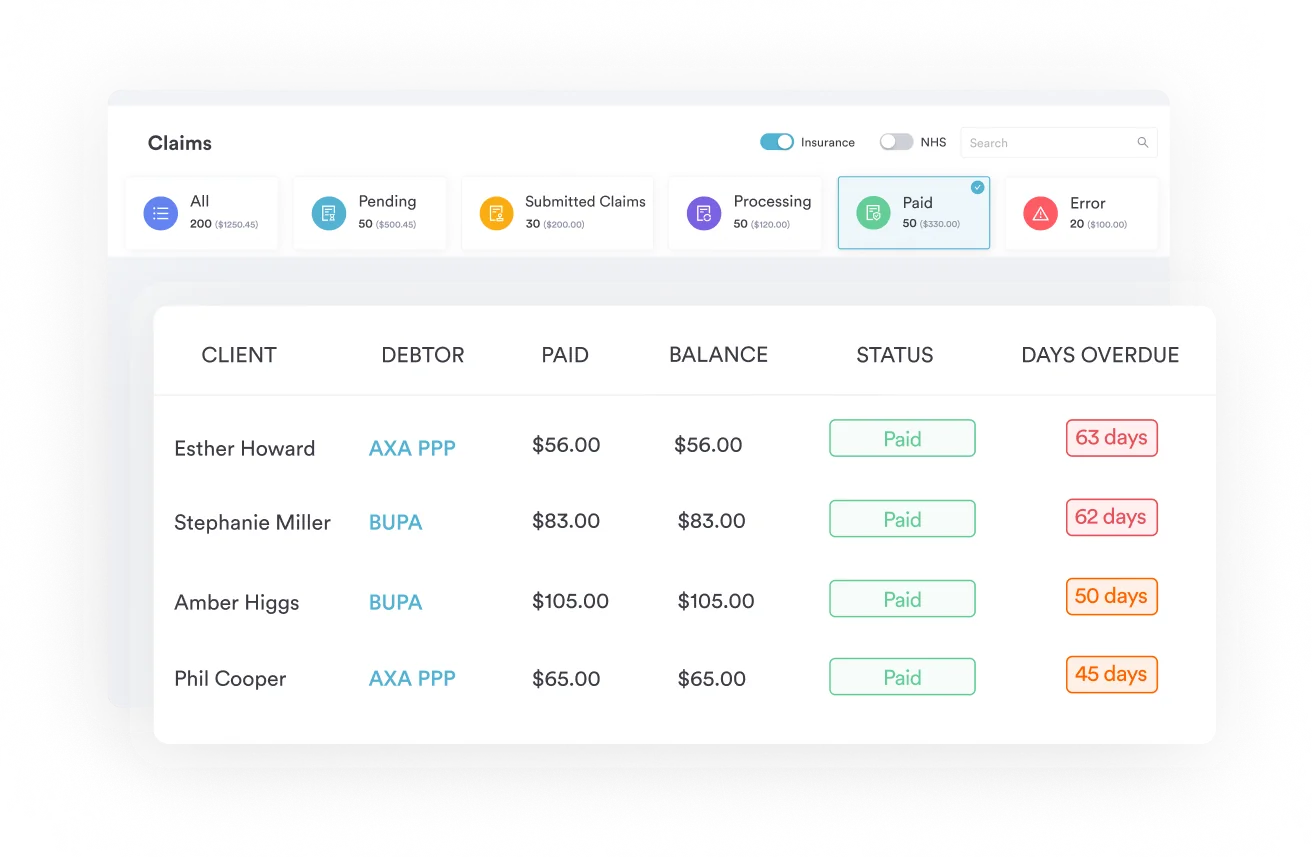
Practice management software like Pabau keeps that trail in one record instead of across separate systems. Pabau’s claims management for suppliers shows claim status by stage. It holds the written order and the evaluation notes against the claim itself, and flags any claim still waiting on authorization.
Practices that also run the clinical side of the evaluation get the same benefit upstream. Structured intake forms and templated evaluation notes capture the face-to-face record completely at the point of care. Nobody has to reconstruct it from memory a month later.
The outcome is that the documents an auditor asks for are already attached to the claim. A post-payment review becomes a lookup instead of a search through paper files.

Pabau’s claims management tools help DME suppliers document medical necessity, track prior authorization status, and submit clean K0831 claims to Medicare without the paperwork bottlenecks.

K0831 is one of the easier codes to get right and one of the easier claims to lose. The descriptor settles the coding question on its own: a group 2 standard base, a captains chair, a seat elevator, and a 300-pound weight capacity. What settles payment is whether the evaluation, the order, and the authorization are all on file in the right sequence.
If you change one thing, change the sequence. A written order dated after delivery, or a PA number obtained after the chair went out, fails on a technicality that no appeal narrative repairs. Build the check into dispensing rather than into billing, and the denial rate follows.
Book a demo to see how Pabau tracks DME claim documentation from the face-to-face evaluation through to reimbursement.

Need to understand medical billing fundamentals before tackling DME codes? What is medical billing covers the end-to-end billing cycle, from charge capture to payment posting, in plain language.
Struggling with post-payment audit exposure on DMEPOS claims? Denial management in healthcare walks through how to build a systematic denial review and appeal workflow.
Want to benchmark your revenue cycle performance for DME? Revenue cycle management explained covers the key metrics and process stages that affect DME reimbursement timelines.
HCPCS Code K0831 covers a group 2 standard power wheelchair with a captains chair seat and a powered seat elevation system. It is billed under Medicare Part B as durable medical equipment. Both the group 2 base and the seat elevation feature must be medically necessary, and each is documented separately.
Medicare K0831 rates are set annually in the CMS DMEPOS fee schedule. They vary by MAC jurisdiction, by competitive bidding area status, and by rural versus non-rural location. Rates change each January 1, so verify the current allowable in the published fee schedule files or with the DME MAC directly.
Five items are required. The clinical set is a physician written order plus face-to-face evaluation notes covering the mobility limitation and the need for seat elevation. The administrative set is a certificate of medical necessity or detailed written order, a signed delivery confirmation, and any PA approval number. Retain the records that corroborate the diagnosis as well.
K0831 covers a group 2 standard base with a captains chair seat and a seat elevator. K0835 covers a group 2 standard base with a single power option other than seat elevation, on a sling or solid seat and back. K0836 is that same single power option on a captains chair. Two or more power options move the claim to K0841 or K0842.
Prior authorization may be required for K0831 under the CMS DMEPOS Prior Authorization Program. Verify with the DME MAC whether the code is currently on the PA list, before the equipment is dispensed. CMS updates that list periodically. Dispensing without required PA approval risks full claim denial.
K0831 is governed by the power mobility devices LCD published by the beneficiary’s DME MAC. Two contractors administer the DME benefit. Noridian covers Jurisdictions A and D, while CGS covers Jurisdictions B and C, and both publish their LCDs in CMS’s coverage database. Confirm the active version before the chair is dispensed.