HCPCS code L0638: Custom fabricated LSO billing guide
HCPCS code L0638 is a brace built for one patient HCPCS code L0638 is the Level ...

Last Updated: Nov 2, 2026
K0828 is the HCPCS Level II code for power wheelchair, group 2 extra heavy duty, sling/solid seat/back, patient weight capacity 601 pounds or more.
K0829 is the same Group 2 extra heavy duty chair with a captain's chair in place of the sling/solid seat and back. K0828 needs prior authorization nationwide, plus a face-to-face encounter and a written order prior to delivery. Medicare pays it as a capped rental.
Let Pabau's smart automation suggest the right codes, reduce claim denials, and keep your practice compliant—effortlessly.
Automate repetitive tasks and focus on what matters most—your patients.
Reduce coding errors and ensure compliance with the latest regulations.
Clean claims, fewer denials, and faster reimbursements.
Powerful insights and reporting to help your practice thrive.
HIPAA compliant SOC 2 certified GDPR-compliant Trusted by 4,000+ clinics worldwide

HCPCS Code K0828 is a group 2 extra heavy duty power wheelchair with a sling/solid seat and back, rated for 601 pounds or more.
Its captain’s chair twin is K0829, while K0826 and K0827 cover the very heavy duty band of 451 to 600 pounds.
Medicare covers K0828 under LCD L33789 when the general power wheelchair criteria are met and the beneficiary weighs 570 pounds or more.
K0828 is on the Required Prior Authorization List and needs a face-to-face encounter and a written order before delivery.
In Pabau’s claims software, the prior authorization code follows the order to the claim, and a claim missing it is flagged before submission.
HCPCS Code K0828 describes a power wheelchair, group 2 extra heavy duty, sling/solid seat/back, patient weight capacity 601 pounds or more.
It is a base power wheelchair with no power seating options, built for the heaviest weight band in the Group 2 range. It sits in the K0813 to K0899 power wheelchair range of the HCPCS Level II codes.
Each part of the descriptor narrows the code. “Group 2” is the performance tier above Group 1. “Extra heavy duty” sets the capacity at 601 pounds or more. “Sling/solid seat/back” separates K0828 from K0829, which carries a captain’s chair instead. A chair at this capacity with one power seating option moves to K0840.
K0828 is a Level II HCPCS code maintained by CMS under the HCPCS coding system. It is billed to the DME MAC (Durable Medical Equipment Medicare Administrative Contractor) for the beneficiary’s state of residence. Two DME MACs cover the four jurisdictions: Noridian for Jurisdictions A and D, and CGS Administrators for Jurisdictions B and C.
Medicare covers HCPCS Code K0828 under the Part B DME benefit when the beneficiary meets every criterion in LCD L33789, Power Mobility Devices. The criteria are cumulative, and each one must be documented in the medical record:
On top of those criteria, the chair must suit the beneficiary’s weight. The LCD covers an extra heavy duty power wheelchair for a beneficiary weighing 570 pounds or more. That threshold sits below the 601-pound capacity in the K0828 descriptor, so record the measured weight rather than an estimate.
K0828 is a Group 2 base chair with no power options. Single and multiple power option chairs and Group 3 chairs need a specialty evaluation by a physical or occupational therapist. Their supplier must also employ a RESNA-certified ATP. Neither requirement applies to K0828.
Record the beneficiary’s measured weight, and the date it was taken, in the face-to-face encounter note. The 570-pound threshold decides K0828 coverage. An estimated or missing weight is the hardest part of the record to defend at review.
Three items must be in place before a K0828 chair is delivered: the face-to-face encounter note, the written order and the prior authorization decision. The home assessment and proof of delivery complete the file.
The treating practitioner must hold a face-to-face encounter within six months before the order date. The note must describe the mobility limitation, why a cane, walker, manual wheelchair or scooter will not work, and the beneficiary’s weight. A routine office visit note that skips these elements will not support the claim.
K0828 also needs a written order prior to delivery (WOPD). It is a standard written order that the supplier must hold before the chair is delivered. The order lists the beneficiary’s name or Medicare Beneficiary Identifier, the order date, the item, the quantity, and the practitioner’s name or NPI and signature.
No Certificate of Medical Necessity is filed for K0828. CMS removed the CMN requirement for power mobility devices in 2006, and LCD L33789 relies on the written order and the medical record instead.
Before or at delivery, the supplier or practitioner must complete an on-site evaluation of the home. The written report must be available to the DME MAC on request. It should confirm the chair fits through doorways and turns within the rooms where the beneficiary needs it.
Keeping a complete file supports medical billing compliance at every step. Suppliers must keep proof of delivery for seven years, and the same file should hold the encounter note, the order and the home assessment.
Every K0828 claim needs ICD-10-CM codes that explain the mobility limitation and the weight. For a Group 2 base chair, LCD L33789 sets functional and weight criteria rather than limiting coverage to named diagnoses. The codes still have to match what the face-to-face note documents. An obesity code such as E66.01, paired with a Z68 BMI code, covers the weight side of the claim.
Code to the highest specificity the record supports, and check each code against the current ICD-10-CM release before filing. AAPC’s K0828 entry can help confirm the descriptor while you build the claim.
Medicare requires prior authorization for HCPCS Code K0828. It has been on the CMS Required Prior Authorization List nationwide since September 1, 2018. The power mobility codes on that list cover scooters and Group 1, 2 and 3 power wheelchairs, not Groups 4 and 5.
The prior authorization process works as follows:
Verifying insurance eligibility before the request confirms that Part B is active. It also shows whether the beneficiary is in traditional Medicare or a Medicare Advantage plan, which sets its own prior authorization rules.
Two facts pick the code within this family: the weight band and the seat type. K0828 and K0829 share the 601-pound-plus capacity. K0828 has a sling/solid seat and back, and K0829 has a captain’s chair.
K0826 and K0827 are the very heavy duty pair, rated for 451 to 600 pounds. K0839 is the very heavy duty chair with one power option, and K0840 is its extra heavy duty counterpart. K0830 is a different chair altogether: a group 2 standard base with a seat elevator, rated up to 300 pounds.
Bill the code the PDAC lists for the base that was delivered, not the one that was ordered. In February 2026 the DME MACs also proposed treating K0830 and K0831 as not reasonable and necessary. Check the final LCD before billing either.
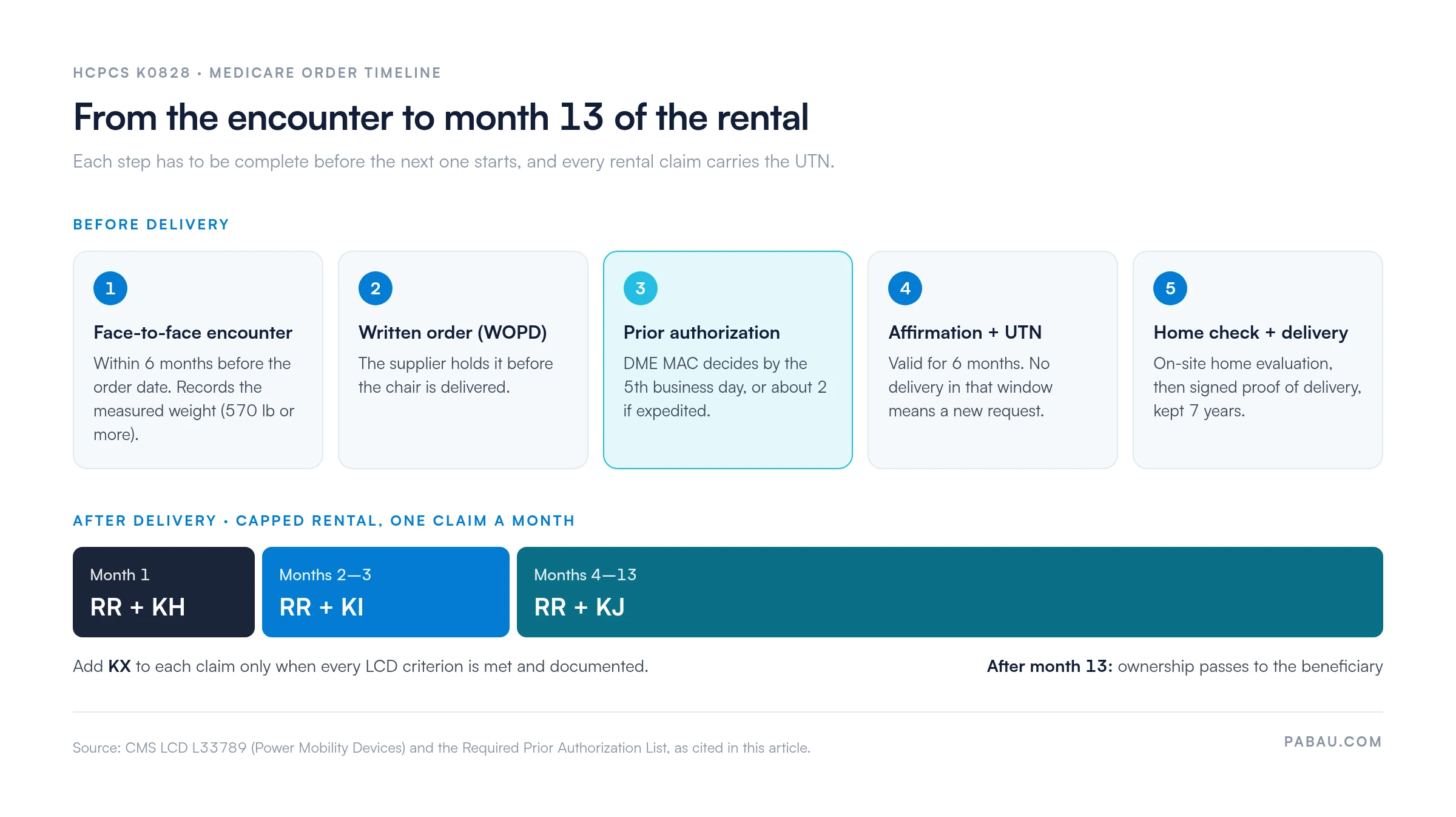
A clean K0828 claim depends on the order of events. Each step below must be complete before the next one starts.
K0828 is a capped rental item, and Medicare requires standard power wheelchairs to be rented. Each monthly claim carries these modifiers:
Put together, the pre-delivery deadlines and the rental modifiers run on one timeline, from the encounter to the 13th month.
Suppliers billing HCPCS Code K0828 must be accredited and enrolled as a DMEPOS supplier under 42 CFR 424.57. Since November 2022, the National Provider Enrollment (NPE) contractors have handled that enrollment in place of the National Supplier Clearinghouse. Integrated claims management software that tracks each K0828 order’s documents reduces submission errors and keeps an audit trail.
A K0828 claim must satisfy prior authorization, the face-to-face rule, the written order rule and the LCD at once. A defect in any one of them is enough for a denial.
Medicare has a five-level appeal process for denied K0828 claims. The first level is a redetermination request to the DME MAC within 120 days of the initial determination. If it is upheld, the supplier can ask a Qualified Independent Contractor (QIC) for reconsideration within 180 days.
Later levels are an Administrative Law Judge hearing, the Medicare Appeals Council and federal district court. New evidence at each level, such as a clarifying practitioner letter, strengthens the appeal. Understanding the full denial management process before filing improves the odds of reversal at the earlier levels.
LCD L33789, “Power Mobility Devices,” is the coverage policy for HCPCS Code K0828 in all four DME MAC jurisdictions. Noridian and CGS publish the same LCD, so the K0828 criteria do not change by state. Each DME MAC may still publish its own billing guidance and policy articles.
The version in force applies to services on or after October 1, 2025. In February 2026 the DME MACs published a proposed revision for comment. Search the CMS Medicare Coverage Database for L33789 and its policy article. Check the effective date before citing either in an authorization request or appeal.
Medicare pays for K0828 as a capped rental. It pays a monthly rental for up to 13 continuous months, after which ownership passes to the beneficiary. Medicare pays 80 percent of the allowed amount after the Part B deductible, and the beneficiary owes 20 percent.
Allowed amounts come from the CMS DMEPOS fee schedule, which is updated each year and varies by state. Where a competitive bidding contract covers the beneficiary’s area, the contract price applies instead. Confirm the current rate before quoting a figure for K0828.
A K0828 order runs on dates. The encounter, the written order, the authorization decision and the delivery must fall in sequence, and the UTN must reach every rental claim.
Pabau, the practice management platform we build, stores each prior authorization as a case. Attach the case when booking, and its authorization code follows through to the claim. A claim still missing a code is flagged with “Assign case” before it goes out.
Claim validation checks each CMS-1500 claim for missing or invalid details before it leaves Pabau. Claims go out through Claim.MD, and eligibility checks run before the visit, so you know which payer’s rules apply.
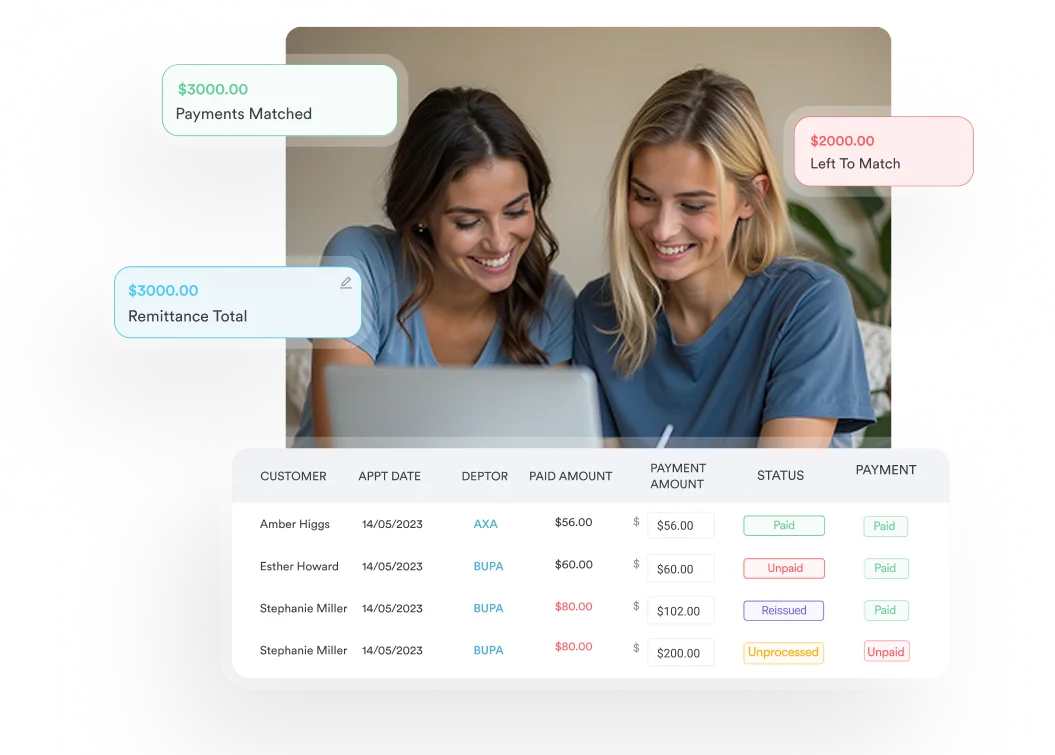
Each insurer payment is recorded once and matched to the invoices it covers. Across 13 rental months, that shows which K0828 claims are paid and which need action.

Pabau stores each prior authorization as a case and carries its code onto the claim. Claim validation flags missing details before a K0828 claim reaches the DME MAC.

K0828 turns on two documented facts: a weight of 570 pounds or more and a chair with a sling/solid seat and back. When both hold, K0828 is the code. When either differs, K0829, K0826 or K0840 fits the claim better.
The payment then depends on order. Hold the encounter note, the written order and the affirmation before delivery, and bill each rental month with the UTN and the right modifiers. Book a demo to see how Pabau keeps authorization codes attached to every power wheelchair claim.

Billing the same family one weight band down? HCPCS Code K0827 covers the Group 2 very heavy duty chair with a captain’s chair, rated for 451 to 600 pounds.
Is the chair fitted with one power seating option? HCPCS Code K0839 covers the Group 2 very heavy duty chair with a single power option, rated for 451 to 600 pounds.
Need a primer on clean claim requirements? What is medical billing explains the end-to-end billing workflow from patient encounter to paid claim.
Struggling with high denial rates across your DME billing? Denial management in healthcare covers the appeals process and prevention strategies for common payer rejections.
Want to improve documentation accuracy before submission? Medical billing compliance outlines the documentation retention and audit-readiness requirements that protect suppliers during DME MAC reviews.
HCPCS Code K0828 covers a group 2 extra heavy duty power wheelchair with a sling/solid seat and back, rated for 601 pounds or more. It is billed to the DME MAC under the Medicare Part B DME benefit.
The seat type. K0828 has a sling/solid seat and back, and K0829 has a captain’s chair. Both are group 2 extra heavy duty power wheelchairs rated for 601 pounds or more.
LCD L33789 covers an extra heavy duty power wheelchair for a beneficiary weighing 570 pounds or more. The beneficiary must also meet the general power wheelchair criteria.
Yes. K0828 is on the CMS Required Prior Authorization List. The supplier needs a provisional affirmation and its unique tracking number (UTN) before delivery, and the UTN goes on the claim.
The supplier needs a face-to-face encounter note from within six months before the order, and a written order received before delivery. It also needs a prior authorization affirmation, a home assessment and signed proof of delivery. No Certificate of Medical Necessity is required.
K0828 is paid as a capped rental for up to 13 months, at rates from the CMS DMEPOS fee schedule. The rate varies by state and changes each year, so check the current schedule before quoting a figure.
LCD L33789, “Power Mobility Devices,” sets the K0828 coverage criteria in all four DME MAC jurisdictions. Check the CMS Medicare Coverage Database for the current version and its policy article before each submission.