HCPCS code K0840 – Power wheelchair, Group 2 extra heavy duty, single power option (601 lbs or more)
Code Definition
K0840 is the HCPCS Level II code for a group 2 extra heavy duty power wheelchair with a single power option. It has a sling/solid seat and back and a patient weight capacity of 601 pounds or more.
No other single power option code, in group 2 or group 3, is rated for 601 pounds or more. Medicare covers the chair for beneficiaries weighing 570 pounds or more. Each claim needs prior authorization, a face-to-face encounter, a written order before delivery, a specialty evaluation and a RESNA-certified ATP.
Related Information
Level
Level II
Category
K — DME temporary codes
Code range
K0800-K0899 Power wheelchairs
Billable
No
Code also known as
power chair, electric wheelchair, power mobility device
Save time. Improve accuracy. Get paid faster.
Automate coding with Pabau
Let Pabau's smart automation suggest the right codes, reduce claim denials, and keep your practice compliant—effortlessly.
Power wheelchair, Group 2 extra heavy duty, single power option (601 lbs or more)
Codes
Suggested by Pabau AI
K0840Power wheelchair, Group 2 extra heavy duty, single power option (601 lbs or more)
HCPCS Code Suggestion
AI
Suggested code
K0840Power wheelchair, Group 2 extra heavy duty, single power option (601 lbs or more)High match
Confidence score
98%
Why this code?
Matches patient diagnosis
Supported by clinical notes
Commonly used for this condition
Why practices choose Pabau
Save hours every week
Automate repetitive tasks and focus on what matters most—your patients.
Improve accuracy
Reduce coding errors and ensure compliance with the latest regulations.
Get paid faster
Clean claims, fewer denials, and faster reimbursements.
Grow with confidence
Powerful insights and reporting to help your practice thrive.
HIPAA compliant•SOC 2 certified•GDPR-compliant•Trusted by 4,000+ clinics worldwide
Key takeaways
K0840 is the group 2 extra heavy duty power wheelchair with a single power option, rated for patients of 601 pounds or more.
It is the only single power option code, in group 2 or group 3, rated for 601 pounds or more.
Medicare requires prior authorization for K0840 nationwide, plus a face-to-face encounter and a written order received before delivery.
Coverage also needs a specialty evaluation by an evaluator with no financial tie to the supplier, and a RESNA-certified ATP.
Append KX only when every LCD coverage criterion is met. Claim lines without a KX, GA, GY or GZ modifier are rejected.
HCPCS Code K0840: Full description and code details
HCPCS Code K0840 is an active HCPCS Level II code for a group 2 extra heavy duty power wheelchair with a single power option. The Centers for Medicare and Medicaid Services (CMS) maintains the code set. K0840 claims go to the DME Medicare Administrative Contractors (DME MACs).
Attribute
Detail
HCPCS code
K0840
Code type
HCPCS Level II K code, the temporary range assigned to the DME contractors
Long descriptor
Power wheelchair, group 2 extra heavy duty, single power option, sling/solid seat/back, patient weight capacity 601 pounds or more
Effective date
October 1, 2006
Product group
Group 2 single power option power wheelchairs (K0835-K0840)
Billing payer
Medicare Part B, through the DME MAC for the beneficiary’s state
Prior authorization
Required nationwide since September 1, 2018
Face-to-face and written order before delivery
Required since April 17, 2023
Payment method
Capped rental, with a purchase option the supplier must offer when the chair is first furnished
Supplier requirement
A RESNA-certified assistive technology professional (ATP) involved in person in selecting the chair
K0840 descriptor breakdown: What each element means
Each part of the descriptor is a classification test. The delivered chair has to pass all of them, or the claim belongs on another code.
Power wheelchair: An electrically driven wheelchair. That separates it from manual wheelchairs (K0001-K0009) and from power operated vehicles, or scooters.
Group 2: The CMS performance class of the base. Group 2 bases meet higher range, speed and obstacle-climbing standards than group 1, and lower ones than group 3.
Extra heavy duty: The weight class, which refers to capacity rather than performance. It is the top class, above standard, heavy duty and very heavy duty. Suppliers often call these chairs bariatric, but CMS uses “extra heavy duty”.
Single power option: The base can accept and run one power seating system, such as power tilt or power recline. A base built for a combined tilt and recline system is a multiple power option chair.
Sling/solid seat/back: The seating type. CMS lists no captain’s chair version of an extra heavy duty single power option chair, so K0840 has no captain’s chair twin.
Patient weight capacity 601 pounds or more: The chair’s rated capacity. The LCD covers an extra heavy duty chair for a beneficiary weighing 570 pounds or more, which leaves headroom above the patient’s weight.
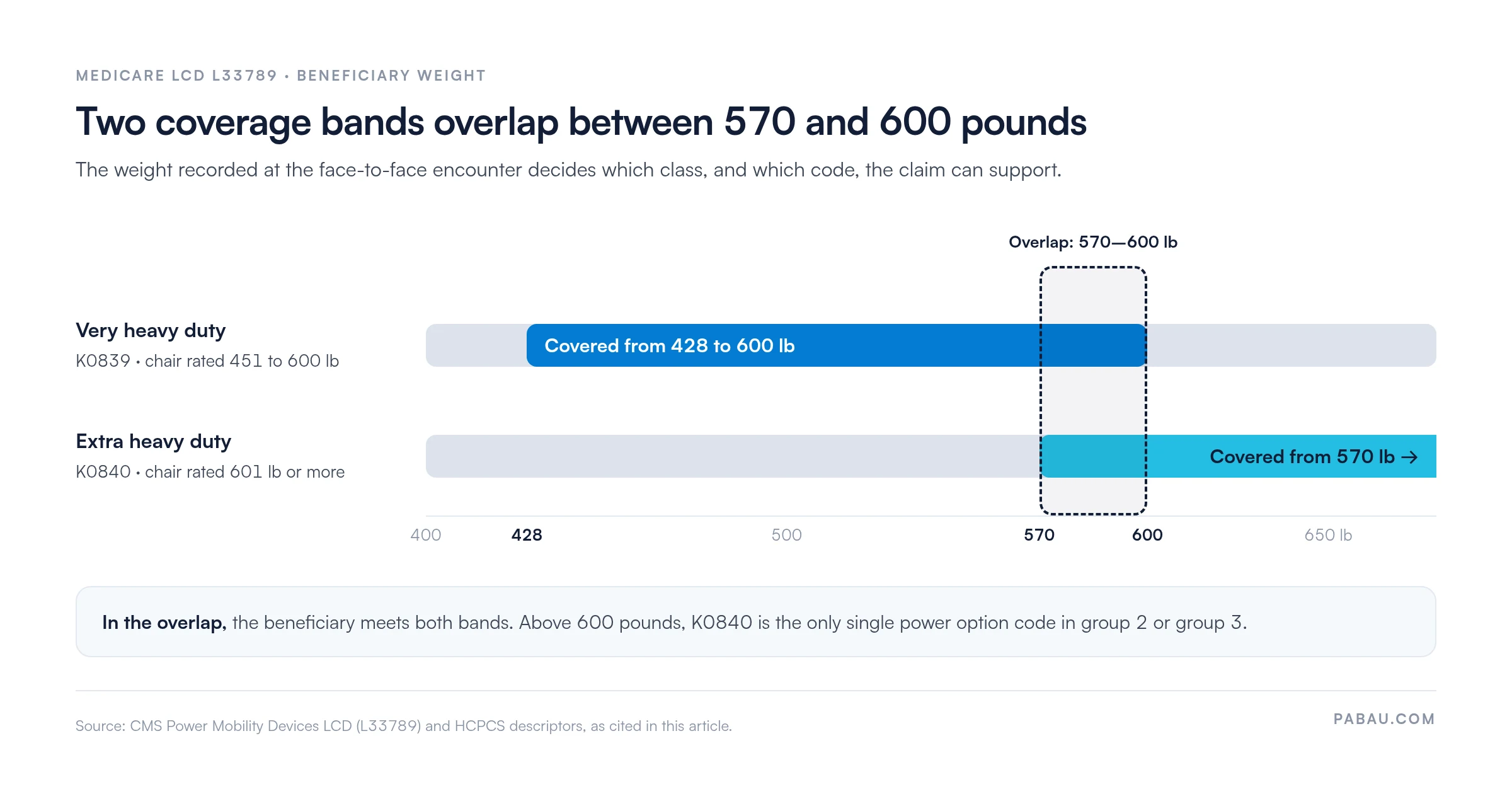
That 570-pound coverage threshold trips up intake teams. Between 570 and 600 pounds, two of the LCD’s coverage bands apply at once. The very heavy duty band covers a beneficiary weight of 428 to 600 pounds, for chairs rated 451 to 600 pounds. The extra heavy duty band covers 570 pounds or more.
A beneficiary in that overlap can qualify for K0839 or K0840, as the chart below shows. The weight recorded at the face-to-face encounter has to support the class you bill.
A beneficiary weighing 570 to 600 pounds meets both bands, so the encounter weight has to back the class you bill. Bands from the Power Mobility Devices LCD (L33789).
The power seating system itself is not part of K0840. It is billed on its own accessory code, such as E1002 for a power tilt seating system.
Medicare fee schedule and K0840 reimbursement
CMS publishes K0840 allowables in the CMS DMEPOS fee schedule, updated each year. Amounts vary by state and by rural or non-rural area, so pull the current file for the beneficiary’s location before you project payment.
Payment context
How reimbursement works
Rental, months 1 to 3
Medicare pays 15% of the purchase price each month
Rental, months 4 to 13
The monthly payment drops to 6% of the purchase price
End of the rental cap
Title passes to the beneficiary on the first day after the 13th continuous rental month
Purchase option
K0840 counts as a complex rehabilitative power wheelchair, so the supplier must offer purchase when the chair is first furnished. If the beneficiary chooses it, Medicare pays a lump sum.
Coinsurance
Medicare pays 80% of the allowable after the Part B deductible. The beneficiary owes the remaining 20%.
The purchase option exists because federal rules define a group 2 chair with power options as complex rehab equipment (42 CFR 414.202). Standard power wheelchairs lost the lump-sum purchase option in 2011, but K0840 kept it.
Medicare coverage criteria for K0840
The Power Mobility Devices LCD (L33789) sets K0840 coverage, and the DME MACs apply the same policy. The beneficiary must first meet the general power wheelchair criteria below.
A mobility limitation significantly impairs the beneficiary’s ability to take part in mobility-related activities of daily living in the home.
A properly fitted cane or walker cannot resolve the limitation safely.
The beneficiary lacks the upper extremity function to self-propel an optimally configured manual wheelchair.
A scooter is not suitable for the beneficiary or for the home.
The beneficiary has the mental and physical capabilities to operate the power wheelchair safely.
The home allows the beneficiary to maneuver the chair, given its layout, doorways, thresholds and surfaces.
The group 2 single power option criteria
K0840 then has to clear the extra criteria for group 2 single power option chairs. Each of the following must hold.
A qualifying trigger: The beneficiary needs a drive control other than a hand- or chin-operated standard joystick, such as head control or sip-and-puff. Or they meet the criteria for a power tilt or power recline system that goes on the chair.
A specialty evaluation: A PT, an OT or a practitioner trained in rehab wheelchair evaluations explains why each option is needed. That evaluator can have no financial relationship with the supplier.
A RESNA-certified ATP: The supplier employs an ATP who specializes in wheelchairs and takes part in person in selecting the chair.
The weight band: The beneficiary weighs 570 pounds or more, the LCD threshold for an extra heavy duty chair.
A chair supplied only to carry power seat elevation, power standing or power elevating legrests does not meet the trigger. Medicare denies it as not reasonable and necessary.
Face-to-face encounter and written order
K0840 is on the CMS list of items that need a face-to-face encounter and a written order prior to delivery (WOPD), effective April 17, 2023. The treating practitioner documents the encounter, and the date of that visit starts a six-month window for the standard written order.
The supplier must hold the written order before the chair is delivered. A chair delivered first is denied as not reasonable and necessary.
K0840 documentation requirements
Incomplete files drive most K0840 denials and post-payment recoupments. Each item below belongs in the beneficiary’s record before delivery. Good medical billing compliance practice treats the file as a pre-delivery checkpoint rather than a post-delivery cleanup task.
Face-to-face encounter notes: The treating practitioner’s record of the mobility limitation, the functional assessment and the beneficiary’s weight.
Standard written order: Completed within six months of the encounter and received before delivery, naming K0840 and the power seating system.
Specialty evaluation report: The evaluator’s written explanation of why the base and its power option are needed.
ATP involvement record: Proof that the RESNA-certified ATP took part in person in choosing this chair.
Home assessment: The on-site evaluation, done before or at delivery, confirming the beneficiary can maneuver the chair at home.
Prior authorization decision: The affirmed decision letter and its unique tracking number (UTN).
Proof of delivery: Signed by the beneficiary or a representative, and describing the chair that was delivered.
K0840 needs no certificate of medical necessity (CMN). CMS stopped requiring CMNs and DME information forms for claims dated January 1, 2023 or later. Medical necessity now rests on the encounter notes, the order and the evaluation reports.
Prior authorization for K0840
CMS has required prior authorization for K0840 nationwide since September 1, 2018, according to the CMS DMEPOS master list entry for K0840. A K0840 claim submitted without a prior authorization decision is denied.
Build the request: The supplier or the ordering practitioner sends the file to the DME MAC. It carries the encounter notes, the written order, the specialty evaluation and the ATP record.
Wait for the decision: The DME MAC issues an initial decision within five business days. For a valid expedited request, the DME MAC makes reasonable efforts to decide within two business days.
Resubmit a non-affirmation: The decision letter explains what is missing, and the supplier can correct the file and send it again.
Deliver within six months: An affirmed decision stays valid for six months. A chair delivered after that window needs a new request.
Bill with the UTN: The unique tracking number goes on the claim, so the DME MAC can match it to the affirmed decision.
K0840 billing guidelines and modifier requirements
Modifiers tell the DME MAC whether the coverage criteria are met and how the chair is being paid for. KX is not automatic on every K0840 claim. It goes on only when every LCD criterion is met and documented.
Modifier
Meaning
When to use it
KX
LCD coverage criteria are met
Every criterion is met and the documentation is on file
GA
Advance Beneficiary Notice (ABN) on file
Coverage criteria are not met and the beneficiary signed a valid ABN
GZ
Item expected to be denied, no ABN
Coverage criteria are not met and there is no valid ABN
GY
Statutorily noncovered
The face-to-face requirements are not met, or the chair is needed only outside the home
RR
Rental
Every monthly rental claim
KH, KI, KJ
Capped rental month
KH for month 1, KI for months 2 and 3, and KJ for months 4 to 13
BP, BR, BU
Purchase option decision
BP if the beneficiary buys, BR if they rent, BU if they have not decided after 30 days of being told both options
NU
New equipment
A new chair bought under the purchase option
Claim lines billed without a KX, GA, GY or GZ modifier are rejected as missing information. Bill each rental month on its own claim, use place of service 12 for the home, and include the UTN every time.
Common K0840 claim denial reasons and how to avoid them
Power wheelchair claims attract close audit attention from the DME MACs and the Office of Inspector General (OIG). The table below maps the most common K0840 denial reasons to their cause and fix. Reviewing denial management workflows before a claim pattern develops saves rework downstream.
Denial reason
Root cause
Corrective action
Weight not supported
The encounter notes record no weight, or a weight under 570 pounds
Record the weight at the face-to-face encounter and check it against the LCD band at intake
No qualifying trigger
The chair was supplied only for seat elevation, standing or elevating legrests
Confirm a nonstandard drive control or a qualifying tilt or recline need before ordering
Evaluation or ATP missing
No specialty evaluation, an evaluator tied to the supplier, or no in-person ATP
Hold the order until both records are on file
Delivered before the order
The supplier did not receive the written order before delivery
Release the chair only once the order is in the file
No prior authorization
The chair was delivered or billed without an affirmed decision, or the UTN is missing
Deliver only after affirmation, within six months, and put the UTN on the claim
Wrong code
K0840 billed for a chair rated under 601 pounds, or for a base with multiple power options
Match the delivered base to the descriptor before the claim goes out
Product not verified
The chair model has no PDAC coding verification for K0840
Check the model on the PDAC Product Classification List before ordering
Missing coverage modifier
No KX, GA, GY or GZ on the claim line
Make the coverage modifier a required field in your claim scrubbing rules
K0840 vs adjacent power wheelchair HCPCS codes
K0840 sits at the top of the group 2 single power option range, K0835-K0840. Nearby codes differ on three axes: weight class, power options and group. Our HCPCS codes index lists the rest of the range.
HCPCS code
Official descriptor
Key difference from K0840
K0835
Power wheelchair, group 2 standard, single power option, sling/solid seat/back, patient weight capacity up to and including 300 pounds
Same power option, standard capacity of up to 300 pounds
K0839
Power wheelchair, group 2 very heavy duty, single power option, sling/solid seat/back, patient weight capacity 451 to 600 pounds
One weight class down, at 451 to 600 pounds
K0840
Power wheelchair, group 2 extra heavy duty, single power option, sling/solid seat/back, patient weight capacity 601 pounds or more
The reference code
K0828
Power wheelchair, group 2 extra heavy duty, sling/solid seat/back, patient weight capacity 601 pounds or more
Same weight class, but the base takes no power option
K0841
Power wheelchair, group 2 standard, multiple power option, sling/solid seat/back, patient weight capacity up to and including 300 pounds
Multiple power options, standard capacity of up to 300 pounds
K0854
Power wheelchair, group 3 extra heavy duty, sling/solid seat/back, patient weight capacity 601 pounds or more
Group 3 base at the same weight class, with no power option
K0856
Power wheelchair, group 3 standard, single power option, sling/solid seat/back, patient weight capacity up to and including 300 pounds
Group 3 base with a single power option, standard capacity
K0864
Power wheelchair, group 3 extra heavy duty, multiple power option, sling/solid seat/back, patient weight capacity 601 pounds or more
Group 3 base with multiple power options at the same weight class
The K0840 and K0841 mix-up is a numbering accident. The codes sit next to each other, yet they differ on both weight class and power options. The K0841 page covers the standard multiple power option chair.
For a beneficiary over 600 pounds, K0840 is the only single power option code in group 2 or group 3. If that beneficiary needs a combined tilt and recline system, the claim moves to K0864, a group 3 base with its own coverage criteria.
Billing K0840: Step-by-step claim submission
A clean K0840 claim follows a set sequence. Skipping or reordering steps is the main reason claims reach the DME MAC with a record missing. Understanding medical billing fundamentals for DME helps billing teams see each step in context. For the claim itself, submitting a clean claim with every required field completed separates first-pass approvals from rework cycles.
Face-to-face encounter: The treating practitioner examines the beneficiary and records the mobility limitation, function and weight.
Specialty evaluation and ATP selection: An independent evaluator documents the need for the power option, and the supplier’s ATP takes part in choosing the chair.
Standard written order: The practitioner completes the order within six months of the encounter, and the supplier receives it before delivery.
Prior authorization: The request goes to the DME MAC, and the supplier records the UTN from the affirmed decision.
Purchase or rental choice: The supplier offers the purchase option and records the beneficiary’s decision for the BP, BR or BU modifier.
Home assessment and delivery: The supplier confirms the chair works in the home and collects signed proof of delivery.
Claim submission: Bill K0840 to the DME MAC with the coverage and payment modifiers, place of service 12, the UTN and the diagnosis codes. Confirm the current descriptor before billing, and use the CGS coding verification lookup tool to check PDAC requirements.
Follow-up and appeals: For a denial, read the remittance reason code and correct the specific defect. Request a redetermination within 120 calendar days of receiving the initial determination.
Pro Tip
Check three dates before every K0840 claim goes out: the face-to-face encounter, the written order and delivery. The order must fall within six months of the encounter. Delivery must follow both the order and the prior authorization decision. Catching a sequence error before billing takes minutes, while a denial takes weeks to work.
How Pabau keeps K0840 authorizations and claims in one place
A K0840 file passes through several hands: the treating practitioner, an independent evaluator, the supplier’s ATP and the DME MAC. When it lives across a spreadsheet, an inbox and a payer portal, the weight record or the tracking number is usually what goes missing.
Pabau, the practice management and billing platform we build, keeps the encounter notes, forms and claims on one patient record. It stores each prior authorization as a case, so the authorization code follows the appointment through to the claim.
Its software for cleaner claims checks each claim for missing or invalid details before it reaches the clearinghouse. A rejected claim is flagged Needs action with the reason attached, so your team fixes it once.
Keep K0840 authorizations and claims together
Pabau stores each prior authorization as a case and validates every claim before submission. Your billing team works each K0840 file from one patient record.
K0840 is easy to code once the weight is on record. It is the only single power option base for patients over 600 pounds, so the descriptor rarely leaves room for doubt.
The risk sits in the file around it. A missing weight, an evaluator tied to the supplier, or a chair delivered before the order or the authorization will undo a correct code.
So decide where those records live before the next order arrives. Keeping them beside the claim takes some setup, and it saves the resubmissions you would otherwise work all year. Book a demo to see how Pabau tracks K0840 authorizations, modifiers and claims on one record.
Continue your research
Need to understand how denials cascade into revenue loss?Denial management in healthcare covers root-cause analysis frameworks for high-denial code categories.
Want a compliance framework for your billing team?Medical billing compliance outlines the documentation and audit-readiness standards that apply to DME claims.
Looking to understand the end-to-end billing cycle?Medical billing fundamentals explains how claims move from order through payment posting.
Billing a patient between 451 and 600 pounds?HCPCS code K0839 covers the very heavy duty single power option chair one weight class down.
Need a group 3 base at the same weight class?HCPCS code K0854 explains the extra heavy duty group 3 chair with no power option.
Frequently asked questions
What does HCPCS Code K0840 cover?
HCPCS Code K0840 covers a group 2 extra heavy duty power wheelchair with a single power option and a sling/solid seat and back. It is rated for a patient weight capacity of 601 pounds or more. Medicare covers it for beneficiaries weighing 570 pounds or more.
What is the difference between K0840 and K0841?
K0840 and K0841 differ on weight class and power options. K0840 is extra heavy duty, rated for 601 pounds or more, with a single power option. K0841 is the group 2 standard chair for up to 300 pounds with a multiple power option. Both use a sling/solid seat and back.
Does K0840 require prior authorization?
Yes, K0840 has required prior authorization nationwide since September 1, 2018. The DME MAC must affirm the request before delivery, and the claim carries the unique tracking number from that decision. An affirmed decision stays valid for six months.
Is modifier KX required on every K0840 claim?
No, KX goes on a K0840 claim only when every LCD coverage criterion is met and documented. If the criteria are not met, use GA with a valid ABN or GZ without one. GY applies when the face-to-face requirements are not met. A claim line with none of these is rejected.
Does K0840 need a certificate of medical necessity?
No, K0840 needs no certificate of medical necessity. CMS stopped requiring CMNs for claims dated January 1, 2023 or later. Medical necessity rests on the face-to-face notes, the written order, the specialty evaluation and the ATP record.
Is K0840 a rental or purchase item?
K0840 is a capped rental item with a purchase option the supplier must offer when the chair is first furnished. Rental pays 15% of the purchase price for months 1 to 3 and 6% for months 4 to 13. Title then passes to the beneficiary.
What ICD-10 codes support K0840 medical necessity?
No ICD-10 code list governs K0840 coverage. The Power Mobility Devices LCD and its policy article list none, so coverage rests on the functional criteria and the beneficiary’s weight. The claim still needs the diagnosis behind the mobility limitation.
What is the Medicare reimbursement rate for K0840?
K0840 has no single national rate. CMS sets allowables by state and by rural or non-rural area in the annual DMEPOS fee schedule. Pull the current file for the beneficiary’s location before you project payment.
Who can order a power wheelchair billed under K0840?
The treating practitioner orders it, whether a physician, nurse practitioner, clinical nurse specialist or physician assistant. They conduct the face-to-face encounter and complete the standard written order within six months of it.