

CCSD code G5100: Bypass of duodenum billing guide
CCSD code G5100 bills a bypass that leaves the duodenum in place CCSD code G5100...

Last Updated: Oct 16, 2026
K0827 is the HCPCS Level II code for a power wheelchair, group 2 very heavy duty, captains chair, patient weight capacity 451 to 600 pounds. DME suppliers bill it to Medicare Part B under the DMEPOS benefit for a bariatric power wheelchair with captains chair seating.
Code selection turns on two facts in the medical record, the documented patient weight and the seat configuration. A captains chair at 301 to 450 pounds is K0825, and a sling or solid seat at 451 to 600 pounds is K0826.
Let Pabau's smart automation suggest the right codes, reduce claim denials, and keep your practice compliant—effortlessly.
Automate repetitive tasks and focus on what matters most—your patients.
Reduce coding errors and ensure compliance with the latest regulations.
Clean claims, fewer denials, and faster reimbursements.
Powerful insights and reporting to help your practice thrive.
HIPAA compliant SOC 2 certified GDPR-compliant Trusted by 4,000+ clinics worldwide

HCPCS Code K0827 covers a Group 2 very heavy duty power wheelchair with captains chair seating and a 451-600 lb weight capacity.
Medicare Part B requires a face-to-face evaluation, a Certificate of Medical Necessity, and a Detailed Written Order before a K0827 claim can be submitted.
Prior authorization is required for K0827 under the CMS Prior Authorization Program for certain DMEPOS items. Obtain it before the wheelchair is delivered.
Practice management software like Pabau keeps billing documentation with the patient record, so the paperwork behind a K0827 claim stays together.
HCPCS Code K0827 is a Healthcare Common Procedure Coding System Level II code maintained by the Centers for Medicare and Medicaid Services (CMS). It falls under the Durable Medical Equipment, Prosthetics, Orthotics, and Supplies (DMEPOS) benefit category. The official descriptor reads: Power wheelchair, group 2 very heavy duty, captains chair, patient weight capacity 451 to 600 pounds.
K0827 sits in the K0820-K0829 block of HCPCS Level II codes, which covers Group 2 power wheelchairs with no power seating option. The table below shows where K0827 fits among the adjacent codes in that block.
The weight capacity boundary decides the code. A patient weighing 301 to 450 pounds who needs a captains chair falls under K0825. Use K0827 only when the physician has documented a weight of 451 to 600 pounds. Above 600 pounds, the captains chair code becomes K0829.
Medicare Part B covers K0827 under the DME benefit when specific medical necessity criteria are met. Coverage is governed by the Power Mobility Devices Local Coverage Determination, LCD L33789. It defines what a patient must demonstrate before a bariatric power wheelchair qualifies for reimbursement.
Tracking whether each patient meets these criteria before the wheelchair is dispensed is where claims management software earns its place.
A face-to-face evaluation by the treating physician or non-physician practitioner (NPP) is required before the order is written. The evaluation must occur within six months before the initial claim date. Its documentation must support the medical necessity criteria above.
Three documents are non-negotiable for every K0827 claim. They are the Certificate of Medical Necessity (CMN), the Detailed Written Order (DWO), and the face-to-face evaluation notes. Missing any one of them is the fastest route to a denial.
Structured intake forms keep face-to-face notes aligned with what CMS requires before the order is placed. A missing element found after delivery is expensive to correct and can trigger an audit. Capturing diagnosis codes and clinical justification at the point of care keeps the documentation chain intact.
Build a K0827 documentation checklist that mirrors your MAC’s LCD criteria. Before submitting a claim, confirm the CMN is complete and signed and the DWO was on file pre-delivery. Then check the face-to-face notes fall within six months, the patient weight is documented, and PDAC verification is confirmed where required.
Prior authorization is required for K0827 under the CMS Prior Authorization Program for certain DMEPOS items. CMS expanded the program to address billing errors and overuse of power mobility devices. Before dispensing any K0827 wheelchair to a Medicare beneficiary, confirm current PA requirements with your Medicare Administrative Contractor (MAC). Rules vary by jurisdiction and change from time to time.
Checking the patient’s benefits early in the ordering process surfaces PA requirements before the equipment is ordered. That prevents the costly case of delivering ahead of authorization.
Medicare reimburses K0827 under the CMS DMEPOS fee schedule, which is updated each year. Rates vary by locality, reflecting the geographic cost index. Purchase or rental type changes the rate as well. A new purchase bills with NU, a rental with KH, KI, or KJ, and used equipment with UE. Verify current rates from the CMS DMEPOS fee schedule before quoting reimbursement amounts, because rates change each January 1.
K0827 power wheelchairs can be billed under either the capped rental or the purchase model. Under capped rental, the DME supplier bills monthly rental claims for up to 13 months. Ownership then transfers to the beneficiary, and the supplier stays responsible for maintenance and servicing during the rental period.
Outright purchase can suit a bariatric patient who uses the chair often, where rental costs across 13 months exceed the purchase price. Either way, track the rental timeline and the purchase conversion point so the correct modifier appears on every monthly claim.
The AAPC HCPCS code reference is a useful cross-check on descriptors. The CMS DMEPOS fee schedule files remain the payment source of record.
Modifiers tell Medicare how the K0827 is being furnished. Using the wrong modifier is one of the top reasons power wheelchair claims are rejected on first submission. The table below covers the modifiers most commonly applied to K0827 claims.
The KX modifier matters most. Submitting a K0827 claim without KX tells the MAC that the supplier has not confirmed the LCD criteria. Many MACs respond with automatic review or denial. KX does not guarantee payment, but it signals that the documentation is in order.
A clean K0827 claim follows a set sequence, and most billing errors start with a step taken out of order. Delivery is the hard gate. Five items must be complete before the wheelchair moves, and three steps follow it.
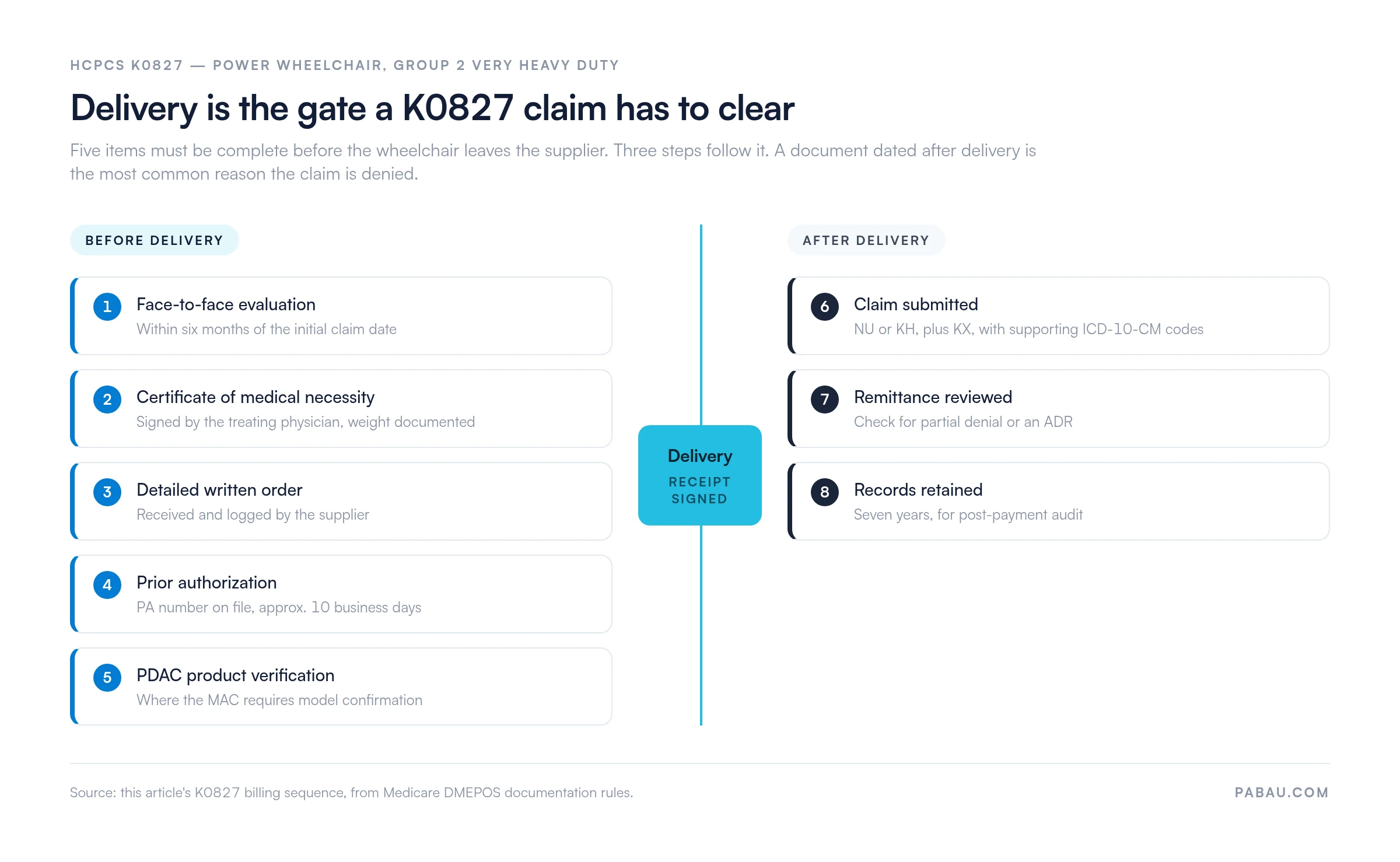
Place of service for K0827 claims is typically code 12 (home), where the patient’s home is the site of use. Confirming the POS code with your MAC before submission prevents a common rejection. Retain every supporting document for at least seven years, because a post-payment audit can look back that far.
Most K0827 denials are preventable, and they cluster into a short list of patterns. Building denial management into the pre-submission check catches them before a remittance arrives, not after.
Run a pre-submission audit on every K0827 claim against five points. The CMN is complete and signed before delivery, the DWO arrived pre-delivery, and the PA number is recorded. The KX modifier is appended, and the documented patient weight falls in the 451-600 lb band.
Most DME suppliers track a K0827 claim across three systems. The clinical notes sit in the EHR. The CMN and DWO sit in a shared drive, and the prior authorization number lives in a spreadsheet. When a MAC asks for documentation, someone has to rebuild the file by hand.
Practice management software like Pabau keeps the patient record, the uploaded forms, and the billing history in one place. Staff attach the face-to-face notes and the signed order to the patient record as they arrive. The supporting documents then sit with the claim rather than beside it.
That matters most when an additional documentation request lands months after delivery. The file is already assembled, so responding becomes a retrieval task rather than a search.

Pabau brings the patient record, signed forms, and billing history together. The documents behind a K0827 claim are ready when a payer asks for them.

HCPCS Code K0827 claims succeed when the documentation chain is built before the wheelchair leaves the supplier’s facility. Face-to-face notes, a completed CMN, a pre-delivery DWO, and a confirmed prior authorization form the record that justifies the payment. Assemble them after delivery and the appeal is already uphill.
Getting the weight band and the seat configuration right is the other half of the job. K0825, K0827, and K0829 are easy to confuse under time pressure. Book a demo to see how Pabau keeps DME billing documentation together for every claim.

Want a plain-English breakdown of how DME billing fits into the revenue cycle? What is revenue cycle management explains the end-to-end process from patient encounter to payment posting.
Need to understand how to keep DME documentation audit-ready? Medical billing compliance covers documentation retention, audit response, and compliance frameworks for healthcare practices.
Dealing with denied K0827 claims after the fact? Denial management in healthcare walks through how to categorize, track, and appeal common payer rejections.
Want the documentation trail behind a claim in one place? Superbill explains what belongs on it and how it supports the codes you bill.
Need to catch authorization requirements before you order equipment? Insurance eligibility verification walks through checking benefits ahead of the visit.
HCPCS Code K0827 is a DMEPOS billing code for a Group 2 very heavy duty power wheelchair with a captains chair. Its patient weight capacity is 451 to 600 pounds. DME suppliers use it to bill Medicare Part B and other payers for bariatric power wheelchairs in this class.
The K0827 weight capacity is 451 to 600 pounds. Patients weighing 301 to 450 pounds fall under K0825. Patients above 600 pounds require K0829. Documenting the patient’s weight in the clinical notes supports the K0827 code selection.
Yes, Medicare Part B covers K0827 under the DME benefit when the patient meets medical necessity criteria. Those criteria are a mobility limitation affecting MRADLs, a clinical need no lesser device can meet, and documented weight between 451 and 600 pounds. A face-to-face evaluation, CMN, and DWO are required before billing.
Three documents are required for every K0827 Medicare claim. They are a completed CMN signed before delivery, a DWO received by the supplier pre-delivery, and face-to-face evaluation notes from the past six months. Supporting records documenting the patient’s bariatric condition and weight are retained for audit purposes.



