

HCPCS code E0198: Water pressure pad billing guide
HCPCS code E0198 is a water pad for a standard mattress HCPCS code E0198 is the ...

Last Updated: Oct 13, 2026
K0813 is the HCPCS Level II code for power wheelchair, group 1 standard, portable, sling/solid seat and back, patient weight capacity up to and including 300 pounds.
Let Pabau's smart automation suggest the right codes, reduce claim denials, and keep your practice compliant—effortlessly.
Automate repetitive tasks and focus on what matters most—your patients.
Reduce coding errors and ensure compliance with the latest regulations.
Clean claims, fewer denials, and faster reimbursements.
Powerful insights and reporting to help your practice thrive.
HIPAA compliant SOC 2 certified GDPR-compliant Trusted by 4,000+ clinics worldwide

HCPCS code K0813 describes a power wheelchair, group 1 standard, with a sling or solid seat and back, billed under Medicare Part B.
Modifier KX is required on every K0813 claim where documentation confirms coverage criteria are met, and omitting it is the leading cause of denial.
CMS mandates prior authorization for K0813, so the supplier needs an affirmation in hand before the chair is delivered.
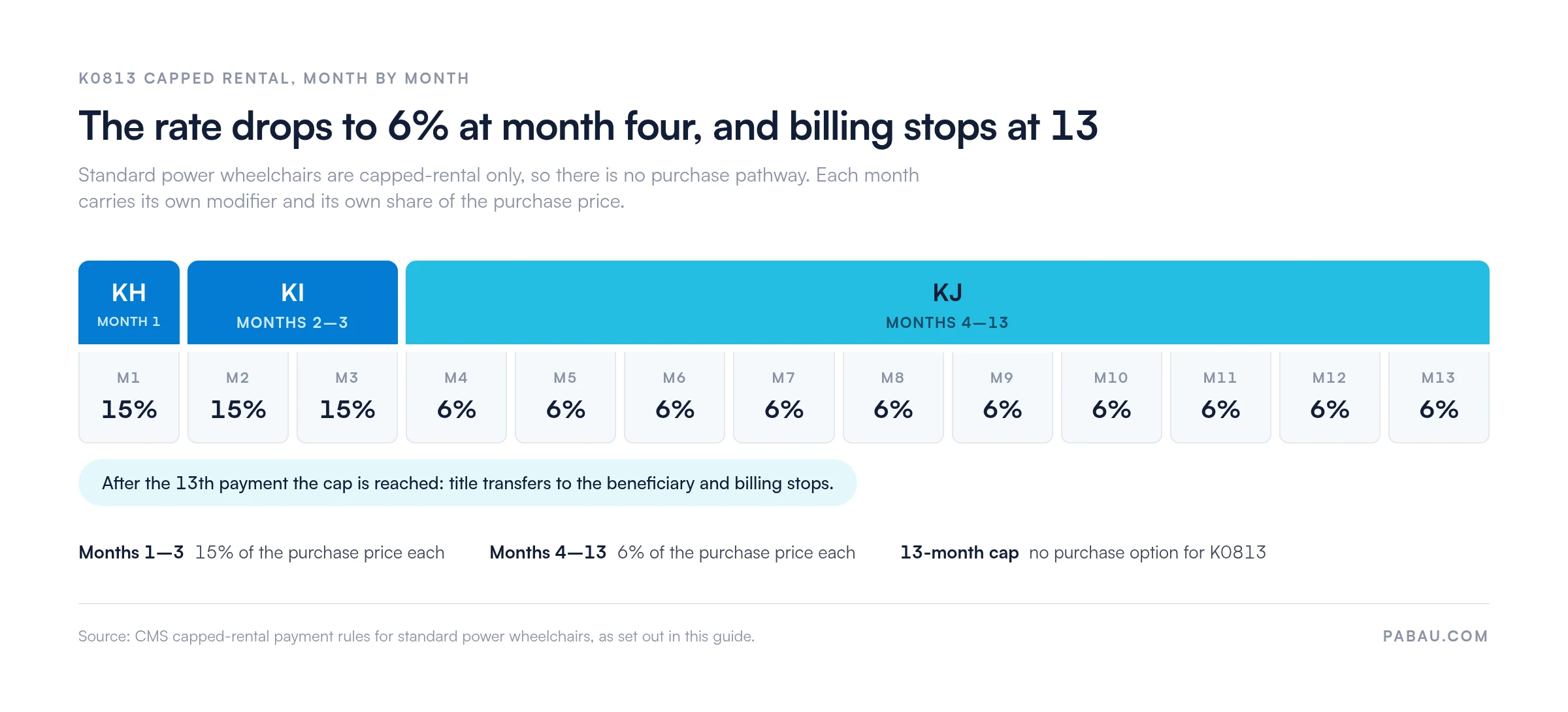
K0813 is capped-rental only, with Medicare paying 15% of the purchase price for months 1 to 3, then 6% through month 13.
Practice management software like Pabau tracks authorization status, flags missing modifiers, and submits K0813 claims through a connected clearinghouse.
K0813 is a Level II HCPCS code classified under Durable Medical Equipment (DME), specifically the power wheelchair group 1 standard category. It is a permanent national code billed under Medicare Part B by accredited DMEPOS suppliers.
K0813 covers both sling and solid seating under one code, so seat type alone never decides between it and its neighbors. The adjacent codes in the K08xx range split on portability and on group level instead. Conflating seat type with group level is how suppliers land on the wrong code.
K0813 reimbursement under Medicare Part B follows the DMEPOS Competitive Bidding Program in covered areas and the non-bid fee schedule elsewhere. Standard power wheelchairs are capped-rental items, so every payment runs through the rental schedule. There is no outright purchase pathway for this code.
Rates also differ between competitive bidding areas (CBAs) and non-bid areas. Verify current figures in the CMS DMEPOS fee schedule before submitting claims.
Rental billing uses modifier KH for the first month, KI for months 2 and 3, and KJ for months 4 through 13. After the thirteenth payment, title passes to the beneficiary and billing stops. Tracking rental months accurately is where suppliers lose revenue, through premature submission or a missed cutoff at the cap. The two payment bands and their modifiers line up like this.
Coverage for K0813 is governed by CMS LCD L33789 (Power Mobility Devices), administered by the DMEPOS Medicare Administrative Contractor (MAC) for the supplier’s jurisdiction. Suppliers should confirm the applicable LCD with their MAC, because policies vary slightly. The core criteria apply broadly across jurisdictions.
To qualify for K0813 coverage, the patient must meet all of the following conditions:
Group 1 designation means the chair meets the base functional and durability specifications under CMS classification. K0813 covers the portable standard configuration with a sling or solid seat and back, capped at 300 pounds. Chairs built for a higher patient weight are not Group 1 at all.
Those heavy-duty tiers sit in the Group 2 range, K0824 through K0829. Documentation that runs unbroken from the face-to-face examination to the delivery receipt is what protects a K0813 claim from an LCD-based denial.
Under 42 CFR 410.38 and CMS LCD L33789, a face-to-face examination is mandatory before a power wheelchair order can be written. The treating physician or a non-physician practitioner (NPP) performs it. The exam must occur within 45 days before the written order date.
Incomplete documentation is the primary reason K0813 claims fail post-payment audits. CMS requires the supplier to hold specific documents on file before delivery, and to retain them for audit purposes. The written order is the first of those documents, and the one most often returned incomplete.
A 7-element order is required for every DMEPOS item that needs a written order prior to delivery. For K0813, the supplier cannot bill Medicare without this order on file. The treating physician or NPP completes it, and the supplier must receive it before the chair is delivered.
Missing even one of the seven elements gives the MAC grounds to deny the claim and to recoup payment on audit. A standardized order form that prompts for each element in turn is the cheapest fix available.
CMS operates a mandatory prior authorization (PA) program for certain DMEPOS items, and power wheelchairs including K0813 are on that list. This is a federal requirement for traditional Medicare, separate from any PA rules imposed by individual Medicare Advantage plans.
Confirming which payer is primary before the chair is ordered saves a resubmission later, because each payer runs its own authorization process. The key steps in the CMS PA process for K0813 are:
Delivering before PA is received does not automatically result in denial, but it removes the protection that an affirmation provides. CMS can and does deny claims where PA was not sought before delivery and the documentation is later found insufficient at audit.
Modifier selection is where K0813 claims most frequently go wrong. Each modifier signals a specific coverage or documentation status to the MAC, and every claim line needs the right one. The table below covers the modifiers that apply to K0813 claims.
Modifier decision rule: If documentation is complete and criteria are met, bill KX. If documentation is incomplete and an ABN was obtained, bill GA. Never bill KX and GA together on the same line.
If documentation cannot support coverage, bill GY or GZ depending on whether an ABN exists. When in doubt, check your MAC’s published billing article, as requirements vary by jurisdiction. See the CGS Medicare coding verification guidance for jurisdiction-specific requirements.
Audit your K0813 claims monthly: filter by denial reason code and sort by modifier. If you see a pattern of KX-missing denials, the issue is upstream, typically in the order intake process, not the billing department. Fix the intake checklist rather than training billers to catch what the intake team missed.
Selecting the wrong code in the K08xx group is either upcoding or downcoding, and both carry compliance risk. The most common confusion is between K0813 and K0823, the Group 2 standard captain’s chair code.
K0800 trips suppliers up for a different reason. It is a power operated vehicle, a scooter, and not a power wheelchair at all. Group assignment is determined by the chair’s CMS functional classification, not by price or perceived quality.
Every power wheelchair code in this table caps at 300 pounds, so weight capacity never decides between them. The variables that matter are the group, the seat and back type, and whether the base is portable.
Group 1 versus Group 2 classification rests on the chair’s technical specifications and the clinical need documented in the face-to-face exam.
Billing K0823 when a Group 1 chair was delivered, or the reverse, is incorrect regardless of the supplier’s intent. Base code selection on the product’s PDAC coding verification and the treating physician’s documented clinical assessment.
Read the product identifier off the packaging rather than the chart note. An implant billed under HCPCS code J7313 takes its NDC from the carton, reported as 68611-0190-02 in 11-digit format.
K0813 sits inside the K0813-K0816 block of Group 1 standard power wheelchair codes. All four cap at 300 pounds and differ only by seat/back type and portability. The Group 2 standard codes, K0820 through K0823, repeat that same four-way split at a higher functional specification.
None of these eight codes vary by patient weight capacity. The heavy-duty tiers begin at K0824 in the Group 2 range. Heavy duty covers 301 to 450 pounds, very heavy duty covers 451 to 600 pounds, and extra heavy duty covers 601 pounds and above.
K0813 denials follow predictable patterns. Knowing which reason is most common, and which missing document triggers it, turns a denial log into a prevention checklist. Structured revenue cycle management catches these errors before submission, which matters most on a high-dollar DME item.
Remittance advice returns CARC and RARC codes rather than plain English. Our reference on denial codes for billers explains what each one means, which shortens the appeal on a K0813 claim.
K0813 claims fail more often than most DMEPOS codes. The document checklist is long, prior authorization is a hard stop before delivery, and the modifier rules leave no margin. Tracking those variables by hand, across many patients and payers, is where errors accumulate.
Practice management software like Pabau pulls those threads together. Pabau’s claims tools for practices connect documentation, modifier validation, and claim submission in one workflow.
For a supplier handling power wheelchair claims, that means authorization status sits against each patient record, and modifier requirements surface before the claim goes out.
Electronic remittance data lands next to the original documentation, so denial codes map back to open claims without a manual match. Appeals get faster, and audit preparation stops being a filing exercise.

Pabau’s claims management software tracks prior authorization status and flags missing modifiers before submission. Claims route through a connected clearinghouse, so K0813 reaches Medicare clean and on time.

K0813 is a simple code wrapped in a demanding workflow. Denials cluster upstream, in incomplete 7-element orders, missing KX modifiers, and chairs delivered before an affirmation arrives. Repair the intake and order steps, and most of the billing trouble disappears with them.
The trade-off worth remembering is timing. An hour spent verifying the order before delivery is cheaper than the same hour spent appealing after the chair has left the warehouse. Book a demo to see how Pabau keeps DME documentation, authorization status, and claim submission in one place.

Need a system for working denials instead of reacting to them? Denial management in healthcare sets out how to triage, appeal, and prevent the denials that follow high-dollar DME claims.
Want to understand how clearinghouses validate DME claims? Claim.MD clearinghouse covers how electronic claim submission reduces manual errors for Medicare Part B billing.
Looking to reduce coding errors across your billing team? Medical billing compliance outlines the documentation and process standards that protect DMEPOS suppliers during post-payment audits.
New to the billing process end to end? What is medical billing walks through each stage, from patient intake to posted payment.
Want fewer claims coming back at all? Clean claim explains what payers check on first pass, and how to clear those checks before you submit.
K0813 is a Level II HCPCS code for a power wheelchair, group 1 standard, with sling or solid seat and back. It applies to patients who qualify under the power mobility device benefit. Under Medicare Part B, accredited DMEPOS suppliers bill it for chairs that meet the Group 1 standard classification in CMS LCD L33789.
The patient must have a severe mobility limitation that prevents adequate function with less costly alternatives. That limitation must affect mobility-related activities of daily living in the home, and the home must accommodate the chair. The treating physician or NPP must also document a face-to-face examination within 45 days before the order date. All criteria are governed by LCD L33789.
Modifier KX is required on all K0813 claims where documentation confirms coverage criteria are met. Rental claims additionally require KH (month 1), KI (months 2 and 3), or KJ (months 4 through 13). If an ABN is on file for a non-covered claim, use GA instead of KX. Never combine KX and GA on the same claim line.
Yes. CMS requires prior authorization for K0813 under the mandatory DMEPOS PA program for traditional Medicare. The supplier must submit the PA request to the DMEPOS MAC before delivering the chair. Most Medicare Advantage plans have their own separate PA requirements that may differ from the CMS program. Always verify with the specific plan before proceeding.
K0813 is a capped-rental item, so Medicare does not pay for it as an outright purchase. The allowable is 15% of the purchase price for each of months 1 to 3, then 6% for each of months 4 to 13. Once the thirteenth payment is made, title transfers to the beneficiary and billing stops.
K0813 is a Group 1 standard power wheelchair: portable, with a sling or solid seat and back. K0823 is a Group 2 standard chair with a captain’s chair seat on a non-portable base. The closest Group 2 match to K0813 is K0820, not K0823. Group 2 chairs meet higher technical and functional specifications than Group 1. Billing K0823 when the chair and patient documentation only support Group 1 is upcoding.
A 7-element order is the written order a supplier must hold before delivering a K0813 chair. It carries the beneficiary’s name, a description of the item, and the date of the face-to-face examination. It also carries the diagnosis supporting the need, the length of need, the physician’s signature, and the date of that signature. Any missing element gives the MAC grounds to deny the claim.



