CPT code 21011: Excision of soft tissue tumor of the face
CPT code 21011: Official descriptor and procedure overview CPT code 21011, as pu...

Last Updated: Oct 8, 2026
K0825 is the HCPCS Level II code for power wheelchair, group 2 heavy duty, captains chair, patient weight capacity 301 to 450 pounds.
The code sits in the temporary national K-series, which covers durable medical equipment with no permanent E-code assignment.
Group 2 power wheelchairs suit patients who need more capability than a group 1 chair offers. They do not need the rehabilitation electronics of a group 3 or higher device. The heavy duty designation means the frame and drive system are rated for occupants weighing 301 to 450 pounds.
Weight capacity is a clinical specification, not a coverage test on its own. Medicare requires a full functional assessment whatever the patient weighs.
Let Pabau's smart automation suggest the right codes, reduce claim denials, and keep your practice compliant—effortlessly.
Automate repetitive tasks and focus on what matters most—your patients.
Reduce coding errors and ensure compliance with the latest regulations.
Clean claims, fewer denials, and faster reimbursements.
Powerful insights and reporting to help your practice thrive.
HIPAA compliant SOC 2 certified GDPR-compliant Trusted by 4,000+ clinics worldwide

HCPCS Code K0825 describes a power wheelchair, group 2 heavy duty, captains chair, for patients weighing 301 to 450 pounds.
Medicare coverage runs under LCD L33789 and requires a face-to-face evaluation plus a signed written order before the device is dispensed.
Prior authorization for K0825 has been required in every DME MAC jurisdiction since September 1, 2018.
K0825 is a capped-rental item, so Medicare pays it over 13 months rather than as an outright purchase.
Pabau’s claims management software helps DMEPOS suppliers track prior authorization status, attach documentation, and submit clean K0825 claims.
Coverage for K0825 falls under LCD L33789 (Power Mobility Devices), administered by the Durable Medical Equipment Medicare Administrative Contractors (DME MACs).
Meeting the weight threshold alone is not sufficient. CMS requires that the patient show a mobility limitation that significantly impairs mobility-related activities of daily living (MRADLs) in the home.
Under LCD L33789, all of the following criteria must be met for K0825 coverage to apply:
Clinical indications that commonly support K0825 claims include hemiplegia, muscular dystrophy, multiple sclerosis, Parkinson’s disease, and severe arthritis of the lower extremities. Weight does not establish medical necessity by itself. The patient’s inability to use a lighter mobility device has to be documented separately.
Prior authorization is required for every K0825 claim. CMS added K0825 to its Required Prior Authorization List effective September 1, 2018, and the requirement applies in all DME MAC jurisdictions.
The earlier jurisdiction-based demonstration ended that year, so the requirement no longer varies by contractor. Completing insurance eligibility verification before you order the device still prevents rejections further downstream.
CMS publishes the current code list and the submission timelines on its prior authorization page for DMEPOS items.
Run a monthly audit of open K0825 claims flagged for prior authorization. An affirmation decision has a validity window, and a claim filed after it lapses is denied. Tracking PA status in your practice management system removes that write-off.
Incomplete documentation is the leading cause of K0825 denials. Under CMS guidance and the DME MAC policy articles that accompany LCD L33789, a compliant K0825 claim carries all of the following.
Build this list into your order intake workflow. Catching a missing element before the chair ships costs minutes. Reconstructing the same records during a post-payment audit costs weeks.
Flag every K0825 order for a documentation review before the device is dispensed. Missing a signature on the written order can trigger a full denial, even when the clinical case is solid. Build a pre-dispense checklist into your DMEPOS intake process.
Medicare pays K0825 under the DMEPOS fee schedule, which CMS updates annually. Rates differ depending on whether the supplier sits in a Competitive Bidding Program (CBP) area.
Pull the current allowed amount for your geography from the CMS DMEPOS fee schedule files rather than a third-party aggregator.
The capped-rental rule shapes the cash-flow picture for suppliers. Medicare pays 80% of the monthly rental allowance after the deductible, and the beneficiary or a secondary payer covers the other 20%. Ownership passes to the patient once the 13th continuous month is paid.
That schedule also stretches the audit window. A documentation problem found in month eight puts both the paid rentals and the remaining ones at risk.
Every K0825 claim needs an ICD-10-CM diagnosis code that establishes medical necessity under LCD L33789. The diagnosis has to describe a condition causing a mobility limitation, not the patient’s weight. Each diagnosis below has its own entry in our ICD-10-CM code library, with the full descriptor and billing notes.
Do not list diagnosis codes speculatively. The ICD-10-CM codes on the claim must match what the treating physician documented. A code absent from the LCD L33789 policy article can draw an automatic denial however strong the clinical case is.
Submitting a K0825 claim takes more than attaching the right code. DMEPOS suppliers have to meet CMS enrollment standards and follow the billing protocols set out in 42 CFR Part 414.
Scrub K0825 claims for formatting errors before they reach the MAC. A clean first submission beats any appeal on speed, and it keeps the 13-month rental clock running on schedule.
Retain the detailed written order, the face-to-face evaluation notes, and the prior authorization decision letter. CMS audits power wheelchair claims after payment, and a missing record leads to a recoupment demand.
Picking the wrong K-code for a power wheelchair claim is a common and costly mistake. The K-series separates group 2 chairs by duty tier and weight capacity, by seat type, and by power option. All three are code-defining, so all three have to match the dispensed device.
The grid below places the group 2 codes this article touches on the two axes that trip billers up most.
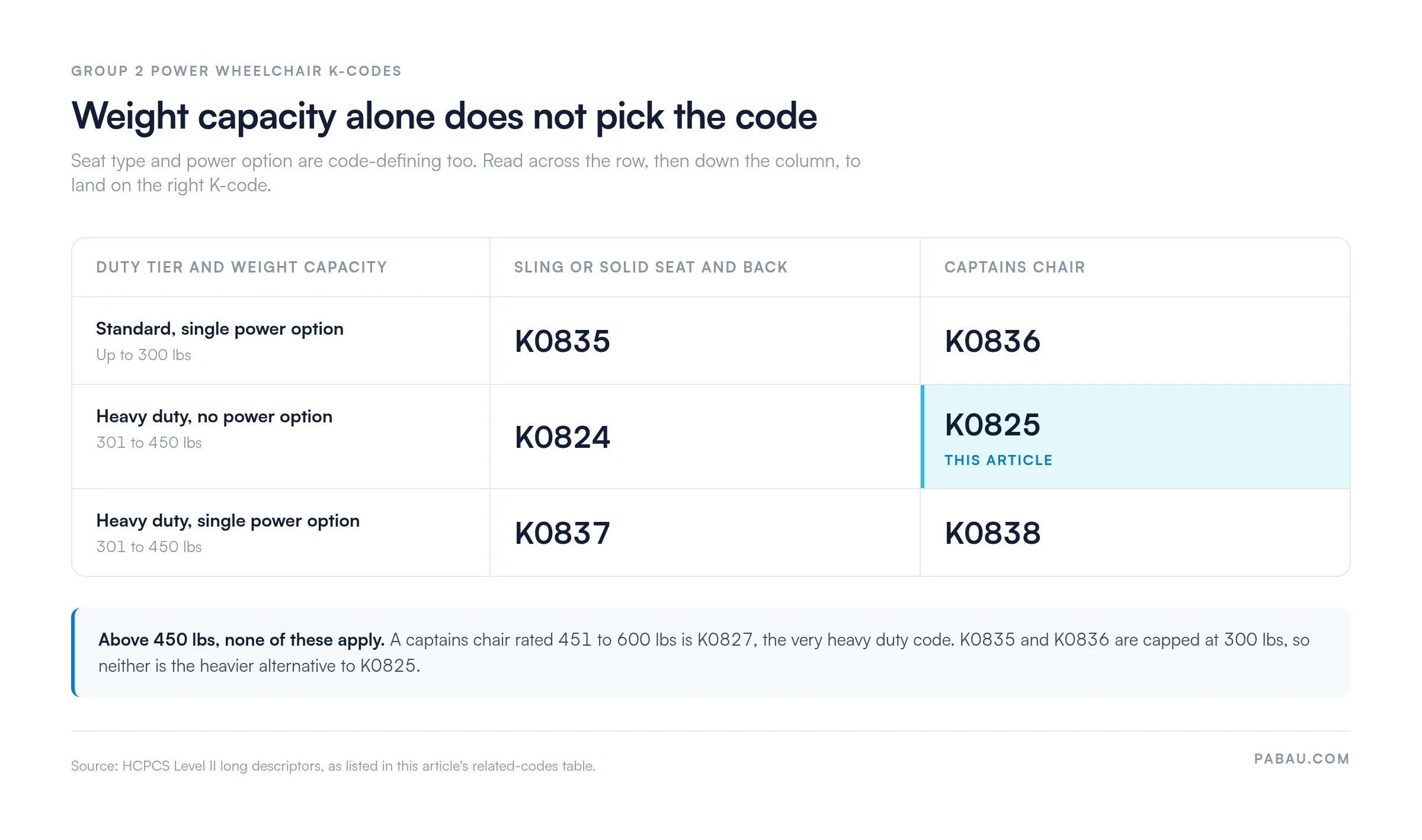
Read the long descriptor before you submit, never the short one. The short description squeezes the duty tier and the seat type into five words, and that is where the wrong code gets picked. Verify the current descriptor against the AAPC HCPCS code lookup.
K0835 is not the heavier version of K0825. K0825 covers a heavy duty captains chair for 301 to 450 pounds with no power seating option. K0835 covers a group 2 standard chair with a sling or solid seat, a single power option, and a 300 pound limit.
The step up from K0825 on weight is K0827, which covers a captains chair rated 451 to 600 pounds. Billing K0825 for a patient weighing 460 pounds mismatches the descriptor and generates a denial.
K0838 is the closest code to K0825 on paper. It shares the duty tier, the weight range, and the captains chair, and differs only by its single power option.
Power wheelchair claims generate more paperwork than almost any other DME category. A single K0825 order carries a prior authorization decision, a written order, an evaluation note, and a product description. Keeping those records across paper files and disconnected spreadsheets is where most DMEPOS billing errors start.
Purpose-built claims management software centralizes the workflow for K-code claims. Practice management software like Pabau lets DMEPOS suppliers attach the prior authorization decision straight to the patient file. You can flag a missing document before submission and route the claim through a clearinghouse for scrubbing.
The result is fewer first-pass rejections and less time spent on appeals. It also means an auditor’s request for the K0825 file becomes a search rather than a scavenger hunt.

Pabau lets DMEPOS suppliers attach prior authorization decisions and track documentation status in one place. Submit K-code claims without switching between systems.

The expensive mistakes on K0825 happen before the claim is filed. A chair dispensed without an affirmed prior authorization, or against a written order nobody signed, is a write-off waiting to be found. Neither problem can be fixed after the device leaves the warehouse.
The capped-rental schedule is the part worth remembering. K0825 pays over 13 months. A documentation problem surfacing in month eight can cost you the rentals already paid and the ones still to come. Front-loading the checks protects the whole payment stream, not just the first claim.
Pabau keeps the prior authorization decision, the written order, and the evaluation note on the same patient record as the claim. Book a demo to see how that shortens a DMEPOS audit response from weeks to an afternoon.

Need to understand how the claims process works end-to-end? Medical billing workflows explained walks through the full revenue cycle from patient encounter to payment.
Want to reduce claim rejections before they happen? Clean claim submission best practices covers the pre-submission checks that prevent the most common DMEPOS denial triggers.
Dealing with post-payment audit pressure? Denial management in healthcare covers how to build a systematic appeal and prevention process for DME claims.
K0825 covers a power wheelchair, group 2 heavy duty, captains chair, for patients weighing 301 to 450 pounds. Coverage requires documented medical necessity under LCD L33789, including a mobility-limiting diagnosis and a face-to-face physician evaluation.
Yes, in every DME MAC jurisdiction. CMS added K0825 to its Required Prior Authorization List effective September 1, 2018, so the requirement is nationwide. Medicare Advantage plans set their own rules, so check with the plan before ordering.
A K0825 claim needs a face-to-face evaluation, a signed detailed written order, and a detailed product description confirming the captains chair and heavy duty frame. Add proof of the weight capacity need and home assessment notes. Some DME MACs also require a CMN.
K0825 is a heavy duty captains chair for 301 to 450 pounds with no power seating option. K0835 is a group 2 standard chair with a sling or solid seat, a single power option, and a 300 pound limit. The 451 to 600 pound captains chair code is K0827.
Medicare treats K0825 as a capped-rental item. Standard power wheelchairs from K0813 to K0831 are rented over 13 months of continuous need rather than bought outright. Title passes to the beneficiary once the 13th rental month is paid.
Codes cited most often include G81.90 (hemiplegia), G71.00 (muscular dystrophy), G35 (multiple sclerosis), G20 (Parkinson’s disease), and G82.50 (quadriplegia). The diagnosis has to describe a mobility-limiting condition. Patient weight alone does not establish medical necessity under LCD L33789.
Medicare Advantage plans may cover K0825, but their prior authorization rules, documentation standards, and coverage criteria often differ from traditional Medicare. Contact the plan before ordering the device to confirm what it needs.