CPT code 21011: Excision of soft tissue tumor of the face
CPT code 21011: Official descriptor and procedure overview CPT code 21011, as pu...

Last Updated: Oct 8, 2026
Billable Code Specific Code
K0820 is the HCPCS Level II code for a power wheelchair, group 2 standard, portable, with a sling/solid seat and back. The official descriptor sets a patient weight capacity up to and including 300 pounds. Medicare Part B covers it as durable medical equipment when a manual wheelchair or group 1 device will not meet the patient's needs at home.
Suppliers bill K0820 as a capped rental, one unit per month with modifier RR, for up to 13 months. Ownership then transfers to the beneficiary. Prior authorization must be in place before delivery.
Let Pabau's smart automation suggest the right codes, reduce claim denials, and keep your practice compliant—effortlessly.
Automate repetitive tasks and focus on what matters most—your patients.
Reduce coding errors and ensure compliance with the latest regulations.
Clean claims, fewer denials, and faster reimbursements.
Powerful insights and reporting to help your practice thrive.
HIPAA compliant SOC 2 certified GDPR-compliant Trusted by 4,000+ clinics worldwide

HCPCS Code K0820 describes a group 2, standard, portable power wheelchair with sling/solid seat and back, billed to Medicare Part B as DME.
Coverage turns on a documented mobility limitation in the home, a face-to-face exam, and a Standard Written Order signed before delivery.
Prior authorization applies to K0820, so the supplier needs a provisional affirmation from the MAC before the chair is delivered.
Medicare pays K0820 as a capped rental, one unit per month with modifier RR, until ownership transfers after month 13.
Practice management software like Pabau tracks the rental months and keeps the documentation attached to the patient record.
HCPCS Code K0820 is the Level II alphanumeric code for a power wheelchair, group 2 standard, portable, with a sling/solid seat and back. The Centers for Medicare and Medicaid Services (CMS) maintains it, and the descriptor caps patient weight capacity at 300 pounds. The K-series of HCPCS codes covers power mobility devices (PMDs) and accessories, which Medicare Part B pays for as durable medical equipment. K0820 applies to base power wheelchairs that meet group 2 performance criteria, which separates them from group 1 and group 3 devices.
The “standard, portable” designation indicates the chair meets specific weight, dimensions, and drive system characteristics as defined in CMS coverage policy. The “sling/solid seat and back” descriptor identifies the seating system included with the base device. That affects how billers code accessories and options separately when suppliers add them.
Medicare Part B covers HCPCS Code K0820 when the beneficiary meets documented medical necessity criteria. Coverage is not automatic based on diagnosis alone. All four DME MACs apply the same Local Coverage Determination to power mobility devices, LCD L33789. It sets the qualifying conditions and functional requirements a claim has to satisfy.
A group 2 power wheelchair requires a mobility limitation that prevents safe self-propulsion at home. A manual wheelchair or a group 1 PMD has to be inadequate for the patient. The key coverage requirements are:
Conditions commonly associated with K0820 coverage include ALS, multiple sclerosis, muscular dystrophy, and severe rheumatoid arthritis. Spinal cord injury and other neuromuscular diseases causing significant lower-extremity weakness also qualify. Documented function determines coverage, not the diagnosis code alone.
Read LCD L33789 alongside its Local Coverage Article before you submit. The LCD carries the coverage criteria, while the article carries the coding and documentation detail, including the diagnosis codes that support medical necessity. Most medical necessity denials trace back to something in the article rather than the LCD itself.
CMS requires prior authorization for HCPCS Code K0820 under its Prior Authorization for Power Mobility Devices program. CMS expanded this program nationally, so suppliers need an approval decision before delivering the wheelchair. Confirming the beneficiary’s eligibility and the prior authorization status before the delivery date is what prevents a non-covered write-off on an expensive rental.
The prior authorization submission must include the full documentation package. CMS issues a provisional affirmation or non-affirmation before delivery. Key steps in the process:
Delivering without a provisional affirmation does not trigger an automatic denial under current CMS rules. The MAC flags those claims for pre-payment review instead, which delays payment on every rental month that follows. Confirm the submission portal with your MAC, whether that is Noridian, CGS, Palmetto, or another jurisdiction.
Incomplete documentation is the most common barrier to K0820 reimbursement. CMS requires a specific set of records to exist before the claim is submitted. Meeting medical billing compliance requirements for a DME power wheelchair claim means assembling all of the following elements:
Sequence matters as much as contents. Two of these records are dated against each other, so a claim fails review when the dates run in the wrong order.
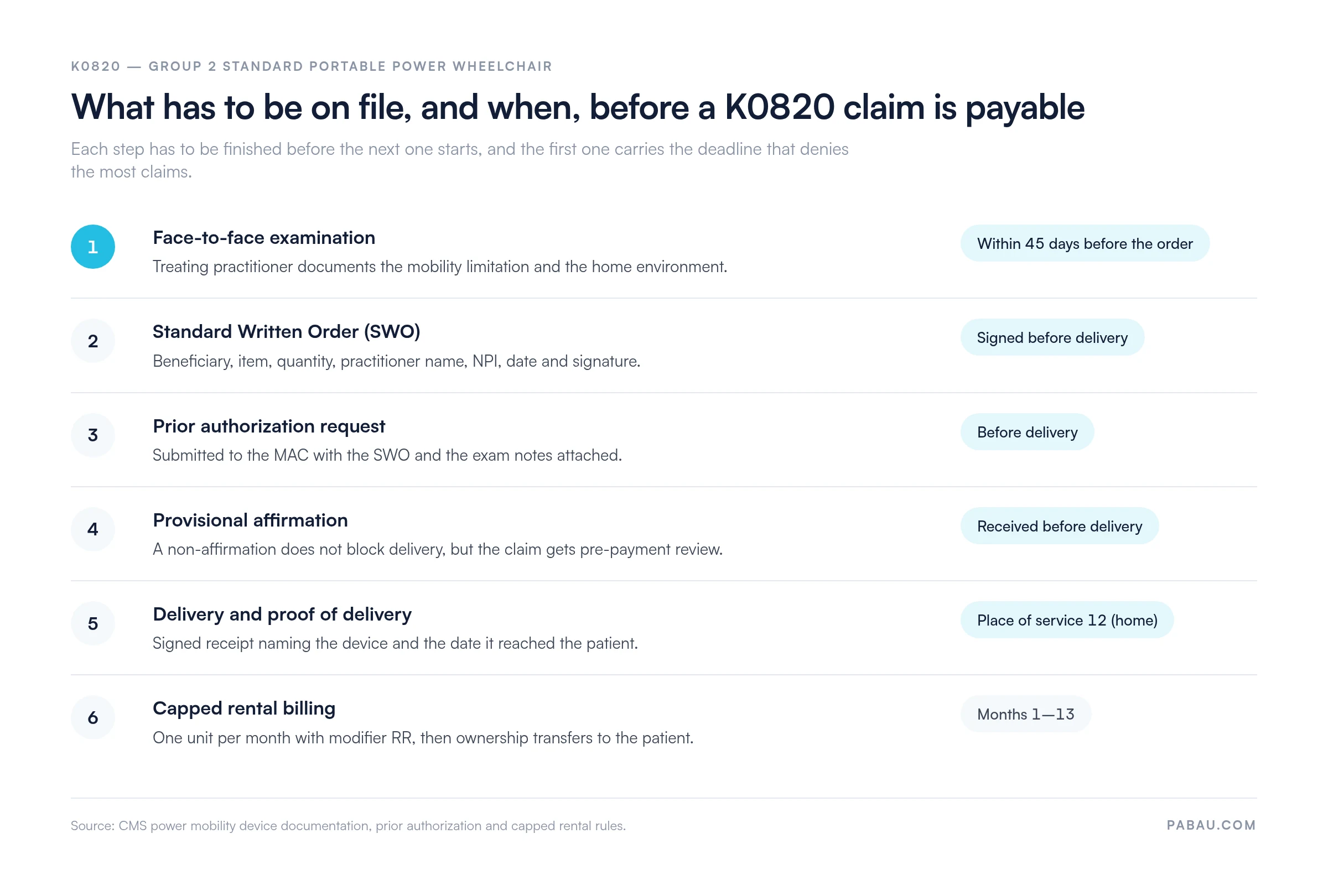
Cross-reference every element against the claim before it leaves the building. CMS frequently audits missing or unsigned documentation under its Targeted Probe and Educate (TPE) reviews for power wheelchair claims.
Medicare reimburses HCPCS Code K0820 under a capped rental payment methodology. The beneficiary rents the wheelchair for up to 13 months, after which ownership transfers to the patient. Monthly rental payments run from month 1 through month 13. Once the rental reaches its cap, the supplier covers maintenance and repairs for the rest of the device’s reasonable useful lifetime. That is generally five years.
The Medicare DMEPOS fee schedule sets K0820 rates, which vary by geographic location and MAC jurisdiction. The payment amount also depends on whether the supplier sits inside a competitive bidding area. CMS adjusts rates annually. To retrieve the current amount for your jurisdiction, use the CMS DMEPOS fee schedule files. The physician fee schedule does not price durable medical equipment. Always check third-party rate figures against the current official file before billing.
Suppliers should also read the electronic remittance advice on each monthly rental claim. Those files carry the exact payment amounts, adjustment codes, and denial reasons the billing team needs to reconcile payments and spot underpayments.
A K0820 claim has to reflect the rental month, the correct modifier, and the place of service. With software for DME suppliers, billing teams can track rental cycles, attach the documentation to the patient record, and submit through the appropriate clearinghouse. The standard billing process follows these steps:
Power wheelchair claims are among the most audited DME categories, and the same handful of mistakes account for most of the denials. The most frequent errors are:
Read the denial reason codes on K0820 remittances alongside the documentation file. The pattern shows which record keeps going missing, well before the write-offs accumulate.
ICD-10 diagnosis codes submitted on a K0820 claim must reflect conditions documented in the patient’s medical record. The diagnosis code alone does not guarantee coverage. The treating practitioner’s notes have to connect the diagnosis to the functional mobility limitation that requires a group 2 power wheelchair.
These ICD-10 codes are commonly paired with HCPCS Code K0820 claims. Medicare contractors recognize each of the conditions below as supporting power wheelchair medical necessity:
Verify the accepted diagnosis codes against the current Local Coverage Article before submission, because that list is revised periodically. If a code needs checking, our ICD-10-CM code reference carries the official descriptor and the notes that govern how each one is assigned.
K0820 is one of several K-series codes covering power mobility devices across groups, performance tiers, and seating configurations. The right code depends on the device’s group classification, portability, weight capacity, and whether it includes a power seating option. Billing the wrong code in the series is a common audit trigger. The table below covers the codes most often confused with K0820:
The AAPC HCPCS code lookup and the CMS HCPCS overview page both give searchable access to the full K-series descriptors. Both are updated annually.
When a beneficiary moves from a group 1 device to a group 2 power wheelchair, the supplier needs a fresh prior authorization. A new Standard Written Order is required before billing K0820. The change in group classification starts a new rental cycle, so the months already billed on the old device do not carry across.
Most DME suppliers track K0820 rental months in a spreadsheet. The prior authorization letters sit in a shared drive, and the exam notes stay in the patient chart. By month seven, confirming that a claim is still supported means reconciling three separate systems.
Pabau keeps the sequence in one record. The face-to-face notes, the Standard Written Order, the prior authorization response, and the signed proof of delivery all attach to the patient. Every rental month then bills against that same file. Pabau’s claims management tools then track submission and remittance, so the team can see which months were paid and which are still open.
That visibility is what protects the margin on a 13-month rental. A missing document shows up before the claim goes out, rather than after the remittance comes back short.

Pabau stores the exam notes, the Standard Written Order, and the prior authorization response against the patient record. It then tracks each K0820 rental month through to payment. Your billing team sees what is missing before the claim goes out.

K0820 is a 13-month commitment rather than a single transaction. The records that make month one payable are the same ones a reviewer asks for in month twelve. Build the file properly once and it holds.
Order is the part suppliers underestimate. Get the face-to-face exam, the Standard Written Order, and the prior authorization in the right sequence, and the rest of the rental cycle is administration. Get the dates out of order and no amount of appeal correspondence repairs it. Book a demo to see how Pabau tracks K0820 documentation and rental months for DME suppliers.

Need to understand how DME denials are structured? Denial codes in medical billing explains the most common CARC and RARC codes that affect DME power wheelchair claims.
Want to improve your claim submission accuracy? What makes a clean claim covers the elements every DME claim needs to pass first-pass adjudication.
Looking to streamline your broader billing cycle? Revenue cycle management explained walks through the end-to-end process from eligibility check to payment posting.
HCPCS Code K0820 is the Medicare Part B code for a power wheelchair, group 2 standard, portable, with a sling/solid seat and back. DME suppliers bill it when they deliver a group 2 power wheelchair to a beneficiary who meets the documented medical necessity criteria.
Medicare covers K0820 when the patient has a documented mobility-limiting condition that prevents safe use of a manual wheelchair or group 1 PMD at home. The patient must also be able to operate a power wheelchair safely. A qualified treating practitioner has to complete a face-to-face examination and a Standard Written Order. LCD L33789 and its Local Coverage Article set the specific diagnosis and functional requirements.
Yes, prior authorization is required for K0820 under CMS’s Prior Authorization for Power Mobility Devices program. The supplier must submit documentation to the MAC and receive a provisional affirmation before delivering the wheelchair to avoid heightened post-payment audit risk.
Commonly paired ICD-10 codes include G35 (multiple sclerosis), G12.21 (ALS), G71.00 (muscular dystrophy), M05.79 (rheumatoid arthritis with significant functional limitation), and G82.50 (quadriplegia). The Local Coverage Article for power mobility devices specifies the accepted diagnosis list. Coverage still depends on documented functional mobility limitations, not on the diagnosis code alone.