HCPCS code L0638: Custom fabricated LSO billing guide
HCPCS code L0638 is a brace built for one patient HCPCS code L0638 is the Level ...

Last Updated: Nov 2, 2026
K0812 is the HCPCS Level II code for a power operated vehicle, not otherwise classified. It covers a POV that meets Medicare's POV requirements and has a PDAC coding verification, but fits no specific group 1 or group 2 code.
A device with no PDAC verification is billed as K0899 instead. Medicare coverage under LCD L33789 also needs a face-to-face exam, a written order before delivery and the right modifier on the claim.
Let Pabau's smart automation suggest the right codes, reduce claim denials, and keep your practice compliant—effortlessly.
Automate repetitive tasks and focus on what matters most—your patients.
Reduce coding errors and ensure compliance with the latest regulations.
Clean claims, fewer denials, and faster reimbursements.
Powerful insights and reporting to help your practice thrive.
HIPAA compliant SOC 2 certified GDPR-compliant Trusted by 4,000+ clinics worldwide

HCPCS code K0812 covers a power operated vehicle that has a PDAC coding verification but fits no specific group 1 or group 2 code.
A POV with no PDAC coding verification is billed as K0899, so confirm the verification before you choose K0812.
Medicare covers a POV for use in the home when a face-to-face exam documents the mobility limitation and a written order comes before delivery.
Add KX only when every LCD criterion is met, and use GA, GY or GZ when the claim takes another path.
Pabau, our practice management platform, pre-fills the claim, offers HCPCS code lookup and checks required fields before you send it.
HCPCS code K0812 is the Level II code for a power operated vehicle, not otherwise classified. A power operated vehicle, or POV, is a tiller-steered mobility scooter. K0812 covers one that meets Medicare’s POV requirements and has a PDAC coding verification, but matches no specific group 1 or group 2 code.
K-codes are temporary codes in the HCPCS Level II set, used mainly by the DME Medicare Administrative Contractors (DME MACs). Other payers may recognize them too. CMS’s HCPCS Level II overview explains how CMS maintains the code set.
What “not otherwise classified” means: The Pricing, Data Analysis and Coding contractor (PDAC) reviews each POV model and issues a coding verification. When that review places the device in no specific group 1 or group 2 code, K0812 applies. A device that was never verified, or failed the review, is billed as K0899 instead. Billing K0812 for a scooter nobody checked is a coding error.
Medicare splits POVs into two performance groups and three weight tiers. Policy article A52498 sets group 1 at a top speed of at least 3 mph and a range of at least 5 miles. Group 2 needs at least 4 mph and 10 miles. Wheel count plays no part, and a POV may have three or four wheels.
The chart below puts that table in the order a biller should check it. Start with the device type and stop at the first outcome that applies.
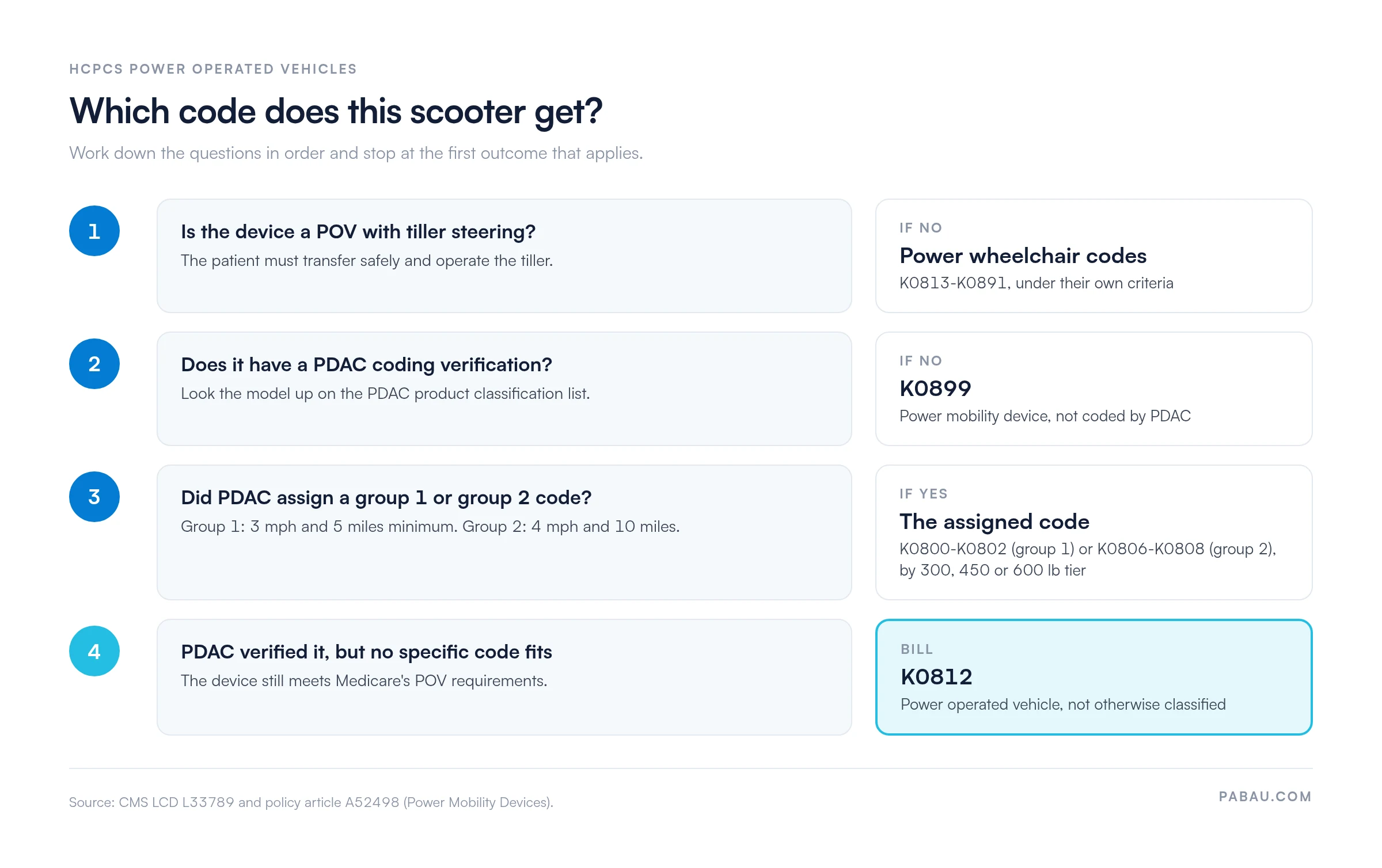
In practice, the supplier looks the model up on the PDAC product classification list before quoting. If PDAC lists it under K0800 or another specific code, that code goes on the claim. K0812 goes on the claim only when the PDAC verification itself names K0812.
A POV needs a patient who can transfer safely, operate the tiller and stay stable while seated. When the face-to-face exam shows the patient cannot, the clinical path moves to power wheelchair codes. Those run from K0813 to K0891, while K0899 is the NOC power mobility code. Power wheelchairs carry their own coverage criteria and payment rates.
Before ordering a K0812 device, confirm in the face-to-face notes that the patient can safely operate tiller steering. If the notes document upper extremity weakness, tremor or cognitive impairment, the clinical path usually leads to power wheelchair codes instead. A POV claim built on a record like that invites an audit.
Medicare Part B covers a POV as durable medical equipment when the beneficiary meets LCD L33789 (Power Mobility Devices). Coverage is for use in the home, and each of these must hold:
Group 2 POVs (K0806-K0808) are not covered, because the LCD finds their added capabilities are not needed for use in the home. For K0812, coverage turns on the PDAC coding verification plus the criteria above.
A POV used mainly outside the home does not meet the benefit, even with a documented limitation. Run insurance eligibility verification before the order goes in, so active Part B coverage and DME benefits are confirmed early.
Every document below must be on file before the claim goes out, not gathered after a denial. On POV claims, medical billing compliance comes down to what the face-to-face notes say and when each document was dated.
Sequence matters as much as content. A WOPD dated before the face-to-face encounter, or received after delivery, cannot support the claim however complete the notes are.
A clean K0812 claim follows the same path every time, from the first visit to the remittance:
A diagnosis alone does not establish medical necessity for a POV. The functional limitation in MRADLs has to be documented separately. The ICD-10-CM codes below often appear on POV claims because their conditions commonly cause that limitation.
Treat these as examples, not a list Medicare pays from. Face-to-face notes that link the diagnosis to the MRADL limitation drive approval. Check LCD L33789 and its policy article with the DME MAC for your jurisdiction, Noridian or CGS.
CMS runs a DMEPOS prior authorization program for certain power mobility devices. CGS’s published list covers K0800-K0802 and K0806-K0808, and K0812 is not on it today. CMS updates the list, so verify the status with your DME MAC before each new order.
If a device is recoded to a listed code, or the list changes, the request follows these steps:
Delivering a listed device before an affirmed decision leaves the claim unpayable. The supplier can bill the beneficiary only with a valid Advance Beneficiary Notice (ABN) signed before delivery.
Every Medicare K0812 claim line needs one of four modifiers: KX, GA, GY or GZ. A line with none of them is rejected as missing information. Policy article A52498 allows KX only when every LCD criterion is met, or when an advance determination of coverage exists.
Never put KX on the same line as GA, GY or GZ. When documentation falls short, choose GA with a signed ABN, GZ without one, or GY for an excluded item or a missing face-to-face exam.
POVs are paid under the DMEPOS fee schedule as capped rental items. Medicare pays monthly rental for up to 13 months, at 80% of the allowed amount after the Part B deductible. After month 13, the beneficiary owns the device.
K0812 is a NOC code, and NOC codes usually carry no national fee schedule amount. Expect the DME MAC to price the line individually. Confirm the current status in the CMS DMEPOS fee schedule files.
Never base a patient’s cost estimate on a third-party fee summary. Get the figure from the DME MAC for the billing scenario in front of you.
Each K0812 denial comes back with a remittance code that points to the step that failed. Match it against the denial codes reference before you correct or appeal.
Log how each denial was resolved. A denial management routine with that log shows whether the same step keeps failing.
Audit your K0812 denials every quarter. Pull denied claims by reason code and map each one to the checklist below. Fixing the failed step protects the claims that follow, as well as the one you are reworking.
Medicare sets most POV policy, but Medicaid and commercial payers need checks of their own.
Medicaid: Coverage varies by state. Some states follow LCD L33789 closely, while others use their own criteria, codes or prior authorization rules. Read the state’s DME policy manual before billing K0812 to Medicaid.
Commercial payers: Many plans require prior authorization for every power mobility device, K0812 included. Covered diagnoses and documentation lists may differ from CMS. Some plans accept K0812 as billed, and others map it to their own code.
Benefits check: Confirm DME benefits, prior authorization and network status for each plan. Record the date, the representative’s name and the reference number in the patient file.
Work through these points on every K0812 claim before it leaves your system:
Without a connected system, a biller re-keys patient details, codes and modifiers from the chart into every claim. Pabau, the practice management platform we build, pre-fills the claim form from the patient record instead.
Its claims management software includes code lookup libraries with more than 20,000 ICD-10, CPT and HCPCS codes, so staff find K0812 and its neighbors quickly. Before you click Send, Pabau checks that the required claim fields are filled. US claims go out through Claim.MD.
After submission, Pabau runs US eligibility checks, posts ERAs and tracks claim status. Your team spots a returned K0812 line sooner and can work it against the checklist above. Choosing the modifier and judging the LCD criteria stay with your billers.

Pabau pre-fills claim forms, offers HCPCS code lookup and checks required fields before claims go out through Claim.MD. See how it fits your DME billing workflow.

K0812 has a firm entry test: a PDAC-verified POV that no specific code fits. Confirm the verification first, because without it the right code is K0899 and the rest of the claim is moot.
The cost of getting K0812 right is paid up front. Sequencing the exam, the WOPD, the home evaluation and delivery takes coordination. Each misstep there returns later as a denial that no appeal fixes cheaply.
Book a demo to see how Pabau pre-fills and checks K0812 claims before they reach the DME MAC.

Need cleaner DME claims on the first pass? Clean claim submission guide covers the elements every claim needs before it reaches the payer.
Working a K0812 remittance? Denial codes in medical billing breaks down the common CARC and RARC codes and how to respond to each.
Is the scooter a group 1 heavy-duty model? HCPCS code K0801 covers POVs rated for patients from 301 to 450 pounds.
Weighing a group 2 very heavy-duty POV? HCPCS code K0808 explains the 451 to 600 lb tier and its coverage limits.
Looking up another Level II code? HCPCS code library collects the billing guides for HCPCS, CPT and CCSD codes.
Yes, when the patient meets LCD L33789. Medicare Part B covers a power operated vehicle as durable medical equipment for use in the home. The patient pays 20% coinsurance after the Part B deductible, and group 2 scooters are not covered.
K0812 is for a POV that PDAC has verified but no specific POV code describes. K0899 is for a power mobility device that PDAC has not coded, or that does not meet the coding criteria.
The manufacturer applies to the PDAC contractor, Palmetto GBA, with product details for review. Verified models appear on the PDAC product classification list, which suppliers search in DMECS before billing.
It depends on the ABN. With a valid ABN signed before delivery and the GA modifier, the supplier can bill the beneficiary. Without one, the claim carries GZ and the supplier usually absorbs the loss.