HCPCS code L0638: Custom fabricated LSO billing guide
HCPCS code L0638 is a brace built for one patient HCPCS code L0638 is the Level ...

Last Updated: Nov 2, 2026
K0802 is the HCPCS Level II code for a group 1 very heavy duty power operated vehicle, rated for patients weighing 451 to 600 pounds. It bills a home-use mobility scooter built to group 1 standards, in the heaviest group 1 weight tier.
Two facts pick the code, the performance group and the rated weight capacity, and wheel count plays no part. Under the 95% rule in LCD L33789, a patient from 428 pounds can qualify. Medicare also expects a face-to-face exam and a written order before the scooter is delivered.
Let Pabau's smart automation suggest the right codes, reduce claim denials, and keep your practice compliant—effortlessly.
Automate repetitive tasks and focus on what matters most—your patients.
Reduce coding errors and ensure compliance with the latest regulations.
Clean claims, fewer denials, and faster reimbursements.
Powerful insights and reporting to help your practice thrive.
HIPAA compliant SOC 2 certified GDPR-compliant Trusted by 4,000+ clinics worldwide

HCPCS code K0802 describes a group 1 very heavy duty power operated vehicle rated for patients weighing 451 to 600 pounds.
Performance group and weight capacity decide the code, while wheel count plays no part in the choice.
Under LCD L33789, a patient from 428 pounds can qualify for K0802, because of the 95% weight rule.
Medicare expects a face-to-face exam, a written order received before delivery, and an on-site home assessment.
Pabau’s claims management software submits insurance claims and tracks their status, so a returned K0802 claim is easy to spot.
HCPCS code K0802 bills a power operated vehicle, group 1 very heavy duty, with a patient weight capacity of 451 to 600 pounds. That is the official CMS descriptor, word for word.
A power operated vehicle (POV) is a scooter. Medicare defines it as a chair-like, battery-powered mobility device with tiller steering and three- or four-wheel construction.
K0802 is a Level II code from the K range, which the Centers for Medicare and Medicaid Services (CMS) uses for durable medical equipment. Suppliers bill it to their DME Medicare Administrative Contractor (DME MAC).
So the code answers two questions at once. Is the scooter a group 1 build, and is it rated for the heaviest group 1 weight tier?
Seven codes make up the POV range. Six of them sit on a grid of two performance groups and three weight tiers, and K0812 catches the rest.
Group 1 is the home build. The Medicare policy article for power mobility devices sets its minimum performance standards:
Group 2 scooters add capabilities a home does not need. LCD L33789 therefore denies a group 2 POV supplied for home use, even when the patient weighs the same. That is why K0808 rarely pays where K0802 does.
Wheel count never enters the decision. A three-wheel and a four-wheel scooter in the same group and weight tier take the same code. For lighter patients, see K0800 and K0801, and confirm the descriptor on the AAPC K0802 entry.
Criterion G in the LCD has two parts. The patient must weigh no more than the scooter’s capacity, and at least 95% of the next lower class’s capacity.
For K0802, the next class down is heavy duty, rated to 450 pounds. Since 95% of 450 is 427.5, the very heavy duty window runs from 428 to 600 pounds. That window overlaps the top of the K0801 range, as the chart shows.
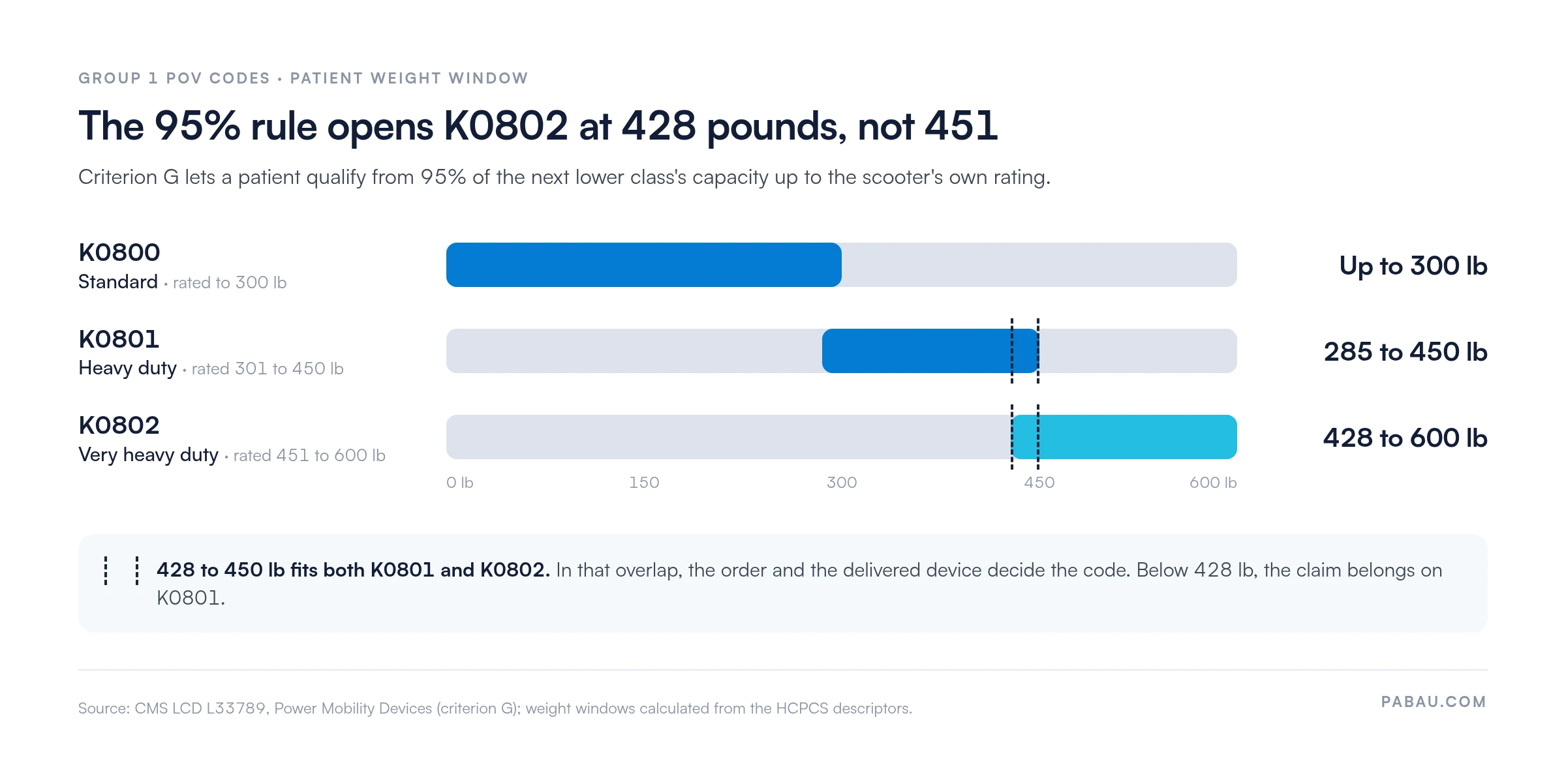
Record the weight in the face-to-face notes, dated close to the order. A figure copied from an old chart invites a reviewer to question the tier.
Medicare covers K0802 under LCD L33789, Power Mobility Devices. A POV used in the home is denied as not reasonable and necessary unless the file shows all nine criteria.
A diagnosis does not qualify anyone on its own. The policy article lists no ICD-10-CM codes that establish medical necessity for a POV, so reviewers judge the functional findings in the notes.
Code the diagnosis to the highest specificity the record supports, then let the narrative carry the case. Notes that explain why the patient cannot reach the bathroom or kitchen do the persuading.
K0800 to K0802 sit on the CMS Required Face-to-Face Encounter and Written Order Prior to Delivery list. That list fixes the order of the paperwork, and the supplier cannot reshuffle it.
One rule catches new suppliers out. A supplier may hand the practitioner a template that lists the order elements, but may not complete any of them.
No Certificate of Medical Necessity applies here. CMS replaced the power mobility CMN with the face-to-face exam and written order in 2006. A K0802 file therefore has no CMN to sign or renew.
CMS lists K0800, K0801, and K0802 on its Required Prior Authorization List, nationwide since April 2022. Check the current list before each order, because CMS revises it.
Where prior authorization applies, the supplier sends the request and the documentation package to the DME MAC before delivery. A provisional affirmation returns a unique tracking number (UTN), and that number goes on the claim.
A non-affirmation judges the paperwork, so the patient can still qualify. Fix what the MAC flagged, resubmit, and hold the delivery until an affirmation arrives. Medicare Advantage and commercial plans set their own rules, so check each plan separately.
Seven steps stand between the referral and the remittance, and they only work in this order.
Steps one and two belong to the referring practice, so suppliers chase those notes early. A claim that reaches the DME MAC with all seven steps behind it is a clean claim, and it rarely comes back.
Every K0802 line needs a coverage modifier. Under the policy article, a line without one is rejected as missing information.
GA and GZ carry opposite consequences. With GA, the supplier can bill the patient if Medicare denies the line. With GZ, the supplier absorbs the loss.
No single national figure exists for K0802. Medicare pays it from the DMEPOS fee schedule, which CMS updates each year with amounts set by state.
K0802 carries pricing indicator 32, the category for inexpensive and other routinely purchased items. Purchase with the NU modifier is the normal route.
Medicare pays 80% of the allowed amount once the Part B deductible is met, and the patient owes the 20% coinsurance. Competitive bidding can change the rate, so check the beneficiary’s area before you quote a figure.
Pull the new DMEPOS fee schedule file each January and update the K0802 amount in your price list. A quote built on last year’s figure misstates the patient’s 20% share.
K0802 denials cluster around a handful of failures, and most are visible before the claim goes out. Match the codes on the remittance against the standard denial codes to see what went wrong.
If two of these keep showing up, fix the intake process rather than the appeals queue.
DME billing teams often lose sight of a claim once it leaves. Its status sits in a clearinghouse portal, and a returned claim waits until someone logs in to check.
Pabau, the practice management platform we build, submits insurance claims from the patient record and tracks each claim’s status in one place. In the US, its claims software for practices sends those claims through Claim.MD.
A rejected K0802 claim then shows up against the record that created it. Your team corrects the modifier or the UTN and resends it, without hunting through a separate portal.

Pabau submits insurance claims from the patient record and tracks their status, so your billing team spots a returned K0802 claim and resends it quickly.

K0802 rewards a supplier who checks two numbers early, the scooter’s group and the patient’s weight. Get both right at the order, and the rest of the file follows a fixed sequence.
The costliest errors happen before billing starts. A K0802 shipped to a 420-pound patient, or delivered before the affirmation, is hard to rescue with a corrected claim.
Once the claim goes out, visibility matters most. Book a demo to see how Pabau submits and tracks DME claims from one patient record.

Need a system for working denials rather than resending them? Denial management in healthcare covers how to sort denials and build an appeals workflow that holds.
Want the full picture of how a claim reaches a payer? What is medical billing walks through each step of the cycle.
Tightening up your compliance program? Medical billing compliance sets out the audit triggers and documentation standards suppliers face.
Checking coverage before the equipment ships? Insurance eligibility verification explains how to confirm benefits before an order is placed.
Looking at the whole revenue cycle, not one claim? Revenue cycle management shows how orders, claims, and payments connect.
No. LCD L33789 covers a POV for use in the home. When the scooter is needed only outside the home, the line takes the GY modifier and Medicare denies it. A patient who needs it indoors and out can still qualify.
Not at initial issue. The POV basic equipment package includes the batteries, a single-mode charger, weight-appropriate seating, and tiller steering. It also covers a full set of tires and the accessories needed for safe use. The K0802 allowance pays for all of them.
A physician, physician assistant, nurse practitioner, or clinical nurse specialist can perform it. The same practitioner then writes the order, within six months of the exam. A different signer on the order breaks that link.
No. A supplier may give the practitioner a template that lists the required order elements. The practitioner completes and signs it. An order with elements filled in by the supplier does not meet LCD L33789.